Global Firepower | Military Industrial Complex | Second World War History
Home | Military Pay Scale Chart | Aircraft | Infantry Weapons | Military Vehicles | Navy Ships | Military Education | French Military Victories | Military Ranks | WW2 Weapons
Military Factory Latest from Military Factory
Thumbnail picture of the Dardo infantry fighting vehicle
Dardo IFV
Thumbnail picture of the Supermarine Scimitar fighter
Supermarine Scimitar
Thumbnail picture of the Centauro B1 8x8 tank killer
Centauro 8x8
Thumbnail picture of the Novi Avion fighter
Novi Avion
Thumbnail picture of the FR F2 bolt-action sniper rifle
FR F2
Thumbnail picture of the Lebel Model 1886 bolt-action rifle
Lebel Model 1886
2009 Military Pay Scale Chart - for Army, Navy, Air Force and Marines
  BY DECADE
    · 1900 to 1909
    · 1910 to 1919
    · 1920 to 1929
    · 1930 to 1939
    · 1940 to 1949
    · 1950 to 1959
    · 1960 to 1969
    · 1970 to 1979
    · 1980 to 1989
    · 1990 to 1999
    · 2000 to 2009
    · 2010 to 2019
    · View All Aircraft
  BY TYPE
    · Attack Helicopters
    · Bombers
    · Close-Support
    · Commercial
    · Dive Bombers
    · Experimental
    · Fighters
    · Floatplanes
    · Flying Boats
    · Fuel Tankers
    · Helicopters
    · Interceptors
    · Multi-Role
    · Navy Aircraft
    · Night-Fighters
    · Recon Aircraft
    · Recon Helos
    · Special Purpose
    · Torpedo Bombers
    · Trainer Aircraft
    · Transport Aircraft
    · Transport Helos
    · UAVs
  WORLD WAR 2
    · Full List
    · 1939
    · 1940
    · 1941
    · 1942
    · 1943
    · 1944
    · 1945
    · Australia
    · Battle of Britain
    · Bombers
    · Britain
    · Dive Bombers
    · Canada
    · Fighters
    · China
    · France
    · Germany
    · German Fighters
    · German Jets
    · Italy
    · Japan
    · Mitsubishi Bombers
    · Poland
    · USA Aircraft
    · USA Bombers
    · Soviet Union
    · Torpedo Bombers
  WORLD WAR 1
    · Full List
    · 1914
    · 1915
    · 1916
    · 1917
    · 1918
    · Aces
    · Austria-Hungary
    · Bombers
    · Britain
    · Fighters
    · France
    · Germany
    · Italy
    · Recon Aircraft
    · Russia
    · USA
  KOREAN WAR
    · Full List
    · Aces
    · Australia
    · USA
    · North Korea
  VIETNAM WAR
    · Full List
    · United States
    · North Vietnam

Military Factory > Military Aircraft > Grumman F4F Wildcat
 
 
More Pictures Cockpit View 3 View Plan QuickGraphs StatsCentral

Grumman F4F Wildcat

The F4F Wildcat was initially conceived of as a biplane, hence its oversized fuselage design.
By Staff Writer

Bookmark and Share

The Grumman F4F Wildcat was the unsung hero of the Allied Pacific Theater campaign in the early years of World War 2. Often overshadowed by the upcoming Grumman F6F Hellcats and Vought F4U Corsair hotrods, the stubby Wildcat with her biplane origins relied as much on the tenacity of her pilots than on the capabilities of this fine machine. For 1936 standards, the Wildcat was a high-performance machine with much to recommend it. The F4F served both the Americans and the British (the latter known as Martlets for a time) during the critical war years, with British Wildcats seeing service up until the end of the war in 1945.

Grumman entered into a 1935 US Navy competition against Brewster to sell the United States Navy its next carrier-born fighter. While Brewster showcased its impressive F2A Buffalo - a speedy, no-frills, single-engine, single-seat monoplane fighter - Grumman set about to impress with its G-16 by-gone biplane design entered into the competition as the XF4F-1. The Brewster F2A Buffalo shined while the USN was less impressed with the Grumman design, eventually earning the Brewster firm the US Navy contract. Some 509 Brewster F2A fighters would be produced.

Despite the US Navy's decision, the G-16 was revised by Grumman into the G-18 design proposal, an aircraft featuring a more conventional monoplane wing arrangement. The US Navy likened the new design - designated as the XF4F-2 - enough to order a flyable prototype. The aircraft achieved first flight in September 1937 and was powered by a Pratt & Whitney R-1830-66 Twin Wasp radial piston engine of 1,050 horsepower. Despite the redesign and more powerful engine, the aircraft still did not match the Brewster Buffalo across the many desired fronts the US Navy was looking for.

Grumman made yet another attempt while still keeping US Navy interest, producing the G-36 model design and fitting it with a larger wing with squared-off ends, a redesigned empennage and the Pratt & Whitney XR-1830-76 series engine with two-stage supercharger. The G-36 was completed in February of 1939 and received the XF4F-3 prototype designation while first flight was achieved the following month. This time, the Grumman team got things right in terms of performance and reliability and the US Navy ordered the type into production as the F4F-3. The F4F-3 earned the right to become the Wildcats series first production model. A few further design changes emanated from the XF4F-3 but these were negligible.

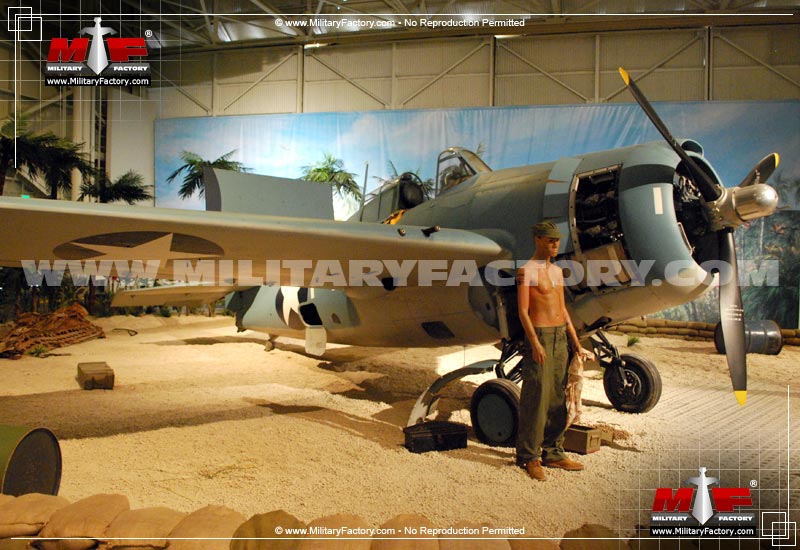
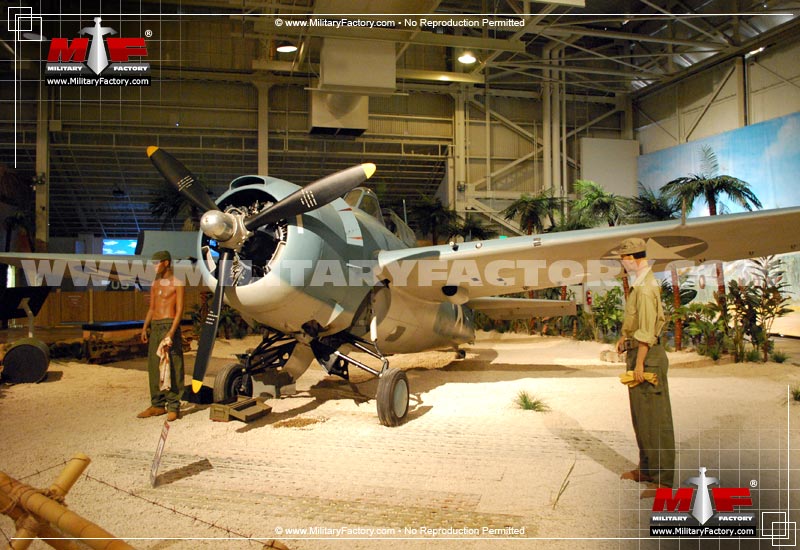
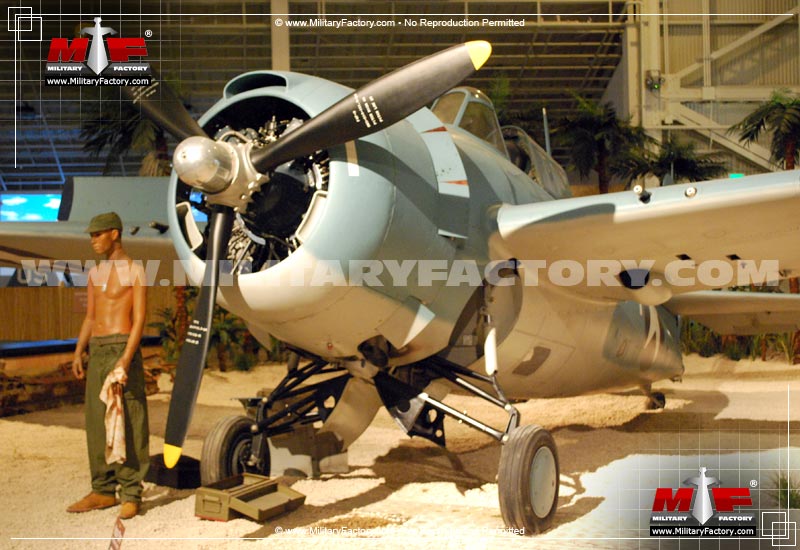
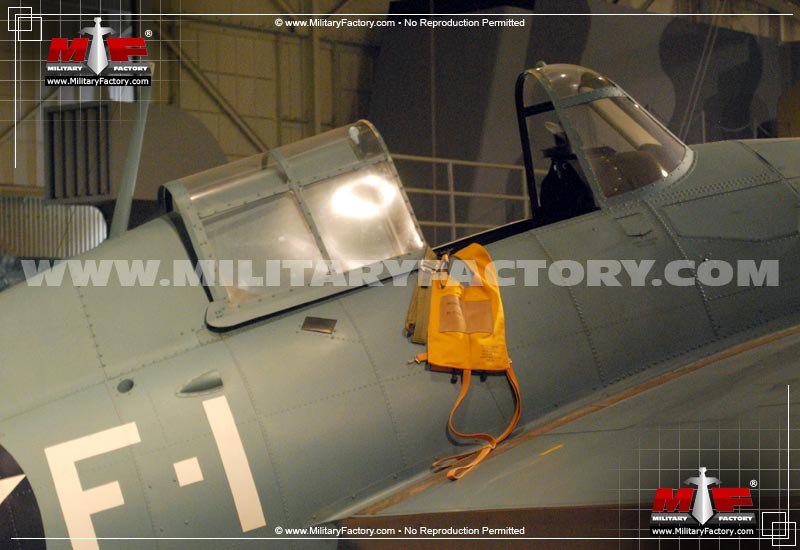
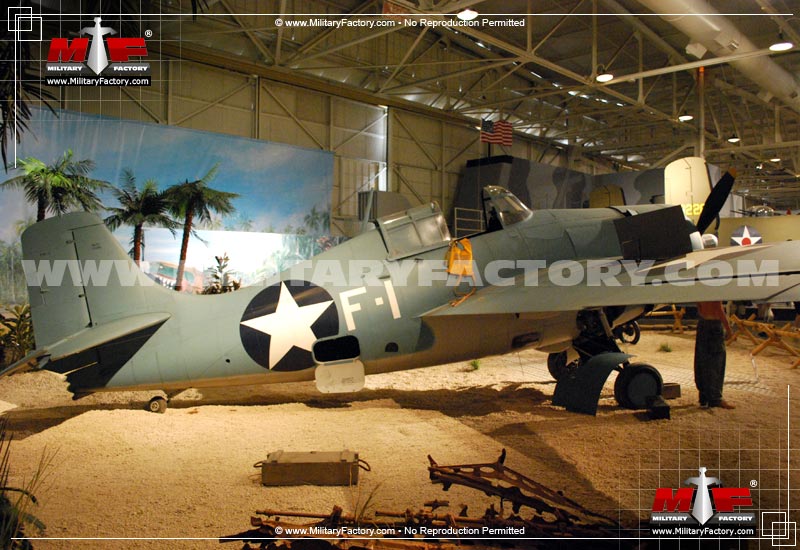
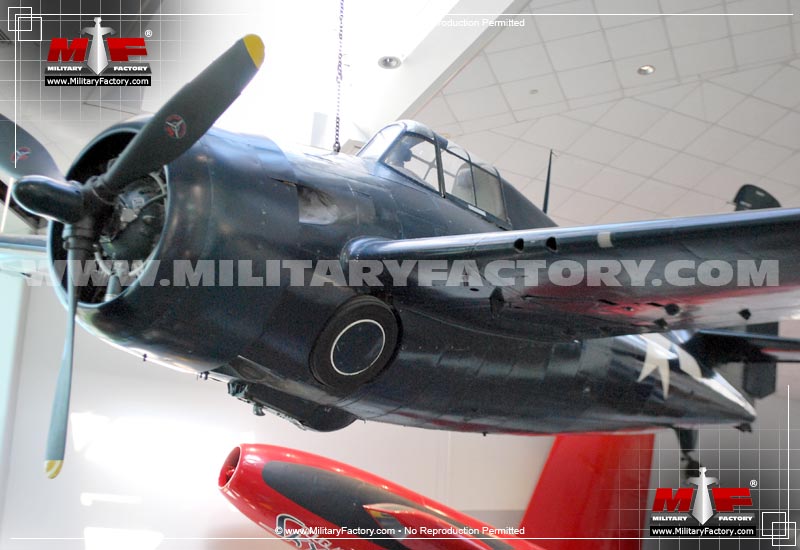
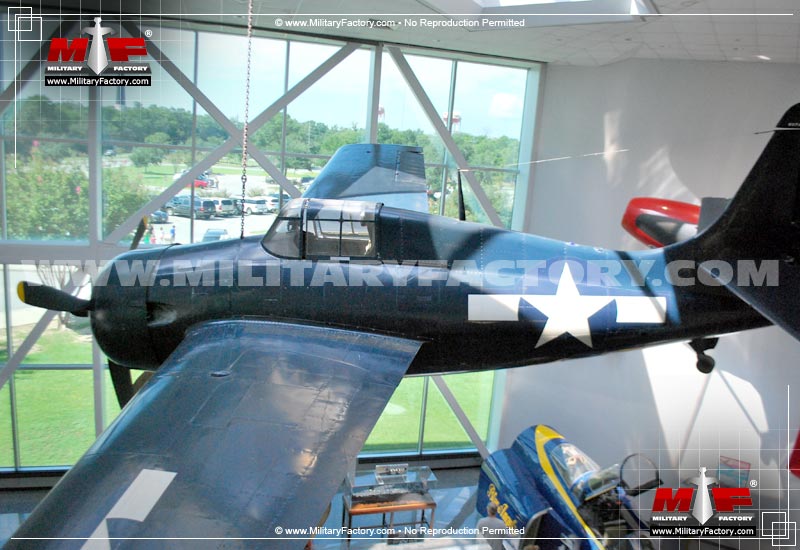
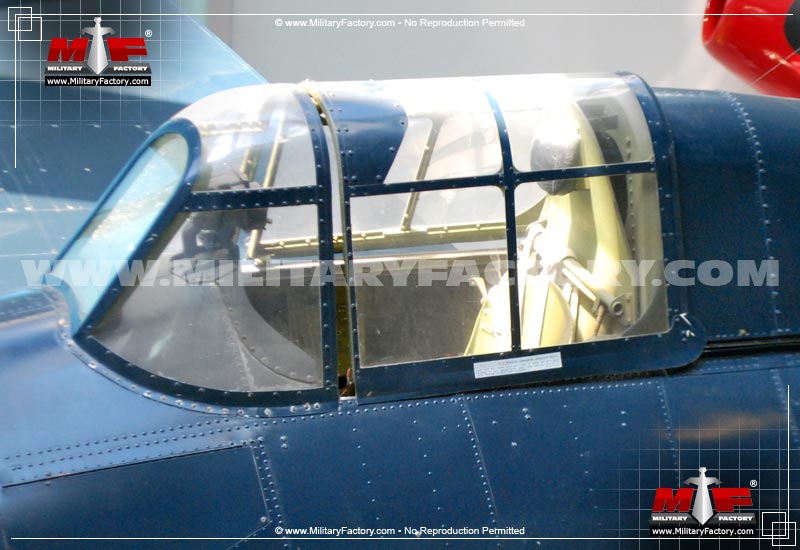
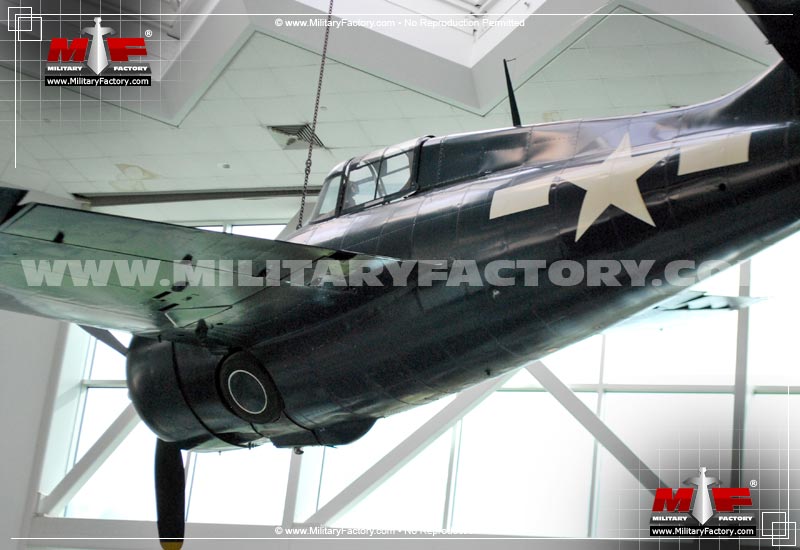
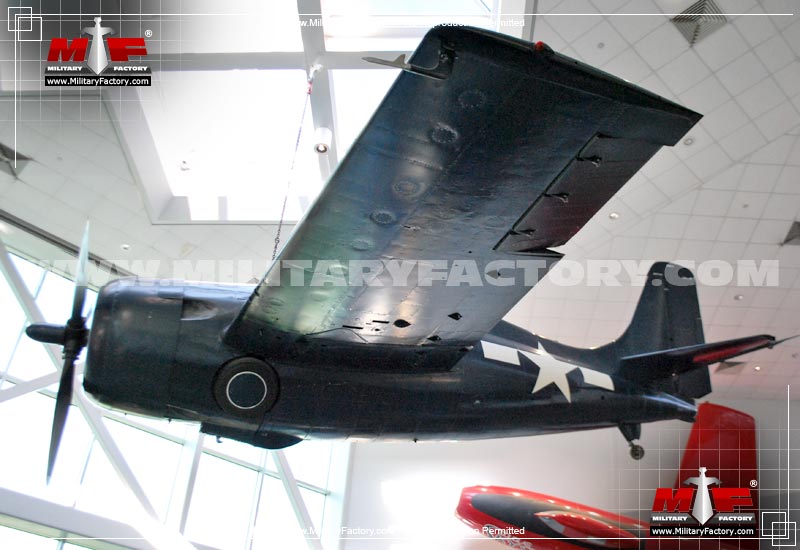
Design of the F4F showcased the stout fuselage of its biplane fighter origins. The Pratt & Whitney powerplant was encased in the cylindrical forward portion of the fuselage and featured an exposed air-cooled radial opening. The engine sported a three-blade propeller system with a simple spinner. The canopy was of a two-piece arrangement with the forward windscreen fixed in place and the second aft piece built on two rear-sliding rails. Both sections featured heavy "greenhouse" style framing. The cockpit integrated directly into a "razorback" style upper rear fuselage, no doubt restricting pilot views to his "six". Wings were slightly forward and mid-mounted to each side of the cockpit. The wings contained armament of 2 x 12.7mm machine guns (two guns to a wing) along with 450 round of ammunition to a gun. The undercarriage was conventional for the time, with the aircraft being of a "tail dragger" design, featuring two main landing gears forward and a tail wheel at rear. The forward landing gears were borrowed from previous Grumman interwar aircraft designs and had to be hand-cranked by the pilot within the cockpit when lowering or raising the gears. The undercarriage design was licensed by Grumman from a Grover Loening design with whom Leroy Grumman worked for prior to starting his aviation company. When completely retracted, the exposed wheel sides conformed to the fuselage sides and were distinct identifiers of the F4F Wildcat series. The empennage was of a traditional sort, featuring a single vertical tail fin and horizontal planes. All wing edges were "squared off", owing to the utilitarian look of the aircraft.

Despite the pilot sitting directly behind the engine mount, he was afforded a decent forward view and relatively good views to the sides. Former pilots - particularly FAA pilots - recounted at how "good" the cockpit generally felt, at least to them. As with most American cockpits, it proved spacious for the average man and featured a relatively clean - almost sparse - instrument panel containing basic dials and gauges and adorned with the gunsight at top. A center console region protruded towards the pilot, between his legs, and contained the ADF Automatic Direction Finder. A simple control stick was positioned between the pilots legs. Rudders were controlled via two floor-mounted rudder pedals and the hand-crank for the undercarriage was positioned at the lower right. All controls were within quick reach or vision of the pilot, making it a relatively easy aircraft to keep tabs on. If the Wildcat pilot failed its pilots at all, these failures were rectified in the improved F6F Hellcat still some years away.

By this time, events unfolding in Europe placed an enormous amount of pressure on France. The German invasion of the country was pushing the nation to the brink of collapse as her military defenders were spread out precariously thin and being punished across all fronts. The French looked to more complete outside solutions for the quick fix, finding one in the Grumman G-36 design (F3F-3). The aircraft was ordered by France as a modified G-36A design and featured "French-friendly" instruments, a redesigned engine cowling featuring a Wright R-1820 Cyclone engine, non-folding wings, an armament of 4 x 7.7mm Darne machine guns and a throttle stick designed to be pulled back for power instead of a conventional push-forward approach. Despite the order, France fell before the aircraft could be delivered. As such, the British - already stretched thin in their aircraft ranks - took on the order as the Martlet Mk I.

The French order of G-36A/F3F-3/Martlet Mk I aircraft were naturally revised for British use under modifications provided by the Blackburn company. Martlets had their throttle sticks reworked to a more conventional English push-forward fashion, armament was revised to a 4 x 12.7mm Browning layout and all instrumentation was made "English-friendly". External bomb provisions were 2 x 100lb bombs or 2 x 58 gallon drop tanks their place. The Martlet Mk I was delivered to the Fleet Air Arm (FAA) in July of 1940 and entered service relatively quickly by September 8th, 1940, with No.804 Squadron becoming its first recipient. In December of that year, a Martlet Mk I was credited with the downing of its first enemy aircraft - a Junkers Ju 88 over Scapa Flow - in effect becoming the first American-built aircraft to achieve a confirmed enemy kill in World War 2.

At the request of the British, Grumman pieced together a proposal for a G-36B design - an F4F-3 fitting the original Twin Wasp engine under a redesigned cowling. The British originally accepted these aircraft as the Martlet Mk II but the fact that the first ten were delivered without folding wings and the next thirty with, the aircraft was given two further designations in the Martlet Mk III and the Martlet Mk III(A) respectively. It should be noted that the batch of 30 was originally intended for delivery to the Hellenic Air Force in Greece to help stave off the German invasion in that land but events similar to what unfolded in France forced these aircraft to be delivered to British hands instead.

The F4F-3 had entered US Navy service in 1940, ordered in an initial batch of 78 examples, and quickly established itself as its premiere carrier-born aircraft, ironically overtaking the US Navy Brewster F2A Buffalos in the process. By this time, the two-stage supercharger was becoming a hard commodity to find though the need for such a performance gain was as much a requirement as was armament. As such, the revised F4F-3A model emerged with a Pratt & Whitney R-1830-90 radial piston engine of 1,200 horsepower mated to a simpler single-stage, two-speed supercharger. The aircraft actually proved a performance downgrade when compared to the base F4F-3 that many-a-US Navy airman openly disliked flying it. Despite this, the F4F-3A was fielded side-by-side with the base F4F-3 models and was also used by the British in its Martlet Mk III(B) guise. A "one-off" F4F emerged in floatplane form as the F4F-3. The floatplanes were provided by the Edo Aircraft Corporation and replaced the undercarriage. First flown on February 28th, 1943, performance of this "Wildcatfish" proved much worse than the already meager offerings of the base F4F fighter. The design was never furthered nor produced.

In April of 1941, a folding-wing version of the F4F was tested while on October 1st, 1941, the designation of "Wildcat" was officially adopted for the F4F series by the United States Navy.

The Wildcat proved so important to the Allied cause at sea in many ways - both in the Atlantic and the Pacific theaters. Most importantly, it provided the Americans and the British with a capable carrier-born fighter that both nations seriously lacked in their inventories at the outset of the war. The Wildcat finally leveled the playing field in favor of the Allies. The British were already stretched thin in their use of the Hawker Hurricane and Supermarine Spitfires through the Royal Air Force that their navalized types arrival - the Hawker Sea Hurricane and Supermarine Seafire respectively - had to be delayed for some time. Likewise, beyond their Brewster F2A Buffalos, the Americans had little to pit against the might of the Mitsubishi A6M "Zero" scourge in the Pacific. By any regard, the arrival of the Wildcat was of monumental importance to the outcome of the early years of the air war.

September 1942 saw the HMS Audacity set sail with her Fleet Air Arm contingent of six Martlets. On September of that month, two Martlets were credited with the downing of a German Focke-Wulf Fw 200 Condor spying on the convoy. Not limited to ocean sorties, the British enlisted the Martlet into service over the skies of North Africa, resulting in the destruction of an Italian Fiat G.50 bomber on September 28, 1941.

The Japanese attack on Pearl Harbor on December 7th, 1941 pressed the American war machine into action. At its disposal was this stubby, straight-winged Wildcat fighter complete with its bi-plane origins - hardly the stuff of legend. Only a handful of Wildcats were in the Pearl area at the time of the attacks - these belonging to the USMC VMF-211 squadron. Nine were damaged or destroyed in the attack on Oahu.

Wildcats were used in anger the next day in the attempted December7th/8th Japanese invasion of the Wake Island atoll. About a dozen F4F-3's were stationed there - these also belonging to the VMF-211 - to which eight of the twelve fighters were damaged or destroyed on the ground. Four Wildcat fighters did succeed in sinking the Japanese destroyer Kisaragi (Wildcats used as bombers) during the assault. The Japanese destroyer Hayate was also sunk though this was attributed to the defensive coastal guns. Events forced the Japanese to abandon the invasion and retreat, leaving Wake to fight on for another day. Survival of this small island - for the time being at least - was in part due to the heroics of these USMC airmen and their Wildcats, delivering Japan's first major defeat in the war .

1942 saw the introduction of the definitive Wildcat in the F4F-4. F4F-4 models were given 6 x 12.7mm Browning machine guns (upgunned from the 4 x arrangement) and folding wings for improved carrier storage aboard the space-strapped Allied aircraft carriers. The armament change was an upgrade over earlier Wildcat forms and was made at the behest of the British. These changes however, came at a cost. The added machine guns forced the total ammunition count to be spread out across the six gun systems instead of four bringing the total "gun burst" time down from the total of 34 seconds to a measly 20 seconds, effectively supplying Wildcat pilots with less ammunition overall. This limitation essentially forced Wildcat pilots to work harder for their kills as more guns firing did not necessarily equate to better accuracy. To add insult to injury, the guns also had a wicked and deadly tendency to jam forcing many-a-Wildcat pilot to become spectators in dogfights.

These internal changes also made for a much heavier Wildcat, adding some level of diminished performance to content with. The extra armament and folding wing understructure brought the Wildcats top speed down to 318 miles per hour while offering up a slower rate-of-climb. Despite these negatives, the F4F-4 became the most produced aircraft, overtaking the F4F-3 on the assembly lines (it was not common practice to produce two variants simultaneously). The British received their F4F-4 models as the Martlet Mk IV, complete with a Wright Cyclone powerplant and revised cowling. Armament was further enhanced (and one can expect that performance was decreased as a result) by the provision for 2 x 250lb external bombs held under the wings (or 2 x 58 gallon drop tanks as needed). The F4F-4 first flew on April 14th, 1941.

February 20th, 1942 saw Wildcat pilot Lieutenant Edward H. O'Hare best five Japanese bombers over Rabaul.

May 1942 added the Battle of Coral Sea, pitting American carriers USS Yorktown and USS Lexington against the Japanese carriers Zuikaku and Shokaku along with the light carrier Shoho. The Japanese were targeting Port Moresby on Papau. Wildcat pilot Lieutenant J.G. McCuskey scored five confirmed kills in the ensuing action. Despite it being a tactical victory for Japan by the sheer number of Allied warships it had sunk or damaged, it turned into a strategic victory for the Allies for the Japanese war machine was finally halted from expanding its reach any further in the Pacific any further. For the British, May of 1942 saw their Fleet Air Arm Martlets operating over Madagascar against Vichy French air elements. Similarly, Martlets sparred with Italian bombers while escorting a convoy to Malta in August. Combat experience had evolved the Wildcat into quite the formidable fighter.

June 1942 brought about the Battle of Midway. By this time, the Pacific carrier fleet were all fielding the F4F-4 models with more trained pilots and better tactics. The Japanese intent in this battle was to 1) respond with force to the brazen "Doolittle Raids" of April and 2) lure the American carriers into a final showdown. American intelligence bested Japanese intent here as the American carriers were already lying in waiting off of Midway to ambush the Japanese. The resulting action and subsequent Allied victory secured Midway as a future vital trans-Pacific launching platform and sunk four Japanese fleet carriers in the process (to only one American carrier).

Between August 7th, 1942 and February 9th, 1943, the Allies launched their first full offensive at Guadalcanal, taking the defending Japanese by surprise. Wildcats fought on in nearly daily engagements as ground and sea forces made their moves. The end result netted the Allies use of Henderson Field and the construction of two more runways becoming a strategically important junction for further Allied operations in the Pacific.

Wildcats took action in several of the major Allied amphibious landings as well, partaking in the invasions of North Africa, Madagascar, Italy and ultimately Normandy. Wildcats in this role provided valuable air cover to the vulnerable landing ships and men called to storm the beaches. The F4F also assisted in U-Boat hunts (in cooperation with Fairey Swordfish aircraft) and anti-reconnaissance sorties against German Focke-Wulf Fw 200 Condors.

By late 1942 and into early 1943, Grumman was wrapping up its own production commitment to the F4F-4. General Motor's Eastern Aircraft Division took over and produced the FM-1 Wildcat models. These aircraft brought the armament total back down to 4 x 12.7mm machine guns. In late 1943, GM introduced the improved FM-2 Wildcat. Beyond that, the Wildcat in America was all but done.

The Wildcat was trialed as a photographic reconnaissance platform in the F4F-7. These aircraft, produced to the tune of 21 examples, saw their guns removed in favor of camera equipment and more fuel. As these aircraft featured fuel fitted into their wings, these "wet wings" were of the non-folding variety, reducing effective in carrier storage. Range on these birds was an impressive 3,700 miles.

Total Wildcat production amounted to 7,722 examples. Martlets made up approximately 1,191 of these. Operators were limited to the United States Navy, United States Marine Corps, the Royal Canadian Air Force and the Royal Navy Fleet Air Arm.

Operationally, the Wildcat was not the perfect answer for these rapidly changing times. Its 1930's decade design was brought to the forefront on many -an-occasion. The Japanese A6M Zero proved to be a vastly superior in performance and firepower when compared to the Wildcat. Despite the early superiority of Zeros, Wildcat pilots gained valuable experience and unparalleled "dive and zoom" tactics that eventually played up the inherent benefits of the Wildcat to offset her shortcomings. Better armor protection and self-sealing fuel tanks - two key survival elements that the Zero lacked - meant that the Wildcat could absorb more punishment than her adversary and stay in the fight longer than most. The Wildcat proved to offer "just enough" in every combat-related category that the Pacific Theater was "contained" until better aircraft systems could be produced by the Allies.

Unlike their navy brethren, USMC Wildcats operated almost exclusively from land-bases. USMC Captain Joe Foss lead his VMF-121 squad of eight Wildcats to 72 confirmed air kills. Foss added 26 of that total himself, accounting for at least five of those in a single day. He was eventually awarded the Congressional Medal of Honor for his exploits.

The F4F Wildcat remained the top carrier-born fighter for the US Navy until the arrival of the Grumman F6F Hellcat in 1943. The British dropped the "Martlet" name and accepted the American "Wildcat" designation beginning January 1944. Despite the system being replaced in the American inventory in the latter years of the war, the British Fleet Air Arm Wildcats fought on through to the end of the conflict, netting four more Messerschmitt Bf 109 fighters over Norway March of 1945 - making these German fighters the FAA last air kills of the war.

The F4F Wildcat proved to be up to the seemingly insurmountable challenges of carrier operations the world over. Despite aforementioned disadvantages, the Wildcat made up for it in immeasurable terms - pilot training, tactics and instincts. She proved a reliable and rugged ace-making mount for many-a-navy airman. Despite it being superseded by the impressive Grumman F6F Hellcats and Vought F4U Corsairs, the F4F Wildcats would still leave their undisputed marks on military aviation history - effectively setting the stage for the ultimate Allied victory against Axis aggression.

In the end, she became the only America-built aircraft to serve throughout the entire conflict. In the latter years of the war, her light-weight and relatively small size made her a regular aboard the smaller escort carriers that the newer, heavier and larger fighters simply could not operate from.

And all this from a fighter design that was nearly discarded.

Text ©2003-2009 www.MilitaryFactory.com • All Rights Reserved • No Reproduction Without Permission • Corrections / Comments to MilitaryFactory at Gmail dot com

Last Revision: 10/24/2009 • Special Thanks to Alan S.


  Specifications for the Grumman FM-2 Wildcat
arrow downDimensions:
Length: 28.87ft (8.80m)
Width:37.99ft (11.58m)
Height: 11.48ft (3.50m)

arrow downPerformance: About MACH
Max Speed: 332mph (534kmh; 288kts)
Max Range: 900miles (1,448km)
Rate-of-Climb: 2,000ft/min (610m/min)
Service Ceiling: 34,698ft (10,576m; 6.6miles)

arrow downStructure:
Accommodation: 1
Hardpoints: 2
Empty Weight: 4,907lbs (2,226kg)
MTOW: 7,423lbs (3,367kg)

arrow downPowerplant:
Engine(s): 1 x Wright Cyclone R-1820-56 9-cylinder air-cooled radial piston engine devlivering 1,350 horsepower.
arrow downArmament Suite:
STANDARD (F4F-3):
4 x 12.7mm M2 Browning machine guns in wings OR 4 x 7.5mm Darne machine guns in wings

STANDARD (F4F-4):
6 x 12.7mm M2 Browning machine guns in wings

OPTIONAL (F4F-3):
2 x 100lb bombs OR 2 x 58 gallon droptanks under wings.

OPTIONAL (F4F-4):
2 x 250lb bombs OR 2 x 58 gallon droptanks under wings.

  Pictures of the Grumman F4F Wildcat
     
Picture of Grumman F4F Wildcat
Picture of the Grumman F4F Wildcat
Image of the Grumman F4F Wildcat
     
arrow upView All 5 Images

CompareX2 CompareX4 Conversions Dictionary Acronyms

Compare and Contrast Military Aircraft Specifications

  Special Aircraft Collections
Aircraft by Conflict:
Falklands War
Indo-Pak War
Operation Allied Force
Operation Desert Storm
Six Day War
Yom Kippur War

Special Collections:
American X-Planes
Classic US Warbirds
Grumman "Cats"
Indian Air Force
Israeli Air Force
Mikoyan-Gurevich
V-Bombers


Korean Air War:
Korean War Aircraft
Aces
Australia
United States
North Korea

Vietnam Air War:
Vietnam War Aircraft

Cold War
Cold War Aircraft
United States
Soviet Union
Soviet Bombers of the Cold War

Modern Aircraft
Modern Military Aircraft
United States

Miscellaneous
MiG-15 Versus Sabre
Top 10 Fighters of All Time


  Recent Military Aircraft Additions
Thumbnail picture of the Supermarine Scimitar fighter
Supermarine Scimitar
Thumbnail picture of the Novi Avion fighter
Novi Avion
Thumbnail picture of the Arado Ar TEW 16/43-23 jet-powered fighter
Arado TEW 16/43

  Contacting MilitaryFactory.com
We can only get better if you tell us how. You can contact MilitaryFactory.com at MilitaryFactory at gmail dot com (replace "at" with "@" and "dot with ".") with any questions, comments or corrections. We also accept related military imagery that you approve for us to use on our website. Keep in mind, however, that due to volume, we may not directly respond to your inquiry. Please add us to your list of non-blocked recipients!
Flying Boats

  Aircraft Quick Profile


Picture of the Grumman F4F Wildcat
Image courtesy of the United States Navy.

flag of United States
1940

Designation: Grumman F4F Wildcat
Classification Type: Carrier-Borne Fighter
Contractor: Grumman Aircraft Corporation / General Motors Eastern Aircraft Division - USA

Country of Origin: United States
Production Total: 7,722

Operators: Canada; United Kingdom; United States


  Variants
G-16 - Grumman Designation for original biplane design.

XF4F-1 - Design designation of G-16.

F4F-1 - Production Designation for proposed biplane design.

G-18 - Grumman Designation for revised monoplane design.

XF4F-2 - Monoplane Prototype for US Navy evaluation; 1,050hp Pratt & Whitney R-1830-66 Twin Wasp radial engine.

F4F-2 - Production Designation for reworked biplane design into monoplane form.

G-36A - Grumman Designation for revised design with new tail, larger wing surface, revised cowling, fixed wings, and XR-1830-76 powerplant.

XF4F-3 - Grumman G-36A Prototype Redesignation.

F4F-3 - Official Production Model Designation based on the G-36A revised monoplane prototype; for French and US Navy use; French orders diverted to British; 4 x 12.7mm M2 Browning machine guns.

F4F-3A - Fitted with Pratt & Whitney R-1830-90 powerplant of 1,200 horsepower; single-stage two-speed supercharger; folding wings.

F4F-3S "Wildcatfish" - Floatplane Variant; floats by Edo Aircraft Corporation; additional ventral fin; one Wildcat converted in this fashion.

G-36B - Grumman Prototype Designation for Martlet II; Twin Wasp engine in modified cowling.

F4F-4 - Definitive Wildcat model featuring folding wings, improved armor protection, self-sealing fuel tanks and 6 x .50 caliber machine guns.

F4F-4B - Modified F4F-4 model with Wright Cyclone engine and revised cowling for export.

F4F-7 - Long-Range Unarmed Photographic Reconnaissance Model; sans armor and guns; non-folding wings; additional fuel stored in wings; 21 examples produced.

XF4F-8 - Prototype fitted with Wright R-1820-56 Cyclone engine of 1,350 horsepower; revised tail unit; provision for 6 x 5" high-explosive unguided rockets.

Martlet Mk I - British Designation of F4F-3 Model based on the G-36A prototype; 4 x 12.7mm M2 Browning machine guns.

Martlet II - British designation of G-36B; single-stage, two-speed supercharger; Pratt & Whitney R-1830-S3C4-G engine; armor and self-sealing fuel tanks; first 10 delivered with fixed wings, later batch with folding wings.

Martlet III - British designation; originally intended for use by Greece; first ten Martlett II's delivered without folding wings; land-based operations.

Martlett III(B) - British Designation of F4F-3A models; Pratt & Whitney R-1830-90 radial piston engine of 1,200 horsepower.

Martlert III(A) - British designation for thirty more Martlet III's with folding wings.

Martlet IV - British designation of F4F-4B Wildcat; Wright-Cyclone engine in revised cowling; 220 examples produced.

Martlet Mk V - based on GM-produced FM-1; 311 examples produced.

Martlet Mk VI - based on GM-produced FM-2; 370 examples produced.

FM-1 - Produced by General Motors Eastern Aircraft Division; equivalent to the F4F-4 model featuring a R-1830-86 powerplant, 4 x .50 caliber machine guns and bomb provisions (Martlet designation dropped in early January of 1944).

FM-2 - Produced by General Motors Eastern Aircraft Division; based on XF4F-8 prototype; small-carrier optimized; taller vertical tail fin.

  Collections
  • Sons of Empire - WW2 Aircraft of Japan
  • Aircraft of the Battle of Britain
  • X-Planes Throughout History
  • French Aircraft of the Great War
  • The German Luftwaffe in World War 2
  • Nightfighters - In a Class All Themselves
  • The Top Ten Fighters of All Time
  • Carrier "Born" Aircraft - Navy Mounts
  • If Boats Could Fly - Flying Boat Aircraft


Free GI Bill Guide

Top MF Stuff: Military Pay Scale Chart | Military Ranks | World War 2 Weapons | Sniper Rifles | Conversion Calculators


©2009 www.MilitaryFactory.com • Content ©2003-2009 MilitaryFactory.com • All Rights Reserved • Disclaimer Privacy Policy Site Map Origins
Most photographic images appearing on this site are courtesy of the United States Department of Defense and are approved for public use.
Other images acquired through the public domain. Digital art work courtesy of Dan Alex.
Business Consulting by Kyle Williams

Material presented throughout this website is for historical and entertainment value and should not to be construed as usable for
hardware restoration, maintenance or general operation. Please consult manufacturers for such information.

Site Contact: militaryfactory at gmail dot com (replace "at" with "@" and "dot" with ".") eXTReMe Tracker