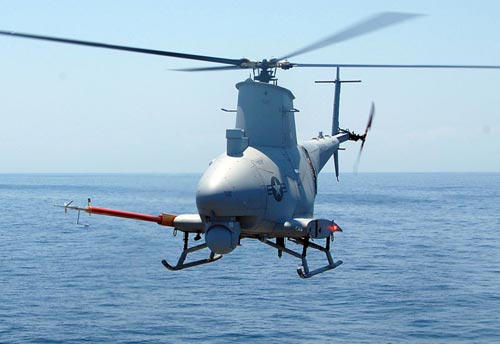
The Northrop Grumman MQ-8 is classified as a "Tactical Unmanned Aerial Vehicle" and - unlike other UAVs in operation today - is more akin in form and function to a traditional helicopter than a fixed-wing aircraft. As a rotary-wing design, the MQ-8 can take off and land vertically from virtually any terrain type and can loiter in air for extended periods of time - features not available to other UAV classes. The system is designed to provide for real-time reconnaissance, surveillance of enemy movement, battle damage assessment, direct targeting of enemy personnel/vehicles and general intelligence gathering. Its aerial nature provides ground commanders (from the company level to small unit) the necessary "eyes in the sky" that can make a true difference in battle - supplying Over The Horizon (OTH) vantage points not unlike the manned reconnaissance balloons of World War 1.
The RQ-8/MQ-8 was born out of a US Navy need to replace its aged and outgoing RQ-2 Pioneer fixed-wing UAV systems. As the use of UAVs began to grow throughout the US military - and specifically within USN doctrine - so did the requirements for a new multi-faceted UAV system. As such, the Navy specified a modern UAV design to have a range out to 125 miles with a mission endurance time of at least 3 hours and be able to carry a payload of up to 200lbs. Additionally, as a USN aircraft, the UAV should also possess the ability to be launched and retrieved at sea from the decks of existing USN surface vessels.
Several American-based concerns submitted proposals and it was ultimately the Schweizer Aircraft firm that won out with a modified form of its commercial light utility helicopter based on Schweizer Model 330. This selection was not without merit for the system was proven and could pose a cost-effective approach for the USN, able to grow the Schweizer design as-needed and relying on readily available parts and proven function. Power would be supplied by a Rolls-Royce 250 engine rotating a three-blade main rotor assembly. The new design was, of course, highly modified as a pilotless UAV and , from there, formally designated as the "RQ-8 Fire Scout". First flight of an RQ-8 was recorded in January of 2000 and initial models were marked simply as "RQ-8A" with Northrop Grumman as the primary contractor (Northrop Grumman supplying the all-important data link functionality, this based on the one as used in the RQ-4 Global Hawk UAV).
As promising as the RQ-8A was, it proved not the answer for the USN need. While USN interest in the product waned, US Army interest in the project grew and, with some additional alterations in the design, an evolution in the project produced the enhanced "RQ-8B" in 2003. The system was then redesignated as the "MQ-8B" in 2006. The RQ-8B evaluation models sported a modular missions package capability - even able to mount ordnance - as well as a four-bladed main rotor assembly that increased/improved specifications. The US Army then contracted for several evaluation airframes to test the battlefield viability of the system. With the arrival of the newer MQ-8B platform, US Navy interest rekindled which led to procurement of evaluation vehicles all their own. In US Navy service, the Fire Scout then became the "Sea Scout" while, interestingly enough, the US Army elected not to pursue the Fire Scout after a period of evaluation - realizing that their RQ-7 Shadow line of UAVs was more than sufficient for their battlefield UAV requirements.
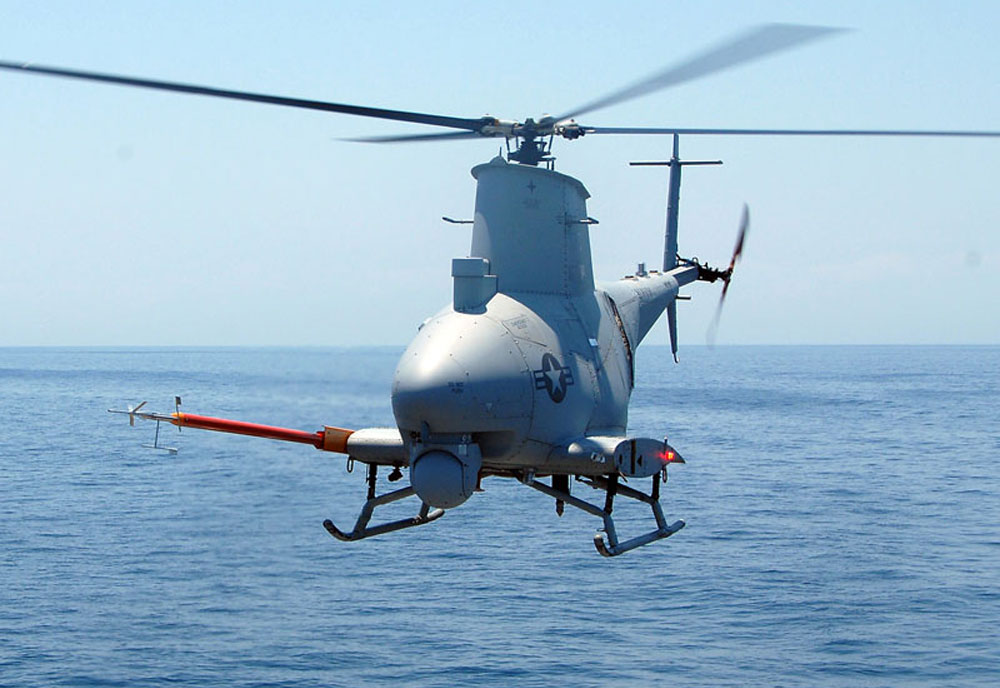
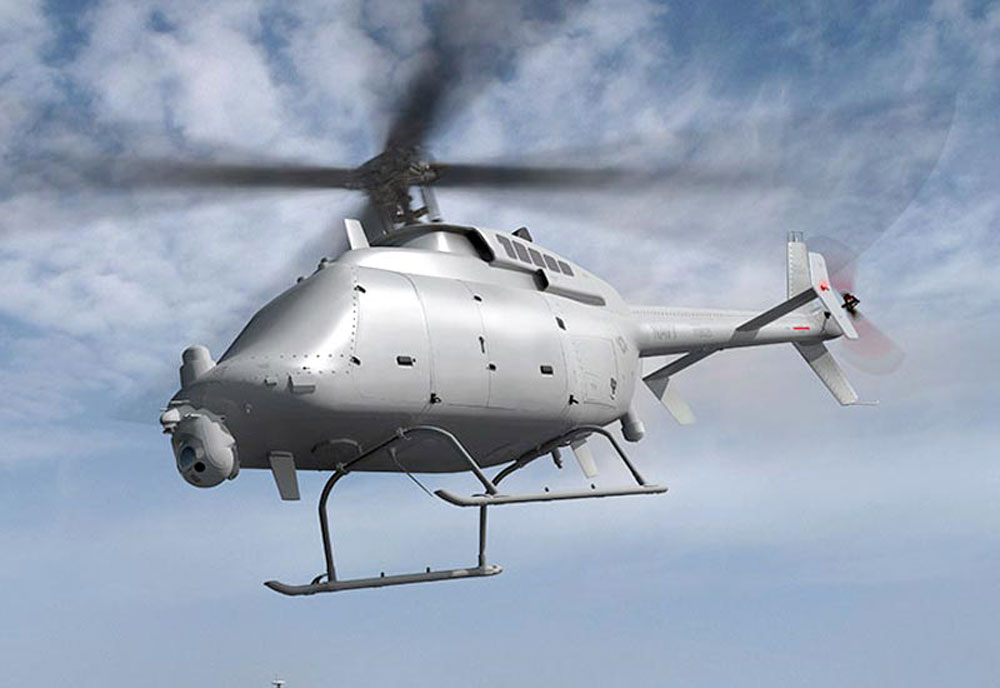
Design-wise, the RQ-8/MQ-8 family followed much in line with the appearance of modern helicopters. The fuselage was well-contoured with a curved nose cone assembly housing the required optics suite. the optics package was slung underneath the nose for unfettered views of the terrain ahead, the cameras set within a rounded blister-type protrusion, completely modular in its inherent design. The optics suite choices currently include the Star SAFIRE III EO/IR/LRF camera package, the US Navy Baseline EO/IR/LRF camera package, a mine detector system, a UHF/VHF Comm Relay kit and a Maritime Radar system. The fuselage body is well-refined and mounts a mast housing for the main rotor assembly while being home to all of the major internal working components needed for mission success. Avionics are stored in a shielded compartment aft of the nose assembly with the nose also housing the UCARS antenna array. The Tactical Common Data Link Antenna array is set above the nose and ahead of the mast superstructure. The mast superstructure holds the required fuel stores for the engine as well as flight control actuators. From the aft portion of the fuselage, there extends a boom assembly that runs a shaft powering the tail rotor, the rotor being conventionally offset to the portside of the aircraft to counter the inherent torque of the main rotor. A UHF/VHF antenna is set along the dorsal portion of the tail boom, just aft of the rotor mast housing. Another UHF/VHF fixture is mounted ventrally along the midway point of the tail boom. A third UHF/VHF antenna resides on the extreme top of the vertical tail fin. Two small GPS dorsal antennas are set a the boom midway point. The tail is capped by a vertical tail fin that extends above and below the boom's tapered aft end whilst the upper fin also sports a small pair of horizontal tailplanes. The underside of the UAV' fuselage is flat in design while the undercarriage is of a traditional skid arrangement, joined to the fuselage at four reinforced strong points. The improved MQ-8 model can fit optional side-mounted pylons for the carrying of equipment pods or ordnance - further broadening the vehicle's mission scope. All told, the MQ-8 can haul upwards of 600lbs of equipment or weaponry.
Overall specifications include a running length of 30 feet with a rotor diameter of 27.5 feet. Height to the top of the tail antenna is 9.7 feet. The MQ-8 is powered by a single Rolls-Royce 250-C20W turboshaft engine. While basic mission endurance time is eight hours, a fully-loaded MQ-8 (fitting its maximum available payload) is just over five hours.
Like other new-generation UAVs, the MQ-8 can be operated in an autonomous nature, meaning it can control itself based on available programming. The system can take-off, fly and land all through automatic means if required though there is a built-in manual override function. Additionally, the UAVs mission parameters can be updated "on-the-fly" without need for the aircraft to land and be reworked. The MQ-8 airframe can reach speeds of up to 125 knots and altitudes of up to 20,000 feet out to distances of 200 kilometers from its launch point. The entire MQ-8 package is designed to be highly modular with current and future planned systems. There is a standard integrated Electro-Optical/Infrared (EO/IR) laser range finder/designator/illuminator as well as a voice/data communications relay suite. Target designation allows the MQ-8 the ability to laser a target for accompanying strike aircraft (strike fighters or helicopters) while the communications relay capability extends battlefield awareness for accompanying ground units and naval vessels. Full motion video is presented in full color treatment for excellent target identification purposes which can help limit civilian and collateral damage. Available optional equipment for the MQ-8 family now includes countermeasures pods, mine detection services, an aerial Traffic Collision Avoidance System (TCAS), SATellite COMmunications (SATCOM), a Joint Tactical Radio System (JTRS), a Tactical Synthetic Aperture Radar (SAR/MTI) and dragged Sonobouy - the latter extremely useful for at-sea deployment and maritime duties. The MQ-8 is fully compatible with the United States Navy's current software network scheme. The main rotor blades can be folded back for improved storage aboard naval vessels where internal stowage space is always a precious commodity. Its relatively small size also allows it to be launched and retrieved from most navy surface vessels with little disruption to standard deck operations.
The US Navy first deployed their Sea Scout in an operational manner aboard the USS McInerney (FFG-8) guided-missile frigate in September of 2009. A Sea Scout aircraft then successfully completed an interception mission of drug-laden speedboat in the Pacific Ocean the following year. Throughout the American involvement of the Libyan Civil War in 2011, the Sea Scout proved useful in the reconnaissance / intelligence-gathering role. However, it is notable that one MQ-8B was lost to enemy fire during operations in the theater, a loss confirmed by US Navy authorities.
December 2014 - Fire Scout (MQ-8B) was successfully operated from the USCG cutter USCGC Bertholf (WMSL-750). The aircraft was handled by an operator stationed on the Bertholf itself.
While initially 168 Fire Scouts were to be procured by the USN, only 96 MQ-8B and MQ-8C models will be purchased. As of 2014, 28 have entered service with the USN.
In January of 2015, the USN announced that it had successfully launched the MQ-8C Fire Scout from the deck of USS Jason Dunham (DDG-109), the first such instance for the in-development UAV. The earlier MQ-8B is itself serving from USS Fort Worth (LCS-3).
September 2016 - The United States Navy announced a contract to Northrop Grumman Systems Corporation for the procurement of ten MQ-8C Fire Scout UASs covered by the USN's 2015 and 2016 procurement funds. The value of this contract is estimated at $108,118,000. The USN remains the sole operator of the Fire Scout system.
January 2018 - Nearly 20 MQ-8B aircraft have been delivered to the USN by Northrop Grumman. An additional fourteen units are on order from Northrop.
April 2018 - The prospect of arming the MQ-8C Fire Scout has been put on hold until sometime in 2023.
July 2018 - Northrop Grumman continues to market its Fire scout series to potential customers: the MQ-8C Fire Scout model made an appearance at Royal International Air Tatoo 2018 where it was used to showcase the Ultra Electronics sonobuoy mission pod promoting the air vehicle's anti-submarine capabilities.
October 2018 - Taiwan has been approved by the United States to become the first export customer of the MQ-8B.
July 2019 - The Fire Scout series has begun formal operations.
May 2020 - The MQ-8C Fire Scout has been flown with a new search radar. The model variant is intended for the United States Navy service. The radar is a Leonardo AN/ZPY-8 series "Osprey" system and testing on the "flat panel" long-range, all-weather, high-frequency radio wave-based unit began in February 2020.
January 2021 - The U.S. Navy has formally announced its intention to replace its MH-60 helicopter and MQ-8 UAV fleets during the mid-2030s.
Power & Performance Those special qualities that separate one aircraft design from another. Performance specifications presented assume optimal operating conditions for the Northrop Grumman MQ-8B Sea Scout Unmanned Autonomous Helicopter (UAH).
1 x Rolls-Royce 250-C20 engine developing 420 horsepower driving a four-bladed main rotor and two-bladed tail rotor. Propulsion
132 mph 213 kph | 115 kts Max Speed
20,013 ft 6,100 m | 4 miles Service Ceiling
932 miles 1,500 km | 810 nm Operational Range
Structure The nose-to-tail, wingtip-to-wingtip physical qualities of the Northrop Grumman MQ-8B Sea Scout Unmanned Autonomous Helicopter (UAH).
0 (UNMANNED) Crew
24.0 ft 7.30 m O/A Length
27.6 ft (8.40 m) O/A Width
9.5 ft (2.90 m) O/A Height
2,072 lb (940 kg) Empty Weight
3,153 lb (1,430 kg) MTOW
Armament Available supported armament and special-mission equipment featured in the design of the Northrop Grumman MQ-8 Fire Scout Unmanned Autonomous Helicopter (UAH) .
OPTIONAL, PROPOSED (MQ-8B Model):
"Hellfire" Anti-Tank Guided-Missiles (ATGMs), "Viper" Strike laser-guided drop bombs, Advanced Precision Kill Weapon System (APKW) , Laser-Guided Folding Fin Rocket (FFR) rocket pods, machine gun pods, and cannon pods.
Up to 600lb of externally-held payload or ordnance.
Variants Notable series variants as part of the Northrop Grumman MQ-8 Fire Scout family line.
RQ-8 "Fire Scout" - Base Series Designation.
RQ-8A - Initial Model based on the Schweizer Model 330 design.
RQ-8B - Second Model based on the Schweizer Model 333 design.
MQ-8B "Fire Scout" - Official US military designation of the RQ-8B Fire Scout.
MQ-8B "Sea Scout" - U.S. Navy Variant for shipboard use based on the MQ-8B Fire Scout; 8-hour mission endurance window with 170 lb payload limit.
MQ-8C "Fire-X" / "Fire Scout" - Improved Fire Scout; increased fourteen-hour mission endurance window; dimensionally larger than B-model; up to 700lb payload capacity; MQ-8B model avionics coupled to Bell 407 helicopter airframe; overall increase performance figures over the MQ-8B.
Operators Global customers who have evaluated and/or operated the Northrop Grumman MQ-8 Fire Scout. Nations are displayed by flag, each linked to their respective national aircraft listing.
Total Production: 38 Units Contractor(s): Northrop Grumman - USA
[ United States ]
1 / 2
An incoming MQ-8B Sea Scout unmanned autonomous helicopter system of the U.S. Navy
2 / 2
Image from Northrop Grumman marketing material; MQ-8B Sea Scout pictured.
The "Military Factory" name and MilitaryFactory.com logo are registered ® U.S. trademarks protected by all applicable domestic and international intellectual property laws. All written content, illustrations, and photography are unique to this website (unless where indicated) and not for reuse/reproduction in any form. Material presented throughout this website is for historical and entertainment value only and should not to be construed as usable for hardware restoration, maintenance, or general operation. We do not sell any of the items showcased on this site. Please direct all other inquiries to militaryfactory AT gmail.com. No A.I. was used in the generation of this content.