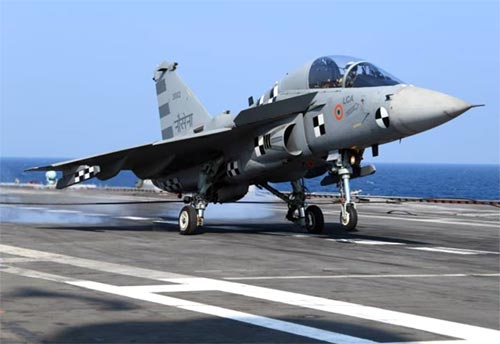
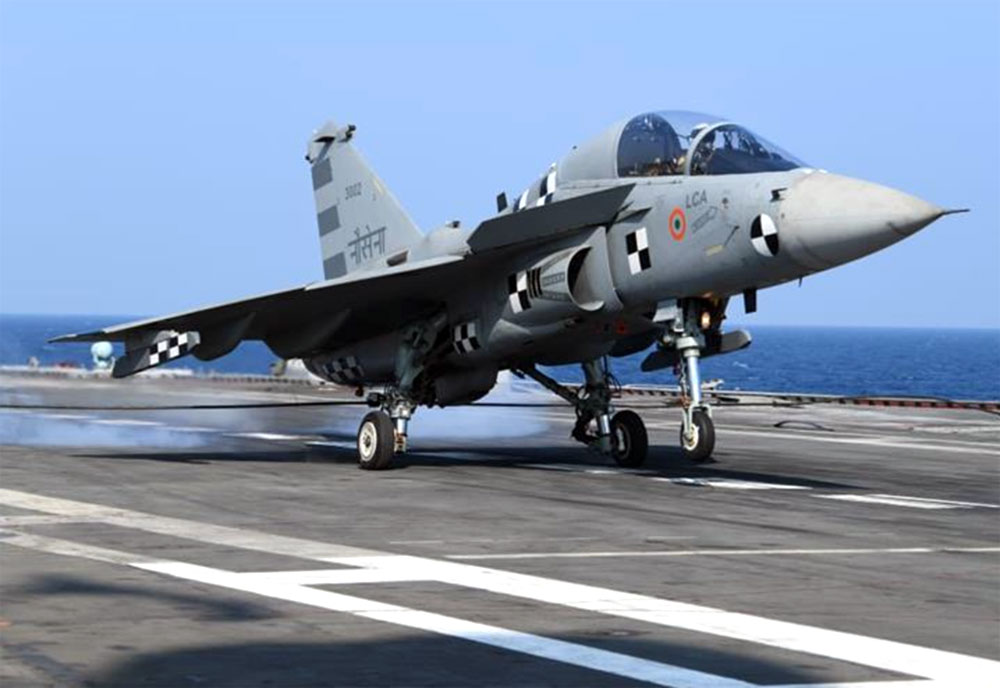
"The HAL Tejas was officially taken into service by the Indian Air Force in July 2016 - marking a milestone for the 30-year-old supersonic jet fighter program from India."
The HAL Tejas is India's newest and latest fighter platform and represents an indigenous design effort culminating from decades of research and development. The HAL Tejas was born from an internal Indian initiative to produce a home-grown fighter design and her ultimate development stemmed from the Light Combat Aircraft (LCA) program enacted in the 1980s in an effort to replace the Soviet Cold War-era Mikoyan-Gurevich MiG-21 "Fishbed" interceptors then in service with the Indian Air Force (IAF). As it stands, the HAL Tejas will become only the second aircraft design by HAL (Hindustan Aeronautics Limited) of India to have inherent supersonic capabilities (the other being the HAL Marut of the 1960s). As of January 2011, the Tejas has been formally accepted into operational service with the IAF with a planned procurement contract to number some 200 single-seat aircraft as well as a further 20 two-seat trainers. The Indian Navy is also considering purchase of the new mount with a 40-strong order in an effort to replace its aging fleet of Sea Harriers and related trainers.
In 1969, Hindustan Aeronautics Limited was selected by Indian authorities to develop a new multirole fighter airframe. Design studies ensued until the project was ultimately shelved due to a lack of a suitable powerplant. After the collapse of the initial attempt, the LCA program was begun in 1983 with the primary goal of replacing the MiG-21 with a secondary internal goal of advancing India's aviation industry. The MiG-21 had served as the backbone of the IAF for decades and was available in large numbers but her days had become obviously marked and her long-term usefulness was suspect considering the advances in military technology in other parts of the world. Up to this point, India had long relied on outside help to stock her aircraft inventories - particularly from the Soviet/Russian firms of Mikoyan and Sukhoi - but the country had advanced to a point that it was appropriate to look for indigenous solutions to her military needs.
In 1984, the Aeronautical Development Agency (ADA) was founded to oversee the LCA program. The ADA consisted of a broad mix of over 100 manufacturing, academic and defense institutions and represented the solid capabilities of a growing Indian infrastructure. HAL was still retained as the primary defense contractor and would charged with handling development and production of the new fighter. ADA was critical to the development of new avionics, flight controls and various integrated onboard management systems. GTRE (Gas Turbine Research Establishment) of Bangalore was tabbed to produce the engine to power the new aircraft. They began work on what would become the GTX-35VS "Kaveri" afterburning turbofan. First flight was scheduled for April of 1990 with operational service to begin sometime in 1995.
However, it was not until October of 1985 that the IAF officially delivered their formal requirements to the design establishment, thusly cancelling any of the preplanned milestone dates. The delay did serve the ADA rightly for the institutions were, in essence, given extra years to evolve, mature and formulate in-house concepts and become a more potent developmental force as a whole. The LCA program was refined by September of 1998 and the French aviation firm of Dassault was called in to review the completed plan. The plan was officially finalized in 1990 and a new multirole fighter of Indian origin was more or less born.
The development would cover two distinct phases that included the proof of concept and first basic prototypes in the first phase as well as additional refined prototypes with a production-quality example and technology demonstrators in the second phase. Technology demonstrators were delivered in 2001 and 2002 with a first flight completed on January 4th, 2001. Prototypes followed in 2003 through 2009 and early production forms were received for review beginning in 2007. The name of "Tejas" was supplied to the new design by then-acting Prime Minister Atal Bihari Vajpayee. To date, only six prototypes and at least eight limited series production aircraft have been completed but the program remains ongoing and is progressing. Over the span of 10 years, some 1,508 flights (some involving munitions deliveries) have been recorded.
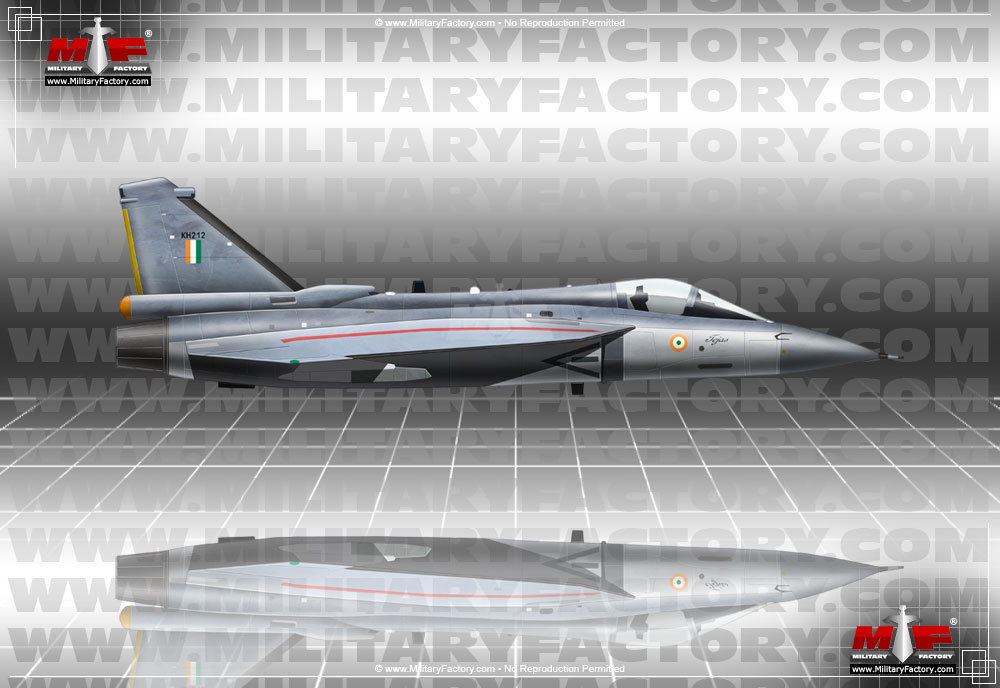
Externally, the Tejas will field a most conventional shape. Her design is dominated by the use of a compound delta wing planform negating the need for horizontal tail planes (i.e. she is a "tail-less delta"). The large wing area adds additional internal volume for fuel and avionics and promotes increased underwing and underfuselage hardpoints for munitions and fuel as well as improved high maneuverability and an increased angle of attack. The major disadvantage of the delta planform is the increased drag brought about by the larger wing surface area and loss of energy in high speed turns. The fuselage is cylindrical in nature, capped at the forward end by the nose cone housing the available radar array. The cockpit sits just aft of the nose cone installation and is covered over in a two-piece canopy with light framing. While making for excellent forward, upward and side views, the canopy joins the fuselage spine and obstructs the rear view to an extent. The pilot will initially have access to a Martin-Baker "Zero-Zero" ejection seat until this system is replaced by an Indian design. Wings are mid-mounted along the fuselage sides and the roots contour elegantly into the fuselage proper. The single engine is aspirated by two half-circle air intakes located under each leading wing root. The empennage is dominated by a single vertical tail fin which sits atop the internal tailpipe works. The engine exhausts at the rear through a conventional circular nozzle. The undercarriage is also conventional, featuring a pair of main landing gear legs and a nose landing gear leg.
On pace with other 4/4.5 Generation fighters, the Tejas will incorporate a certain level of "stealth" into its final design. Composites (aluminum-lithium based alloys as well as carbon-fiber and titanium-alloy) are used in her construction and various purposely-designed exterior faces will be coupled with a special Radar Absorbent Material (RAM) to help reflect or minimized incoming radar waves.
Two initial technology demonstrators were constructed as TD-1 and TD-2. TD-1 was unveiled on January 4th, 2001 with TD-2 following on June 6th, 2002. Prototype forms followed in the PV-1, PV-2, PV-3, PV-4 and PV-5. The PV-5 was the fighter-trainer airframe. Naval prototypes were developed later and produced the NP-1 (July 2010) and the NP-2 - the difference between the pair being the two-seat arrangement of the NP-1 airframe. Limited series production aircraft have totaled 28 airframes with a further 20 on order. The LSP-1 was debuted on April 25th, 2007 followed by the LSP-2 with its GE-404-IN20 engine in 2008. The LSP-3 of 2010 was fitted with the intended Hybrid MMR radar suite. The LSP-4 appeared on June 2nd, 2010 and reflected the Tejas as requested by an IAF standard. She also flew with her full suite of Hybrid MMR, an IFF (Identification Friend or Foe) system and countermeasures. All sensor systems were installed in the LSP-5, appearing on November 19th, 2010. LSP-6 will be used to test angles of attack (AoA). The LSP-7 and LSP-8 will be delivered for evaluation to the IAF and SP-1 to SP-40 will be delivered after 2013 for preproduction service. In all, the Tejas family line will include the base single-seat IAF multirole platform, the two-seat trainer derivative and a navalized Tejas featuring a reinforced undercarriage and airframe as well as a cut-down nose (for improved visibility on take-off and approaches) for the Indian Navy. The Tejas Mark 2 is already planned for the fielding of a more powerful engine (GE F414 series) and revised aerodynamic elements, these slated for use by the IAF. Each production aircraft is expected to cost in the vicinity of $31 million USD.
The Tejas prototype was initially intended to use the General Electric F404-GE-F2J3 series turbofan engine for testing and the production quality airframes would have been completed with the indigenously designed GTRE GTX-35VS "Kaveri" turbofan. However, development of the Kaveri powerplant has been delayed so as to force the Indian government to settle on the General Electric GE F404-IN20 series turbofan.
As it stands, the Tejas is powered by a single General Electric F404-GE-IN20 turbofan engine which supplies the airframe with a dry thrust output of 11,250lbf and afterburner output of 19,000lbf. The engine provides the Tejas with a maximum listed speed of 1,475 mph, equal to about Mach 1.8 at 49,200 feet of altitude. Internal fuel capacity is limited to 3,000 liters and this can be further expanded by way of external fuel reserves along underwing and underfuselage hardpoints adding up to 3,600 more liters. The inherent range on solely internal fuel is 1,840 miles. Service ceiling is limited to 54,000 feet. Flight control is handled by a quadruplex digital fly-by-wire (FBW) system.
In terms of weaponry, the Tejas maintains a base internally-mounted 23mm twin-barrel GSh-23 cannon of Soviet origin for close-in work. Some 220 projectiles of 23mm ammunition will be afforded to the system. Classified as a multirole mount, the Tejas will enjoy access to a plethora of munitions options available to the IAF and include air-to-air missiles, air-to-surface missiles, laser-guided weaponry and conventional drop ordnance that is Indian, Israeli and Russian in nature. Weapons will be carried across eight total external hardpoints (6 x underwing, 2 x underfuselage). Conventional ordnance support will include dumb bombs as well as cluster bombs. In place of some munitions, the Tejas can also be outfitted with the LITENING targeting pod for precision self-targeting and guidance of laser-guided munitions (such as the Kh-59ME Television-guided and the Kh-59MK laser-guided types). Anti-ship missiles figure into the ordnance load mix as well. Several stations will also be plumbed for 5 x 800 liter or 3 x 1,200 liter external fuel tanks to help increase loitering and operation distances.
In terms of avionics, the Tejas will eventually be fitted with the indigenous pulse Doppler Hybrid MMR (Multi-Mode Radar) system developed by LRDE of Bangalore and HAL Hyderabad. While delays in the program have forced the inclusion of the Israeli-based Elta M-2032 system for the interim, the finished Hybrid MMR system will be able to track 10 targets simultaneously and engage multiple threats at once. The Elta M-2032 advanced pulse Doppler suite with multimode Fire Control Radar is based on the original Israeli Lavi-installed design. It allows for multirole functionality and can switch between air-to-air and air-to-surface modes to match the mission at hand. The Elta EL/M-2032 has been sccessfully mated to various American and Soviet/Russian airframes and include the McDonnell Douglas F-4 Phantom II, the Northrop F-5 Tiger, the General Dynamics F-16 Fighting Falcon, the Lockheed T-50 Golden Eagle and the Mikoyan-Gurevich MiG-21 "Fishbed".
The Tejas pilot will sit behind an all-glass digital cockpit featuring multi-function displays (MFDs) and supports NVG (Night Vision Goggle) eyewear. There will also be a standard HUD (Heads-Up Display) to reflect real-time performance numbers and mission information. The pilot will control the airframe through conventional hands-on-throttle-and-stick (HOTAS) functionality and wear a helmet-mounted display and sight (HMDS). All this will come together to form a cockpit that works with the pilot on reducing mission workloads and provides pertinent mission information while keeping his attention on critical cockpit operations. The self-defense suite will consist of a radar warning receiver (RWR), integrated jammer, various warning systems to reflect enemy missile tracking and a conventional chaff and flare dispenser to deal with incoming threats.
Full operational squadron capability of production-quality Tejas is not expected to occur until 2013. The first production models will be formally designated as the "Tejas Mk I" and these will be superseded by the much improved "Tejas Mk II" models at a later date. These will feature a more powerful GE 414 engine line. First flight of the latter is not expected until 2014 however. Completed airframes will be delivered out of HAL facilities at a rate of one per month signifying that the run up to full operational numbers may be relatively slow in forming.
As it stands in early 2014, the Indian Air Force (IAF) is planning to procure some 220 Tejas fighters to go along with an initial order for 20 aircraft.
January 2014 - The Tejas will undergo months of intense final testing to clear its weapons delivery capabilities, radar usability and supersonic fuel drop tanks use. Additional testing will center around the installed internal cannon as well as aerial refueling via probe. At this time, the Mikoyan-Gurevich MiG-21FL of the Indian Air Force have been removed from frontline use to make room for the incoming flight of Tejas Mk I models. The IAF plans to procure a total of 83 Tejas Mk II models. Despite having entered its own test phase in 2013, the navalized Tejas is moving along at a slower-than-expected pace.
July 2016 - The HAL Tejas officially entered Indian Air Force service on July 1st, 2016. Two Mk.1 examples were taken on - this after some 30 years of development. While comparable to other 4th Generation Fighter types in terms of onboard qualities, the Mk.1 model still lacks Full Operational Capability (FOC) and it is not expected to reach the status until sometime in 2020. Firing tests continue with some more advanced munitions including Israel's Rafael "Derby" long-range AAM. The Mk.1A is still slated to come online as an improved, though interim measure, until the more powerful Mk.II series can be brought to fruition. First-flight of an Mk.1A model is expected sometime in 2018.
November 2016 - The Defense Acquisition Council of India has approved a request to purchase 83 Tejas Mk.1A series fighters for the Indian Air Force. The deal is worth $7.5 billion USD. This is in addition to the forty already on order.
January 2017 - The Indian Navy has elected not to pursue a navalized Tejas fighter aircraft for its carriers. The commitment would have involved some 57 fighter aircraft outfitted for the role. Instead, an all-new process is being written up calling for a new carrier-based fighter design for the Navy. A frontrunner is the French Dassault Rafale which the Indian Air Force has already committed to (36 on order). Another possibility is the American Boeing F/A-18 Super Hornet.
May 2017 - It was reported that a Tejas fighter launched its first Beyond Visual Range (BVR) air-to-air missile in testing. The evaluation was a success.
January 2018 - India has moved ahead with its desire to procure a complete fleet of 83 Tejas fighters. These will be delivered in the Tejas Mk.1A mold.
April 2018 - It was reported that the HAL Tejas fighter successfully fire a Beyond-Visual-Range (BVR) air-to-air missile during tests on April 27th.
August 2018 - A navalized version, LCA Prototype 2, successfully tested an arrestor hook engagement at a shore-based runway.
September 2018 - The Tejas has successfully completed its first "wet" mid-air refueling exercise. This occurred on September 10th and included both internal stores and external drop tanks on the Tejas fighter flying at 20,000 feet. A dry run was successfully conducted days earlier on September 4th.
January 2019 - The Indian government has approved the production effort of an upgraded Tejas Light Combat Aircraft. The Tejas design effort has been in active development since 1983 - some 36 years ago.
February 2019 - It was announced that India's Aeronautical Development Agency is looking to evolve the Tejas Mk.1 Light Combat Aircraft (LCA) form into the more advanced Tejas Mk.2 Medium Weight Fighter (MWF). This new version will retain the single-engine configuration of the Mk.1 but introduce a lengthened, heavier fuselage and canard foreplanes. Additionally, the new design will expand ordnance-carrying capabilities by as much as much as 85%.
September 2019 - The Indian government is making plans to unveil its new Tejas Mk.2 medium fighter sometime in 2020.
January 2020 - The LCA has successfully completed an arrestor hook landing on the Indian Navy carrier INS Vikramaditya, making it the first Indian-made jet to do so. The testing also went on to include a ski-jump take-off action - which was also successful.
March 2020 - A $5.3 billion USD deal for 83 Tejas Mk.1A fighters has been secured by the Indian government for the Indian Air Force. The deal now awaits Cabinet Committee on Security (CCS) approval.
May 2020 - In a project milestone, the Indian Air Force has inducted its first Final Operational Clearance (FOC) Tejas LCA fighter into its inventory. The aircraft brings about an in-built air-to-air refueling capability, drop tank support, enhanced medium-to-long-range missile capability, advanced avionics and flight controlling, and an internal automatic cannon for close-in fighting. Initial Operational Clearance (IOC) for the series was gained back in 2013.
January 2021 - India has placed an order for 83 Tejas Mk.1A interim production standard models.
August 2021 - HAL of India has ordered ninety-nine additional F404 turbofan engines for its Tejas fighter project.
Power & Performance Those special qualities that separate one aircraft design from another. Performance specifications presented assume optimal operating conditions for the HAL Tejas Mk.1 4th Generation Lightweight Multirole Fighter Aircraft.
1 x General Electric F404-GE-IN20 afterburning turbofan engine developing 12,100lb of thrust dry and 20,200lb thrust with reheat. Propulsion
1,227 mph 1,975 kph | 1,066 kts Max Speed
54,134 ft 16,500 m | 10 miles Service Ceiling
1,988 miles 3,200 km | 1,728 nm Operational Range
Structure The nose-to-tail, wingtip-to-wingtip physical qualities of the HAL Tejas Mk.1 4th Generation Lightweight Multirole Fighter Aircraft.
1 (MANNED) Crew
43.3 ft 13.20 m O/A Length
26.9 ft (8.20 m) O/A Width
14.4 ft (4.40 m) O/A Height
14,440 lb (6,550 kg) Empty Weight
29,762 lb (13,500 kg) MTOW
Armament Available supported armament and special-mission equipment featured in the design of the HAL Tejas LCA (Light Combat Aircraft) 4th Generation Lightweight Multirole Fighter Aircraft provided across 8 hardpoints.
STANDARD:
1 x 23mm GSh-23 twin-barrel internal automatic cannon.
OPTIONAL:
Air-to-air (short-range, medium-range, and long-range), air-to-surface, laser-guided and conventional drop/launch ordnance as needed (up to 11,685lb).
External fuel replaces some weapons hardpoints.
LITENING targeting pod mounted at port side intake hardpoint.
Ordnance options also include rocket pods, anti-radiation missiles, anti-ship missiles, laser-guided bombs, Fuel-Air Explosives (FAEs), and cluster bombs.
X
X
X
X
X
X
X
Hardpoints Key:
Centerline
Wingroot(L)
Wingroot(R)
Wing
Wingtip
Internal
Not Used
Variants Notable series variants as part of the HAL Tejas LCA (Light Combat Aircraft) family line.
"Tejas" - Base Series Name.
TD-1 - Technology Demonstrator.
TD-2 - Technology Demonstrator.
PV-1 - Prototype.
PV-2 - Prototype.
PV-3 - Prototype; basis of first production version.
PV-4 - Proposed naval version; becoming second production version.
PV-5 - Dual Fighter-Trainer Platform.
NP-1 - Naval Two-Seat Variant.
NP-2 - Naval Single-Seat Variant.
LSP-1 - Limited Series Production Model.
LSP-2 - Limited Series Production Model; fitted with 1 x GE-404-IN20 series turbofan engine.
LSP-3 - Limited Series Production Model; fitted with Hybrid MMR radar system.
LSP-4 - Limited Series Production Model; Indian Air Force standard; fitted with MMR radar system, IFF and Countermeasure Dispensing System.
LSP-5 - Limited Series Production Model; fitted with all sensors and auto-pilot system.
LSP-6 - Limited Series Production Model; test platform.
LSP-7 - Limited Series Production Model; evaluation model for IAF.
LSP-8 - Limited Series Production Model; evaluation model for IAF.
Tejas Trainer - Proposed Two-Seat Trainer Conversion Model based on production single-seat version.
Tejas Navy - Proposed Navalized single-seat Tejas; reinforced airframe and undercarriage; revised downward-sloped nose for improved ground visibility.
LCA Naval Prototype 1 - Initial navalized prototype used in testing.
LCA Naval Prototype 2 - Second navalized prototype used in testing.
LCA Navy Mk.II - Navalized production form of the Tejas multirole fighter.
Tejas Mk.1 - Initial production model with GE F404-IN20 turbofan engine of 19,000lb thrust output; limited attack capabilities.
Tejas Mk.1A - Interim model with improved capabilities bridging gap to Mk.2 production model; Elta/HAL AESA radar fit; in-flight refueling capability; external self-defense jammer equipment; lightweight by 2,200lb; powered by GE 404 turbofan engine; first-flight expected in 2018.
Tejas Mk.2 Medium Weight Fighter (MWF) - More powerful, refined Tejas single-seat fighter; fitting uprated GE F414-INS6 turbofan engine; revised aerodynamic qualities to include canard foreplants; lengthened fuselage, overall heavier design; 85% increased ordnance-carrying capability.
Operators Global customers who have evaluated and/or operated the HAL Tejas LCA (Light Combat Aircraft). Nations are displayed by flag, each linked to their respective national aircraft listing.
Total Production: 33 Units Contractor(s): Hindustan Aeronautics Limited (HAL) - India
[ India ]
1 / 2
Image released to the Public by the Indian Navy.
2 / 2
Image copyright www.MilitaryFactory.com; No Reproduction Permitted.
Similar Developments of similar form-and-function, or related, to the HAL Tejas LCA (Light Combat Aircraft) 4th Generation Lightweight Multirole Fighter Aircraft.
The "Military Factory" name and MilitaryFactory.com logo are registered ® U.S. trademarks protected by all applicable domestic and international intellectual property laws. All written content, illustrations, and photography are unique to this website (unless where indicated) and not for reuse/reproduction in any form. Material presented throughout this website is for historical and entertainment value only and should not to be construed as usable for hardware restoration, maintenance, or general operation. We do not sell any of the items showcased on this site. Please direct all other inquiries to militaryfactory AT gmail.com. No A.I. was used in the generation of this content.