Military Factory
Military Pay Chart
Global Firepower
Military Industrial Complex
Second World War
Home
Military Pay Scale
Military Ranks
Small Arms
Aircraft
Land Systems
Navy
Education
Military Factory Facebook Logo
flag of United Kingdom

Vickers Vimy Heavy Bomber (1919)

Authored By Staff Writer | Last Updated: 9/5/2012

The Vickers Vimy arrived just in time for the Armistice to end World War 1 but went on to become a record-breaker in the years following.

Find a School Near You
Follow Military Factory on Facebook:
Trending on Military Factory:
Recent Articles:
The Vimy was designed to a Royal Air Force (RAF) requirement for a night bomber with inherently long endurance intended to reach targets deep within German territory during World War 1.As it stood, the once-fluid war had grown into a terrible stalemate incorporating geographical chokepoints, strategic use of elevation and all manner of military weaponry (flamethrowers, grenades, artillery, tanks, bombers, etc...) across miles of trench networks and fortifications. So as to force the Germans to allocate resources elsewhere in their war effort, and dismantle their war-making capabilities from within, it became imperative for the Allies to attack Germany directly. As such, aircraft of considerable range were required and, to this, aircraft that would be capable of effective attacks in low light levels where enemy Flak gunners were at an obvious disadvantage. To that end, the Vickers Limited concern developed the "F.B.27", a large twin-engined biplane bomber design specifically to suit the RAF requirement. The RAF liked what it saw and commissioned for three completed prototypes in August of 1917 (four were eventually produced). Construction of the aircraft proceeded at a lightning pace to coincide with the critical war time need and the initial prototype was readied for its first flight by December of that year.

While tested with a pair of Hispano-Suiza 200 horsepower engines, the Vimy design was evaluated with a whole slew of powerplant options, largely due to the readily available and popular engines being required of other in-production designs at the time. Even after testing, the Vimy was cleared to utilized several engine makes once upon entering serial production. The RAF went ahead and placed a 776-strong order for the "F.B.27A Vimy Mk II" though only three of these were available in October of 1918. The war ended in November of 1918 with the signed Armistice and the once-important Vimy requirement was not as critical as initially envisioned. Regardless, the RAF took delivery of their Vimys across 11 total squadrons in the period following the war and full strength was finally achieved in July of 1919. Examples were also shipped to RAF forces in British holdings across the Middle East.

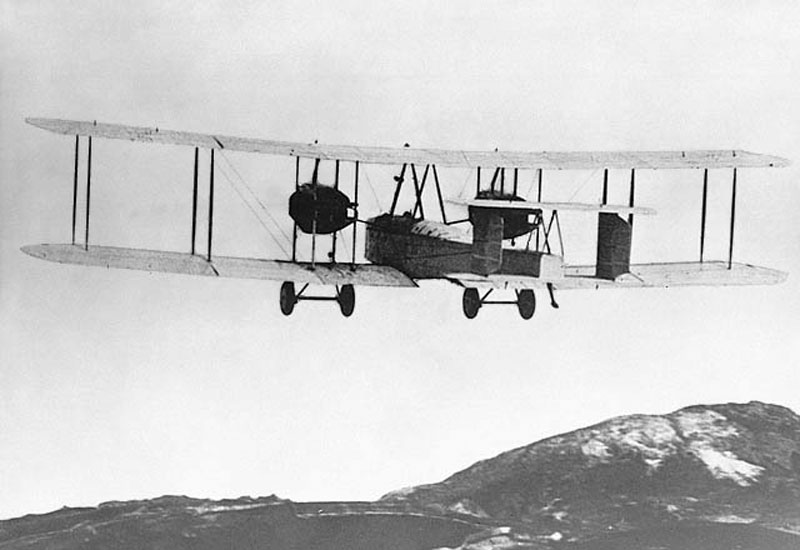
Outwardly, the Vimy was of a conventional design for the period, sporting long-span wings comprised of an upper and lower assembly. The two wings were joined by heavy parallel struts and cabling while the engines were held outboard of the fuselage in suspended nacelles. Each engine powered a four-bladed wooden propeller. The fuselage was typical of World War 1 design and consisted of a slab-sided affair with a curved front end and tapered rear. All positions were open-air in their nature with a forward and rear gunnery cockpit present as well as the cockpit proper itself. The empennage was capped by a complicated wing arrangement integrating an upper and lower horizontal span across a pair of vertical tail fins. The undercarriage was fixed in place with a pair of two-wheeled main legs supporting the bulk of the mass when at rest. The rear was managed through a simple tail skid arrangement while an anti-tipping structure could be affixed to the front under the nose.

Armament consisted of 1 x 7.7mm Lewis machine gun on a trainable mount at the nose cockpit. A second Lewis gun was mounted in a trainable mount at the rear cockpit. All told, the Vimy was cleared to carry upwards of 2,500lbs of ordnance.

Vimy stocked the inventories of No. 7, No. 9, No. 24, No. 45, No. 58, No. 70, No. 99, No. 100, No. 216, No. 500 and No.502 squadrons of the RAF. Its numbers dictated that she become the backbone of the British heavy bomber force for years following the war and some were then utilized in training up-and-coming British bomber crews. It was not until the arrival of the twin-engined Vickers Virginia heavy biplane bomber that the now-outdated Vimy was steadily removed from frontline service. The Virginia emerged in 1924 and served until World War 2 in 1941, 124 examples being produced in all. The last of the Vimys saw a rather unceremonious end to their active tenures, being utilized as targets for the training of ground-based searchlight personnel well into the 1930s. The final Vimy was retired in 1933. A military-minded transport derivative was also produced as the "Vickers Vernon" and purchased by the RAF in number (55). Similarly, the RAF relied on an air ambulance variant as well.

However, it was in the private sector that the Vimy clearly made a name for itself. It was the source of several long-distance records of the time with one achieving a complete non-stop crossing of the Atlantic in June of 1919. The success of the Vimy in the civilian market prompted production of a civilized variant known as the "Vimy Commercial". This form sported a bulbous streamlined fuselage lined with porthole windows while the remainder of the design stayed largely faithful to the original work. Power was served through 2 x Rolls-Royce Eagle VIII series piston engines. First flight of this design occurred on April 13th, 1919.

China purchased approximately 100 Vimys with about 40 ultimately received due to a lack of payment. Modified versions were then used in anger during the 2nd Zhili-Fengtian War of 1924 where they initially gave a good account of themselves in the low-level bombing role. These Vimys managed a non-descript existence until the arrival of the Japanese prior to World War 2. After that they were largely retired from service, the rest being destroyed during the Japanese occupation.

The "Vimy" name came from the "Battle of Vimy Ridge", the April 1917 engagement on French soil between a joint Canadian-British force comprised of five divisions against three divisions of the Imperial German Army (170,000 personnel versus 40,000). The battle resulted in a victory for the Canadian-British force at the cost of some 7,000 souls. The outnumbered Germans suffered 4,000 war dead.

The Vimy served China, France, Spain and the United Kingdom as a civilian passenger hauler.
Text ©2003-2013 www.MilitaryFactory.com • All Rights Reserved • No Reproduction Permitted
MilitaryFactory.com does NOT sell equipment/weaponry. Material presented throughout this website is for historical and entertainment value and should not to be construed as usable for hardware restoration, maintenance or general operation. Please consult manufacturers for such information. Our disclaimer. Email corrections / Comments to MilitaryFactory at Gmail dot com.
Picture of Vickers Vimy
View All Images (1)

Specifications for the
Vickers Vimy
Heavy Bomber


Country of Origin: United Kingdom
Manufacturer: Vickers Limited - UK
Initial Year of Service: 1919
Production: 200


Focus Model: Vickers Vimy Mk II
Crew: 3


Length: 43.54ft (13.27m)
Width: 67.16ft (20.47m)
Height: 15.26ft (4.65m)
Weight (Empty): 7,103lbs (3,222kg)
Weight (MTOW): 12,450lbs (5,647kg)


Powerplant: 2 x Rolls-Royce Eagle VIII V-12 piston engines delivering 360 horsepower each.


Maximum Speed: 103mph (166kmh; 90kts)
Maximum Range: 910miles (1,464km)
Service Ceiling: 10,000ft (3,048m; 1.9miles)
Rate-of-Climb: 0 feet per minute (0m/min)


Hardpoints: 4
Armament Suite:
STANDARD:
1 x 7.7mm (0.303 caliber) Lewis machine gun on trainable mount in forward cockpit.
1 x 7.7mm (0.303 caliber) Lewis machine gun on trainable mount in rear dorsal cockpit.

OPTIONAL:
Up to 2,476lbs of ordnance.


Variants:
F.B.27 (Vimy Mk I) - Designation covering four completed prototypes.


F.B.27A (Vimy Mk II) - Primary RAF production model.

Vimy (Ambulance) - Air Ambulance with revised fuselage.

Vimy (Commercial) - Commercial variant with bulbous fuselage lined with porthole windows.


Operators: China; France; Spain; United Kingdom

ALL AIRCRAFT CATEGORIES

BY DECADE:


1900 to 1909
1910 to 1919
1920 to 1929
1930 to 1939
1940 to 1949
1950 to 1959
1960 to 1969
1970 to 1979
1980 to 1989
1990 to 1999
2000 to 2009
2010 to 2019
2020 to 2029
VIEW ALL
Compare Aircraft


BY TYPE:


Anti-Submarine Warfare (ASW)
Attack Helicopters
Bomber Aircraft
Medium Bombers
Heavy Bombers
Close-Air Support (CAS)
Commercial Aircraft
Dive Bombers
Electronic Warfare Aircraft (EWA)
Experimental / X-Planes
Fighter Aircraft
Floatplane Aircraft
Flying Boat Aircraft
Aerial Refueling Tankers
Helicopters (ALL)
Interceptor Aircraft
Multi-Role Aircraft
Navy Carrier Aircraft
Night Fighters
Reconnaissance / Scout
Search & Rescue (SAR)
Scout Helicopters
Special Purpose
Torpedo Bombers
Trainer Aircraft
Transport Aircraft
Transport Helicopters
Unmanned Aerial Vehicles (UAVs)
Unmanned Combat Air Vehicles (UCAVs)


COLLECTIONS:


4th Generation Fighter Aircraft
5th Generation Fighter Aircraft
US X-Planes
Classic US Warbirds
French Military Helicopters
Grumman "Cats"
Howard Hughes Aircraft
Indian Air Force
Israeli Air Force
Libyan Aircraft
Modern Chinese Aircraft
Modern Chinese Fighters
Modern Military Aircraft
Modern North Korean Aircraft
Modern Trainer Aircraft
Modern US Aircraft
Mikoyan Aircraft
Sukhoi Aircraft
Syrian Aircraft
Top 10 Fighter Aircraft of All Time


AIRCRAFT BY CONFLICT:


Arab-Israeli War (1948)
Cuban Missile Crisis (1959-1962)
Falklands War (1982)
Indo-Pak War (1965, 1971)
Iran-Iraq War (1980-1988)
Lebanon War (1982)
Operation Allied Force (1999)
Operation Desert Storm (1991)
Six Day War (1967)
Spanish Civil War (1936)
Soviet-Afghan War (1979-1989)
Yom Kippur War (1973)


MISCELLANEOUS:


Aircraft Cockpits
Aircraft Manufacturers List
Aircraft Timeline

WORLD WAR 2:


1939 Aircraft
1940 Aircraft
1941 Aircraft
1942 Aircraft
1943 Aircraft
1944 Aircraft
1945 Aircraft
1946 Aircraft
Australian Aircraft
Battle of Britain Aircraft
Bombers
Four-Engine Bombers
British Aircraft
British Bombers
British Transports
Dive Bombers
Canadian Aircraft
Fighters
Chinese Aircraft
French Aircraft
German Aircraft
German Fighters
German Flying Boats
German Jets
Secret Weapons of the Luftwaffe
Italian Aircraft
Imperial Japanese Aircraft
Imperial Japanese Fighters
Mitsubishi Bombers
Navy Aircraft
Pearl Harbor
Polish Aircraft
Romanian Aircraft
US Aircraft
US Bombers
US Navy Aircraft
Soviet Aircraft
Torpedo Bombers
Trainer Aircraft
Transport Aircraft
Tuskegee Airmen Aircraft
W.A.S.P. Aircraft
WW2 Aircraft Ranked by Speed
VIEW ALL


WORLD WAR 1:


1914 Aircraft
1915 Aircraft
1916 Aircraft
1917 Aircraft
1918 Aircraft
Aircraft Timeline
Austro-Hungarian Aircraft
Bomber Aircraft
British Aircraft
Fighters
Flying Boats
French Aircraft
Imperial German Aircraft
Italian Aircraft
Scout Aircraft
Russian Empire Aircraft
US Aircraft
WW1 Aircraft Ranked by Speed
VIEW ALL


KOREAN WAR:


Australian Aircraft
Korean War Aces
Korean War Jets
North Korean Aircraft
US Military Aircraft
VIEW ALL


VIETNAM WAR:


Helicopters
North Vietnam Air Force
US Airpower
VIEW ALL


COLD WAR:


1950s French Aircraft
British V-Bombers
Cold War Bombers
Soviet Aircraft
Soviet Bombers
Soviet Interceptors
Soviet Helicopters
Strategic Air Command
US Aircraft
US Bombers
US Interceptors
VIEW ALL

Site Disclaimer | Privacy Policy | Site Map | MF Origins


©2013 www.MilitaryFactory.com • Content ©2003-2013 MilitaryFactory.com • All Rights Reserved • Site Contact Email: militaryfactory at gmail dot com. The "Military Factory" name and MilitaryFactory.com logo are registered ® trademarks and protected by all applicable domestic and international intellectual property laws.


Top MF Stuff: 2013 Military Pay Scale | Military Ranks | WW2 Weapons | Sniper Rifles | Kts to Mph | WW1 Aircraft | Automatic Rifles | Aircraft Cockpits | Vietnam War Weapons | Main Battle Tanks | Submachine Guns | Shotguns | French Military Victories


Most photographic images appearing on this site are courtesy of the United States Department of Defense and are approved for public use. Other images acquired through the public domain. Digital art work courtesy of Dan Alex. Business Consulting by Kyle Williams. Material presented throughout this website is for historical and entertainment value and should not to be construed as usable for hardware restoration, maintenance or general operation. Please consult manufacturers for such information.


eXTReMe Tracker