Military Factory
Military Pay Chart
Global Firepower
Military Industrial Complex
Second World War
Home
Military Pay Scale
Military Ranks
Small Arms
Aircraft
Land Systems
Navy
Education
Military Factory Facebook Logo
flag of United States

North American B-25 Mitchell Medium Bomber (1940)

Authored By Staff Writer | Last Updated: 8/7/2012

B-25 Mitchells were part of Doolittle's 'Raiders' on the April 1942 mission against Tokyo.

Find a School Near You
Follow Military Factory on Facebook:
Trending on Military Factory:
Recent Articles:
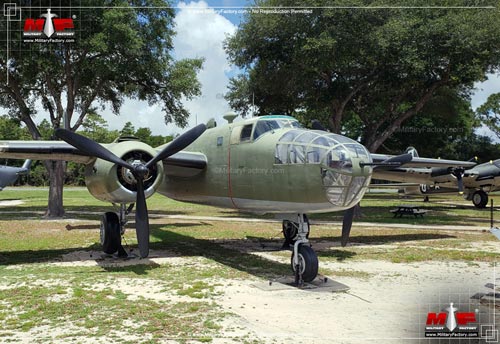
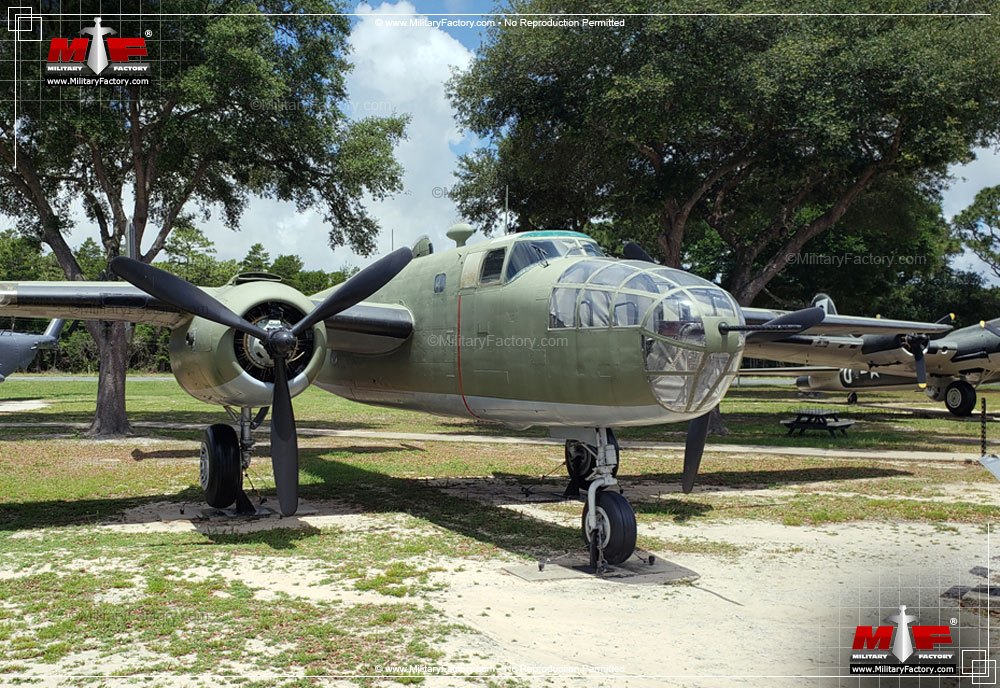
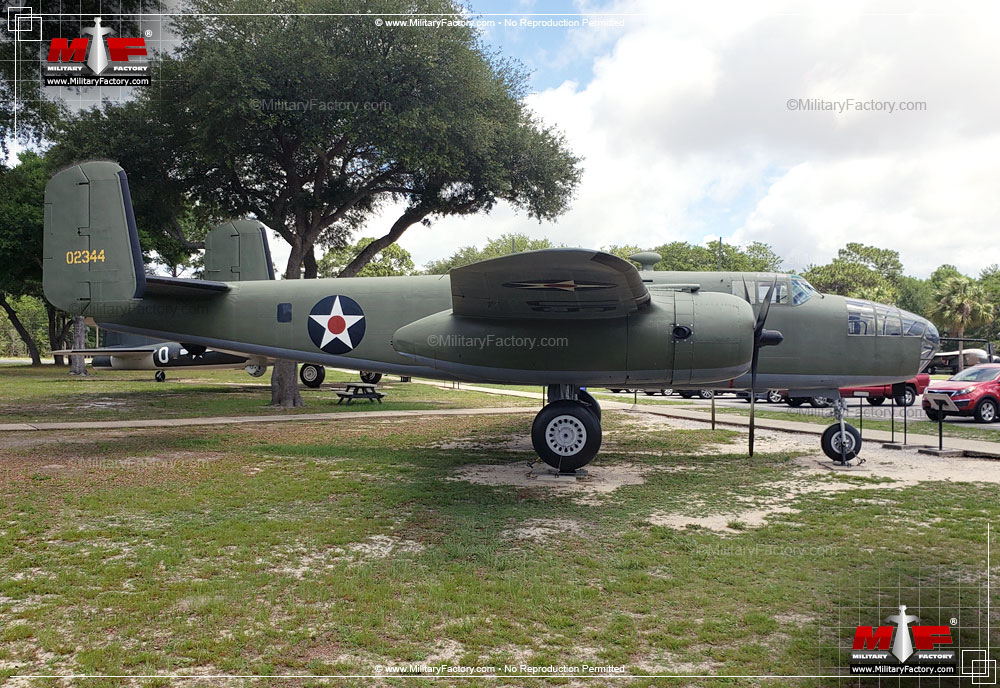
The North American B-25 Mitchell series of medium bombers went on to become one of the classic American aircraft designs to emerge during World War Two. Designed as early as 1939, the series was built to specifications as required by the United States Army. The B-25 would go on to gain national fame in the United States as the aircraft used by the famous "Doolittle Raiders", the end result having shown the American ability to bomb the heart of Tokyo from a USN carrier stationed in the Pacific (USS Hornet).

The B-25 was initially designed as a three-crew, high-mounted wing bomber utilizing twin Pratt & Whitney R-1830-S6C-3 radial engines. By the end of its production run, the system would be overhauled to include 5 to 6 crew members in various gun positions, a shoulder-mount wing assembly and twin Wright GR-2600-A71 radial engines. After over 9,800 were produced, the Mitchell had evolved into a host of variants that included trainers, dedicated ground strike, reconnaissance and torpedo carriers.

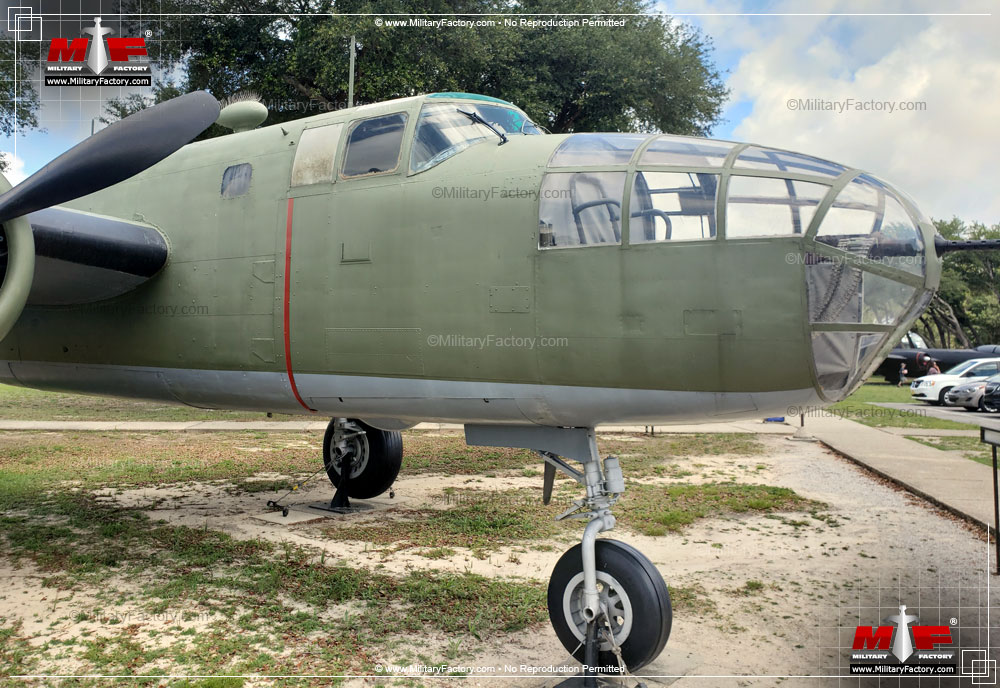
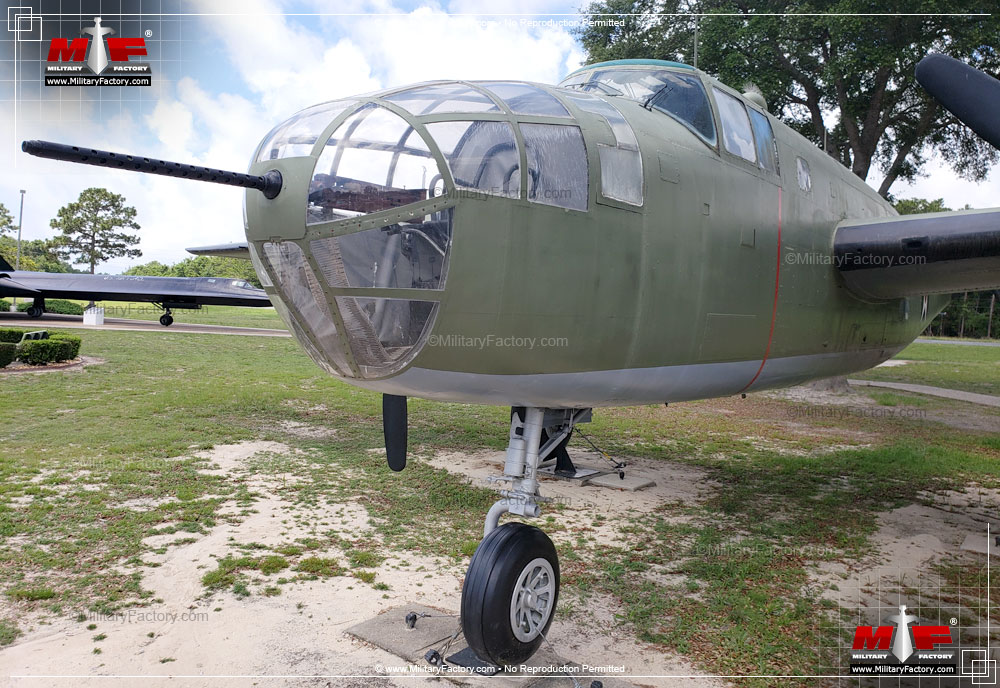
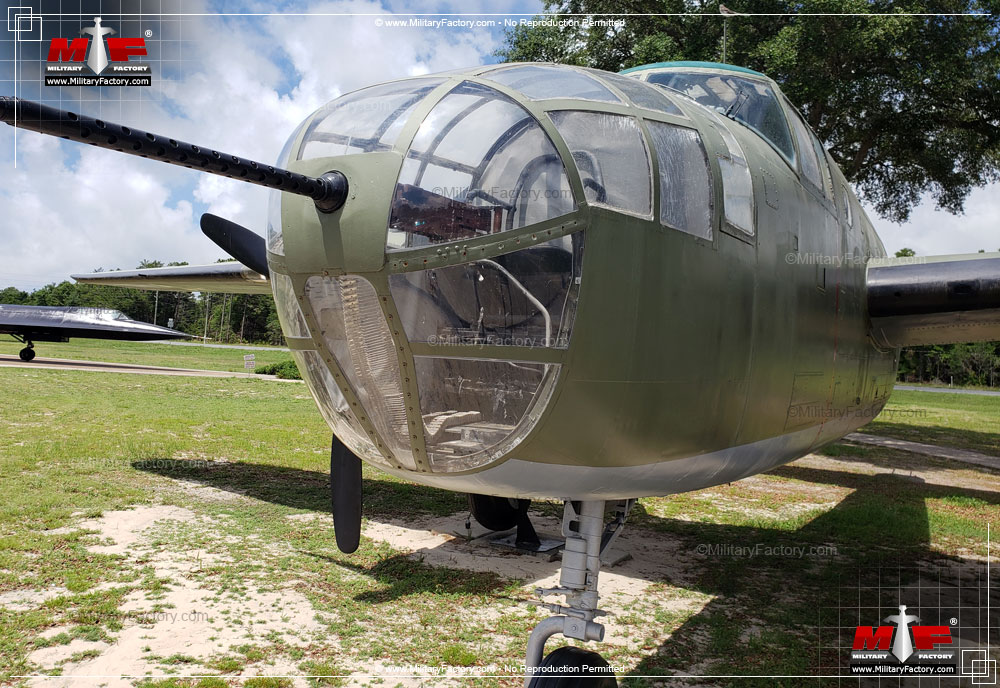
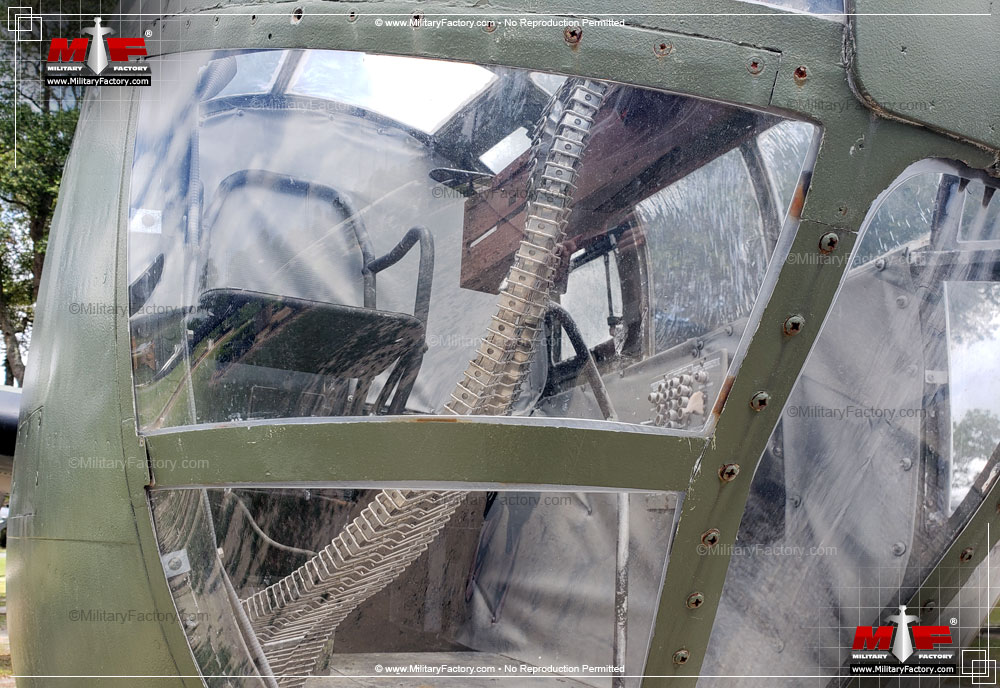
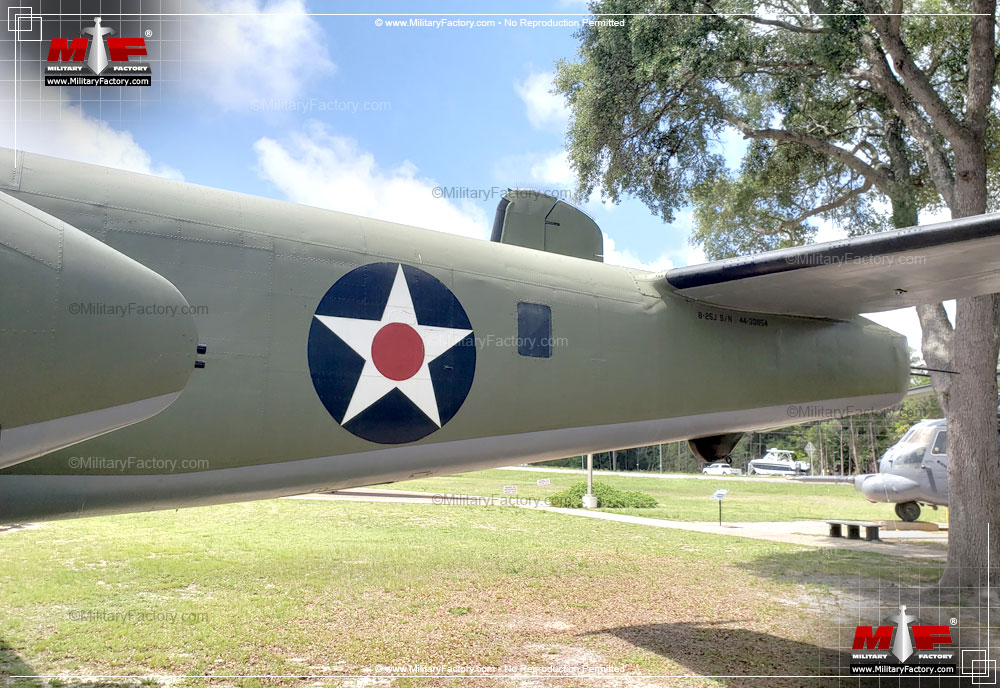
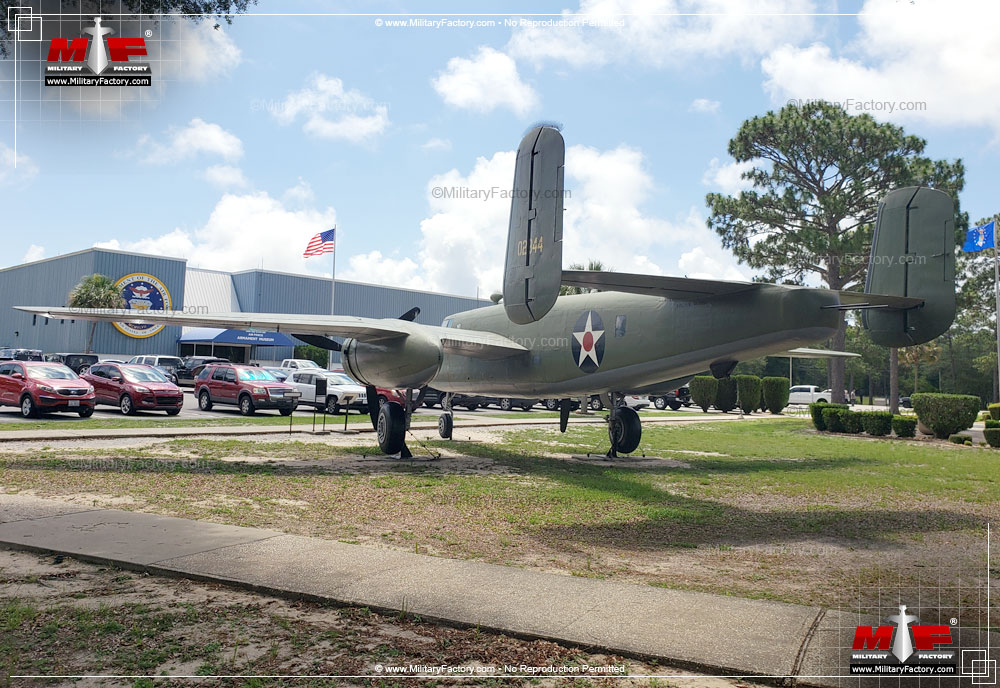
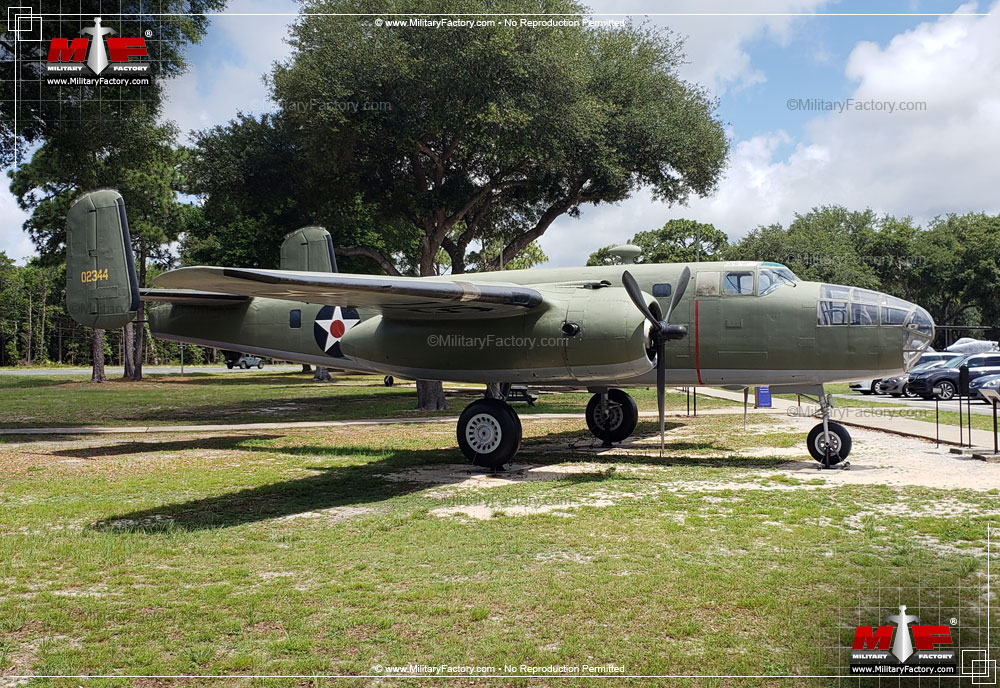
The more identifiable B-25's were a twin-engine design with the radials mounted underneath either wing element. The forward fuselage was of a greenhouse-type design affording the forward-located gunners and bombardiers a good field of vision. The pilot and co-pilot sat in a raised location just behind the nose assembly and had good vision forward, above and to the sides. A top dorsal turret was included and was mounted with twin .50 caliber machine guns. Waist gunner positions were added with single .50 caliber guns, as was a twin .50 caliber gun position in the tail. The B-25 made use of a powered-tricycle landing gear system and a decent internal bomb bay. Twin rudder assemblies differentiated the system from the other similar-looking twin-engine medium bombers of American design.

Initial B-25 designs limited the crew to just three, whereas a fuselage widening helped to increase width and seat the pilot and co-pilot side-by-side. Armor and self-sealing fuel tanks were already common in about 40 developmental models of the "A" variety. The "B" model would go on to feature 119 production aircraft with powered dorsal and ventral turret emplacements but the rear tail gunner position removed.

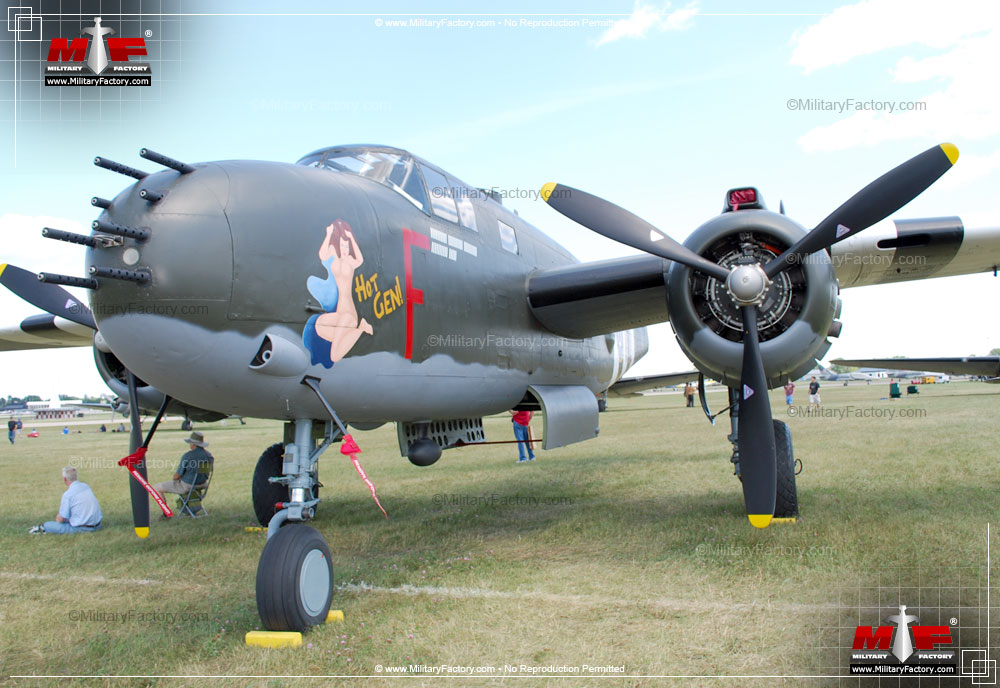
It would not be until the valuable and definitive "C" models joined the lines that the B-25 would come into its own. C-model construction would leap into the 1,600's and featured an autopiloting system, underwing hardpoints, provision for torpedo carrying and the identifiable forward-fixed 4 x .50 caliber machine gun pods on either side of the lower-front fuselage.

Following the C-models would be the very similar "D" series that varied in only being produced on a different production line facility. The next "G" models would feature a large-caliber 75mm cannon in the nose followed by "H" models with a similar gun system and upwards of 18 defensive machine guns positioned throughout the aircraft. Dedicated ground strike models were even featured with a devastating array of 8 x .50 caliber machine guns in a forward-fixed assembly mounted in the nose.
Text ©2003-2013 www.MilitaryFactory.com • All Rights Reserved • No Reproduction Permitted
MilitaryFactory.com does NOT sell equipment/weaponry. Material presented throughout this website is for historical and entertainment value and should not to be construed as usable for hardware restoration, maintenance or general operation. Please consult manufacturers for such information. Our disclaimer. Email corrections / Comments to MilitaryFactory at Gmail dot com.
Picture of North American B-25 Mitchell
Pic of the North American B-25 Mitchell
Image of the North American B-25 Mitchell
View All Images (30)

Specifications for the
North American B-25 Mitchell
Medium Bomber


Country of Origin: United States
Manufacturer: North American Aircraft Corporation - USA
Initial Year of Service: 1940
Production: 9,816


Focus Model: North American B-25C Mitchell
Crew: 5


Length: 52.92ft (16.13m)
Width: 67.55ft (20.59m)
Height: 15.75ft (4.80m)
Weight (Empty): 20,300lbs (9,208kg)
Weight (MTOW): 34,000lbs (15,422kg)


Powerplant: 2 x Wright Cyclone R-2600-19 air-cooled piston engines delivering 1,700hp each.


Maximum Speed: 272mph (438kmh; 237kts)
Maximum Range: 1,350miles (2,173km)
Service Ceiling: 24,196ft (7,375m; 4.6miles)
Rate-of-Climb: 1,666 feet per minute (508m/min)


Hardpoints: Up to 8 (model dependent)
Armament Suite:
Model-specific armament included:

8 x 12.7mm machine gun array OR 1 x 75mm cannon in forward-fixed nose assembly.

2 x 12.7mm machine guns in forward-fixed lower-left side fuselage position (beneath and behind cockpit position).
2 x 12.7mm machine gun in forward-fixed lower-right side fuselage position (beneath and behind cockpit position).
2 x 12.7mm machine guns in ventral turret (powered turrets in some models).
2 x 12.7mm machine guns in dorsal turret (powered turrets in some models).
1 x 12.7mm machine gun in left waist port position.
1 x 12.7mm machine gun in right waist port position.
2 x 12.7mm machine guns in tail gun position (some models removed).
1 x Torpedo in under-fuselage arrangement (model-specific fitting).
8 x 250lb bombs on 8 external hardpoints (model-specific fitting).

Maximum internal bombload of 3,000lbs (1,361 kg).


Variants:
NA-62 / B-25 - Further Production Design with wing element lowered to middle position; Widened fuselage to accommodate side-by-side seating for pilot / copilot; Crew increase from 3 to 5 crewmen; Improved offensive armament array and defensive capabilities; R-2600-9 powerplants; 24 initial aircraft produced.


B-25A - At least forty produced with self-sealing fuel tanks and additional armor protection.

B-25B - At least 119 produced with power-operated ventral and dorsal turret systems; Tail gun emplacement removed on some models; Plexiglass nose assembly.

B-25C - Major production model featuring autopilot, provisioning for eight external 250lb bombs or a single under-fuselage torpedo; Some produced with 4 x 12.7mm machine guns in forward-firing position on either lower-side of the cockpit.

B-25D - Based on B-25C model except from a different production line / facility.

B-25G - Featured a 75mm nose cannon; At least 405 produced with this feature; Retractable belly turret.

B-25H - Featured between 14 to 18 x 12.7mm machine guns in various positions; At least 1,000 of this type produced; Solid nose assembly; Belly turret removed; 4 x 12.7mm machine guns in forward-fixed firing position in nose above 75mm cannon; Two aft-fuselage plexiglass blisters with 12.7mm gun mounts; Tail turret reintroduced with 2 x 12.7mm machine guns; Wright R-2600-13 or R2600-29 powerplants.

B-25J - Final Production Model with R-2600-92 radial powerplants; 12 x 12.7mm machine guns in various positions.

F-10 - Reconnaissance Model

AT-25 - Pilot / Crewman Trainer Conversion Model

TB-25 - Pilot / Crewman Trainer Conversion Model

PBJ - Navy Pilot / Crewman Trainer Conversion Model


Operators: Australia; Argentina; Biafra; Bolivia; Brazil; Canada; China; Chile; Colombia; Cuba; Dominican Republic; France; Indonesia; Mexico; Netherlands; Peru; Poland; Spain; Soviet Union; Taiwan; United Kingdom; United States; Uruguay; Venezuela

ALL AIRCRAFT CATEGORIES

BY DECADE:


1900 to 1909
1910 to 1919
1920 to 1929
1930 to 1939
1940 to 1949
1950 to 1959
1960 to 1969
1970 to 1979
1980 to 1989
1990 to 1999
2000 to 2009
2010 to 2019
2020 to 2029
VIEW ALL
Compare Aircraft


BY TYPE:


Anti-Submarine Warfare (ASW)
Attack Helicopters
Bomber Aircraft
Medium Bombers
Heavy Bombers
Close-Air Support (CAS)
Commercial Aircraft
Dive Bombers
Electronic Warfare Aircraft (EWA)
Experimental / X-Planes
Fighter Aircraft
Floatplane Aircraft
Flying Boat Aircraft
Aerial Refueling Tankers
Helicopters (ALL)
Interceptor Aircraft
Multi-Role Aircraft
Navy Carrier Aircraft
Night Fighters
Reconnaissance / Scout
Search & Rescue (SAR)
Scout Helicopters
Special Purpose
Torpedo Bombers
Trainer Aircraft
Transport Aircraft
Transport Helicopters
Unmanned Aerial Vehicles (UAVs)
Unmanned Combat Air Vehicles (UCAVs)


COLLECTIONS:


4th Generation Fighter Aircraft
5th Generation Fighter Aircraft
US X-Planes
Classic US Warbirds
French Military Helicopters
Grumman "Cats"
Howard Hughes Aircraft
Indian Air Force
Israeli Air Force
Libyan Aircraft
Modern Chinese Aircraft
Modern Chinese Fighters
Modern Military Aircraft
Modern North Korean Aircraft
Modern Trainer Aircraft
Modern US Aircraft
Mikoyan Aircraft
Sukhoi Aircraft
Syrian Aircraft
Top 10 Fighter Aircraft of All Time


AIRCRAFT BY CONFLICT:


Arab-Israeli War (1948)
Cuban Missile Crisis (1959-1962)
Falklands War (1982)
Indo-Pak War (1965, 1971)
Iran-Iraq War (1980-1988)
Lebanon War (1982)
Operation Allied Force (1999)
Operation Desert Storm (1991)
Six Day War (1967)
Spanish Civil War (1936)
Soviet-Afghan War (1979-1989)
Yom Kippur War (1973)


MISCELLANEOUS:


Aircraft Cockpits
Aircraft Manufacturers List
Aircraft Timeline

WORLD WAR 2:


1939 Aircraft
1940 Aircraft
1941 Aircraft
1942 Aircraft
1943 Aircraft
1944 Aircraft
1945 Aircraft
1946 Aircraft
Australian Aircraft
Battle of Britain Aircraft
Bombers
Four-Engine Bombers
British Aircraft
British Bombers
British Transports
Dive Bombers
Canadian Aircraft
Fighters
Chinese Aircraft
French Aircraft
German Aircraft
German Fighters
German Flying Boats
German Jets
Secret Weapons of the Luftwaffe
Italian Aircraft
Imperial Japanese Aircraft
Imperial Japanese Fighters
Mitsubishi Bombers
Navy Aircraft
Pearl Harbor
Polish Aircraft
Romanian Aircraft
US Aircraft
US Bombers
US Navy Aircraft
Soviet Aircraft
Torpedo Bombers
Trainer Aircraft
Transport Aircraft
Tuskegee Airmen Aircraft
W.A.S.P. Aircraft
WW2 Aircraft Ranked by Speed
VIEW ALL


WORLD WAR 1:


1914 Aircraft
1915 Aircraft
1916 Aircraft
1917 Aircraft
1918 Aircraft
Aircraft Timeline
Austro-Hungarian Aircraft
Bomber Aircraft
British Aircraft
Fighters
Flying Boats
French Aircraft
Imperial German Aircraft
Italian Aircraft
Scout Aircraft
Russian Empire Aircraft
US Aircraft
WW1 Aircraft Ranked by Speed
VIEW ALL


KOREAN WAR:


Australian Aircraft
Korean War Aces
Korean War Jets
North Korean Aircraft
US Military Aircraft
VIEW ALL


VIETNAM WAR:


Helicopters
North Vietnam Air Force
US Airpower
VIEW ALL


COLD WAR:


1950s French Aircraft
British V-Bombers
Cold War Bombers
Soviet Aircraft
Soviet Bombers
Soviet Interceptors
Soviet Helicopters
Strategic Air Command
US Aircraft
US Bombers
US Interceptors
VIEW ALL

Site Disclaimer | Privacy Policy | Site Map | MF Origins


©2013 www.MilitaryFactory.com • Content ©2003-2013 MilitaryFactory.com • All Rights Reserved • Site Contact Email: militaryfactory at gmail dot com. The "Military Factory" name and MilitaryFactory.com logo are registered ® trademarks and protected by all applicable domestic and international intellectual property laws.


Top MF Stuff: 2013 Military Pay Scale | Military Ranks | WW2 Weapons | Sniper Rifles | Kts to Mph | WW1 Aircraft | Automatic Rifles | Aircraft Cockpits | Vietnam War Weapons | Main Battle Tanks | Submachine Guns | Shotguns | French Military Victories


Most photographic images appearing on this site are courtesy of the United States Department of Defense and are approved for public use. Other images acquired through the public domain. Digital art work courtesy of Dan Alex. Business Consulting by Kyle Williams. Material presented throughout this website is for historical and entertainment value and should not to be construed as usable for hardware restoration, maintenance or general operation. Please consult manufacturers for such information.


eXTReMe Tracker