Military Factory
Military Pay Chart
Global Firepower
Military Industrial Complex
Second World War
Home
Military Pay Scale
Military Ranks
Small Arms
Aircraft
Land Systems
Navy
Education
Military Factory Facebook Logo
flag of Nazi Germany

Heinkel He 70 (Blitz) Reconnaissance Bomber / Transport (1933)

Authored By Staff Writer | Last Updated: 6/28/2010

For its time, the Heinkel He 70 was a fast reconnaissance bomber but limited in what it could carry.

The Heinkel 70 (Blitz) was originally born out of a need for a speedy aeroplane charged with "fast" mail delivery for the Deutsche Lufthansa company. Lufthansa was in the market for such a platform to best performance of the six-passenger monoplane Lockheed Vegas and Model 9 Orions over short distances. In the end, the Heinkel engineers delivered an excellent product that would quickly set eight world speed records, covering speed-over-distance. Some He 70s would later see combat actions in the Spanish Civil War with the fabled German "Condor Legion". Regardless, the type was quickly overtaken by more impressive breeds worldwide by the time of World War 2.

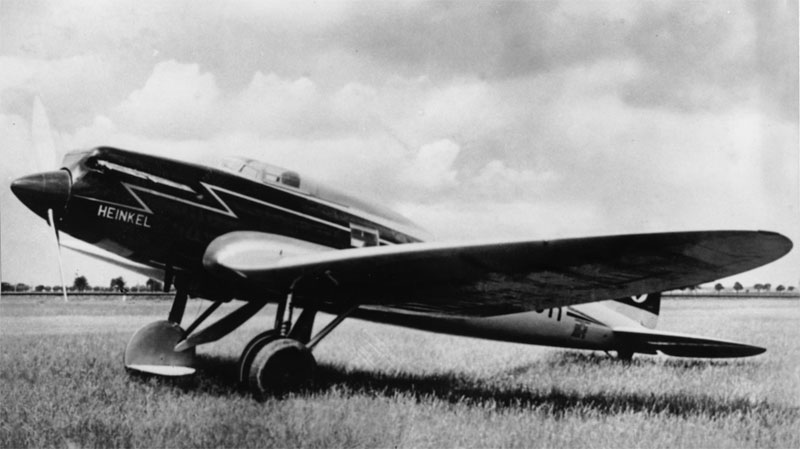
Heinkel delivered a proposal to Lufthansa that ultimately became the firm's He 70 design. The aircraft utilized a wing concept as brought about by the Gunther brothers, the pair now having joined the Heinkel bureau. As speed was the call of the day, landing gears would be made wholly retractable, rivets would be countersunk to leave a smooth aerodynamic finish and the design would be highly streamlined complete with rounded wing edges. First flight was recorded on December 1st, 1932, and its general responsiveness was highly promising while performance proved excellent. Standard operating crew for the aircraft were two personnel (pilot and navigator seated in tandem). Cabin space was such that cargo or up to four passengers could be ferried about. In the latter role, luggage could be stored safely in an aft compartment and seating for the four was arranged in two pairs of seats - the seat rows to face one another. Power was derived from a single BMW VI series V12 liquid-cooled engine. Of note to this powerplant was that it was cooled by ethylene glycol as opposed to water or other means - this being a design decision by Heinkel engineers and required a smaller radiator, further relieving the airframe of excess weight. The He 70a became the first prototype followed by the He 70b passenger prototype. The He 70c served as a gunnery trial platform while the fourth was produced for Lufthansa with the BMW engine. Likewise, the fifth prototype went to the Luftwaffe as a light bomber with the BMW engine.

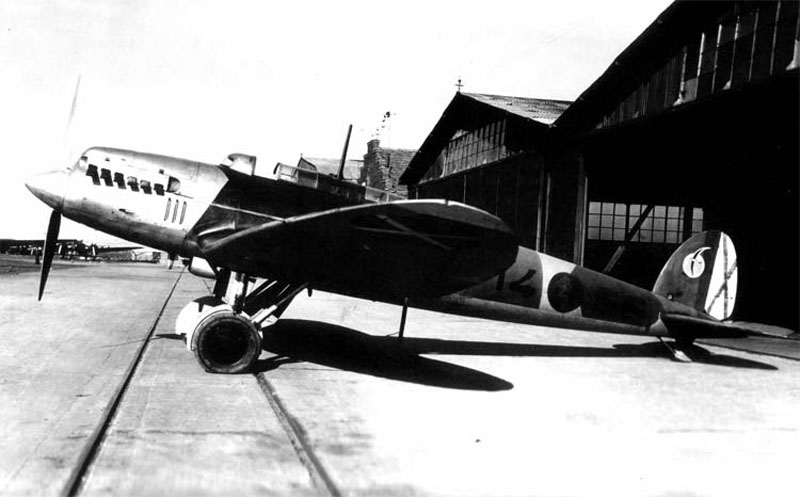
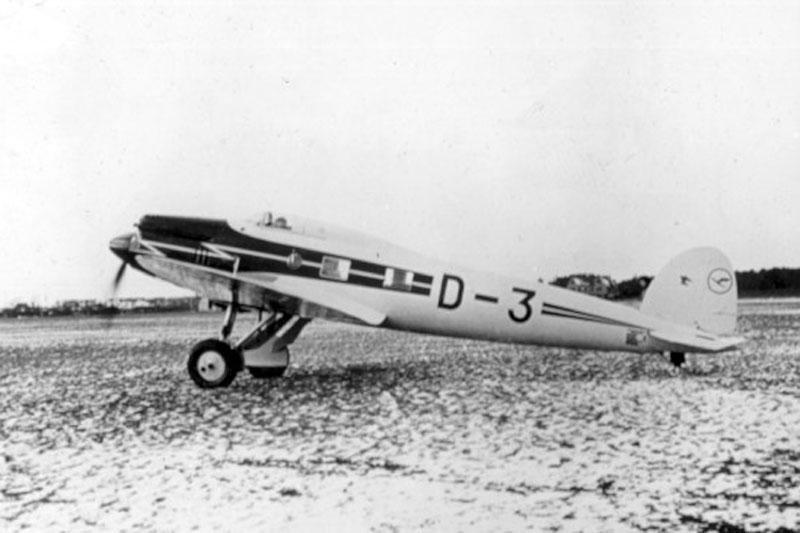
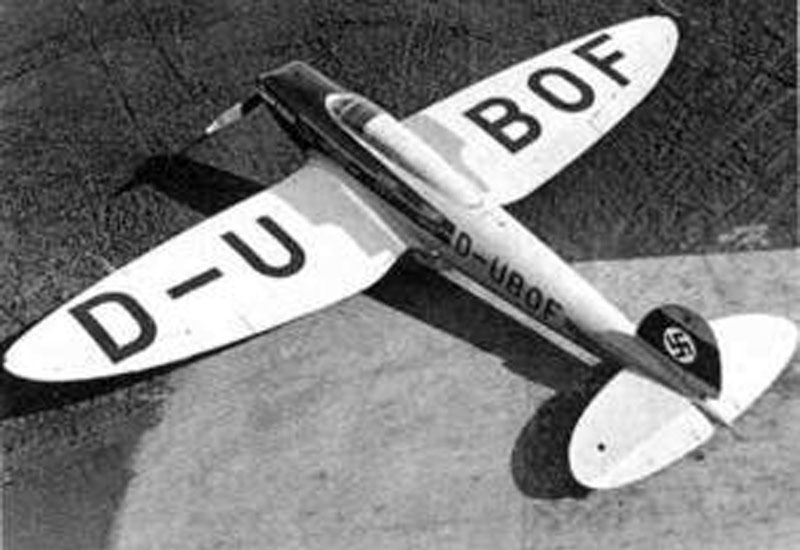
The He 70 sported a clean design, consistent with Heinkel standards. The engine was fitted to the extreme forward end of slim duralumin monocoque fuselage and mounted low. When viewed head on, the forward fuselage displayed a rectangular shape, culminating in a rounded body and rounded empennage. The crew compartment was fitted ahead of amidships under a framed contoured canopy and was interestingly offset to the portside ever so slightly. The low cantilever wings, constructed of spruce and plywood, were elliptical in shape and arranged in a low-wing monoplane format also ahead of amidships. The empennage tapered off to a point to which a round-edge vertical fin sat. Stabilizers were affixed to the empennage sides at the extreme rear. While the He 70 maintained two retractable main landing gear legs, there was no tail wheel - just a tail skid. In all, the Heinkel He 70 was a pleasing design full of streamlining and contours.

Production of the civilian airliner model reached 28 examples with 14 delivered to Lufthansa. The initial passenger model became the He 70A followed by the He 70D and He 70G. At its inception, the He 70 was an impressive aircraft, essentially modern by early 1930s standards - fast and adaptable to multiple roles. Lufthansa managed its fleetfrom 1934 to 1937 with several routes across Germany opened. Despite its impressiveness, the He 70 would lead a relatively short civilian-minded life before being replaced by larger aircraft that could ferry more passengers, luggage and associated goods from place to place. Additionally, the Luftwaffe found a need for the fast monoplane by 1935 and its military value soon grew.

The Heinkel He 70 caught the eye of the rebuilding German Luftwaffe, they themselves ordering and receiving deliveries of a communications-minded He 70D model. From there, the type was evolved into a three-man light bomber (He 70E) and a three-man reconnaissance/courier model (He 70F). A long-range reconnaissance model existed under the He 70F-1 and He 70F-2 marks. At least 28 He 70s served with the Condor Legion in the Spanish Civil War, this conflict essentially a test-bed for such German war machines as the Panzer tank, the Messerschmitt Bf 109 fighter (Heinkel's own He 112 fighter competed unsuccessfully for this fighter contract) and the Dornier Do 17 medium bomber. After Germany's involvement there ended, some eleven Condor Legion aircraft were passed on to the Ejercito del Aire of Spain.

While the He 70 proved a solid aircraft in her own right, the system was not without some major flaws. Dominant of these was the aircraft's tendency to burst into flames when hit, this owing to its magnesium airframe which combusted when heated in the air. Crews were generally quite unlucky if their aircraft were to catch fire, the blaze quickly engulfing crew and aircraft alike. Additionally, as impressive as the He 70 was by early 1930s standards, it became clearly outclassed by the middle of the decade and the type was relegated to secondary roles or retired altogether, replaced by the newer breed of aircraft coming online in time for World War.

By the time of World War 2, the heydays of the He 70 were behind her. She was used by the German Luftwaffe primarily as a trainer by then. It is of note that the He 70 was also delivered to the Empire of Japan for evaluation, resulting in the Aichi D3A "Val" light bomber of the IJN. Heinkel and the Empire would meet on such common ground on several more occasions before the war negated such exchange of ideas and technology.

In the end, over 320 examples were produced in all, both in military and civilian forms and included license production of the type in Hungary as the He 70K/He 170A. Eighteen German He 70s were also delivered to Hungary between 1937 and 1938, though these were fitted with the Gnome-Rhone 14K Mistral Major engine. Armament for these Hungarian exports included a pair of 7.8mm Gebauer machine guns. As the combustible issue became well-known, the Hungarians also retired their He 70s lesser types until Germany could deliver a more modern product.

The British firm of Rolls-Royce purchased at least one He 70G to be used as a flying laboratory of sorts in the testing of various powerplants. The cabin aboard the He 70 served this purpose well for engineers and equipment could be held onboard and monitor performance in real time while in flight. The purchase through the RLM was made in exchange for four Kestrel engines.

Heinkel's other wartime design, the better-known He 111 medium bomber, was born from the lessons learned in the He 70. Looking at the two designs side-by-side, the similarities are apparent, particularly the elliptical planform, quite a difference from the bombers developed by Junkers and Dornier in that same span.
Text ©2003-2013 www.MilitaryFactory.com • All Rights Reserved • No Reproduction Permitted
MilitaryFactory.com does NOT sell equipment/weaponry. Material presented throughout this website is for historical and entertainment value and should not to be construed as usable for hardware restoration, maintenance or general operation. Please consult manufacturers for such information. Our disclaimer. Email corrections / Comments to MilitaryFactory at Gmail dot com.
Picture of Heinkel He 70 (Blitz)
Pic of the Heinkel He 70 (Blitz)
Image of the Heinkel He 70 (Blitz)
View All Images (4)

Specifications for the
Heinkel He 70 (Blitz)
Reconnaissance Bomber / Transport


Country of Origin: Nazi Germany
Manufacturer: Heinkel Flugzeugwerke - Germany
Initial Year of Service: 1933
Production: 342


Focus Model: Heinkel He 70F-2 (Blitz)
Crew: 2


Length: 39.37ft (12m)
Width: 48.56ft (14.80m)
Height: 10.17ft (3.10m)
Weight (Empty): 5,203lbs (2,360kg)
Weight (MTOW): 7,628lbs (3,460kg)


Powerplant: 1 x BMW VI 7.3 12-cylinder water-cooled piston engine delivering 750 horsepower.


Maximum Speed: 224mph (360kmh; 194kts)
Maximum Range: 559miles (900km)
Service Ceiling: 17,552ft (5,350m; 3.3miles)
Rate-of-Climb: 0 feet per minute (0m/min)


Hardpoints: 0
Armament Suite:
STANDARD:
1 x 7.92mm MG 15 machine gun in rear cockpit.

OPTIONAL:
6 x 110lb OR 24 x 22lb bombs


Variants:
He 70a - First Prototype Model


He 70b - Second Prototype Model; seating for four passegers; crew of two personnel.

He 70c - Third Prototype Model; armed evaluation platform.

He 70d - Fourth Passenger Transport Prototype Model; fitted with 1 x BMW VI 7.3 series engine; produced in 1934 for Lufthansa Airlines.

He 70e - Fifth Bomber Prototype Model; fitted with BMW VU 7.3 series engine; produced in 1934 for the Luftwaffe.

He 70A - Lufthansa Passenger Production Model

He 70D - Lufthansa Passenger Production Model; 12 examples produced.

He 70E - Luftwaffe Light Bomber Production Model

He 70F - Luftwaffe Reconnaissance / Transport Production Model.

He 70F-1 - Long-Range Reconnaissance Variant

He 70F-2 - Long-Range Reconnaissance Variant

He 70G - Lufthansa Passenger Transport

He 70G-1 - Single Example fitting Rolls-Royce Kestrel engine of 810 horsepower.

He 70K (He 170A) - Hungarian license-produced He 70; fitted with WM-K-14 radial piston engine of 1,000 horsepower; utilized as fast reconnaissance platform.

He 270 (W.Nr.1973, D-OEHF) - Single Prototype Example fitted with a Daimler-Benz DB 601Aa series inline piston engine.


Operators:
Hungary; Japan; Nazi Germany; United Kingdom; Spain

ALL AIRCRAFT CATEGORIES

BY DECADE:


1900 to 1909
1910 to 1919
1920 to 1929
1930 to 1939
1940 to 1949
1950 to 1959
1960 to 1969
1970 to 1979
1980 to 1989
1990 to 1999
2000 to 2009
2010 to 2019
2020 to 2029
VIEW ALL
Compare Aircraft


BY TYPE:


Anti-Submarine Warfare (ASW)
Attack Helicopters
Bomber Aircraft
Medium Bombers
Heavy Bombers
Close-Air Support (CAS)
Commercial Aircraft
Dive Bombers
Electronic Warfare Aircraft (EWA)
Experimental / X-Planes
Fighter Aircraft
Floatplane Aircraft
Flying Boat Aircraft
Aerial Refueling Tankers
Helicopters (ALL)
Interceptor Aircraft
Multi-Role Aircraft
Navy Carrier Aircraft
Night Fighters
Reconnaissance / Scout
Search & Rescue (SAR)
Scout Helicopters
Special Purpose
Torpedo Bombers
Trainer Aircraft
Transport Aircraft
Transport Helicopters
Unmanned Aerial Vehicles (UAVs)
Unmanned Combat Air Vehicles (UCAVs)


COLLECTIONS:


4th Generation Fighter Aircraft
5th Generation Fighter Aircraft
US X-Planes
Classic US Warbirds
French Military Helicopters
Grumman "Cats"
Howard Hughes Aircraft
Indian Air Force
Israeli Air Force
Libyan Aircraft
Modern Chinese Aircraft
Modern Chinese Fighters
Modern Military Aircraft
Modern North Korean Aircraft
Modern Trainer Aircraft
Modern US Aircraft
Mikoyan Aircraft
Sukhoi Aircraft
Syrian Aircraft
Top 10 Fighter Aircraft of All Time


AIRCRAFT BY CONFLICT:


Arab-Israeli War (1948)
Cuban Missile Crisis (1959-1962)
Falklands War (1982)
Indo-Pak War (1965, 1971)
Iran-Iraq War (1980-1988)
Lebanon War (1982)
Operation Allied Force (1999)
Operation Desert Storm (1991)
Six Day War (1967)
Spanish Civil War (1936)
Soviet-Afghan War (1979-1989)
Yom Kippur War (1973)


MISCELLANEOUS:


Aircraft Cockpits
Aircraft Manufacturers List
Aircraft Production
Aircraft Timeline

WORLD WAR 2:


1939 Aircraft
1940 Aircraft
1941 Aircraft
1942 Aircraft
1943 Aircraft
1944 Aircraft
1945 Aircraft
1946 Aircraft
Australian Aircraft
Battle of Britain Aircraft
Bombers
Four-Engine Bombers
British Aircraft
British Bombers
British Transports
Dive Bombers
Canadian Aircraft
Fighters
Chinese Aircraft
French Aircraft
German Aircraft
German Fighters
German Flying Boats
German Jets
Secret Weapons of the Luftwaffe
Italian Aircraft
Imperial Japanese Aircraft
Imperial Japanese Fighters
Mitsubishi Bombers
Navy Aircraft
Pearl Harbor
Polish Aircraft
Romanian Aircraft
US Aircraft
US Bombers
US Navy Aircraft
Soviet Aircraft
Torpedo Bombers
Trainer Aircraft
Transport Aircraft
Tuskegee Airmen Aircraft
W.A.S.P. Aircraft
WW2 Aircraft Ranked by Speed
VIEW ALL


WORLD WAR 1:


1914 Aircraft
1915 Aircraft
1916 Aircraft
1917 Aircraft
1918 Aircraft
Aircraft Timeline
Austro-Hungarian Aircraft
Bomber Aircraft
British Aircraft
Fighters
Flying Boats
French Aircraft
Imperial German Aircraft
Italian Aircraft
Scout Aircraft
Russian Empire Aircraft
US Aircraft
WW1 Aircraft Ranked by Speed
VIEW ALL


KOREAN WAR:


Australian Aircraft
Korean War Aces
Korean War Jets
North Korean Aircraft
US Military Aircraft
VIEW ALL


VIETNAM WAR:


Helicopters (ALL)
Transport Helicopters
North Vietnam Air Force
US Airpower
VIEW ALL


COLD WAR:


1950s French Aircraft
British V-Bombers
Cold War Bombers
Soviet Aircraft
Soviet Bombers
Soviet Interceptors
Soviet Helicopters
Strategic Air Command
US Aircraft
US Bombers
US Interceptors
VIEW ALL

Site Disclaimer | Privacy Policy | Site Map | MF Origins


©2013 www.MilitaryFactory.com • Content ©2003-2013 MilitaryFactory.com • All Rights Reserved • Site Contact Email: militaryfactory at gmail dot com. The "Military Factory" name and MilitaryFactory.com logo are registered ® trademarks and protected by all applicable domestic and international intellectual property laws.


Top MF Stuff: 2013 Military Pay Scale | Military Ranks | WW2 Weapons | Sniper Rifles | Kts to Mph | WW1 Aircraft | Automatic Rifles | Aircraft Cockpits | Vietnam War Weapons | Main Battle Tanks | Submachine Guns | Shotguns | French Military Victories


Most photographic images appearing on this site are courtesy of the United States Department of Defense and are approved for public use. Other images acquired through the public domain. Digital art work courtesy of Dan Alex. Business Consulting by Kyle Williams. Material presented throughout this website is for historical and entertainment value and should not to be construed as usable for hardware restoration, maintenance or general operation. Please consult manufacturers for such information.


eXTReMe Tracker