Military Factory
Military Pay Chart
Global Firepower
Military Industrial Complex
Second World War
Home
Military Pay Scale
Military Ranks
Small Arms
Aircraft
Land Systems
Navy
Education
Military Factory Facebook Logo
flag of United States

Hughes H-1 (Hughes 1B) Racer Aircraft (1935)

Authored By Staff Writer | Last Updated: 11/15/2010

The Hughes H-1 Racer proved a record-setter for the Hughes Aircraft company.

Find a School Near You
Follow Military Factory on Facebook:
Trending on Military Factory:
Recent Articles:
The H-1 (also known as the "Hughes 1B") model was the first product of the Hughes Aircraft firm and was intended as a world record-setting landplane from her modest beginnings. The aircraft lived up to its billing and forged Hughes' name into aviation lore while at the same time becoming the last such non-military, record-setting aircraft to be constructed by an individual. The H-1 went on to set a world airspeed record and later captured the transcontinental speed record over the United States before the end of her tenure. The single production example now resides in the National Air and Space Museum in Washington, D.C., becoming part of the aviation collection when it was donated to the establishment in 1975.

H1 Origins

Engineer Glen Odekirk and Howard Hughes met while the two worked on Hughes aviation epic and box office success "Hell's Angels". Odekirk was employed for the film by Hughes and charged with keeping the fleet of 100 or so aircraft air-worthy. While production progressed, the two men began developing plans for a record-breaking aircraft design which eventually evolved to become the celebrated "H-1". Designs were on the drawing board as early as 1934 with promising wind tunnel tests following. Evaluation of a mock up proved enticing and development continued.

Hughes H-1 Walk-Around

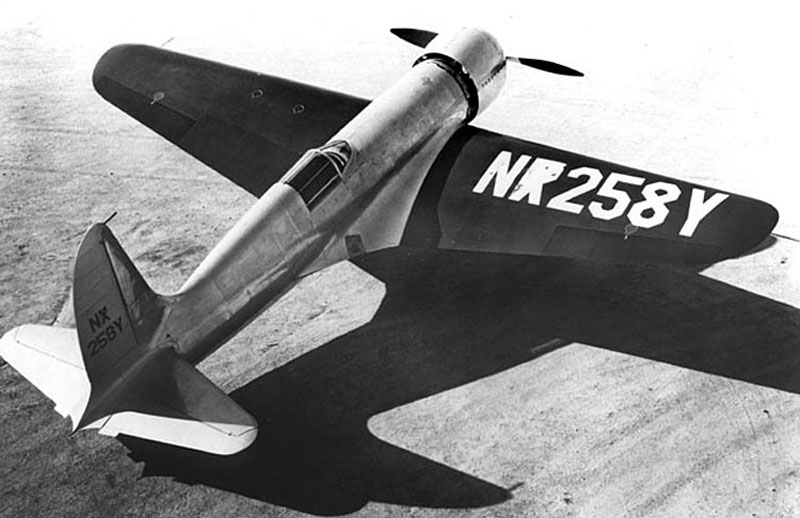
Design of the H-1, credited to Richard Palmer and Hughes with construction credited to Odekirk, exuded speed from any one of her viewable angles. She sported low-set monoplane wings with noticeable dihedral and each were made of wood attached to a tubular pencil like fuselage left as bare metal. The engine was held well-forward in the design and extended out ahead of the wings. The cockpit was set well behind the wing assemblies and sported only light framing, allowing for unfettered views across the front and sides of the aircraft. The H-1 featured a short empennage capped by a single vertical tail fin complimented by applicable horizontal stabilizers. The undercarriage consisted of two single-wheeled main landing gear legs and a hydraulically-controlled metal tail skid at the rear. The main legs retracted inwards towards the fuselage centerline. There were two sets of wings constructed to tackle two distinct flying modes - speed racing and cross-country racing.

The Wings

In its original configuration, the H-1 sported shorter wings of 25 feet and fielded in this fashion for setting the initial landplane speed record. These were indicated by their red paint coating. For the transcontinental record, the H-1 was then fitted with longer-spanning wings of 31 feet, 9 inches. These were indicated by their blue paint coating.

Hughes - Always the Visionary

Of particular note in the design of the H-1 were several revolutionary and key features to keep the "need for speed" criteria at the forefront. The H-1 made use of monoplane wings at a time when most aircraft (even military types) were still using biplanes with origins in a bygone era. The undercarriage's retractable nature was also a departure from conventional aircraft types then in use, many making due with static structures while others housed landing gear legs in streamlined, though fixed, fairings. The H-1 was also constructed with individually machined flush rivets which contoured perfectly with the smooth metal skin of the aircraft, making for a superior streamlined affair. All these implementations combined to produced the fastest of possible airframes.

The Power Within

Power for the H-1 was delivered from a single Pratt & Whitney R-1535 series, twin-row, 14-cylinder radial piston engine producing approximately 700 horsepower (although modified in the H-1 for an impressive output of up to 1,000 horsepower) and actuating a two-bladed metal propeller. This supplied up to listed 352 miles per hour making it one of the fastest piston engine aircraft of the time. The fuselage maintained a running length of 27 feet and a height of 8 feet. When empty, she listed at 3,565lbs and a full 5,492lbs when loaded.

The Records

On September 13th, 1935, the H-1's first flight (with Hughes himself at the controls) the H-1 achieved a new world speed record of 352 miles per hour, this over the skies of Santa Ana, California. Hughes took the H-1 through her paces and accomplished the record before being forced to crash land after running out of fuel. Both Hughes and the H-1 survived without any major damage with Hughes only convinced that he could make his new creation fly faster.

The transcontinental flight to follow, this from Los Angeles, California, to Newark, New Jersey, occurred on January 19th, 1937, and was covered in 7 hours, 28 minutes and 25 seconds. Hughes' average speed on the jaunt was an impressive 332 miles per hour. This was less than the 9 hours, 27 minutes Hughes managed in a previous transcontinental attempt.

Why Not a Military Pursuit Fighter?

The H-1 was undoubtedly an aircraft ahead of its time and if anyone knew this it was Howard Hughes. Always the businessman, he assumed interest from the United States Army Air Force was forthcoming but this came to naught. The USAAF never contracted for any evaluation H-1s and the aircraft lived on only as a racing airplane with the Hughes name. In post-war reports before the Unites States Senate, Hughes commented that the USAAF thought a cantilever monoplane not suitable for a pursuit fighter. Wartime designs such as the American Republic P-47 Thunderbolt, German Focke-Wulf Fw 190 and Japanese Mitsubishi A6M "Zero" were all thought to borrow some elements of Hughes' design but each respected designer never admitted as such, some outright refuting any such claim. It is only left to the imagination what the H-1 racer could have become if transformed and utilized as a pursuit fighter.
Text ©2003-2013 www.MilitaryFactory.com • All Rights Reserved • No Reproduction Permitted
MilitaryFactory.com does NOT sell equipment/weaponry. Material presented throughout this website is for historical and entertainment value and should not to be construed as usable for hardware restoration, maintenance or general operation. Please consult manufacturers for such information. Our disclaimer. Email corrections / Comments to MilitaryFactory at Gmail dot com.
Picture of Hughes H-1 (Hughes 1B)
View All Images (1)

Specifications for the
Hughes H-1 (Hughes 1B)
Racer Aircraft


Country of Origin: United States
Manufacturer: Hughes Aircraft - USA
Initial Year of Service: 1935
Production: 1


Focus Model: Hughes H-1 (Hughes 1B)
Crew: 1


Length: 27.00ft (8.23m)
Width: 31.73ft (9.67m)
Height: 7.87ft (2.40m)
Weight (Empty): 3,571lbs (1,620kg)
Weight (MTOW): 5,503lbs (2,496kg)


Powerplant: 1 x Pratt & Whitney R-1535 radial piston engine delivering 700 horsepower.


Maximum Speed: 352mph (566kmh; 306kts)
Maximum Range: 0miles (0km)
Service Ceiling: 0ft (0m; 0.0miles)
Rate-of-Climb: 0 feet per minute (0m/min)


Hardpoints: 0
Armament Suite:
None.


Variants:
H-1 - Base series designation; single prototype produced.


Operators: United States

ALL AIRCRAFT CATEGORIES

BY DECADE:


1900 to 1909
1910 to 1919
1920 to 1929
1930 to 1939
1940 to 1949
1950 to 1959
1960 to 1969
1970 to 1979
1980 to 1989
1990 to 1999
2000 to 2009
2010 to 2019
2020 to 2029
VIEW ALL
Compare Aircraft


BY TYPE:


Anti-Submarine Warfare (ASW)
Attack Helicopters
Bomber Aircraft
Medium Bombers
Heavy Bombers
Close-Air Support (CAS)
Commercial Aircraft
Dive Bombers
Electronic Warfare Aircraft (EWA)
Experimental / X-Planes
Fighter Aircraft
Floatplane Aircraft
Flying Boat Aircraft
Aerial Refueling Tankers
Helicopters (ALL)
Interceptor Aircraft
Multi-Role Aircraft
Navy Carrier Aircraft
Night Fighters
Reconnaissance / Scout
Search & Rescue (SAR)
Scout Helicopters
Special Purpose
Torpedo Bombers
Trainer Aircraft
Transport Aircraft
Transport Helicopters
Unmanned Aerial Vehicles (UAVs)
Unmanned Combat Air Vehicles (UCAVs)


COLLECTIONS:


4th Generation Fighter Aircraft
5th Generation Fighter Aircraft
US X-Planes
Classic US Warbirds
French Military Helicopters
Grumman "Cats"
Howard Hughes Aircraft
Indian Air Force
Israeli Air Force
Libyan Aircraft
Modern Chinese Aircraft
Modern Chinese Fighters
Modern Military Aircraft
Modern North Korean Aircraft
Modern Trainer Aircraft
Modern US Aircraft
Mikoyan Aircraft
Sukhoi Aircraft
Syrian Aircraft
Top 10 Fighter Aircraft of All Time


AIRCRAFT BY CONFLICT:


Arab-Israeli War (1948)
Cuban Missile Crisis (1959-1962)
Falklands War (1982)
Indo-Pak War (1965, 1971)
Iran-Iraq War (1980-1988)
Lebanon War (1982)
Operation Allied Force (1999)
Operation Desert Storm (1991)
Six Day War (1967)
Spanish Civil War (1936)
Soviet-Afghan War (1979-1989)
Yom Kippur War (1973)


MISCELLANEOUS:


Aircraft Cockpits
Aircraft Manufacturers List
Aircraft Timeline

WORLD WAR 2:


1939 Aircraft
1940 Aircraft
1941 Aircraft
1942 Aircraft
1943 Aircraft
1944 Aircraft
1945 Aircraft
1946 Aircraft
Australian Aircraft
Battle of Britain Aircraft
Bombers
Four-Engine Bombers
British Aircraft
British Bombers
British Transports
Dive Bombers
Canadian Aircraft
Fighters
Chinese Aircraft
French Aircraft
German Aircraft
German Fighters
German Flying Boats
German Jets
Secret Weapons of the Luftwaffe
Italian Aircraft
Imperial Japanese Aircraft
Imperial Japanese Fighters
Mitsubishi Bombers
Navy Aircraft
Pearl Harbor
Polish Aircraft
Romanian Aircraft
US Aircraft
US Bombers
US Navy Aircraft
Soviet Aircraft
Torpedo Bombers
Transport Aircraft
Tuskegee Airmen Aircraft
W.A.S.P. Aircraft
WW2 Aircraft Ranked by Speed
VIEW ALL


WORLD WAR 1:


1914 Aircraft
1915 Aircraft
1916 Aircraft
1917 Aircraft
1918 Aircraft
Aircraft Timeline
Austro-Hungarian Aircraft
Bomber Aircraft
British Aircraft
Fighters
Flying Boats
French Aircraft
Imperial German Aircraft
Italian Aircraft
Scout Aircraft
Russian Empire Aircraft
US Aircraft
WW1 Aircraft Ranked by Speed
VIEW ALL


KOREAN WAR:


Australian Aircraft
Korean War Aces
Korean War Jets
North Korean Aircraft
US Military Aircraft
VIEW ALL


VIETNAM WAR:


Helicopters
North Vietnam Air Force
US Airpower
VIEW ALL


COLD WAR:


1950s French Aircraft
British V-Bombers
Cold War Bombers
Soviet Aircraft
Soviet Bombers
Soviet Interceptors
Soviet Helicopters
Strategic Air Command
US Aircraft
US Bombers
US Interceptors
VIEW ALL

Site Disclaimer | Privacy Policy | Site Map | MF Origins


©2013 www.MilitaryFactory.com • Content ©2003-2013 MilitaryFactory.com • All Rights Reserved • Site Contact Email: militaryfactory at gmail dot com. The "Military Factory" name and MilitaryFactory.com logo are registered ® trademarks and protected by all applicable domestic and international intellectual property laws.


Top MF Stuff: 2013 Military Pay Scale | Military Ranks | WW2 Weapons | Sniper Rifles | Kts to Mph | WW1 Aircraft | Automatic Rifles | Aircraft Cockpits | Vietnam War Weapons | Main Battle Tanks | Submachine Guns | Shotguns | French Military Victories


Most photographic images appearing on this site are courtesy of the United States Department of Defense and are approved for public use. Other images acquired through the public domain. Digital art work courtesy of Dan Alex. Business Consulting by Kyle Williams. Material presented throughout this website is for historical and entertainment value and should not to be construed as usable for hardware restoration, maintenance or general operation. Please consult manufacturers for such information.


eXTReMe Tracker