Military Factory
Military Pay Chart
Global Firepower
Military Industrial Complex
Second World War
Home
Military Pay Scale
Military Ranks
Small Arms
Aircraft
Land Systems
Navy
Education
Military Factory Facebook Logo
flag of Netherlands

Fokker G.I (Reaper) Heavy Fighter (1938)

Authored By Dan Alex | Last Updated: 4/7/2011

Only about fifty of the type were ever produced, those in service eventually captured by Germany and used as BF110 crew trainers.

Find a School Near You
Follow Military Factory on Facebook:
Trending on Military Factory:
Recent Articles:
The Fokker G.I "Reaper" began as a private venture in 1936 under the leadership of Dr. Erich Schatzki, head engineer at Fokker. Founded in 1912, Fokker began as a major fighter producer for the German Empire during World War 1. In 1919, the firm relocated to the Netherlands and turned into a dominant player of the civilian airliner market throughout the 1920s and 1930s - this period also known as the "Golden Age of Flight", a time when the public could not get enough of airplanes and powered flight. Fokker contributed both the G.I and the D.XXI to the Dutch Air Force in the build up to World War 2, but both accomplished little to thwart the German invasion of the Netherlands in 1940.

The Heavy Fighter
The G.I was developed as a dedicated "heavy fighter" with military potential from the start - the G.I was an airframe that could match performance against fighters while also being able to deliver a formidable firepower load against enemy bombers. The G.I was part of a select class of heavy fighters - such as the twin-seat, twin-engine Messerschmitt BF 110 of the German Luftwaffe - these machines playing key roles in the early stages of World War 2. By the end of the conflict, however, heavy fighters had given way to dedicated fighter and bomber platforms.

The Fokker X-2 Prototype
With the Fokker design in place, construction on the X-2 prototype commenced and involved meshing a welded frame with an aluminum skin. Wood was used along the wings, skinned over in triplex. Powered was supplied by a pair of Hispano-Suiza 14AB-02/03 series engines delivering 650 horsepower each. First flight was on March 16th, 1937 and the results proved promising. Trouble eventually found the X-2 program in a later test flight in the month of September when a supercharger exploded in mid-flight. The pilot was, however, able to bring his bird down in one piece. After review of the incident, the Hispano-Suiza powerplants were replaced in favor of the American Pratt & Whitney SB4-G Twin Wasp Junior radial piston engines. Evaluation ensued with more test flights.

Spain Places an Order
Satisfied with the current results of Fokker's program, Spain placed an order for a dozen examples of the G.I export model, these models known under the simple designation of "G.Ib" (initial Dutch production models would carry the designation of G.Ia). However, a Dutch political embargo against the warring nation meant that Fokker could not deliver their aircraft, even after the Spanish government had paid the procurement bill in full. These aircraft were still constructed and would later serve the Dutch Air Force during the German invasion.

The Fokker G.I as a Dive-Bomber
After interest in the G.I as a potential dive-bomber rose, the G.I was slightly modified to include dive brakes on the wing undersides. Testing revealed excellent diving characteristics from the strong airframe and several nations placed meaningful orders - including the Dutch air force with an order for 36 examples. Quantitative production soon began and two- and three-seat G.Ia models were leaving Fokker factories. Upon reception, the Dutch air force quickly put their new G.Ia to work, particularly along the fronts of a destabilizing situation in Europe.

Fokker G.I Walk-Around
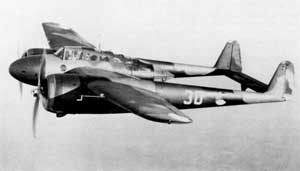
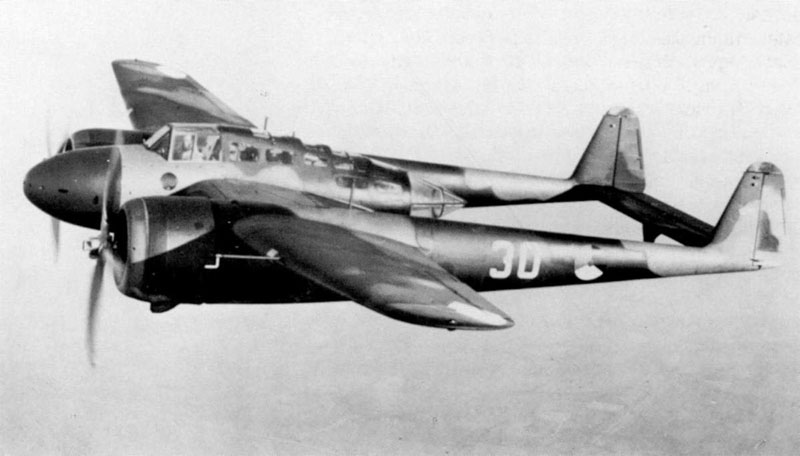
The crew compartment (room for two or three personnel depending on the production airframe) was held in a centralized nacelle. The nacelle was streamlined from nose to tip, featuring a smooth-rounded nose cone and a pointed, glazed rear window cone. The pilot maintained a dominant position at the front, overlooking the nose and both engines, with a relatively clear view of the oncoming action. The rear gunner (also doubling as the radio operator and navigator) sat directly aft of the pilot and both shared a heavily-glazed canopy view of the outside world. The third crew member (if any) was usually the designated bombardier. The G.I design was, of course, characterized by her twin-boom appearance. Each engine was held well-forward in each boom, these boom structures extending both ahead and aft of the wing leading and trailing edges respectively. The radial engines were set off from the wing roots and managed three-blade propeller systems. The boom structures tapered off into rounded vertical tail fins at the rear. Between the two tail fins was affixed a single horizontal stabilizer.

Fokker G.I Power
The Fokker G.Ia production model fitted a pair of Bristol Mercury VIII radial piston engines, each delivering up to 830 horsepower. This allowed for a maximum speed of up to 295 miles per hour with a range equal to 938 miles. Her service ceiling was listed at 32,808 feet. Empty weight was reported at 7,330lbs with a maximum take-off weight limit of 10,582lbs. She maintained a wingspan of just over 56 feet, a running length of 35 feet, 8 inches and a height of approximately 12 feet when at rest.

Fokker G.I Armament
Obviously, armament was the key factor in developing a competent heavy fighter. The G.I made use of a battery of machine guns as well as maintaining provision for external bomb ordnance. There were up to 8 x 7.9mm FN-Browning machine guns - all fitted in the nose - in a fixed, forward-firing arrangement and controlled by the pilot. In its original form, the G.I was fielded with 2 x 23mm Madsen cannons and 2 x 7.9mm machine guns in the nose - this perhaps the more formidable armament in retrospect. Bomb loads topped off at roughly 880lbs and were usually made up of a pair of conventional drop bombs held under each wing root.

Fokker G.I Variants
Beyond the single example prototype, the G.I was produced in just two notable variants. This included the G.Ia, which fitted 2 x Bristol Mercury VIII series radial piston engines and could have seating for two or three crewmembers, and the G.Ib, an export derivative fitted with 2 x Pratt & Whitney SB4-G Twin Wasp Junior radial piston engines. In all, approximately fifty of the G.I family of aircraft were ultimately produced with the Militaire Luchvaartafdeeling of the Netherlands being the primary operator. The German Luftwaffe made use of only a few G.Is during World War 2.

War Comes to the Netherlands
Hitler's German war machine moved on Dutch territory on May 10th, 1940. At the time, only 23 G.1a type aircraft were available to the Dutch air force. As was typical of German attacks, opening air strikes on Dutch airfields quickly rendered the Dutch airborne elements useless. Within time, air-to-air combat depleted ranks and inventory alike, though not without some aerial victories on the part of the brave, yet outclassed, Dutch airmen. G.Is were also unleashed as ground-attack platforms and harassed advancing German formations. German transport aircraft also became key targets of the heavily-armed G.Is. Despite this valiant effort, Netherlands fell to the might of the German war machine within a week and all remaining G.Is in serviceable shape were now under ownership of the Luftwaffe, who continued to use the type in small numbers throughout the remainder of the war.
Text ©2003-2013 www.MilitaryFactory.com • All Rights Reserved • No Reproduction Permitted
MilitaryFactory.com does NOT sell equipment/weaponry. Material presented throughout this website is for historical and entertainment value and should not to be construed as usable for hardware restoration, maintenance or general operation. Please consult manufacturers for such information. Our disclaimer. Email corrections / Comments to MilitaryFactory at Gmail dot com.
Picture of Fokker G.I (Reaper)
View All Images (1)

Specifications for the
Fokker G.I (Reaper)
Heavy Fighter


Country of Origin: Netherlands
Manufacturer: Fokker - Netherlands
Initial Year of Service: 1938
Production: 50


Focus Model: Fokker G.Ia (Reaper)
Crew: 2


Length: 35.66ft (10.87m)
Width: 56.30ft (17.16m)
Height: 12.47ft (3.80m)
Weight (Empty): 7,330lbs (3,325kg)
Weight (MTOW): 10,582lbs (4,800kg)


Powerplant: 2 x Bristol Mercury VIII radial piston engines delivering up to 830 horsepower each.


Maximum Speed: 295mph (475kmh; 256kts)
Maximum Range: 938miles (1,510km)
Service Ceiling: 32,808ft (10,000m; 6.2miles)
Rate-of-Climb: 44 feet per minute (13m/min)


Hardpoints: 2
Armament Suite:
ORIGINAL:
2 x 23mm Madsen fixed, forward-firing cannons in nose.
2 x 7.92mm FN-Browning fixed, forward-firing machine guns in nose.
1 x 7.92mm FN-Browning machine gun on trainable mount in rear cockpit.

STANDARD:
8 x 7.9mm fixed, forward-firing FN-Browning machine guns mounted in nose.
1 x 7.9mm trainable machine gun in rear cockpit.

OPTIONAL:
Up to 881lbs of external stores.


Variants:
G.I - Prototype Model Designation


G.Ia - Base Production Model Designation; covers both two- and three-seat variant; fitted with Bristol Mercury VIII engines.

G.Ib - Export Model Designation; two-seater; fitted with Pratt & Whitney SB4-G Twin Wasp Junior radial piston engines.


Operators: Nazi Germany; Netherlands

ALL AIRCRAFT CATEGORIES

BY DECADE:


1900 to 1909
1910 to 1919
1920 to 1929
1930 to 1939
1940 to 1949
1950 to 1959
1960 to 1969
1970 to 1979
1980 to 1989
1990 to 1999
2000 to 2009
2010 to 2019
2020 to 2029
VIEW ALL
Compare Aircraft


BY TYPE:


Anti-Submarine Warfare (ASW)
Attack Helicopters
Bomber Aircraft
Medium Bombers
Heavy Bombers
Close-Air Support (CAS)
Commercial Aircraft
Dive Bombers
Electronic Warfare Aircraft (EWA)
Experimental / X-Planes
Fighter Aircraft
Floatplane Aircraft
Flying Boat Aircraft
Aerial Refueling Tankers
Helicopters (ALL)
Interceptor Aircraft
Multi-Role Aircraft
Navy Carrier Aircraft
Night Fighters
Reconnaissance / Scout
Search & Rescue (SAR)
Scout Helicopters
Special Purpose
Torpedo Bombers
Trainer Aircraft
Transport Aircraft
Transport Helicopters
Unmanned Aerial Vehicles (UAVs)
Unmanned Combat Air Vehicles (UCAVs)


COLLECTIONS:


4th Generation Fighter Aircraft
5th Generation Fighter Aircraft
US X-Planes
Classic US Warbirds
French Military Helicopters
Grumman "Cats"
Howard Hughes Aircraft
Indian Air Force
Israeli Air Force
Libyan Aircraft
Modern Chinese Aircraft
Modern Chinese Fighters
Modern Military Aircraft
Modern North Korean Aircraft
Modern Trainer Aircraft
Modern US Aircraft
Mikoyan Aircraft
Sukhoi Aircraft
Syrian Aircraft
Top 10 Fighter Aircraft of All Time


AIRCRAFT BY CONFLICT:


Arab-Israeli War (1948)
Cuban Missile Crisis (1959-1962)
Falklands War (1982)
Indo-Pak War (1965, 1971)
Iran-Iraq War (1980-1988)
Lebanon War (1982)
Operation Allied Force (1999)
Operation Desert Storm (1991)
Six Day War (1967)
Spanish Civil War (1936)
Soviet-Afghan War (1979-1989)
Yom Kippur War (1973)


MISCELLANEOUS:


Aircraft Cockpits
Aircraft Manufacturers List
Aircraft Timeline

WORLD WAR 2:


1939 Aircraft
1940 Aircraft
1941 Aircraft
1942 Aircraft
1943 Aircraft
1944 Aircraft
1945 Aircraft
1946 Aircraft
Australian Aircraft
Battle of Britain Aircraft
Bombers
Four-Engine Bombers
British Aircraft
British Bombers
British Transports
Dive Bombers
Canadian Aircraft
Fighters
Chinese Aircraft
French Aircraft
German Aircraft
German Fighters
German Flying Boats
German Jets
Secret Weapons of the Luftwaffe
Italian Aircraft
Imperial Japanese Aircraft
Imperial Japanese Fighters
Mitsubishi Bombers
Navy Aircraft
Pearl Harbor
Polish Aircraft
Romanian Aircraft
US Aircraft
US Bombers
US Navy Aircraft
Soviet Aircraft
Torpedo Bombers
Transport Aircraft
Tuskegee Airmen Aircraft
W.A.S.P. Aircraft
WW2 Aircraft Ranked by Speed
VIEW ALL


WORLD WAR 1:


1914 Aircraft
1915 Aircraft
1916 Aircraft
1917 Aircraft
1918 Aircraft
Aircraft Timeline
Austro-Hungarian Aircraft
Bomber Aircraft
British Aircraft
Fighters
Flying Boats
French Aircraft
Imperial German Aircraft
Italian Aircraft
Scout Aircraft
Russian Empire Aircraft
US Aircraft
WW1 Aircraft Ranked by Speed
VIEW ALL


KOREAN WAR:


Australian Aircraft
Korean War Aces
Korean War Jets
North Korean Aircraft
US Military Aircraft
VIEW ALL


VIETNAM WAR:


Helicopters
North Vietnam Air Force
US Airpower
VIEW ALL


COLD WAR:


1950s French Aircraft
British V-Bombers
Cold War Bombers
Soviet Aircraft
Soviet Bombers
Soviet Interceptors
Soviet Helicopters
Strategic Air Command
US Aircraft
US Bombers
US Interceptors
VIEW ALL

Site Disclaimer | Privacy Policy | Site Map | MF Origins


©2013 www.MilitaryFactory.com • Content ©2003-2013 MilitaryFactory.com • All Rights Reserved • Site Contact Email: militaryfactory at gmail dot com. The "Military Factory" name and MilitaryFactory.com logo are registered ® trademarks and protected by all applicable domestic and international intellectual property laws.


Top MF Stuff: 2013 Military Pay Scale | Military Ranks | WW2 Weapons | Sniper Rifles | Kts to Mph | WW1 Aircraft | Automatic Rifles | Aircraft Cockpits | Vietnam War Weapons | Main Battle Tanks | Submachine Guns | Shotguns | French Military Victories


Most photographic images appearing on this site are courtesy of the United States Department of Defense and are approved for public use. Other images acquired through the public domain. Digital art work courtesy of Dan Alex. Business Consulting by Kyle Williams. Material presented throughout this website is for historical and entertainment value and should not to be construed as usable for hardware restoration, maintenance or general operation. Please consult manufacturers for such information.


eXTReMe Tracker