Military Factory
Military Pay Chart
Global Firepower
Military Industrial Complex
Second World War
Home
Military Pay Scale
Military Ranks
Small Arms
Aircraft
Land Systems
Navy
Education
Military Factory Facebook Logo
flag of Imperial Japan

Kyushu K11W Shiragiku (White Chrysanthemum) Advanced Bomber Crew Trainer / Transport / Anti-Submarine Warfare (1942)

Authored By Captain Jack | Last Updated: 1/15/2010

The Kyushu K11W Shiragiku played the all-important role of bomber crew trainer for the Imperial Japanese Navy during World War 2.

Find a School Near You
Follow Military Factory on Facebook:
Trending on Military Factory:
Recent Articles:
Oft-forgotten, but no less important to the Japanese war effort of World War 2, was the Kyushu K11W Shiragiku ("White Chrysanthemum") advanced bomber crew trainer. The aircraft served as part of the Imperial Japanese Navy and was produced from 1942 to 1945 in some 798 examples. Though primarily a trainer, a second limited-production model existed as a submarine hunter and transport while many K11's ultimately fell into the macabre role of Kamikaze suicide planes by war's end. The K11W directly replaced the aged Mitsubishi K3M types and proved a serviceable and economic aircraft in her defined roles.

The Imperial Japanese Navy put forth a requirement for an advanced and modern crew trainer to train its bomber personnel. Watanabe Ironworks Company (Watanabe Tekkosho KK Design Team) designed their K11W1 prototype and achieved first flight in November of 1942. Further evaluation of the airframe completed in an impressively short amount of time with few setbacks noted in the program and the type was ordered for production under the formal designation of "Navy Operations Trainer Shiragiku". However, by the end of 1942, Watanabe of Fukoaka Japan had been reorganized to become the Kyushu Aeroplane Company and so the designation for the new trainer became "Kyushu K11W". First production examples were delivered in the summer of 1943.

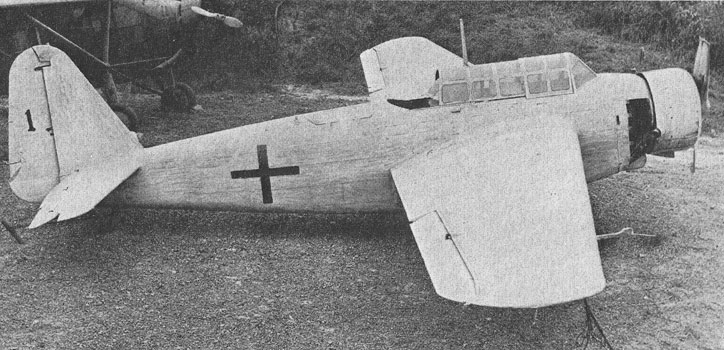
Design was quite conventional and utilitarian in nature. The K11 sported mid-mounted monoplane wings with curved wingtips. The assemblies were set just ahead of amidships. The radial piston engine was fitted to the extreme forward of the fuselage and powered a two-bladed propeller system. The cockpit area was heavily glazed and contained the pilot and gunner trainee seated in tandem. The gunner trainee also doubled as the radio operator. The stout profile of the K11 allowed a lower deck to be installed in the deep fuselage, this area containing room for the bombardier, navigator and the instructor. The lower deck sat beneath the wing assemblies and rectangular windows could be identified along the fuselage sides. The empennage featured a slab-sided appearance and was capped by a traditional tail system featuring a single vertical tail fin and applicable horizontal planes with curved edges. The undercarriage was of the conventional "tail dragger" arrangement made up of two main single-wheeled landing gear legs and a single-wheeled tail leg - all being fully retractable.

Power was supplied from a single Hitachi GK2B Amakaze 21 series 9-cylinder radial piston engine rated at 515 horsepower. Maximum speed was listed at 143 miles per hour at 5,600 feet. Cruising speed was 109 miles per hour. Range was an impressive 1,093 miles while the service ceiling capped off at 18,440 feet.

Armament was strictly practice-minded and included a single 7.7mm Type 92 rear-firing machine gun on a flexible mount for gunnery training and a practice ordnance load of 2 x 66lb bombs. When used in the Kamikaze role, the K11W1 was fitted with a single 550lb bomb for maximum effect.

While the K11W1 was the designation for the base bomber crew trainer, the K11W2 was a limited-production Anti-Submarine Warfare (ASW) variant that doubled as a transport platform. The major difference between the two was in the K11W2's use of all-wood construction as opposed to the costlier K11W1's use of all-metal (though the latter with fabric-covered control surfaces). A third proposed variant existed under the designation of Q3W1 "Nankai" ("South Sea"). This unfulfilled design would have fought as an maritime patrol anti-submarine aircraft however the prototype was lost to a landing accident in January of 1945.

The existence (and importance) of the stout K11W trainer series was little known to the Allies and, as such, no traditional "codename" was assigned to her.
Text ©2003-2013 www.MilitaryFactory.com • All Rights Reserved • No Reproduction Permitted
MilitaryFactory.com does NOT sell equipment/weaponry. Material presented throughout this website is for historical and entertainment value and should not to be construed as usable for hardware restoration, maintenance or general operation. Please consult manufacturers for such information. Our disclaimer. Email corrections / Comments to MilitaryFactory at Gmail dot com.
Picture of Kyushu K11W Shiragiku (White Chrysanthemum)
View All Images (1)

Specifications for the
Kyushu K11W Shiragiku (White Chrysanthemum)
Advanced Bomber Crew Trainer / Transport / Anti-Submarine Warfare


Country of Origin: Imperial Japan
Manufacturer: Watanabe Tekkosho Kabushiki Kaisha - Japan
Initial Year of Service: 1942
Production: 789


Focus Model: Kyushu K11W Shiragiku (White Chrysanthemum)
Crew: 5


Length: 33.60ft (10.24m)
Width: 49.15ft (14.98m)
Height: 12.89ft (3.93m)
Weight (Empty): 3,697lbs (1,677kg)
Weight (MTOW): 6,173lbs (2,800kg)


Powerplant: 1 x Hitachi GK2B Amakaze 21 9-cylinder radial piston engine delivering 515 horsepower.


Maximum Speed: 143mph (230kmh; 124kts)
Maximum Range: 1,094miles (1,760km)
Service Ceiling: 18,438ft (5,620m; 3.5miles)
Rate-of-Climb: 154 feet per minute (47m/min)


Hardpoints: 2
Armament Suite:
STANDARD:
1 x 7.7mm Type 92 rear-firing machine gun on flexible mounting (training).

OPTIONAL:
2 x 66lb bombs (training)

KAMIKAZE:
1 x 551lb bomb


Variants:
K11W - Main Production Model; 789 examples produced; all-metal construction.


K11W2 - Anti-Submarine Warfare (ASW) and Transport Model; limited production; all-wood construction.


Operators: Imperial Japan

ALL AIRCRAFT CATEGORIES

BY DECADE:


1900 to 1909
1910 to 1919
1920 to 1929
1930 to 1939
1940 to 1949
1950 to 1959
1960 to 1969
1970 to 1979
1980 to 1989
1990 to 1999
2000 to 2009
2010 to 2019
2020 to 2029
VIEW ALL
Compare Aircraft


BY TYPE:


Anti-Submarine Warfare (ASW)
Attack Helicopters
Bomber Aircraft
Medium Bombers
Heavy Bombers
Close-Air Support (CAS)
Commercial Aircraft
Dive Bombers
Electronic Warfare Aircraft (EWA)
Experimental / X-Planes
Fighter Aircraft
Floatplane Aircraft
Flying Boat Aircraft
Aerial Refueling Tankers
Helicopters (ALL)
Interceptor Aircraft
Multi-Role Aircraft
Navy Carrier Aircraft
Night Fighters
Reconnaissance / Scout
Search & Rescue (SAR)
Scout Helicopters
Special Purpose
Torpedo Bombers
Trainer Aircraft
Transport Aircraft
Transport Helicopters
Unmanned Aerial Vehicles (UAVs)
Unmanned Combat Air Vehicles (UCAVs)


COLLECTIONS:


4th Generation Fighter Aircraft
5th Generation Fighter Aircraft
US X-Planes
Classic US Warbirds
French Military Helicopters
Grumman "Cats"
Howard Hughes Aircraft
Indian Air Force
Israeli Air Force
Libyan Aircraft
Modern Chinese Aircraft
Modern Chinese Fighters
Modern Military Aircraft
Modern North Korean Aircraft
Modern Trainer Aircraft
Modern US Aircraft
Mikoyan Aircraft
Sukhoi Aircraft
Syrian Aircraft
Top 10 Fighter Aircraft of All Time


AIRCRAFT BY CONFLICT:


Arab-Israeli War (1948)
Cuban Missile Crisis (1959-1962)
Falklands War (1982)
Indo-Pak War (1965, 1971)
Iran-Iraq War (1980-1988)
Lebanon War (1982)
Operation Allied Force (1999)
Operation Desert Storm (1991)
Six Day War (1967)
Spanish Civil War (1936)
Soviet-Afghan War (1979-1989)
Yom Kippur War (1973)


MISCELLANEOUS:


Aircraft Cockpits
Aircraft Manufacturers List
Aircraft Timeline

WORLD WAR 2:


1939 Aircraft
1940 Aircraft
1941 Aircraft
1942 Aircraft
1943 Aircraft
1944 Aircraft
1945 Aircraft
1946 Aircraft
Australian Aircraft
Battle of Britain Aircraft
Bombers
Four-Engine Bombers
British Aircraft
British Bombers
British Transports
Dive Bombers
Canadian Aircraft
Fighters
Chinese Aircraft
French Aircraft
German Aircraft
German Fighters
German Flying Boats
German Jets
Secret Weapons of the Luftwaffe
Italian Aircraft
Imperial Japanese Aircraft
Imperial Japanese Fighters
Mitsubishi Bombers
Navy Aircraft
Pearl Harbor
Polish Aircraft
Romanian Aircraft
US Aircraft
US Bombers
US Navy Aircraft
Soviet Aircraft
Torpedo Bombers
Transport Aircraft
Tuskegee Airmen Aircraft
W.A.S.P. Aircraft
WW2 Aircraft Ranked by Speed
VIEW ALL


WORLD WAR 1:


1914 Aircraft
1915 Aircraft
1916 Aircraft
1917 Aircraft
1918 Aircraft
Aircraft Timeline
Austro-Hungarian Aircraft
Bomber Aircraft
British Aircraft
Fighters
Flying Boats
French Aircraft
Imperial German Aircraft
Italian Aircraft
Scout Aircraft
Russian Empire Aircraft
US Aircraft
WW1 Aircraft Ranked by Speed
VIEW ALL


KOREAN WAR:


Australian Aircraft
Korean War Aces
Korean War Jets
North Korean Aircraft
US Military Aircraft
VIEW ALL


VIETNAM WAR:


Helicopters
North Vietnam Air Force
US Airpower
VIEW ALL


COLD WAR:


1950s French Aircraft
British V-Bombers
Cold War Bombers
Soviet Aircraft
Soviet Bombers
Soviet Interceptors
Soviet Helicopters
Strategic Air Command
US Aircraft
US Bombers
US Interceptors
VIEW ALL

Site Disclaimer | Privacy Policy | Site Map | MF Origins


©2013 www.MilitaryFactory.com • Content ©2003-2013 MilitaryFactory.com • All Rights Reserved • Site Contact Email: militaryfactory at gmail dot com. The "Military Factory" name and MilitaryFactory.com logo are registered ® trademarks and protected by all applicable domestic and international intellectual property laws.


Top MF Stuff: 2013 Military Pay Scale | Military Ranks | WW2 Weapons | Sniper Rifles | Kts to Mph | WW1 Aircraft | Automatic Rifles | Aircraft Cockpits | Vietnam War Weapons | Main Battle Tanks | Submachine Guns | Shotguns | French Military Victories


Most photographic images appearing on this site are courtesy of the United States Department of Defense and are approved for public use. Other images acquired through the public domain. Digital art work courtesy of Dan Alex. Business Consulting by Kyle Williams. Material presented throughout this website is for historical and entertainment value and should not to be construed as usable for hardware restoration, maintenance or general operation. Please consult manufacturers for such information.


eXTReMe Tracker