Military Factory
Military Pay Chart
Global Firepower
Military Industrial Complex
Second World War
Home
Military Pay Scale
Military Ranks
Small Arms
Aircraft
Land Systems
Navy
Education
Military Factory Facebook Logo
flag of United States

Curtiss SBC Helldiver Dive Bomber / Fighter (1938)

Authored By Staff Writer | Last Updated: 10/26/2010

The Curtiss SBC Helldiver became the US Navy's last acquired biplane when it was introduced in 1938.

Find a School Near You
Follow Military Factory on Facebook:
Trending on Military Factory:
Recent Articles:
In 1932, the United States Navy contracted the Curtiss-Wright Corporation to produce a modern, two-seat fighter design for use on its growing family of aircraft carriers. Curtiss responded by putting forth their Model 73 - a two-seat monoplane design featuring a single set of parasol wings fitted high atop the fuselage. The US Navy designated the prototype as XF12C-1. The Model 73 was powered by a single Wright R-1510-92 Whirlwind 14 series radial piston engine and sported a modern retractable undercarriage. The Curtiss product achieved first flight in 1933 though, by the end of the year, the US Navy had revamped their requirement and categorized the XF12C-1 prototype as the "XS4C-1 scout plane". Once again, this time in early 1934, the US Navy reorganized their needs and labeled the XS4C-1 as a the "XSBC-1 dual-role scout-bomber". Curtiss fitted a Wright R-1820 Cyclone series radial piston engine to the design and testing of the prototype ensued.

Among the evaluations was a dive bombing test in September of 1934 that resulted in a failure of the parasol monoplane wing assembly. Though the pilot and machine were wholly spared, the prototype was nonetheless heavily damaged. Testing had shown that the parasol wing assembly was generally unfit for the stresses of what the new aircraft would be called upon to achieve. As a result, the US Navy ordered a new prototype to fall in line with stricter requirements. Curtiss once again delivered an answer, this time the Model 77, to which the US Navy affixed the designation of XSBC-2. The reimagined airframe was now given a biplane wing arrangement and a new engine in the Wright R-1510-12 Whirlwind 14 series radial. First flight of the XSBC-2 was recorded on December 9th, 1935. In March of 1936, a Pratt & Whitney R-1535-82 Twin Wasp Junior radial piston engine was fitted to the airframe, resulting in the revised company designation of "Model 77A" and the revised US Navy designation of "XSBC-3".

The United States Navy, content with the latest Curtiss-Wright offering, contracted the company to deliver some 83 SBC-3 "Helldiver" production-quality aircraft - the deal signed on August 29th, 1936. Initial deliveries occurred on July 17th, 1937 to Squadron VS-5 of the carrier USS Yorktown. By all reports, the SBC proved a rather pleasant airframe to control, however, the constantly changing world of technology in the late 1930s solidified the SBC as an out-of-date design, forcing the fighter to undertake second-line duties in the training of upcoming airmen out of Florida. When the Japanese Empire unleashed their surprise attack on the US Naval base at Pearl Harbor, Hawaii, on December 7th, 1941 - thusly thrusting America into full-fledged world war - the SBC was more or less accepted as an obsolete design. Regardless, the biplane dive-bomber soldiered on for a time longer with both US Navy and Marine Corps branches aboard such active carriers as the USS Hornet. The SBC Helldiver would lead a short active life with the US Navy and officially meet her end by October of 1944, being replaced by much-improved and modern types. To ensure something of a legacy, the SBC Helldiver was in fact the last biplane aircraft to be purchased by the United States Navy.

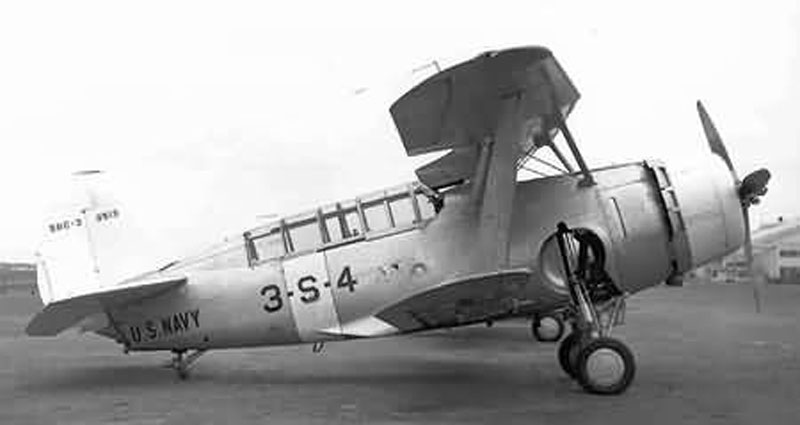
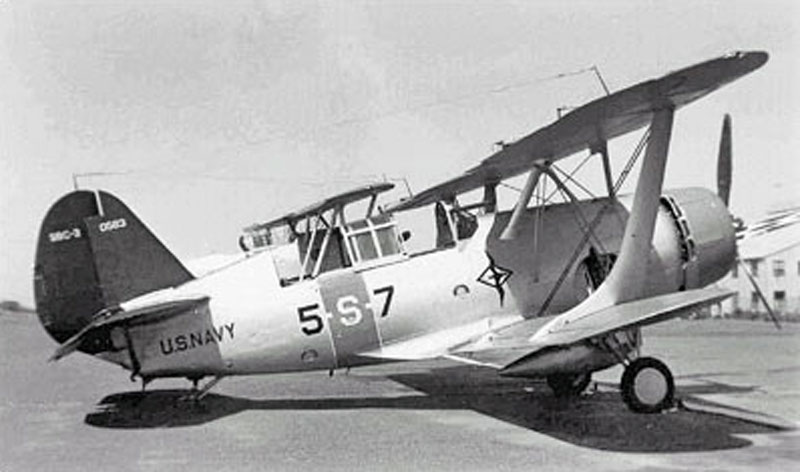
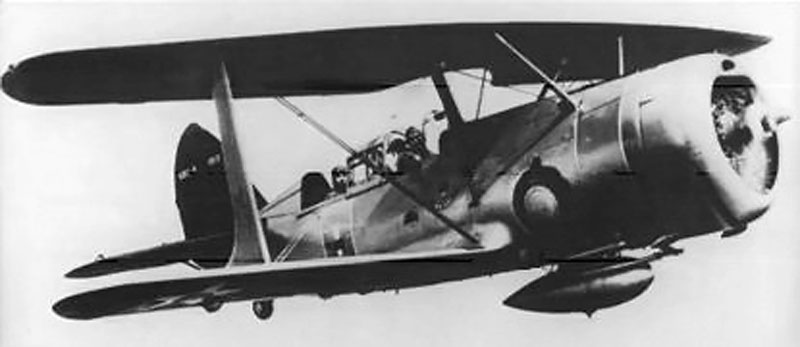
Design of the SBC Helldiver was a relative mix of two eras of aviation. On the one hand, the design was characterized by its staggered, uneven span biplane wing arrangement with thick outboard struts, cabling and skeletal inboard struts holding the wings in place. On the other hand, the fuselage was encased with metalwork and a streamlined shape, contouring finely to a tapered end to which a rounded vertical tail fin was affixed. The undercarriage, while retractable, still sported its visible wheels tucked in alongside each forward fuselage side. The engine was held well forward in the design and was of a radial piston type requiring air cooling and powered a three-bladed propeller system. The crew of two sat in tandem under a long-running glazed canopy with heavy framing with generally poor forward views of the oncoming action. The cockpit was set at amidships, aft of the both wing assemblies. Like other aircraft of this time period, the SBC took on a noticeable "nose-up" appearance when at rest, being fitted with a "tail-dragging" undercarriage arrangement featuring a small tailwheel at the empennage base. Being powered by the radial engine, the SBC Helldiver could afford top speeds of 234 miles per hour with a base 175 mile per hour cruise speed. Service ceiling was limited to 24,000 feet while range was out to 405 miles. Armament was rather modest and included a pair of 0.30 caliber machine guns (one forward fixed for the pilot and the other on a trainable mount in the rear cockpit) with an optional 1,000lb bombload along the fuselage centerline.

Curtiss worked on improving the base SBC-3 series design and set one airframe aside for such work. The resulting tests yielded the new Model 77B to which the US Navy appended the designation of SBC-4 to. To go along with several improvements was a more powerful Wright R-1820 Cyclone 9 series radial piston engine of 850 horsepower. The US Navy signed a production contract for 174 examples of this mount on January 5th, 1938 with the first deliveries beginning in March of1939 followed by formal service entry. By this time, Europe was completely engulfed in a war that would soon spread beyond its borders.

Germany's blitzkrieg had taken all of Europe by surprise. Hitler's combined attacks utilizing coordinated strikes from land and air elements yielded tremendous results in the first phases of action. After much of Europe had fallen to the Germans, France was next in its sights. As such, France desperately attempted to counter the German advance by quickly improving their military inventory to help stave off mounting losses, even contracting American aircraft firms for whatever they could make available. In early 1940, the United States Navy rerouted some 50 of its actively serving SBC-4 Helldiver aircraft to the French Navy with a total of 90 on order to France in whole. Aircraft were repainted via French standards and the 0.30 caliber armament was upgraded to a more potent pairing of 2 x 0.50 caliber. All American instruments were replaced by French-labeled ones and Curtiss employees would be involved in delivering the aircraft to the French carrier Bearn by way of Nova Scotia. The Bearn eventually accepted the aircraft and made her way across the Atlantic back to France.

Like other military equipment earmarked for use by France from the United States, this delivery would arrive too late to be of much use in combat and the nation of France eventually capitulated after Paris fell to Hitler, leaving Britain essentially alone to "fight the good fight". The Bearn moved south to the Caribbean island of Martinique where the remaining forty-nine SBC-4s fell victim to the corrosive effects of the tropical environment, destined never to fight. At least five SBC-4s were accepted into the inventory of the Royal Air Force under the designation of Curtiss "Cleveland" Mk.I and generally used to train ground personnel out of Little Rissington, UK. While the SBC-4 failed to make much of an impact in the European war, the US Navy stood firm on their production and secured a revised SBC-4 model with the all-important addition of self-sealing fuel tanks.
Text ©2003-2013 www.MilitaryFactory.com • All Rights Reserved • No Reproduction Permitted
MilitaryFactory.com does NOT sell equipment/weaponry. Material presented throughout this website is for historical and entertainment value and should not to be construed as usable for hardware restoration, maintenance or general operation. Please consult manufacturers for such information. Our disclaimer. Email corrections / Comments to MilitaryFactory at Gmail dot com.
Picture of Curtiss SBC Helldiver
Pic of the Curtiss SBC Helldiver
Image of the Curtiss SBC Helldiver
View All Images (3)

Specifications for the
Curtiss SBC Helldiver
Dive Bomber / Fighter


Country of Origin: United States
Manufacturer: Curtiss-Wright Corporation - USA
Initial Year of Service: 1938
Production: 257


Focus Model: Curtiss SBC-4 Helldiver
Crew: 2


Length: 28.35ft (8.64m)
Width: 33.99ft (10.36m)
Height: 12.60ft (3.84m)
Weight (Empty): 4,841lbs (2,196kg)
Weight (MTOW): 7,632lbs (3,462kg)


Powerplant: 1 x Wright R-1820-34 Cyclone radial piston engine developing 950 horsepower.


Maximum Speed: 237mph (381kmh; 206kts)
Maximum Range: 590miles (950km)
Service Ceiling: 27,297ft (8,320m; 5.2miles)
Rate-of-Climb: 1,630 feet per minute (497m/min)


Hardpoints: 1
Armament Suite:
STANDARD:
1 x 7.62mm forward-fixed M1919 Browning machine gun.
1 x 7.62mm trainable machine gun in rear cockpit.

FRENCH EXPORT VERSION:
1 x 12.7mm forward-fixed heavy machine gun
1 x 12.7mm trainable heavy machine gun in rear cockpit.

OPTIONAL:
1 x 1,000lb bomb


Variants:
XF12C-1 - Prototype Model Designation; fitted with R-1510-92 radial piston engine of 625 horsepower; parasol wings; single example produced.


XS4C-1 - Redesignation; fitted R-1820-80 radial piston engine; biplane wings.

XSBC-1 - Redesignation of XS4C-1

XSBC-2 - Revised XSBC-1; fitted with XR-1510-12 radial piston engine of 700 horsepower; single example produced.

XSBC-3 - Single modified XSBC-2 fitted with R-1535-82 radial piston engine of 750 horsepower.

SBC-3 - Fitted with R-1534-94 radial piston engine of 825 horsepower; 83 examples produced.

XSBC-4 - Single modified SBC-3 production model fitted with R-1820-22 radial piston engine of 950 horsepower.

SBC-4 - Fitted with R-1820-34 radial piston engine of 950 horsepower; 173 examples produced; 50 shipped to French Navy.

Cleveland I - British Designation of SBC-4 production models; 5 examples acquired.


Operators: France; United Kingdom; United States

ALL AIRCRAFT CATEGORIES

BY DECADE:


1900 to 1909
1910 to 1919
1920 to 1929
1930 to 1939
1940 to 1949
1950 to 1959
1960 to 1969
1970 to 1979
1980 to 1989
1990 to 1999
2000 to 2009
2010 to 2019
2020 to 2029
VIEW ALL
Compare Aircraft


BY TYPE:


Anti-Submarine Warfare (ASW)
Attack Helicopters
Bomber Aircraft
Medium Bombers
Heavy Bombers
Close-Air Support (CAS)
Commercial Aircraft
Dive Bombers
Electronic Warfare Aircraft (EWA)
Experimental / X-Planes
Fighter Aircraft
Floatplane Aircraft
Flying Boat Aircraft
Aerial Refueling Tankers
Helicopters (ALL)
Interceptor Aircraft
Multi-Role Aircraft
Navy Carrier Aircraft
Night Fighters
Reconnaissance / Scout
Search & Rescue (SAR)
Scout Helicopters
Special Purpose
Torpedo Bombers
Trainer Aircraft
Transport Aircraft
Transport Helicopters
Unmanned Aerial Vehicles (UAVs)
Unmanned Combat Air Vehicles (UCAVs)


COLLECTIONS:


4th Generation Fighter Aircraft
5th Generation Fighter Aircraft
US X-Planes
Classic US Warbirds
French Military Helicopters
Grumman "Cats"
Howard Hughes Aircraft
Indian Air Force
Israeli Air Force
Libyan Aircraft
Modern Chinese Aircraft
Modern Chinese Fighters
Modern Military Aircraft
Modern North Korean Aircraft
Modern Trainer Aircraft
Modern US Aircraft
Mikoyan Aircraft
Sukhoi Aircraft
Syrian Aircraft
Top 10 Fighter Aircraft of All Time


AIRCRAFT BY CONFLICT:


Arab-Israeli War (1948)
Cuban Missile Crisis (1959-1962)
Falklands War (1982)
Indo-Pak War (1965, 1971)
Iran-Iraq War (1980-1988)
Lebanon War (1982)
Operation Allied Force (1999)
Operation Desert Storm (1991)
Six Day War (1967)
Spanish Civil War (1936)
Soviet-Afghan War (1979-1989)
Yom Kippur War (1973)


MISCELLANEOUS:


Aircraft Cockpits
Aircraft Manufacturers List
Aircraft Timeline

WORLD WAR 2:


1939 Aircraft
1940 Aircraft
1941 Aircraft
1942 Aircraft
1943 Aircraft
1944 Aircraft
1945 Aircraft
1946 Aircraft
Australian Aircraft
Battle of Britain Aircraft
Bombers
Four-Engine Bombers
British Aircraft
British Bombers
British Transports
Dive Bombers
Canadian Aircraft
Fighters
Chinese Aircraft
French Aircraft
German Aircraft
German Fighters
German Flying Boats
German Jets
Secret Weapons of the Luftwaffe
Italian Aircraft
Imperial Japanese Aircraft
Imperial Japanese Fighters
Mitsubishi Bombers
Navy Aircraft
Pearl Harbor
Polish Aircraft
Romanian Aircraft
US Aircraft
US Bombers
US Navy Aircraft
Soviet Aircraft
Torpedo Bombers
Trainer Aircraft
Transport Aircraft
Tuskegee Airmen Aircraft
W.A.S.P. Aircraft
WW2 Aircraft Ranked by Speed
VIEW ALL


WORLD WAR 1:


1914 Aircraft
1915 Aircraft
1916 Aircraft
1917 Aircraft
1918 Aircraft
Aircraft Timeline
Austro-Hungarian Aircraft
Bomber Aircraft
British Aircraft
Fighters
Flying Boats
French Aircraft
Imperial German Aircraft
Italian Aircraft
Scout Aircraft
Russian Empire Aircraft
US Aircraft
WW1 Aircraft Ranked by Speed
VIEW ALL


KOREAN WAR:


Australian Aircraft
Korean War Aces
Korean War Jets
North Korean Aircraft
US Military Aircraft
VIEW ALL


VIETNAM WAR:


Helicopters
North Vietnam Air Force
US Airpower
VIEW ALL


COLD WAR:


1950s French Aircraft
British V-Bombers
Cold War Bombers
Soviet Aircraft
Soviet Bombers
Soviet Interceptors
Soviet Helicopters
Strategic Air Command
US Aircraft
US Bombers
US Interceptors
VIEW ALL

Site Disclaimer | Privacy Policy | Site Map | MF Origins


©2013 www.MilitaryFactory.com • Content ©2003-2013 MilitaryFactory.com • All Rights Reserved • Site Contact Email: militaryfactory at gmail dot com. The "Military Factory" name and MilitaryFactory.com logo are registered ® trademarks and protected by all applicable domestic and international intellectual property laws.


Top MF Stuff: 2013 Military Pay Scale | Military Ranks | WW2 Weapons | Sniper Rifles | Kts to Mph | WW1 Aircraft | Automatic Rifles | Aircraft Cockpits | Vietnam War Weapons | Main Battle Tanks | Submachine Guns | Shotguns | French Military Victories


Most photographic images appearing on this site are courtesy of the United States Department of Defense and are approved for public use. Other images acquired through the public domain. Digital art work courtesy of Dan Alex. Business Consulting by Kyle Williams. Material presented throughout this website is for historical and entertainment value and should not to be construed as usable for hardware restoration, maintenance or general operation. Please consult manufacturers for such information.


eXTReMe Tracker