Military Factory
Military Pay Chart
Global Firepower
Military Industrial Complex
Second World War
Home
Military Pay Scale
Military Ranks
Small Arms
Aircraft
Land Systems
Navy
Education
Military Factory Facebook Logo
flag of Russia

Sukhoi Su-34 (Fullback) Fighter-Bomber / Strike Fighter (2012)

Authored By Dan Alex | Last Updated: 1/21/2013

The Sukhoi Su-34 Fullback is a two-seat, dedicated fighter-bomber version of the successful Su-27 Flanker fighter series.

Find a School Near You
Follow Military Factory on Facebook:
Trending on Military Factory:
Recent Articles:
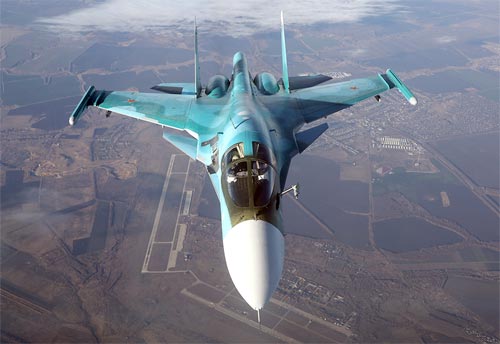
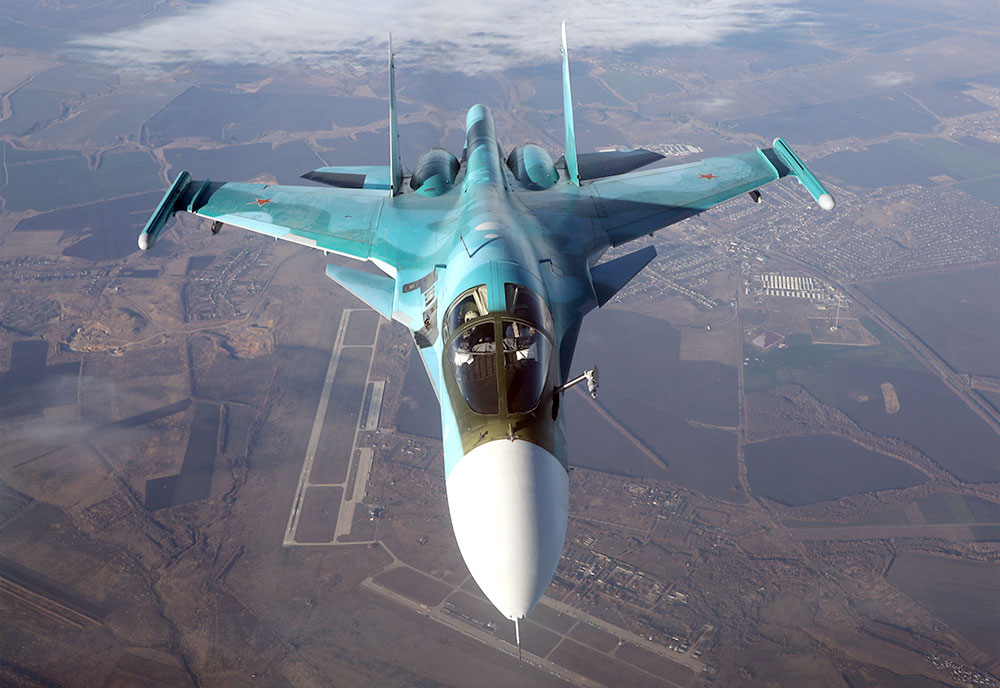
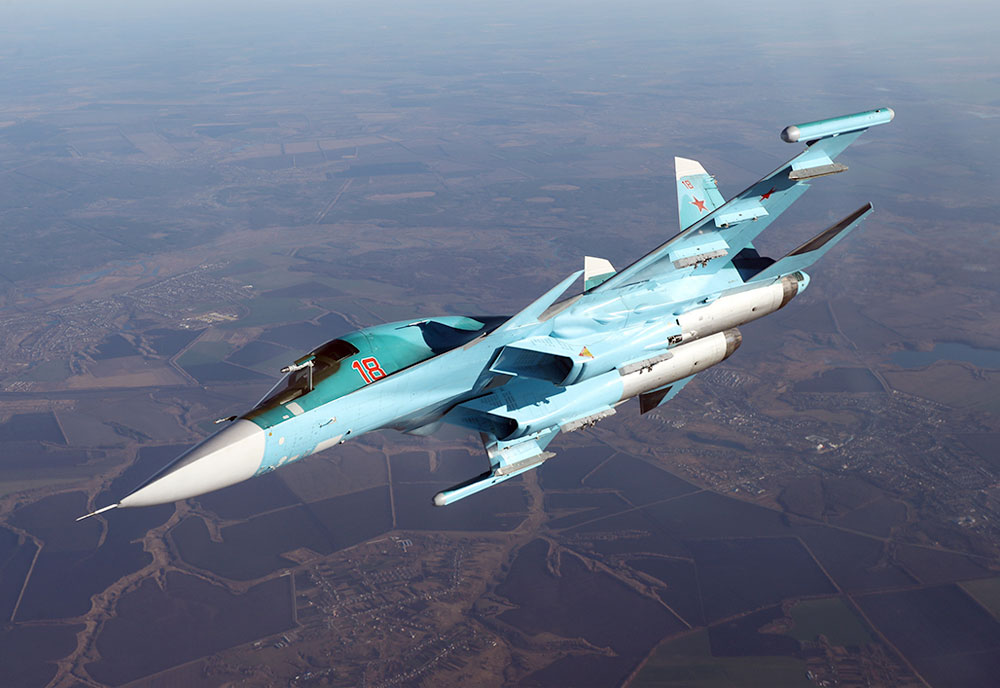
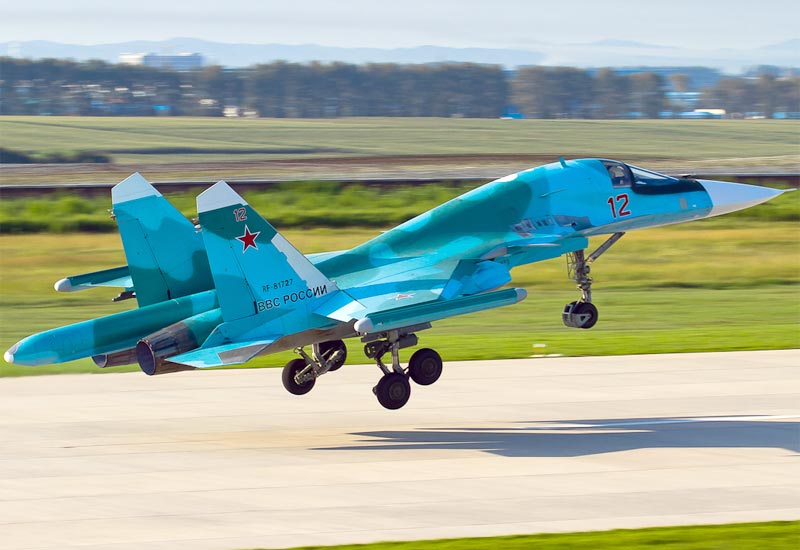
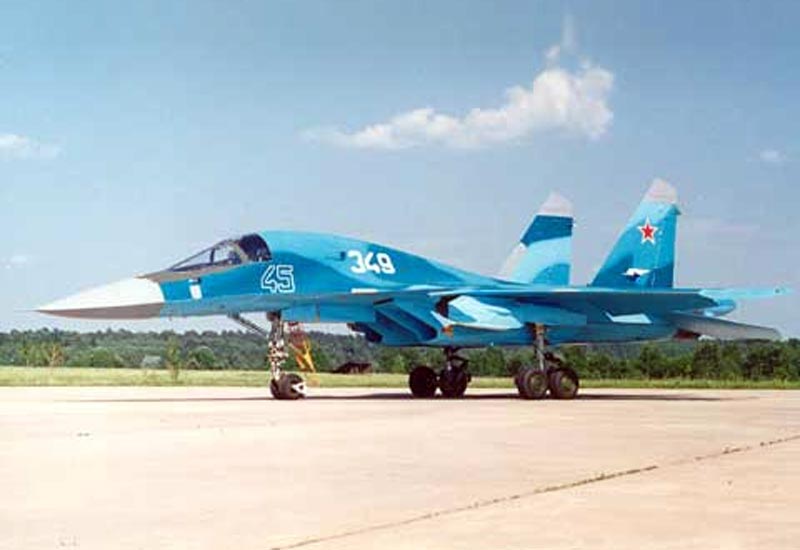
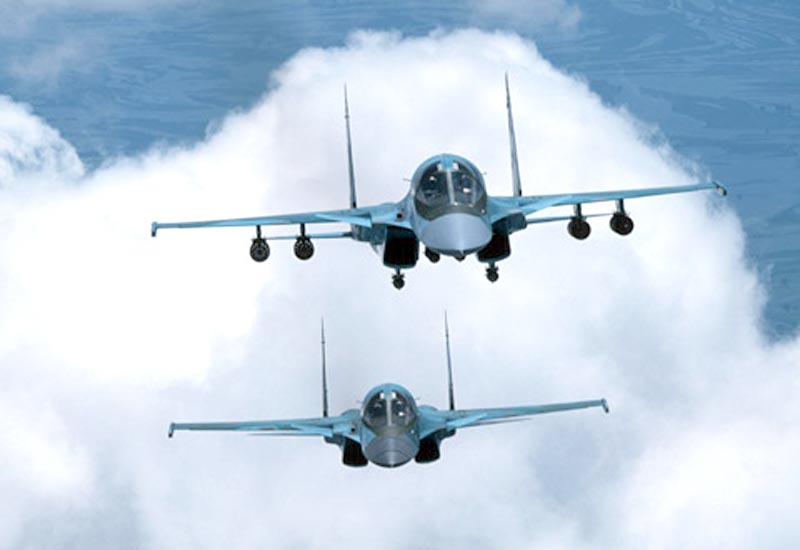
The Sukhoi Su-34 (NATO reporting name of "Fullback") is a dedicated Fourth Generation two-seat fighter-bomber/strike fighter platform based on the successful Su-27 "Flanker" air superiority fighter series for the Russian Air Force. The Flanker family of aircraft was born out of the Sukhoi Design Bureau in the 1970s and entered service in December of 1984, having since spawned into a handful of capable combat-minded roles including the Su-33 ("Flanker-D") navalized multi-role variant and the Su-35 long-range, air superiority/strike series ("Flanker-E"). While being largely based on the preceding Su-27 design (exported worldwide as the "Su-30") and incorporating some of its key qualities, the Su-34 is regarded as an all-new, independent aircraft design as it is heavily modified and intended for the strike role as primary with air superiority being a secondary quality of the design.

The Su-34 began life under the Sukhoi "T-10V" product designation, an initiative brought about by a 1980s Soviet Air Force requirement for a new, long endurance, high-speed tactical bomber intended to supersede the outgoing Sukhoi Su-24 "Fencer" series in the same role. The Sukhoi concern looked to its new Su-27 airframe as a possible starting point, the aircraft now beginning to take hold in useful numbers across the Soviet air inventory. The airframe was a excellent commodity and flexible enough to modify for the requirement, as proven through the promising - though ultimately abandoned - twin-seat T-10KM-2 navalized training aircraft once intended for the Soviet Navy. Sukhoi engineers felt comfortable with retaining much of the Su-27 arrangement with only a new forward fuselage added to the mix. As the Su-27 family of aircraft relied on a single-seat configuration, the fuselage was allowed a nice cylindrical design shape. However, for the new fighter-bomber endeavor, this would be modified through a new approach in which two pilots - seated side-by-side - would be added to a widened cockpit. To this, engineers then installed forward wing canards ahead of the main wing elements intended to improved stability and increase maneuverability. The Su-27's Lyulka series turbofan engines were uprated for greater power in the new Sukhoi initiative. The ultimate goal for the program was to develop a competent strike platform while retaining the excellent fighter qualities (handling and performance) of the Su-27 family. The Sukhoi program ultimately yielded the first T-10V-1 prototype form (born from an existing Su-27UB) which went airborne for the first time on April 13th, 1990. The T-10V designator was then dropped in favor of "Su-27IB" to indicate the type's new fighter-bomber role ("Istrebeetel'-bombardirovschchik"). The Su-27IB was first formally unveiled in 1992 and a second prototype followed, taking to the air on December 18th, 1993. By this time, the series was assigned the officially Russian Air Force designation of "Su-34" and further codenamed "Fullback" by NATO.

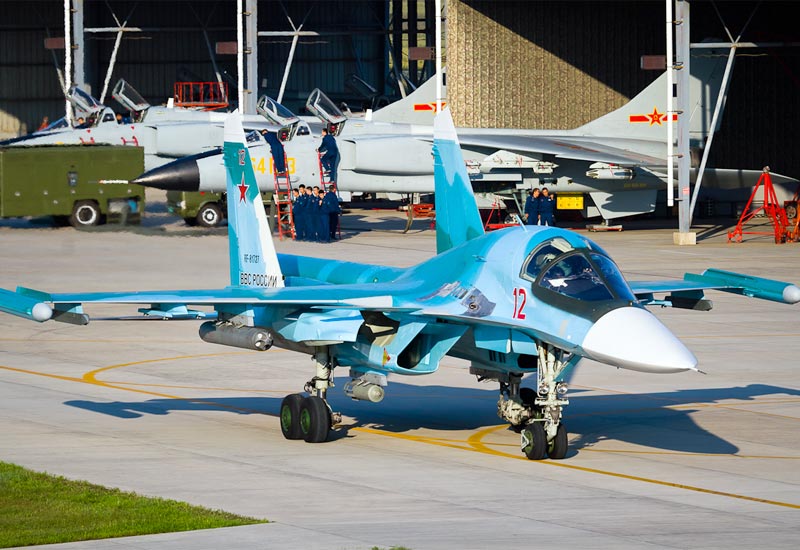
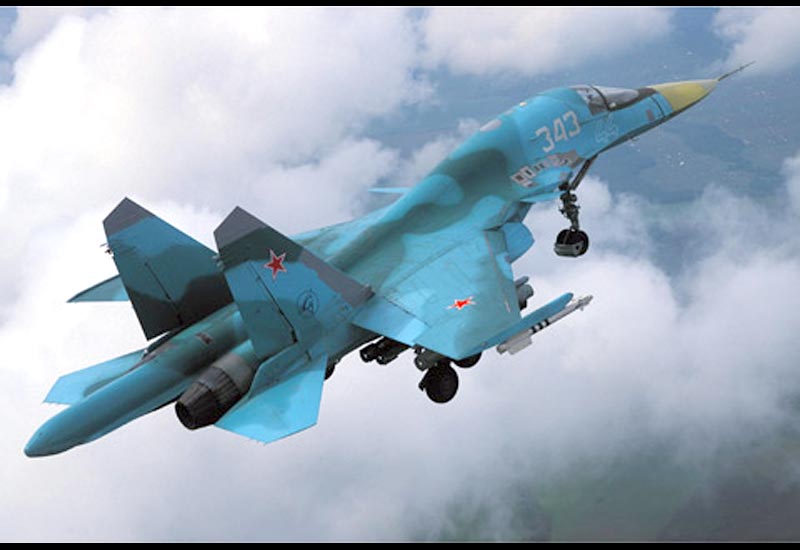
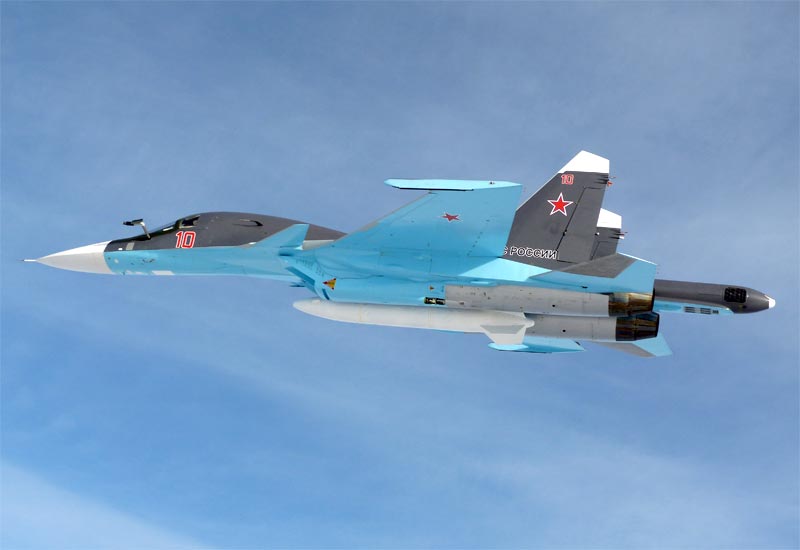
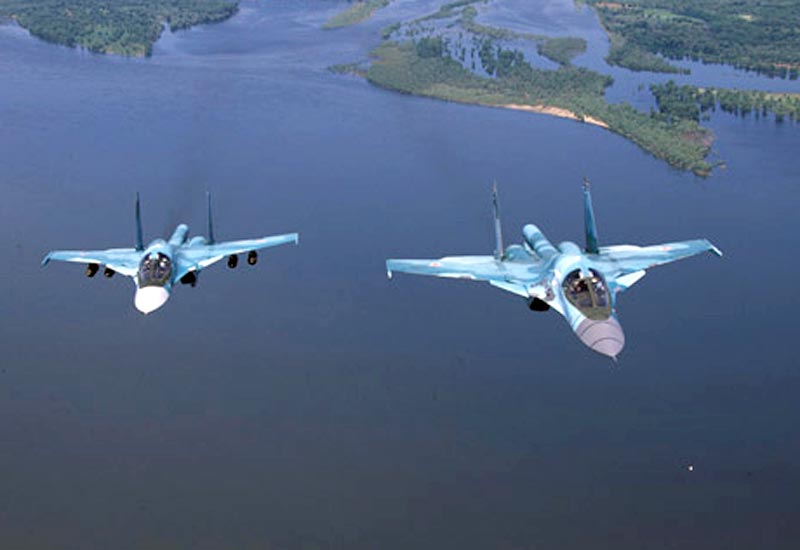
The most obvious design departure of the Su-34 when compared to the Su-27 was its larger cockpit cabin and forward fuselage assembly. The cockpit was deliberately designed as a large, comfortable operating space for the two crew and applicable systems. The area aft of the cockpit would feature a full in-flight galley and lavatory to help offset the fatigue and physical stresses undertaken by the crew over long sorties - the crew can stand or lay down as needed. The crew was made up of a primary pilot and his weapons operator, seated in a side-by-side arrangement (as in the American General Dynamics F-111 Aardvark fighter-bomber). The use of two crew allowed the mission workload to be spread about, lessening crew fatigue (and inherent mistakes) while a consistently pressurized cockpit allowed for a working environment not requiring cumbersome oxygen masks to be worn. The resulting Sukhoi aircraft retained the wings, tail unit, fixed intake engine nacelles and aft-fuselage of the original Su-27, incorporating the new forward fuselage and a modified rear "stinger" housing a rear-facing/scanning radar array. The Su-34 makes use of the prominent rearward-looking radar system housed in a "stinger" at the rear of the fuselage to counter any approaching enemy threats in pursuit of the aircraft. The undercarriage consists of two main landing gear legs and a nose leg, the former outfitted with a pair of inline wheels to offset the added weight of the new design while the latter makes use of a dual-wheel, side-by-side arrangement. These were different from the simpler configuration of the Su-27.

The Su-34's cockpit is a modern, all-glass effort dominated by CRT displays and sporting the latest in Russian avionics technology as well as digital processing systems. Views from within the cockpit are relatively good thanks to the large clear canopy with only a forward frame splitting the frontal view - though the raised fuselage spine (required for larger internal volume) defeats any rearward visibility for the crew. The cockpit's noticeable duck-bill type design approach features a pronounced "nose-down" appearance which aids the crew in taxiing actions and landing of the aircraft. Onboard systems propel the Su-34 (and the Russian Air Force for that matter) into the modern age and feature real-time digital battlefield management systems, advanced targeting and tracking options and a vastly improved navigation suite over previous Russian attempts. Onboard automation extends the overall value of the aircraft by allowing the crew to concentrate on other facets of the mission at hand - engine status, crew health and scanning/incoming threats can all be handled by the aircraft - autopilot is truly autonomous requiring only directional input, the aircraft capable of guiding itself to a point. The crew (as well as engine intakes and internal fuselage fuel cells) are armored for protection against enemy ground fire when in the low-level attack role. Each operator is also afforded the typical Russian helmet-mounted sight and ejection seating. HUD (Head-Up Display) is present and stealth features have been subtly incorporated throughout the airframe (including use of a radar-absorbing skin coat) - though the Su-34 remains a largely conventional Fourth Generation aircraft design and not a true stealth design (as in the now-retired F-117 Nighthawk).

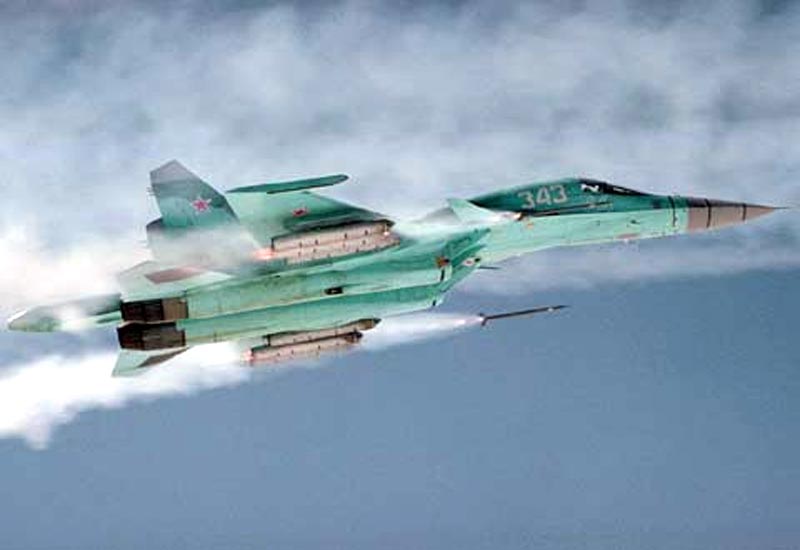
Externally, the Su-34 sports the same wing design as the Su-2 before it. These are shoulder-mounted to provide acceptable ground clearance for a bevy of munitions options. A standard fitting is the 30mm GSh-30-1 series internal cannon with up to 180 rounds of ammunition and intended for extreme close-in work. There are no fewer than 12 external munitions hardpoints to which the Su-34 can field various guided missiles and bombs, rocket pods, air-to-air missiles and specialized mission equipment as required per sortie. The Su-34 can, therefore, be called to fulfill a variety of peacetime and wartime roles including patrol, interdiction, interception, strike (including over-water maritime sorties), early warning and reconnaissance. While not a "true" dedicated fighter thoroughbred at its core, the Su-34 retains the key fighter qualities of the Flanker series to which, when the aircraft is armed with air-to-air ordnance, it can contend with incoming aerial threats such as enemy bombers and contending fighters. In keeping with its Cold War roots, the Su-34 is also a capable nuclear payload delivery system. The airframe is cleared to carry up to 17,600lbs of externally-held ordnance in various load out combinations. External jettisonable fuel tanks can also factor into the mix for extended operational ranges. At least two weapon stations are plumbed for fuel tanks.

The Su-34 is fitted with 2 x Lyulka AL-31FM1 series turbofan engines, each rated at approximately 30,000lbs of thrust and are afterburner-capable for short bursts of increased speed (these engines appear in a slightly different form on the Su-27). The twin engine arrangement allows for a maximum speed of Mach 1.8 (1,375 miles per hour) at altitude to be reached. Ferry range is out to 2,500 miles and the aircraft's listed service ceiling is roughly 50,000 feet. This provides the Russian Air Force with a long-endurance, high-altitude performer that is equally at home in the low-altitude attack level role or operating at higher altitudes when threats require it. Fuel is served through large internal cells while external fittings are supported across two hardpoints. Additionally, the Su-34 features an integrated in-flight refueling facility for near-infinite mission ranges - though a typical "long sortie" would be in the 10-hour range. Despite the new aircraft's increased weight over that of the basic Su-27, the Su-34 features performance specifications roughly equivalent to the original Flanker design.

The original Su-27IB prototype was unveiled several times over the course of a decade and appeared under various guises and project designations. The program was moved along as funding allowed though the collapse of the Soviet Empire in 1991 threatened its future existence as a viable military product - this explains the type's first flight in 1990 and its service introduction in 2012. As funding became available, so too did progression on the Su-34 project. Today (2013), some 32 aircraft have been completed - five based at Lipetsk AB and twenty at Voronezh Malshevo while the remaining seven being identified as project prototypes.

For the Russian Air Force, the Su-34 "Fullback" is intended as a direct successor to the hundreds of Cold War-era Sukhoi Su-24 "Fencer" aircraft still in operational service. Modernization programs have fortunately kept this old aircraft viable in the new century though its Cold War origination cannot be overlooked. The Su-24 will be kept on station until the Su-34 is fully ready and available in the required numbers. It is estimated that the Russian Air Force will look to procure some 200 Su-34s through an initial production run. The Su-34 may already have seen early operational combat service in the 2008 South Ossetia War where it is thought they were armed with anti-radar systems intended to suppress the Georgian anti-aircraft defensive network.

The Su-34 remains a major part of the Russian rearmament initiative currently (2013) ongoing as of this writing. The Russian military intends to regain the prominence it once held during the peak of the Cold War years. The massive military commitment - in the billions of dollars - will see all-new air force, naval and army assets added to the modernization effort under President Putin's watch.
Text ©2003-2013 www.MilitaryFactory.com • All Rights Reserved • No Reproduction Permitted
MilitaryFactory.com does NOT sell equipment/weaponry. Material presented throughout this website is for historical and entertainment value and should not to be construed as usable for hardware restoration, maintenance or general operation. Please consult manufacturers for such information. Our disclaimer. Email corrections / Comments to MilitaryFactory at Gmail dot com.
Picture of Sukhoi Su-34 (Fullback)
View All Images (1)

Specifications for the
Sukhoi Su-34 (Fullback)
Fighter-Bomber / Strike Fighter


Country of Origin: Russia
Manufacturer: Sukhoi Design Bureau - Russia
Initial Year of Service: 2012
Production: 32


Focus Model: Sukhoi Su-34 (Fullback)
Crew: 2


Length: 76.57ft (23.34m)
Width: 48.23ft (14.70m)
Height: 19.98ft (6.09m)
Weight (Empty): 0lbs (0kg)
Weight (MTOW): 99,428lbs (45,100kg)


Powerplant: 2 x Lyulka AL-31FM1 turbofan engines with afterburner delivering 30,000lbs thrust each.


Maximum Speed: 1,181mph (1,900kmh; 1,026kts)
Maximum Range: 2,485miles (4,000km)
Service Ceiling: 49,213ft (15,000m; 9.3miles)
Rate-of-Climb: 0 feet per minute (0m/min)


Hardpoints: 12
Armament Suite:
STANDARD:
1 x 30mm GSh-30-1 internal cannon

OPTIONAL:
2 x R-73 (AA-11) "Archer" air-to-air missiles on wingtip launch rails

Up to 17,630lbs of external ordnance on 12 underwing and fuselage hardpoints. Weaponry includes:

Kh-25MT/ML air-to-ground missiles
Kh-25MP air-to-ground missiles
Kh-29L/T air-to-ground anti-radiation missiles
Kh-31P air-to-ground anti-radiation missiles
Kh-35 "Uran" air-to-surface anti-ship missiles
Kh-36 air-to-ground missiles
Kh-38 air-to-ground missiles
Kh-41 "Moskit" air-to-surface anti-ship missiles
Kh-58 air-to-ground missiles
Kh-59 "Ovod" air-to-ground long-range tactical cruise missiles
Kh-65S air-to-ground missiles
Kh-SD air-to-ground missiles
KAB-500L/KR guided bombs
KAB-1500L guided bombs
Conventional drop Bombs
B-8 rocket pods (20 x 80mm S-8 rockets)
B-13 rocket pods (5 x 122mm S-13 rockets)
O-25 rocket pods (1 x 340mm S-25 rocket)
Reconnaissance Pod
Early Warning Pod
Jettisonable External Fuel Tanks


Variants:
T-10V - Original Prototype Designation


T-10V-1 - Initial Prototype Designation

Su-27IB - Project Redesignation

Su-34 ("Fullback") - Official Russian Air Force designation.


Operators: Russia

ALL AIRCRAFT CATEGORIES

BY DECADE:


1900 to 1909
1910 to 1919
1920 to 1929
1930 to 1939
1940 to 1949
1950 to 1959
1960 to 1969
1970 to 1979
1980 to 1989
1990 to 1999
2000 to 2009
2010 to 2019
2020 to 2029
VIEW ALL
Compare Aircraft


BY TYPE:


Anti-Submarine Warfare (ASW)
Attack Helicopters
Bomber Aircraft
Medium Bombers
Heavy Bombers
Close-Air Support (CAS)
Commercial Aircraft
Dive Bombers
Electronic Warfare Aircraft (EWA)
Experimental / X-Planes
Fighter Aircraft
Floatplane Aircraft
Flying Boat Aircraft
Aerial Refueling Tankers
Helicopters (ALL)
Interceptor Aircraft
Multi-Role Aircraft
Navy Carrier Aircraft
Night Fighters
Reconnaissance / Scout
Search & Rescue (SAR)
Scout Helicopters
Special Purpose
Torpedo Bombers
Trainer Aircraft
Transport Aircraft
Transport Helicopters
Unmanned Aerial Vehicles (UAVs)
Unmanned Combat Air Vehicles (UCAVs)


COLLECTIONS:


4th Generation Fighter Aircraft
5th Generation Fighter Aircraft
US X-Planes
Classic US Warbirds
French Military Helicopters
Grumman "Cats"
Howard Hughes Aircraft
Indian Air Force
Israeli Air Force
Libyan Aircraft
Modern Chinese Aircraft
Modern Chinese Fighters
Modern Military Aircraft
Modern North Korean Aircraft
Modern Trainer Aircraft
Modern US Aircraft
Mikoyan Aircraft
Sukhoi Aircraft
Syrian Aircraft
Top 10 Fighter Aircraft of All Time


AIRCRAFT BY CONFLICT:


Arab-Israeli War (1948)
Cuban Missile Crisis (1959-1962)
Falklands War (1982)
Indo-Pak War (1965, 1971)
Iran-Iraq War (1980-1988)
Lebanon War (1982)
Operation Allied Force (1999)
Operation Desert Storm (1991)
Six Day War (1967)
Spanish Civil War (1936)
Soviet-Afghan War (1979-1989)
Yom Kippur War (1973)


MISCELLANEOUS:


Aircraft Cockpits
Aircraft Manufacturers List
Aircraft Timeline

WORLD WAR 2:


1939 Aircraft
1940 Aircraft
1941 Aircraft
1942 Aircraft
1943 Aircraft
1944 Aircraft
1945 Aircraft
1946 Aircraft
Australian Aircraft
Battle of Britain Aircraft
Bombers
Four-Engine Bombers
British Aircraft
British Bombers
British Transports
Dive Bombers
Canadian Aircraft
Fighters
Chinese Aircraft
French Aircraft
German Aircraft
German Fighters
German Flying Boats
German Jets
Secret Weapons of the Luftwaffe
Italian Aircraft
Imperial Japanese Aircraft
Imperial Japanese Fighters
Mitsubishi Bombers
Navy Aircraft
Pearl Harbor
Polish Aircraft
Romanian Aircraft
US Aircraft
US Bombers
US Navy Aircraft
Soviet Aircraft
Torpedo Bombers
Transport Aircraft
Tuskegee Airmen Aircraft
W.A.S.P. Aircraft
WW2 Aircraft Ranked by Speed
VIEW ALL


WORLD WAR 1:


1914 Aircraft
1915 Aircraft
1916 Aircraft
1917 Aircraft
1918 Aircraft
Aircraft Timeline
Austro-Hungarian Aircraft
Bomber Aircraft
British Aircraft
Fighters
Flying Boats
French Aircraft
Imperial German Aircraft
Italian Aircraft
Scout Aircraft
Russian Empire Aircraft
US Aircraft
WW1 Aircraft Ranked by Speed
VIEW ALL


KOREAN WAR:


Australian Aircraft
Korean War Aces
Korean War Jets
North Korean Aircraft
US Military Aircraft
VIEW ALL


VIETNAM WAR:


Helicopters
North Vietnam Air Force
US Airpower
VIEW ALL


COLD WAR:


1950s French Aircraft
British V-Bombers
Cold War Bombers
Soviet Aircraft
Soviet Bombers
Soviet Interceptors
Soviet Helicopters
Strategic Air Command
US Aircraft
US Bombers
US Interceptors
VIEW ALL

Site Disclaimer | Privacy Policy | Site Map | MF Origins


©2013 www.MilitaryFactory.com • Content ©2003-2013 MilitaryFactory.com • All Rights Reserved • Site Contact Email: militaryfactory at gmail dot com. The "Military Factory" name and MilitaryFactory.com logo are registered ® trademarks and protected by all applicable domestic and international intellectual property laws.


Top MF Stuff: 2013 Military Pay Scale | Military Ranks | WW2 Weapons | Sniper Rifles | Kts to Mph | WW1 Aircraft | Automatic Rifles | Aircraft Cockpits | Vietnam War Weapons | Main Battle Tanks | Submachine Guns | Shotguns | French Military Victories


Most photographic images appearing on this site are courtesy of the United States Department of Defense and are approved for public use. Other images acquired through the public domain. Digital art work courtesy of Dan Alex. Business Consulting by Kyle Williams. Material presented throughout this website is for historical and entertainment value and should not to be construed as usable for hardware restoration, maintenance or general operation. Please consult manufacturers for such information.


eXTReMe Tracker