Military Factory
Military Pay Chart
Global Firepower
Military Industrial Complex
Second World War
Home
Military Pay Scale
Military Ranks
Small Arms
Aircraft
Land Systems
Navy
Education
Military Factory Facebook Logo
flag of United States

Republic XF-12 Rainbow Strategic Reconnaissance Aircraft (1946)

Authored By Staff Writer | Last Updated: 2/13/2012

The Republic XF-12 Rainbow squared off against the Hughes XF-11 with both losing out thanks to the end of World War 2 and the shift to jets.

Find a School Near You
Follow Military Factory on Facebook:
Trending on Military Factory:
Recent Articles:
During World War 2, the Republic Aviation name was primarily tied to the excellent P-47 "Thunderbolt" fighter-bomber which proved so popular with its pilots and so valuable to warplanners for her multi-faceted capabilities. One of Republic's lesser-known projects during the war became the XF-12 "Rainbow" reconnaissance platform which appeared only in a pair of prototype forms but these were only made available after the war had come to a close. The XF-12 was born from a mid-war requirement brought about by the USAAC (United States Army Air Corps) ATSC (Air Technical Service Command) describing a high-performance, high-altitude long-range platform to assist in photography and reconnaissance of potential vital enemy targets - primarily in the Pacific Theater of war against the likes of the Japanese Empire.

The war front of the Pacific was a very different sort of beast than that as found in Africa, Europe and Asia. There were miles and miles of ocean surface to contend with and the war effort on this side of the globe would ultimately involve all types of available weaponry - warships, submarines, aircraft carriers, bombers, fighters, soldiers and marines - often fighting in the worst possible environments imaginable (despite the images of palm trees and beaches). The primary challenge for aircraft in the theater was managing the vast expanse of ocean - a challenge that would soon allow the aircraft carrier to replace the battleship as "king of the seas". However, aircraft carriers were realistically designed for small-class fighters and torpedo dive bombers - not multi-engined bombers. As such, the need was there for a long-range, land-based bomber to reach the heart of the Japanese Empire.

As the theater grew to encapsulate more fronts than original envisioned, there was a definite need for aircraft that could manage longer distances - which is where aircraft like the Lockheed P-38 Lightning and Consolidated B-24 Liberator shined (among many flying boats as well). Regardless, a dedicated need was required and the formal specifications called for an airframe possessing a 400 mile per hour maximum speed with a range out to 4,600 miles and a service ceiling of 40,000 feet to help keep it out of the reach of enemy fighters and ground-based "flak" artillery. The design would therefore have to have high-performance engines built for both speed and high-altitude operation. The fuselage would be pressurized for the safety of the crew operating in high-level flight and possess an internal fuel load and fuel efficiency to help meet the mission demand. Mission equipment would include a bevy of photographic cameras and applicable systems.

Two firms proved up to the challenge - these being Howard Hughes's Hughes Aircraft and competing Republic Aviation. The Hughes design was designated as the "XF-11" and was a large, twin-engine, twin-boom design with a crew of three. It was powered by a pair of Pratt & Whitney R-4360-31 "Wasp Major" series radial piston engines each delivering 3,000 horsepower. The design promised a top speed of 450 miles per hour, a range of 5,000 miles and a service ceiling of 44,000 feet - all specifications exceeding the original US military requirement. The Republic submission became the "XF-12" and this proved more of a conventional, large-scale bomber design sporting four radial engines, a tubular fuselage and a conventional tail section with a crew of seven. The engines were the same as on the Hughes XF-11 while performance promised a top speed of over 470 miles per hour, a range of 4,500 miles and a service ceiling in excess of 45,000 feet with output rated at 3,250 horsepower. Design of this aircraft was attributed to Alexander Kartveli, a Georgian-American who had previously worked for Alexander de Seversky's "Seversky Aircraft Company" founded in 1931 (having since reorganized under its new name of "Republic Aviation" beginning in 1939). Comparatively the USAAC itself would become known as the United States Army Air Force (USAAF) in World War 2 before becoming the United States Air Force (USAF) of today - fully separated from its Army origins. Contra-rotating propellers were initially intended for both the XF-11 and XF-12 design but the latter never implemented them. The first Hughes XF-11 prototype did fly with its contra-rotating propellers (lost in the famous Howard Hughes crash) but the second was completed with conventional propellers.

First flight of the Republic XF-12 Rainbow occurred on February 4th, 1946. Students of history will note the end of World War 2 in August of 1945 so the XF-12 could never have been considered for war time use unless the conflict proceeded another year or two. This undoubtedly removed much of the interest and fervor surrounding the developments of the XF-11 and XF-12 together. Regardless, performance of the XF-12 showcased promising results.

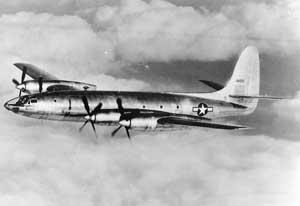
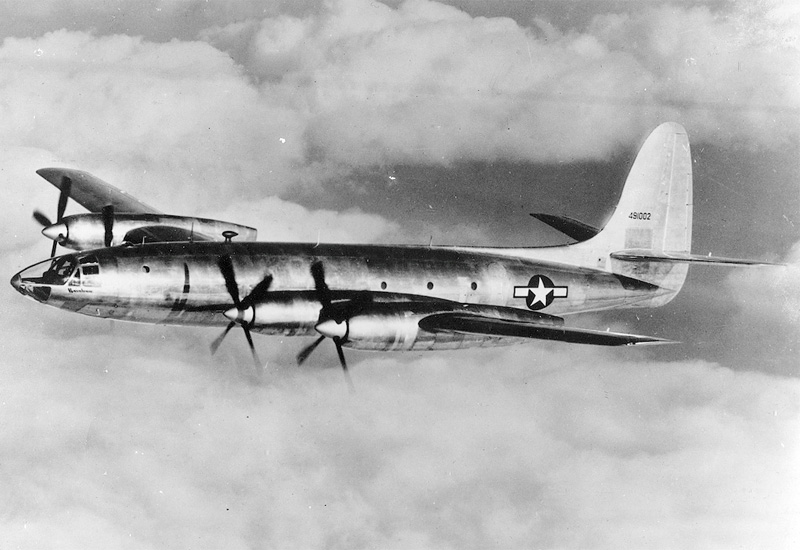
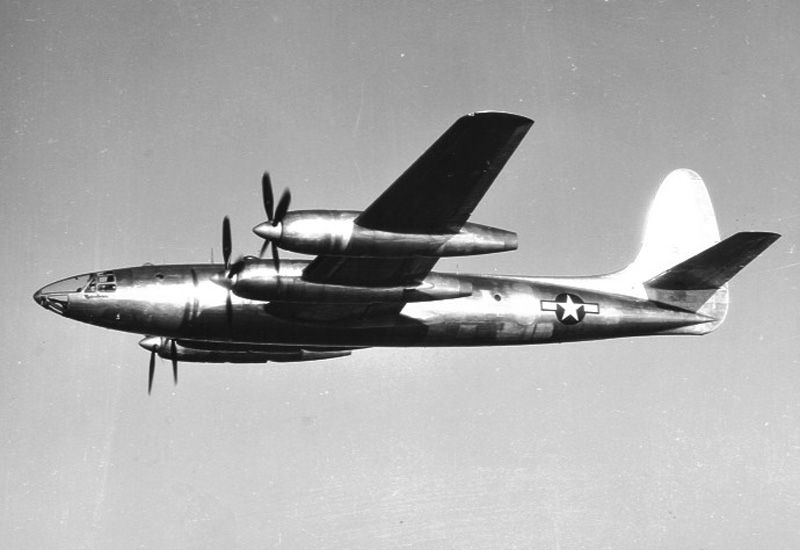
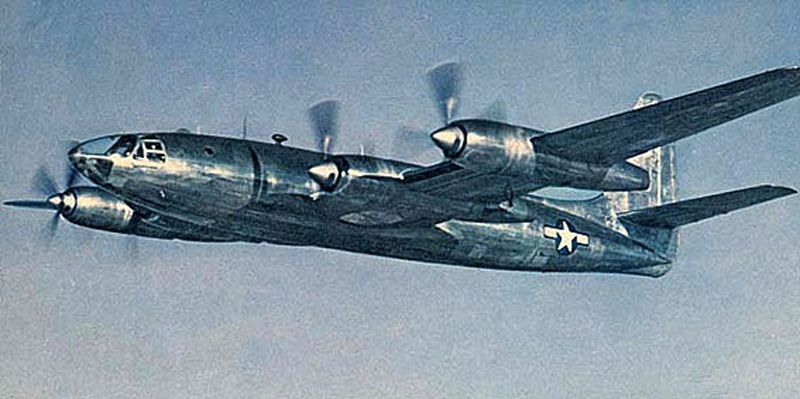
The XF-12 incorporated several design indicatives of note. Despite use of radial piston engines (in which the area around the propeller base is left open to facilitate airflow for cooling), the XF-12 made use of streamlined nacelles with sliding cowl facilities. This maintained a high degree of aerodynamics particularly across the surfaces of the wings as the nacelles ran from ahead of the leading edges to aft of the trailing edges. Air for cooling was, instead, drawn through the wing leading edge sections found between each engine pairing and exhausted at the rear of each engine nacelle. Engines were also turbocharged for increased output at altitude. The wings themselves were straight in their basic design though slightly angled upwards. The fuselage of the XF-12 was as streamlined as possible - from nose to tail - to, again, facilitate airflow to a maximum degree. The undercarriage was fully-retractable and of the tricycle variety - this arrangement now becoming the norm with new-breed aircraft of the time. The nose of the aircraft was further covered in large areas of glass for maximum viewing outside of the aircraft. The large internal space of the aircraft could be reserved for both specialized equipment and extra fuel. The internal makeup of the XF-12 allowed for all-weather operation - which would have given American warplanners a certain tactical edge in-the-field, especially against the Soviets.

Unfortunately for both the Hughes and Republic designs, the end of the war (and the dawn of the jet age) signified the end of the project, forcing the Republic design endeavor into post-war obscurity. The XF-12 was a promising design by any measure - despite the loss of the second prototype - and was slated to be one of the fastest operational four-engine aircraft of its time. In the end, the XF-12 project was outright cancelled as the USAAF (now the USAF, apart from the Army) looked to cut back on war-time spending. It eventually saw little need for a costly and completely new dedicated observation/reconnaissance system in the post-war world. Despite the USAAF ordering 98 of the Hughes XF-11, only two prototypes existed in the end. Similarly, only a pair of XF-12 Rainbow prototypes ("S/N 44-91002" and "S/N 44-91003") were ever completed by Republic and the second was lost over the Gulf of Mexico along with two of her crew after an engine exploded in-flight. The first prototype was damaged in a July 10th, 1947 crash landing forced by a the loss of the right main landing gear leg. This was repaired and the aircraft continued development until the aircraft was officially retired in June of 1952. This prototype was then, rather sadly, used as a target at the Aberdeen Proving Grounds.

The XF-12 also went under the lesser-known "XR-12" reconnaissance designation of the newly-founded US Air Force. Republic was planning on building an elongated passenger airliner version of its impressive XF-12 as the "RC-2" - of course this was never fulfilled. Both American Airlines and Pan-Am held initial interest in the RC-2's design but settled on existing aircraft types once the XF-12 project fell to naught with the US military. Likewise, the US military settled for existing airframes that could roughly accomplish what the XF-11/XF-12 project set out to do - these included the multi-engined Northrop P-61 Black Widow, Lockheed Constellation and the Boeing Superfortress lines.
Text ©2003-2013 www.MilitaryFactory.com • All Rights Reserved • No Reproduction Permitted
MilitaryFactory.com does NOT sell equipment/weaponry. Material presented throughout this website is for historical and entertainment value and should not to be construed as usable for hardware restoration, maintenance or general operation. Please consult manufacturers for such information. Our disclaimer. Email corrections / Comments to MilitaryFactory at Gmail dot com.
Picture of Republic XF-12 Rainbow
Pic of the Republic XF-12 Rainbow
Image of the Republic XF-12 Rainbow
View All Images (3)

Specifications for the
Republic XF-12 Rainbow
Strategic Reconnaissance Aircraft


Country of Origin: United States
Manufacturer: Republic Aviation - USA
Initial Year of Service: 1946
Production: 2


Focus Model: Republic XF-12 Rainbow
Crew: 7


Length: 93.70ft (28.56m)
Width: 129.17ft (39.37m)
Height: 28.05ft (8.55m)
Weight (Empty): 64,999lbs (29,483kg)
Weight (MTOW): 101,399lbs (45,994kg)


Powerplant: 4 x Pratt & Whitney R-4360-31 engines delivering 3,250hp each.


Maximum Speed: 470mph (756kmh; 408kts)
Maximum Range: 4,500miles (7,242km)
Service Ceiling: 45,000ft (13,716m; 8.5miles)
Rate-of-Climb: 5,000 feet per minute (1,524m/min)


Hardpoints: 0
Armament Suite:
None. Limited to camera equipment in fuselage bay.


Variants:
XF-12 - Prototypes S/N 44-91002 and S/N 44-91003; second prototype lost in crash.


XR-12 - Change in designation from XF-12 with the advent of the USAF from the USAAF.

RC-2 - Proposed Commercial Passenger Transport; fitted with Pratt & Whitney R-4360-59 engines; elongated fuselage; seating for up to 46 passengers along with the 7 crewmembers.


Operators: United States

ALL AIRCRAFT CATEGORIES

BY DECADE:


1900 to 1909
1910 to 1919
1920 to 1929
1930 to 1939
1940 to 1949
1950 to 1959
1960 to 1969
1970 to 1979
1980 to 1989
1990 to 1999
2000 to 2009
2010 to 2019
2020 to 2029
VIEW ALL
Compare Aircraft


BY TYPE:


Anti-Submarine Warfare (ASW)
Attack Helicopters
Bomber Aircraft
Medium Bombers
Heavy Bombers
Close-Air Support (CAS)
Commercial Aircraft
Dive Bombers
Electronic Warfare Aircraft (EWA)
Experimental / X-Planes
Fighter Aircraft
Floatplane Aircraft
Flying Boat Aircraft
Aerial Refueling Tankers
Helicopters (ALL)
Interceptor Aircraft
Multi-Role Aircraft
Navy Carrier Aircraft
Night Fighters
Reconnaissance / Scout
Search & Rescue (SAR)
Scout Helicopters
Special Purpose
Torpedo Bombers
Trainer Aircraft
Transport Aircraft
Transport Helicopters
Unmanned Aerial Vehicles (UAVs)
Unmanned Combat Air Vehicles (UCAVs)


COLLECTIONS:


4th Generation Fighter Aircraft
5th Generation Fighter Aircraft
US X-Planes
Classic US Warbirds
French Military Helicopters
Grumman "Cats"
Howard Hughes Aircraft
Indian Air Force
Israeli Air Force
Libyan Aircraft
Modern Chinese Aircraft
Modern Chinese Fighters
Modern Military Aircraft
Modern North Korean Aircraft
Modern Trainer Aircraft
Modern US Aircraft
Mikoyan Aircraft
Sukhoi Aircraft
Syrian Aircraft
Top 10 Fighter Aircraft of All Time


AIRCRAFT BY CONFLICT:


Arab-Israeli War (1948)
Cuban Missile Crisis (1959-1962)
Falklands War (1982)
Indo-Pak War (1965, 1971)
Iran-Iraq War (1980-1988)
Lebanon War (1982)
Operation Allied Force (1999)
Operation Desert Storm (1991)
Six Day War (1967)
Spanish Civil War (1936)
Soviet-Afghan War (1979-1989)
Yom Kippur War (1973)


MISCELLANEOUS:


Aircraft Cockpits
Aircraft Manufacturers List
Aircraft Timeline

WORLD WAR 2:


1939 Aircraft
1940 Aircraft
1941 Aircraft
1942 Aircraft
1943 Aircraft
1944 Aircraft
1945 Aircraft
1946 Aircraft
Australian Aircraft
Battle of Britain Aircraft
Bombers
Four-Engine Bombers
British Aircraft
British Bombers
British Transports
Dive Bombers
Canadian Aircraft
Fighters
Chinese Aircraft
French Aircraft
German Aircraft
German Fighters
German Flying Boats
German Jets
Secret Weapons of the Luftwaffe
Italian Aircraft
Imperial Japanese Aircraft
Imperial Japanese Fighters
Mitsubishi Bombers
Navy Aircraft
Pearl Harbor
Polish Aircraft
Romanian Aircraft
US Aircraft
US Bombers
US Navy Aircraft
Soviet Aircraft
Torpedo Bombers
Transport Aircraft
Tuskegee Airmen Aircraft
W.A.S.P. Aircraft
WW2 Aircraft Ranked by Speed
VIEW ALL


WORLD WAR 1:


1914 Aircraft
1915 Aircraft
1916 Aircraft
1917 Aircraft
1918 Aircraft
Aircraft Timeline
Austro-Hungarian Aircraft
Bomber Aircraft
British Aircraft
Fighters
Flying Boats
French Aircraft
Imperial German Aircraft
Italian Aircraft
Scout Aircraft
Russian Empire Aircraft
US Aircraft
WW1 Aircraft Ranked by Speed
VIEW ALL


KOREAN WAR:


Australian Aircraft
Korean War Aces
Korean War Jets
North Korean Aircraft
US Military Aircraft
VIEW ALL


VIETNAM WAR:


Helicopters
North Vietnam Air Force
US Airpower
VIEW ALL


COLD WAR:


1950s French Aircraft
British V-Bombers
Cold War Bombers
Soviet Aircraft
Soviet Bombers
Soviet Interceptors
Soviet Helicopters
Strategic Air Command
US Aircraft
US Bombers
US Interceptors
VIEW ALL

Site Disclaimer | Privacy Policy | Site Map | MF Origins


©2013 www.MilitaryFactory.com • Content ©2003-2013 MilitaryFactory.com • All Rights Reserved • Site Contact Email: militaryfactory at gmail dot com. The "Military Factory" name and MilitaryFactory.com logo are registered ® trademarks and protected by all applicable domestic and international intellectual property laws.


Top MF Stuff: 2013 Military Pay Scale | Military Ranks | WW2 Weapons | Sniper Rifles | Kts to Mph | WW1 Aircraft | Automatic Rifles | Aircraft Cockpits | Vietnam War Weapons | Main Battle Tanks | Submachine Guns | Shotguns | French Military Victories


Most photographic images appearing on this site are courtesy of the United States Department of Defense and are approved for public use. Other images acquired through the public domain. Digital art work courtesy of Dan Alex. Business Consulting by Kyle Williams. Material presented throughout this website is for historical and entertainment value and should not to be construed as usable for hardware restoration, maintenance or general operation. Please consult manufacturers for such information.


eXTReMe Tracker