Military Factory
Military Pay Chart
Global Firepower
Military Industrial Complex
Second World War
Home
Military Pay Scale
Military Ranks
Small Arms
Aircraft
Land Systems
Navy
Education
Military Factory Facebook Logo
flag of Canada

Avro Canada CF-105 Arrow Interceptor (1958)

Authored By Staff Writer | Last Updated: 12/31/2009

The anticipated debut of the Avro CF-105 Arrow was overshadowed by the world-wide coverage of the Soviet satellite Sputnik.

The Avro CF-105 "Arrow" appeared at a time when the Soviet Union was consistently developing higher-flying and longer range bombers capable of nuclear strikes virtually anywhere within reach. As a result, the Arrow was developed to counteract these advancements and was envisioned as a true high-speed interceptor with a full complement of missiles ready to react to those incoming Soviet threats. As promising as the design was, the series was only limited to five full-working examples before the entire program (including the Orenda jet engine program) were cancelled in 1959.

Canada had already found success in the CF-100 Canuck series of jet-powered fighters but was already on the lookout for its successor with a more capable repertoire. This was realized by the Avro company (then part of Hawker Siddeley since the end of World War 2) in the CF-105 with development starting in 1953). The CF-105 featured a true delta-wing design fitted with twin turbojet engines. The aircraft sported technological advancements throughout and would be piloted by a crew of two, made up of a pilot and his radar operator. The early years of the jet age, that is the period following World War 2, saw engine designs full of potential but short on practicality. Engines proved to be thirsty beasts and somewhat unreliable for a time. Additionally, experts debated the merits of swept wing design over delta wing forms as to which was indeed the better route to go. Swept-back wings offered improved air flow and less drag but the larger surface of the delta wing provided a larger internal capacity for fuel and stores while still maintaining the qualities of swept-back performance at the cost of increased drag - noted moreso at lower speeds and altitudes. At any rate, Avro made the decision to design the CF-105 as a pure delta wing platform. The aircraft's single-minded interceptor purpose was to travel in straight lines anyhow, finding the fastest way to get to its target in the shortest amount of time. The increase in drag was offset by the added fuel that could be stored in the wings as the CF-105 system would be expected to feed two thirsty turbojet engines, each with afterburner capability. The Orenda Iroquois - a highly advanced engine for its time - was selected as the powerplant that would propel the CF-105 Arrow for decades to come.

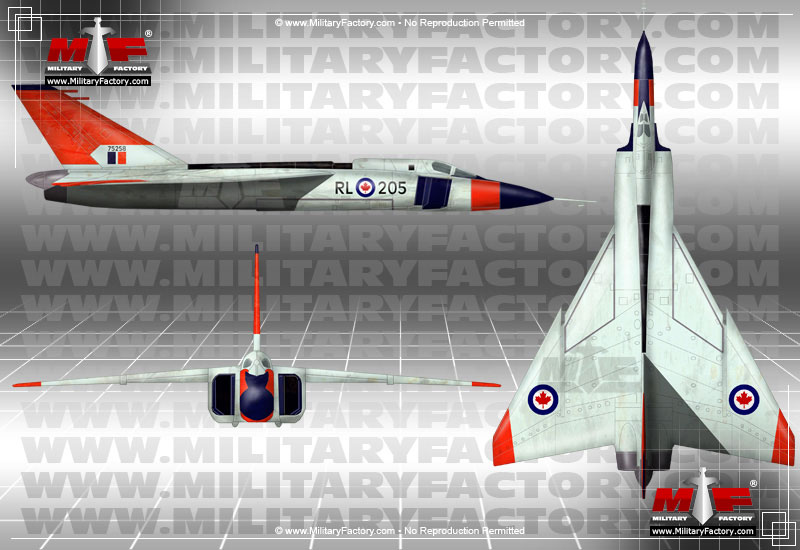
Design of the Arrow followed suit with many of the delta forms of the time. The two-man cockpit was held well-forward in the design, protruding between the two rectangular intakes to either side. The intakes ran the length of the fuselage and the delta wings extended from the installations as high shoulder-mounted assemblies. The aircraft's layout ended with the twin engine outtakes at rear capped by a single vertical tail fin set between the two engine compartments. The main landing gear extended from the wings (another benefit of the delta wing concept) as opposed to the fuselage body with two wheels to a gear (in single file arrangement). The nose landing gear leg retracted into the fuselage just behind and below the cockpit. In many ways, the CF-105 shared design similarities to those existing American and Soviet interceptors, a family of aircraft showcasing sharp lines and an overall clean appearance. At its core, the CF-105 was becoming a very large interceptor with plenty of potential.

The Arrow appeared in its first form as the Mark 1 (or "Mk 1") with production approved by 1955. This proved quite a departure from the years of design, testing and development seen during the CF-100 Canuck program. The first Arrow to roll off the assembly lines became model RL-201 and this aircraft was fitted with lower-powered Pratt & Whitney J75 series engines while the Orenda brand series were completing development. The unveiling was intended to be a huge affair but the successful launch of the Soviet satellite Sputnik destroyed any hope of that and in many ways forecasted the future of the CF-105 program itself. Several other delays of the internal systems added to the already bumpy curtain-raising event. First flight was achieved on March 25th, 1958 with good results and four more Mark 1 systems soon followed. Over the months of testing, a major issue arose with the complex main landing gear arrangement. The design relied upon the two main single-file landing gear wheels to fit into the wing. This necessitated that the gear rotate before settling fully into the thin delta wing design. After addressing several of these key issues, the five CF-105's were moved out of the A.V. Roe internal company test program and forwarded to official military trials beginning 1959.

By this time, the future of the CF-105 was already highly in doubt. 1957 saw a political turn in Canada which the new conservative-leaning party began targeting the spending projects of the former liberal party. The CF-105 was not immune to the discourse and when the Americans came calling with their NORAD (NORth American Air Defense) initiative and its thousands of available aircraft for use across Canadian air defense, it was seen fit to cancel the CF-105 Arrow project altogether. It is estimated that an astounding 50,000 jobs were lost with the cancelation of the program - or about 80% of Avro Canada altogether - permanently damaging the Canadian aerospace industry.

The only other variant in the CF-105 Arrow series was a proposed Mark 2 (Mk 2). This aircraft was to be fitted with the originally intended Orenda Iroquois powerplant and slated to be a top-flight interceptor with a higher overall speed. The cancellation of the Arrow program as a whole left just a single incomplete Mark 2 aircraft (in the form of the RL-206).

In any case, the CF-105 was another bold move and (in many ways) successful follow up to the CF-100 series. The education garnered from in-flight testing and design studies surely played a role in future delta projects all around the world. The CF-105 laid a solid foundation for the cream of the delta crop that would eventually appear in France and Swedish aircraft designs. To some extent, the CF-105 succeeded indirectly by helping produce aircraft designs appearing in the following decade.
Text ©2003-2013 www.MilitaryFactory.com • All Rights Reserved • No Reproduction Permitted
MilitaryFactory.com does NOT sell equipment/weaponry. Material presented throughout this website is for historical and entertainment value and should not to be construed as usable for hardware restoration, maintenance or general operation. Please consult manufacturers for such information. Our disclaimer. Email corrections / Comments to MilitaryFactory at Gmail dot com.
Picture of Avro Canada CF-105 Arrow
Pic of the Avro Canada CF-105 Arrow
Image of the Avro Canada CF-105 Arrow
View All Images (3)

Specifications for the
Avro Canada CF-105 Arrow
Interceptor


Country of Origin: Canada
Manufacturer: Avro Aircraft Limited - Canada
Initial Year of Service: 1958
Production: 5


Focus Model: Avro Canada CF-105 Arrow Mk 1
Crew: 2


Length: 77.79ft (23.71m)
Width: 50.00ft (15.24m)
Height: 20.51ft (6.25m)
Weight (Empty): 49,042lbs (22,245kg)
Weight (MTOW): 68,608lbs (31,120kg)


Powerplant: 2 x Pratt & Whitney J75-P-3 afterburning turbojet engines developing 47,000lbs of thrust.


Maximum Speed: 1,307mph (2,104kmh; 1,136kts)
Maximum Range: 410miles (660km)
Service Ceiling: 58,563ft (17,850m; 11.1miles)
Rate-of-Climb: 0 feet per minute (0m/min)


Hardpoints: 8
Armament Suite:
Armament included any combination of the following munitions (1 internal weapons bay):

8 x AIM-4 Falcon air-to-air missiles
8 x Velvet Glove semi-active radar homing air-to-air missiles
2 x AIM-7 Sparrow II 2D active guidance air-to-air missiles
4 x AIR-2 Genie unguided nuclear rockets


Variants:
Mark 1 (Mk 1) - Initial Production Model Designation; fitted with Pratt & Whitney J75-3/5 series afterburning turbojet engines (47,000lbs); five examples completed for delivery.


Mark 2 (Mk 2) - Proposed Follow-up Production Model fitted with 2 x Orenda PS-13 Iroquois turbojet engines (56,000lbs); single example nearly completed before project's cancellation.


Operators:
Canada

ALL AIRCRAFT CATEGORIES

BY DECADE:


1900 to 1909
1910 to 1919
1920 to 1929
1930 to 1939
1940 to 1949
1950 to 1959
1960 to 1969
1970 to 1979
1980 to 1989
1990 to 1999
2000 to 2009
2010 to 2019
2020 to 2029
VIEW ALL
Compare Aircraft


BY TYPE:


Anti-Submarine Warfare (ASW)
Attack Helicopters
Bomber Aircraft
Medium Bombers
Heavy Bombers
Close-Air Support (CAS)
Commercial Aircraft
Dive Bombers
Electronic Warfare Aircraft (EWA)
Experimental / X-Planes
Fighter Aircraft
Floatplane Aircraft
Flying Boat Aircraft
Aerial Refueling Tankers
Helicopters (ALL)
Interceptor Aircraft
Multi-Role Aircraft
Navy Carrier Aircraft
Night Fighters
Reconnaissance / Scout
Search & Rescue (SAR)
Scout Helicopters
Special Purpose
Torpedo Bombers
Trainer Aircraft
Transport Aircraft
Transport Helicopters
Unmanned Aerial Vehicles (UAVs)
Unmanned Combat Air Vehicles (UCAVs)


COLLECTIONS:


4th Generation Fighter Aircraft
5th Generation Fighter Aircraft
US X-Planes
Classic US Warbirds
French Military Helicopters
Grumman "Cats"
Howard Hughes Aircraft
Indian Air Force
Israeli Air Force
Libyan Aircraft
Modern Chinese Aircraft
Modern Chinese Fighters
Modern Military Aircraft
Modern North Korean Aircraft
Modern Trainer Aircraft
Modern US Aircraft
Mikoyan Aircraft
Sukhoi Aircraft
Syrian Aircraft
Top 10 Fighter Aircraft of All Time


AIRCRAFT BY CONFLICT:


Arab-Israeli War (1948)
Cuban Missile Crisis (1959-1962)
Falklands War (1982)
Indo-Pak War (1965, 1971)
Iran-Iraq War (1980-1988)
Lebanon War (1982)
Operation Allied Force (1999)
Operation Desert Storm (1991)
Six Day War (1967)
Spanish Civil War (1936)
Soviet-Afghan War (1979-1989)
Yom Kippur War (1973)


MISCELLANEOUS:


Aircraft Cockpits
Aircraft Manufacturers List
Aircraft Production
Aircraft Timeline

WORLD WAR 2:


1939 Aircraft
1940 Aircraft
1941 Aircraft
1942 Aircraft
1943 Aircraft
1944 Aircraft
1945 Aircraft
1946 Aircraft
Australian Aircraft
Battle of Britain Aircraft
Bombers
Four-Engine Bombers
British Aircraft
British Bombers
British Transports
Dive Bombers
Canadian Aircraft
Fighters
Chinese Aircraft
French Aircraft
German Aircraft
German Fighters
German Flying Boats
German Jets
Secret Weapons of the Luftwaffe
Italian Aircraft
Imperial Japanese Aircraft
Imperial Japanese Fighters
Mitsubishi Bombers
Navy Aircraft
Pearl Harbor
Polish Aircraft
Romanian Aircraft
US Aircraft
US Bombers
US Navy Aircraft
Soviet Aircraft
Torpedo Bombers
Trainer Aircraft
Transport Aircraft
Tuskegee Airmen Aircraft
W.A.S.P. Aircraft
WW2 Aircraft Ranked by Speed
VIEW ALL


WORLD WAR 1:


1914 Aircraft
1915 Aircraft
1916 Aircraft
1917 Aircraft
1918 Aircraft
Aircraft Timeline
Austro-Hungarian Aircraft
Bomber Aircraft
British Aircraft
Fighters
Flying Boats
French Aircraft
Imperial German Aircraft
Italian Aircraft
Scout Aircraft
Russian Empire Aircraft
US Aircraft
WW1 Aircraft Ranked by Speed
VIEW ALL


KOREAN WAR:


Australian Aircraft
Korean War Aces
Korean War Jets
North Korean Aircraft
US Military Aircraft
VIEW ALL


VIETNAM WAR:


Helicopters (ALL)
Transport Helicopters
North Vietnam Air Force
US Airpower
VIEW ALL


COLD WAR:


1950s French Aircraft
British V-Bombers
Cold War Bombers
Soviet Aircraft
Soviet Bombers
Soviet Interceptors
Soviet Helicopters
Strategic Air Command
US Aircraft
US Bombers
US Interceptors
VIEW ALL

Site Disclaimer | Privacy Policy | Site Map | MF Origins


©2013 www.MilitaryFactory.com • Content ©2003-2013 MilitaryFactory.com • All Rights Reserved • Site Contact Email: militaryfactory at gmail dot com. The "Military Factory" name and MilitaryFactory.com logo are registered ® trademarks and protected by all applicable domestic and international intellectual property laws.


Top MF Stuff: 2013 Military Pay Scale | Military Ranks | WW2 Weapons | Sniper Rifles | Kts to Mph | WW1 Aircraft | Automatic Rifles | Aircraft Cockpits | Vietnam War Weapons | Main Battle Tanks | Submachine Guns | Shotguns | French Military Victories


Most photographic images appearing on this site are courtesy of the United States Department of Defense and are approved for public use. Other images acquired through the public domain. Digital art work courtesy of Dan Alex. Business Consulting by Kyle Williams. Material presented throughout this website is for historical and entertainment value and should not to be construed as usable for hardware restoration, maintenance or general operation. Please consult manufacturers for such information.


eXTReMe Tracker