Military Factory
Military Pay Chart
Global Firepower
Military Industrial Complex
Second World War
Home
Military Pay Scale
Military Ranks
Small Arms
Aircraft
Land Systems
Navy
Education
Military Factory Facebook Logo
flag of United States

Grumman XP-50 Skyrocket Twin-Engine Fighter (1941)

Authored By Staff Writer | Last Updated: 9/9/2009

The Grumman XP-50 came in a close second to the Lockheed XP-38 for the US Army - the latter going on to become a classic fighter of the 20th Century.

Firmly entrenched as an aircraft supplier to the United States Navy, the Grumman aircraft company set about to supply an equally lucrative deal with the US Army to produce a hybrid high-speed pursuit fighter and light bomber platform. Having developed the radical-looking XF5F-1 Skyrocket in the 1930's, Grumman chose to forward the concept with a few design alterations. These included the addition of a longer nose section to accommodate a nose landing gear and make for a tricycle landing system not to dissimilar to that as showcased by the Bell corporation and its Airacobra series. The resulting design sparked enough interest from the United States Army to warrant production of a flyable prototype with the designation of XP-50.

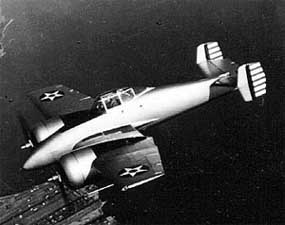
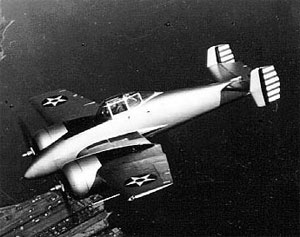
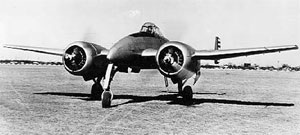
The XP-50 showcased many similarities to its predecessor. The pilot sat in a stubby yet streamlined fuselage with the lengthened nose extending just beyond the engine nacelles. The engines were held in low-mounted monoplane wings, all forward of the cockpit. The engines selected were Wright-branded R-1820-G205 which carried a military designation of R-1820-67/-69 and each turned in opposite directions to counter the naturally-occurring torque effects unique to any engine. Wings were clipped at the ends (ala the North American P-51 Mustang) and the empennage was dominated by the spit twin vertical fins as was found on the original XF5F-1. The cockpit was positioned in the middle of the fuselage and covered with a glazed frame canopy. Vision was reported solid when peering forward and above yet the wing and engine placement no doubt hampered vision below - a common design detriment of twin-engine fighters throughout the war.

Armament options were tossed about during the development of the XP-50. Since heavy caliber air-cooled machine guns were the norm for US aircraft designs of the time, a preliminary armament package of 6 x 12.7mm Browning machine guns was brought forth. This would have a cluster of 4 x 12.7mm guns in the nose assembly and an additional 1 x 12.7mm to a wing. An impressive total of 500 rounds per gun was envisioned. The second proposed armament package was more in line with the future of the quintessential dogfighter and consisted of a battery of 2 x 20mm Hispano-Suiza cannons in the nose along with 2 x 12.7mm machine guns. 60 rounds were to be afforded the cannons. A further 2 x 12.7mm machine guns were intended to be mounted in each wing. Al in all, either weapon formation would have made the XP-50 an aircraft to be reckoned with. To make the Xp-50 a true hybrid fighter-bomber, provision was added for a single 165lb drop bomb under each wing. In an interesting design note, a window was installed on the cockpit floor for the sole use of assisting the pilot in bombing. Unfortunately for the XP-50, none of this armament was ever fitted into the design.

First flight for the XP-50 occurred in February of 1941 and the system passed all crucial performance tests despite the relatively short flight time of just twenty minutes. Successive flights were equally promising until on April 14th, 1941, the aircraft suffered a catastrophic failure of one of the turbosuperchargers forcing the pilot to eject the aircraft and lose it to the waters above Long Island Sound. This no doubt provided a hefty dark stain on the XP-50 and the US Army made moves to secure the Lockheed XP-38 instead.

Despite the setback, the design was reconstituted into yet another new design - the Model G-51. This particular design was to form the basis of the XF7F which would become the F7F Tigercat of United States Marine fame (missing out on World War 2 altogether yet making a splash in the Korean War a few short years later). In any case, the XP-50 was a solid design when compared to other developmental aircraft of the war. Grumman would no doubt recover from the rejection by becoming one of America's best known aircraft firms with the production of the F6F Hellcat, F8F Bearcat and the timeless F-14 Tomcat among other notable systems.
Text ©2003-2013 www.MilitaryFactory.com • All Rights Reserved • No Reproduction Permitted
MilitaryFactory.com does NOT sell equipment/weaponry. Material presented throughout this website is for historical and entertainment value and should not to be construed as usable for hardware restoration, maintenance or general operation. Please consult manufacturers for such information. Our disclaimer. Email corrections / Comments to MilitaryFactory at Gmail dot com.
Picture of Grumman XP-50 Skyrocket
Pic of the Grumman XP-50 Skyrocket
View All Images (2)

Specifications for the
Grumman XP-50 Skyrocket
Twin-Engine Fighter


Country of Origin: United States
Manufacturer: Grumman - USA
Initial Year of Service: 1941
Production: 1


Focus Model: Grumman XP-50 Skyrocket
Crew: 1


Length: 31.89ft (9.72m)
Width: 41.99ft (12.80m)
Height: 11.98ft (3.65m)
Weight (Empty): 8,298lbs (3,764kg)
Weight (MTOW): 10,600lbs (4,808kg)


Powerplant: 2 x Wright R-1820-67/-69 developing 1,200hp each.


Maximum Speed: 424mph (683kmh; 369kts)
Maximum Range: 1,250miles (2,011km)
Service Ceiling: 40,000ft (12,192m; 7.6miles)
Rate-of-Climb: 3,800 feet per minute (1,158m/min)


Hardpoints: 2
Armament Suite:
PROPOSED ARMAMENT PACKAGE 1:
4 x 12.7mm Browning air-cooled machine guns in nose with 500 rounds each gun.
2 x 12.7mm Browning air-cooled machine guns in wings (1 to a wing) with 500 rounds each gun.

PROPOSED ARMAMENT PACKAGE 2:
2 x 20mm Hispano-Suiza cannons in nose with 60 rounds each.
2 x 12.7mm Browning air-cooled machine guns in nose.
2 x 12.7mm Browning air-cooled machine guns in wings (1 to a wing).

OPTIONAL:
2 x 165lb drop bombs (1 under each wing)


Variants:
Design 34 - Internal Grumman Designation


G-46A - Internal Grumman Designation

XP-50 - Single Prototype Model; S/N: 39-2517; fitted with 2 x Wright R-1820-67/-69 series engines; armament proposed but never installed; did not complete full flight testing.

XP-65 - "Improved" XP-50 Proposal; fitted with 2 x Wright R-2600-10 series engines; never constructed.


Operators:
the United States of America

ALL AIRCRAFT CATEGORIES

BY DECADE:


1900 to 1909
1910 to 1919
1920 to 1929
1930 to 1939
1940 to 1949
1950 to 1959
1960 to 1969
1970 to 1979
1980 to 1989
1990 to 1999
2000 to 2009
2010 to 2019
2020 to 2029
VIEW ALL
Compare Aircraft


BY TYPE:


Anti-Submarine Warfare (ASW)
Attack Helicopters
Bomber Aircraft
Medium Bombers
Heavy Bombers
Close-Air Support (CAS)
Commercial Aircraft
Dive Bombers
Electronic Warfare Aircraft (EWA)
Experimental / X-Planes
Fighter Aircraft
Floatplane Aircraft
Flying Boat Aircraft
Aerial Refueling Tankers
Helicopters (ALL)
Interceptor Aircraft
Multi-Role Aircraft
Navy Carrier Aircraft
Night Fighters
Reconnaissance / Scout
Search & Rescue (SAR)
Scout Helicopters
Special Purpose
Torpedo Bombers
Trainer Aircraft
Transport Aircraft
Transport Helicopters
Unmanned Aerial Vehicles (UAVs)
Unmanned Combat Air Vehicles (UCAVs)


COLLECTIONS:


4th Generation Fighter Aircraft
5th Generation Fighter Aircraft
US X-Planes
Classic US Warbirds
French Military Helicopters
Grumman "Cats"
Howard Hughes Aircraft
Indian Air Force
Israeli Air Force
Libyan Aircraft
Modern Chinese Aircraft
Modern Chinese Fighters
Modern Military Aircraft
Modern North Korean Aircraft
Modern Trainer Aircraft
Modern US Aircraft
Mikoyan Aircraft
Sukhoi Aircraft
Syrian Aircraft
Top 10 Fighter Aircraft of All Time


AIRCRAFT BY CONFLICT:


Arab-Israeli War (1948)
Cuban Missile Crisis (1959-1962)
Falklands War (1982)
Indo-Pak War (1965, 1971)
Iran-Iraq War (1980-1988)
Lebanon War (1982)
Operation Allied Force (1999)
Operation Desert Storm (1991)
Six Day War (1967)
Spanish Civil War (1936)
Soviet-Afghan War (1979-1989)
Yom Kippur War (1973)


MISCELLANEOUS:


Aircraft Cockpits
Aircraft Manufacturers List
Aircraft Production
Aircraft Timeline

WORLD WAR 2:


1939 Aircraft
1940 Aircraft
1941 Aircraft
1942 Aircraft
1943 Aircraft
1944 Aircraft
1945 Aircraft
1946 Aircraft
Australian Aircraft
Battle of Britain Aircraft
Bombers
Four-Engine Bombers
British Aircraft
British Bombers
British Transports
Dive Bombers
Canadian Aircraft
Fighters
Chinese Aircraft
French Aircraft
German Aircraft
German Fighters
German Flying Boats
German Jets
Secret Weapons of the Luftwaffe
Italian Aircraft
Imperial Japanese Aircraft
Imperial Japanese Fighters
Mitsubishi Bombers
Navy Aircraft
Pearl Harbor
Polish Aircraft
Romanian Aircraft
US Aircraft
US Bombers
US Navy Aircraft
Soviet Aircraft
Torpedo Bombers
Trainer Aircraft
Transport Aircraft
Tuskegee Airmen Aircraft
W.A.S.P. Aircraft
WW2 Aircraft Ranked by Speed
VIEW ALL


WORLD WAR 1:


1914 Aircraft
1915 Aircraft
1916 Aircraft
1917 Aircraft
1918 Aircraft
Aircraft Timeline
Austro-Hungarian Aircraft
Bomber Aircraft
British Aircraft
Fighters
Flying Boats
French Aircraft
Imperial German Aircraft
Italian Aircraft
Scout Aircraft
Russian Empire Aircraft
US Aircraft
WW1 Aircraft Ranked by Speed
VIEW ALL


KOREAN WAR:


Australian Aircraft
Korean War Aces
Korean War Jets
North Korean Aircraft
US Military Aircraft
VIEW ALL


VIETNAM WAR:


Helicopters (ALL)
Transport Helicopters
North Vietnam Air Force
US Airpower
VIEW ALL


COLD WAR:


1950s French Aircraft
British V-Bombers
Cold War Bombers
Soviet Aircraft
Soviet Bombers
Soviet Interceptors
Soviet Helicopters
Strategic Air Command
US Aircraft
US Bombers
US Interceptors
VIEW ALL

Site Disclaimer | Privacy Policy | Site Map | MF Origins


©2013 www.MilitaryFactory.com • Content ©2003-2013 MilitaryFactory.com • All Rights Reserved • Site Contact Email: militaryfactory at gmail dot com. The "Military Factory" name and MilitaryFactory.com logo are registered ® trademarks and protected by all applicable domestic and international intellectual property laws.


Top MF Stuff: 2013 Military Pay Scale | Military Ranks | WW2 Weapons | Sniper Rifles | Kts to Mph | WW1 Aircraft | Automatic Rifles | Aircraft Cockpits | Vietnam War Weapons | Main Battle Tanks | Submachine Guns | Shotguns | French Military Victories


Most photographic images appearing on this site are courtesy of the United States Department of Defense and are approved for public use. Other images acquired through the public domain. Digital art work courtesy of Dan Alex. Business Consulting by Kyle Williams. Material presented throughout this website is for historical and entertainment value and should not to be construed as usable for hardware restoration, maintenance or general operation. Please consult manufacturers for such information.


eXTReMe Tracker