Military Factory
Military Pay Chart
Global Firepower
Military Industrial Complex
Second World War
Home
Military Pay Scale
Military Ranks
Small Arms
Aircraft
Land Systems
Navy
Education
Military Factory Facebook Logo
flag of Nazi Germany

Focke-Wulf Ta 183 (Huckebein) Jet-Powered Fighter (1945)

Authored By Staff Writer | Last Updated: 4/15/2011

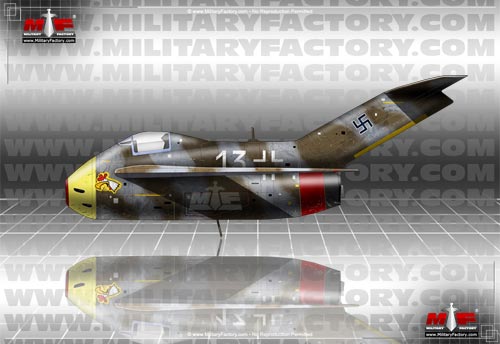
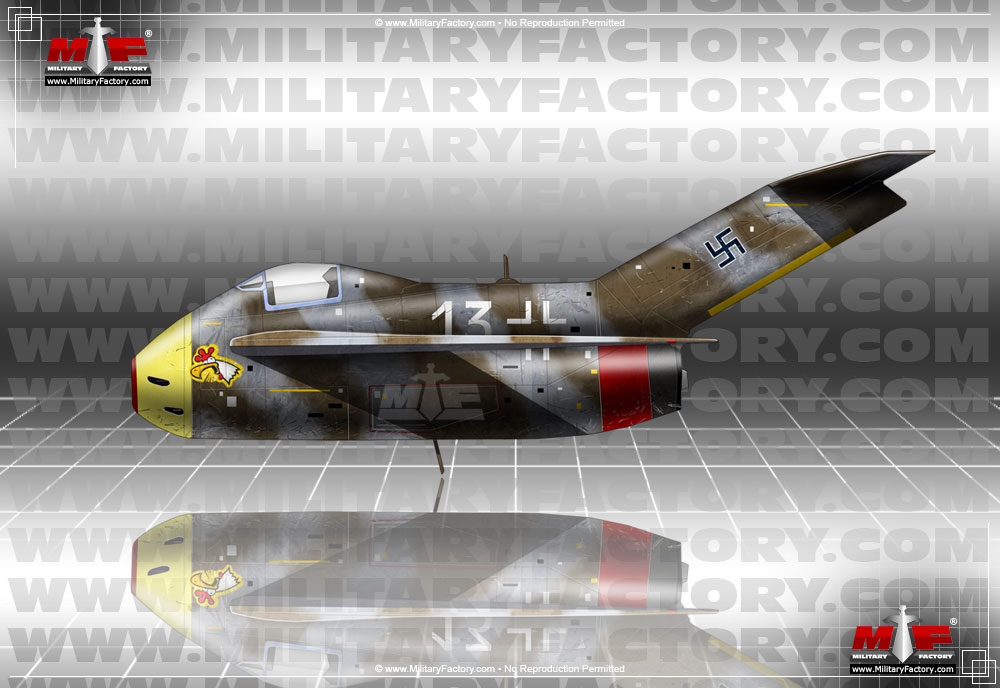
The Focke-Wulf Ta 183 was only in the prototype phase at the end of the Second World War and thus never flew.

Find a School Near You
Follow Military Factory on Facebook:
Trending on Military Factory:
Recent Articles:
Little MF Logo
Little MF Logo
Little MF Logo
Little MF Logo
Little MF Logo
Little MF Logo
Little MF Logo
Little MF Logo
Little MF Logo
Little MF Logo
By late in World War 2, German authorities had already made a stout commitment to the production of fighters over bombers. Seeing it that she would be fighting more or less a defensive-minded war for some time to come, models such as the Messerschmitt Bf 109 and Focke-Wulf 190 were evermore the important element to sustaining the German cause. It was therefore no surprise that the emphasis was also later placed on jet-powered fighter designs when the first rocket and turbojet-powered engines were being successfully tested. The Ta 183 design - a fighter design appearing on drawing boards as early as 1942 - was revisited and furthered once another Focke-Wulf fighter project, known simply as "Project VII", was officially rejected by the RLM. However, a pressed Germany meant that the Ta 183 "Huckebein" would only reach the design stage by the end of World War 2 in Europe.

The Ta 183 was intended to supplant all front-line fighters then in Luftwaffe service including the relatively new, first-generation, jet-powered Messerschmitt Me 262 "Schwalbe" and Heinkel He 162 "Volksjager" fighters. The Ta 183 was designed by a Kurt Tank team, led by talented engineer Hans Multhopp, in response to an RLM initiative calling for a highly-capable jet-powered fighter as part of its evolving "Emergency Fighter Program". Tank, serving as a long-time engineering at Focke-Wulf and having proved his worth to the firm, was allowed use of the first two letters of his last name in the designation of several late-war aircraft (to include the production Ta-152 high-altitude fighter, a variant of his successful Fw 190 fighter). However, the war would end before the impressive Ta 183 would even see the light of day - limiting the aircraft to several advanced wind tunnel models for evaluation.

The design of the Ta 183 was quite revolutionary and featured a nose-mounted intake running underneath the bubble canopy cockpit. Swept-back wings of 40 degrees, tricycle undercarriage and an identifiable high-mounted T-tail system were also part of the advanced look. The pilot sat firmly entrenched in a center-positioned cockpit area just aft of the nose intake and above the forward-placed, mid-mounted monoplane wings. The engine - a single Heinkel HeS 011 series turbojet of 3,500lbf - exited just at the base of the empennage. Overall, the design took on a sleek, nimble look with capabilities seemingly limited only by the imagination. The base armament would have been a battery of heavy caliber 4 x Mk 108 series 30mm cannons, all mounted in the nose - capable of attacking fighter or bomber with equal fervor. Ordnance capabilities would have included up to 1,000 pounds of external munitions for the strike fighter role - the centerline fuselage position would have allowed for semi-recessed ordnance while, overall, some five hardpoints could be assigned depending on individual munitions load.

During the initial stages of design, various ideas were taken under consideration including the use of rocket-assisted take-off. Construction was mostly of aluminum, steel sheeting and wood. The design weighed heavily on keeping the aircraft's center of gravity in check though many issues arose during development that would have plagued the aircraft throughout any foreseeable career. A total of two designs were seriously looked into and known as Design II and Design III. The former featured a repositioned undercarriage and subtle changes in design throughout. The latter - and the design eventually selected for competition - saw a slightly-less sweep on the wings and a repositioning of the wing and cockpit.

The Ta 183 design eventually lost out (at least on paper) to a Junkers design (in the form of the EF128). When it was realized that the Ta 183 was in fact the better of the two designs, the Ta 183 was put back on the forefront with prototype and production numbers being seriously considered. This put Kurt Tank and his experts into action on a working model but the end of the war would see an end to all further development - Tank would later take off for Argentina to avoid any type of criminal prosecution for his role in the war.

While in exile in Argentina, Tank took to completing the Hans Multhopp Ta 183 design for the Argentine government. Financial ruin in the country left the nation looking for a budgeted alternative to any new, troublesome and costly designs, thusly settling for the North American F-86 Sabre available in some numbers on the market following the Korean War. To that end, the Ta 183 did see life in the form of the Argentine IAe "Pulqui II" but only five of its type were ever completed by the Fabrica Militar de Aviones. This incarnation of Multhopp's design was viewed largely as a failure with Tank's changes to the initial configuration being largely to blame.

It is also suspected that the Soviet Union's MiG-15 "Fagot" design was inspired by Ta 183 documentation captured from German sources after the war. The aircraft did seem to share an outward similarity but are generally viewed as quite different in most respects. The Swedish SAAB Tunnan is also thought to be inspired by the Ta 183. Regardless, the Ta 183 design itself proved quite an undertaking considering the ambitiousness inherent in the drastic layout and infant jet technology required to power such a design. Though none were wholly-built, its "paper" form can still be thought of as inspiring other designs in its wake.

Incidentally, the designation of "Huckebein" is in reference to a cartoon raven of the time - a character that created mischief for others whenever possible. An applicable designation considering the design goals of the German Emergency Fighter Program.
Text ©2003-2013 www.MilitaryFactory.com • All Rights Reserved • No Reproduction Permitted
MilitaryFactory.com does NOT sell equipment/weaponry. Material presented throughout this website is for historical and entertainment value and should not to be construed as usable for hardware restoration, maintenance or general operation. Please consult manufacturers for such information. Our disclaimer. Email corrections / Comments to MilitaryFactory at Gmail dot com.
Picture of Focke-Wulf Ta 183 (Huckebein)
View All Images (1)

Specifications for the
Focke-Wulf Ta 183 (Huckebein)
Jet-Powered Fighter


Country of Origin: Nazi Germany
Manufacturer: Focke-Wulf - Germany
Initial Year of Service: 1945
Production: Not Available


Focus Model: Focke-Wulf Ta 183 (Huckebein)
Crew: 1


Length: 30.18ft (9.2m)
Width: 32.81ft (10.00m)
Height: 0.00ft (0.00m)
Weight (Empty): 5,247lbs (2,380kg)
Weight (MTOW): 9,480lbs (4,300kg)


Powerplant: 1 x Heinkel HeS 011 turbojet engine developing 3,500lbf of thrust.


Maximum Speed: 593mph (955kmh; 516kts)
Maximum Range: 0miles (0km)
Service Ceiling: 45,932ft (14,000m; 8.7miles)
Rate-of-Climb: 4,020 feet per minute (1,225m/min)


Hardpoints: 5
Armament Suite:
STANDARD:
4 x 30mm Mk 108 cannons in chin nose position

OPTIONAL:
Up to 1,000lbs of external ordnance (conventional drop bombs)


Variants:
Design II - Focke-Wulf Company Designation; minor wingtip redesign; repositioned undercarriage.


Design III - Focke-Wulf Company Designation; reduced wing sweep to 32 degrees; repositioned cockpit and wing assembly.

Project V - Alternative Project Designation

Project VI - Alternative Project Designation in some sources.

Ta 183 "Huckebein" - Base Series Designation; single prototype was never completed before the end of the war.

FMA IAe 33 "Pulqui II" - Argentinian futher development of the German design in post-war.


Operators:
Nazi Germany

ALL AIRCRAFT CATEGORIES

BY DECADE:


1900 to 1909
1910 to 1919
1920 to 1929
1930 to 1939
1940 to 1949
1950 to 1959
1960 to 1969
1970 to 1979
1980 to 1989
1990 to 1999
2000 to 2009
2010 to 2019
2020 to 2029
VIEW ALL


BY TYPE:


Anti-Submarine Warfare (ASW)
Attack Helicopters
Bomber Aircraft
Medium Bombers
Heavy Bombers
Close-Air Support (CAS)
Commercial Aircraft
Dive Bombers
Electronic Warfare Aircraft (EWA)
Experimental / X-Planes
Fighter Aircraft
Floatplane Aircraft
Flying Boat Aircraft
Aerial Refueling Tankers
Helicopters (ALL)
Interceptor Aircraft
Multi-Role Aircraft
Navy Carrier Aircraft
Night Fighters
Reconnaissance / Scout
Search & Rescue (SAR)
Scout Helicopters
Special Purpose
Torpedo Bombers
Trainer Aircraft
Transport Aircraft
Transport Helicopters
Unmanned Aerial Vehicles (UAVs)
Unmanned Combat Air Vehicles (UCAVs)


COLLECTIONS:


4th Generation Fighter Aircraft
5th Generation Fighter Aircraft
US X-Planes
Classic US Warbirds
French Military Helicopters
Grumman "Cats"
Howard Hughes Aircraft
Indian Air Force
Israeli Air Force
Libyan Aircraft
Modern Chinese Aircraft
Modern Chinese Fighters
Modern Military Aircraft
Modern North Korean Aircraft
Modern Trainer Aircraft
Modern US Aircraft
Mikoyan Aircraft
Sukhoi Aircraft
Syrian Aircraft
Top 10 Fighter Aircraft of All Time


AIRCRAFT BY CONFLICT:


Arab-Israeli War (1948)
Cuban Missile Crisis (1959-1962)
Falklands War (1982)
Indo-Pak War (1965, 1971)
Iran-Iraq War (1980-1988)
Lebanon War (1982)
Operation Allied Force (1999)
Operation Desert Storm (1991)
Six Day War (1967)
Spanish Civil War (1936)
Soviet-Afghan War (1979-1989)
Yom Kippur War (1973)


MISCELLANEOUS:


Aircraft Cockpit Pictures
Aircraft Comparison Tool
Aircraft Manufacturers
Aircraft Production Totals
Aircraft Timeline

WORLD WAR 2:


1939 Aircraft
1940 Aircraft
1941 Aircraft
1942 Aircraft
1943 Aircraft
1944 Aircraft
1945 Aircraft
1946 Aircraft
Australian Aircraft
Battle of Britain Aircraft
Bombers
Four-Engine Bombers
British Aircraft
British Bombers
British Transports
Dive Bombers
Canadian Aircraft
Fighters
Chinese Aircraft
French Aircraft
German Aircraft
German Fighters
German Flying Boats
German Jets
Secret Weapons of the Luftwaffe
Italian Aircraft
Imperial Japanese Aircraft
Imperial Japanese Fighters
Mitsubishi Bombers
Navy Aircraft
Pearl Harbor
Polish Aircraft
Romanian Aircraft
US Aircraft
US Bombers
US Navy Aircraft
Soviet Aircraft
Torpedo Bombers
Trainer Aircraft
Transport Aircraft
Tuskegee Airmen Aircraft
W.A.S.P. Aircraft
WW2 Aircraft Ranked by Speed
VIEW ALL


WORLD WAR 1:


1914 Aircraft
1915 Aircraft
1916 Aircraft
1917 Aircraft
1918 Aircraft
Aircraft Timeline
Austro-Hungarian Aircraft
Bomber Aircraft
British Aircraft
Fighters
Flying Boats
French Aircraft
Imperial German Aircraft
Italian Aircraft
Scout Aircraft
Russian Empire Aircraft
US Aircraft
WW1 Aircraft Ranked by Speed
VIEW ALL


KOREAN WAR:


Australian Aircraft
Korean War Aces
Korean War Jets
North Korean Aircraft
US Military Aircraft
VIEW ALL


VIETNAM WAR:


Helicopters (ALL)
Transport Helicopters
North Vietnam Air Force
US Airpower
VIEW ALL


COLD WAR:


1950s French Aircraft
British V-Bombers
Cold War Bombers
Soviet Aircraft
Soviet Bombers
Soviet Interceptors
Soviet Helicopters
Strategic Air Command
US Aircraft
US Bombers
US Interceptors
VIEW ALL

Site Disclaimer | Privacy Policy | Site Map | MF Origins


©2013 www.MilitaryFactory.com • Content ©2003-2013 MilitaryFactory.com • All Rights Reserved • Site Contact Email: militaryfactory at gmail dot com. The "Military Factory" name and MilitaryFactory.com logo are registered ® trademarks and protected by all applicable domestic and international intellectual property laws.


Top MF Stuff: 2013 Military Pay Scale | Military Ranks | WW2 Weapons | Sniper Rifles | Kts to Mph | WW1 Aircraft | Automatic Rifles | Aircraft Cockpits | Vietnam War Weapons | Main Battle Tanks | Submachine Guns | Shotguns | French Military Victories


Most photographic images appearing on this site are courtesy of the United States Department of Defense and are approved for public use. Other images acquired through the public domain. Digital art work courtesy of Dan Alex. Business Consulting by Kyle Williams. Material presented throughout this website is for historical and entertainment value and should not to be construed as usable for hardware restoration, maintenance or general operation. Please consult manufacturers for such information.


eXTReMe Tracker