Military Factory
Military Pay Chart
Global Firepower
Military Industrial Complex
Second World War
Home
Military Pay Scale
Military Ranks
Small Arms
Aircraft
Land Systems
Navy
Education
Military Factory Facebook Logo
flag of United Kingdom

Supermarine Scimitar Carrierbased Strike-Fighter (1957)

Authored By Dan Alex | Last Updated: 7/6/2010

The Scimitar was a capable carrierborne fighter and the last product of the fabled Supermarine aircraft firm.

Find a School Near You
Follow Military Factory on Facebook:
Trending on Military Factory:
Recent Articles:
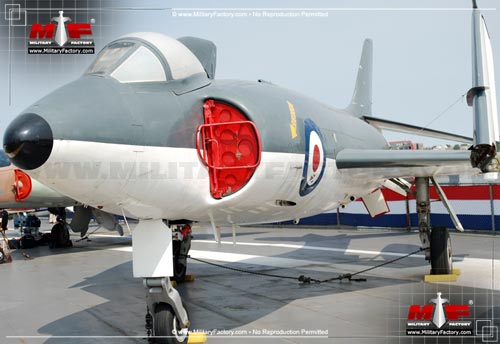
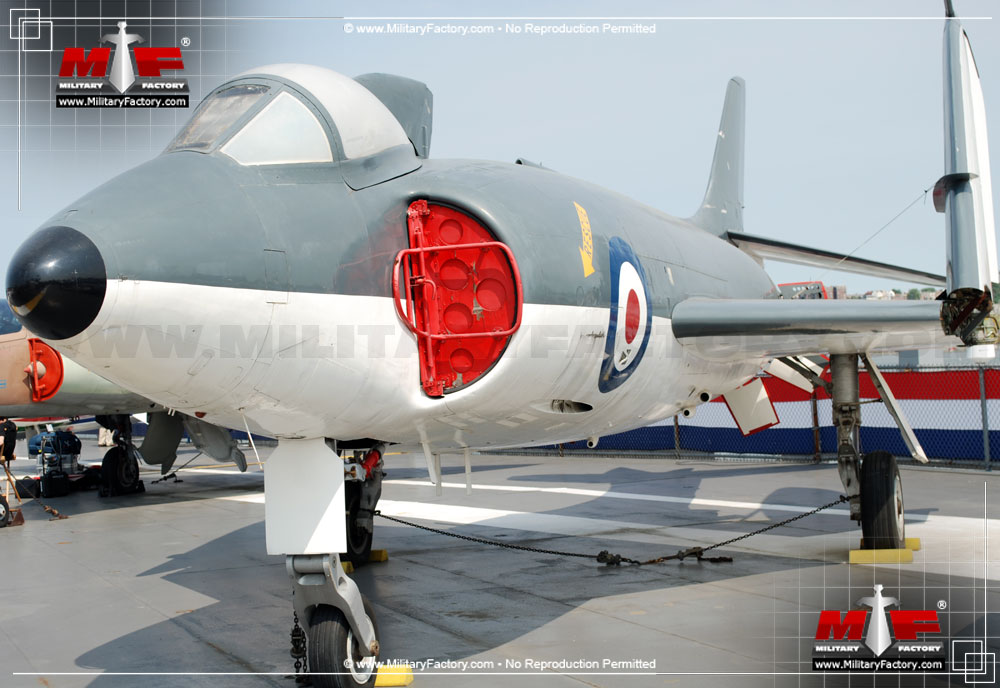
The Supermarine Scimitar was an oft-forgotten carrier-based, jet-powered, single-seat fighter for the British Fleet Air Arm. The aircraft held a few "firsts" in its service run with the British Royal Navy - it became its first swept-wing, single-seat jet fighter and the first Fleet Air Arm aircraft to be cleared for use with Atomic weapons. The Scimitar could be called on to undertake multirole sorties encompassing long-range reconnaissance, high-altitude interception and low-level bombing, making it an ideal and lethal addition to the ranks of the Royal Navy and the aircraft served in these varying capacities for a decade.

The legacy of the Scimitar was born out of a protracted development period covering a single-seat naval fighter that began with the Vickers-Supermarine Type 508. The Type 508 was a jet-powered, straight-wing fighter design with a "Vee" style tail assembly. Another straight-wing prototype soon emerged under the designation of Type 529 while still another research prototype, this with swept-back wings, was designated as the Type 525.

Attention soon centered in on the Type 525 prototype and the design proved promising. First flight of this prototype was on April 27th, 1954. Though later lost to accident (in some ways a sign of things to come), the Type 525 design itself endured in a revised form as the Type 544. Three subtly-different prototypes of the Type 544 were then produced. Under Specification N113, a revised Royal Navy need changed the Type 544 requirement from a dedicated fighter platform to that of a low-level strike aircraft. The Type 544 subsequently achieved its first flight on January 19th, 1956 and 100 examples were soon put on order under the final designation of "Scimitar F.1". The Scimitar F.1 made its maiden flight on January 11th, 1957. Soon enough, the original production order was cut down to just 76 aircraft.

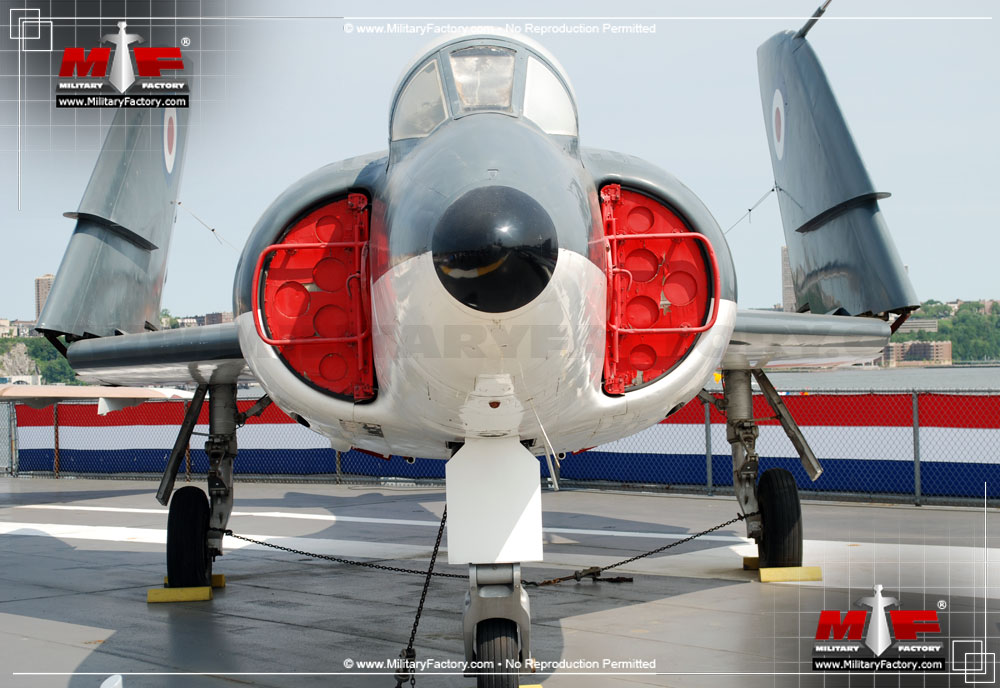
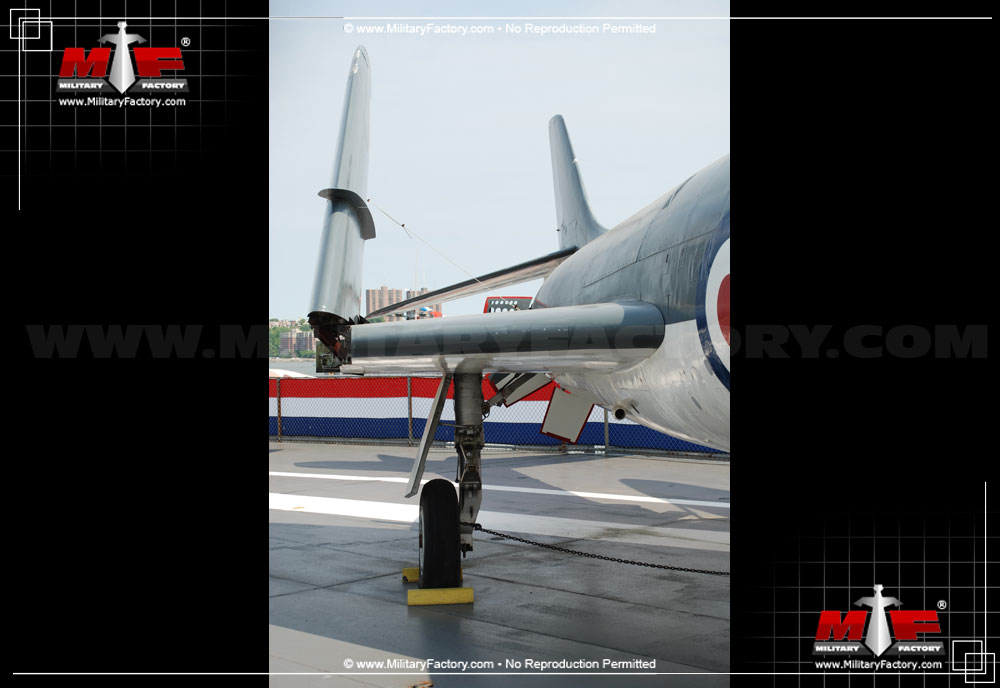
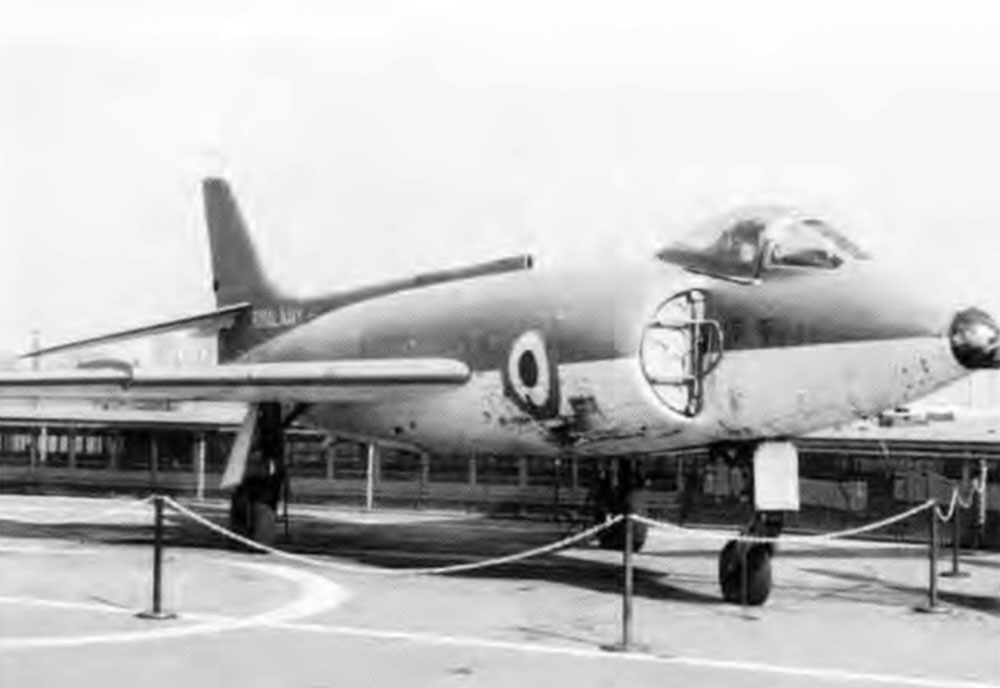
Design of this rather large aircraft was quite conventional. The cockpit was held well forward in the rounded fuselage as part of the shortened nose assembly. Intakes were fitted to either fuselage side and ran about 80% of the aircraft's length, ultimately capped by exhaust nozzles just ahead of the empennage. The empennage was conventional as well, fitting a single vertical tail fin with elevated horizontal planes. All tail surfaces were swept. The main wings were low-mounted along the fuselage sides and featured high degrees of sweep, moreso along the leading edges. The undercarriage was a tricycle arrangement featuring two single-wheeled main landing gear legs and a single-wheeled nose landing gear leg. The main landing gears retracted towards centerline while the nose landing gear retracted rearwards, just under and aft of the cockpit floor. An arrestor hook was fitted to the base of the empennage.

Power to the Scimitar F.1 was supplied via two Rolls-Royce Avon 202 series turbojets delivering up to 11,250lbf of thrust each. Performance specifications included a top speed of 736 miles per hour at sea level with a range of 1,422 miles. The aircraft had a service ceiling listed at 46,000 feet. Total weight at take-off was approximately 34,200lbs.

Standard armament centered around a impressive battery of quadruple 30mm ADEN cannons. This could be complimented by external ordnance spread across four hardpoints. Hardpoints could fitted with air-to-air missiles in the form of the American-made AIM-9 Sidewinder or air-to surface missiles in the form of the AGM-12 Bullpup. Additionally, the Scimitar could make use of up to 4 x 1,000 conventional drop bombs or 4 x rocket pods fielding 2" or 3" unguided rockets as needed.

The fact that the legacy of the Scimitar was limited is showcased in the only existing production form as the Scimitar F.1. Of the 76 production aircraft delivered, some 39 of these eventually lost to accident - an appalling accident rate to say the least. Scimitars had a penchant for accidents in that the rather smallish carriers of the British Royal Navy and the powerful performance capabilities of the advanced aircraft worked well against one another. Though pilots and crews alike appreciated the intricacies of their Scimitars, it was somewhat ahead of its time and required a great deal of attention and skill - be it in the air or on the ground. At one point, it is said that a single Scimitar required some 1,000 hours of maintenance attention to keep her at the ready.

Once in service with the Royal Navy's Fleet Air Arm, the Scimitar was fielded by the 736, 800, 803, 804 and 807 Naval Air Squadrons, replacing the rather vanilla single-seat Hawker Sea Hawks. Its first users became the boys of No. 803 out of Loussiemouth in June of 1958. The Scimitar was eventually replaced in service by the Blackburn Buccaneer in the ground attack role and removed from frontline service as soon as 1966 but retained her nuclear role up until 1969. Ironically, Scimitars served Buccaneers as aerial fuel tanks for a time. Though the Scimitar also maintained some air interception qualities about her, she too was done in for this role by the unique de Havilland Sea Vixen beginning service in July of 1959.

A Supermarine Scimitar F.1 (serial XD220) can be found along the deck of the Intrepid Sea-Air-Space Museum in New York City. This particular example is on loan from the FAA museum itself.

In all, the Scimitar lived a somewhat "under the radar" existence though a short one at that. The aircraft was also the last product by the fabled Supermarine firm, the company responsible for the excellent war-winning Supermarine Spitfire of World War 2 fame.
Text ©2003-2013 www.MilitaryFactory.com • All Rights Reserved • No Reproduction Permitted
MilitaryFactory.com does NOT sell equipment/weaponry. Material presented throughout this website is for historical and entertainment value and should not to be construed as usable for hardware restoration, maintenance or general operation. Please consult manufacturers for such information. Our disclaimer. Email corrections / Comments to MilitaryFactory at Gmail dot com.
Picture of Supermarine Scimitar
Pic of the Supermarine Scimitar
Image of the Supermarine Scimitar
View All Images (4)

Specifications for the
Supermarine Scimitar
Carrierbased Strike-Fighter


Country of Origin: United Kingdom
Manufacturer: Supermarine - UK
Initial Year of Service: 1957
Production: 76


Focus Model: Supermarine Scimitar F.1
Crew: 1


Length: 55.35ft (16.87m)
Width: 37.17ft (11.33m)
Height: 17.32ft (5.28m)
Weight (Empty): 23,962lbs (10,869kg)
Weight (MTOW): 34,200lbs (15,513kg)


Powerplant: 2 x Rolls-Royce Avon 202 turbojet engines producing 11,250lbs of static thrust each.


Maximum Speed: 710mph (1,143kmh; 617kts)
Maximum Range: 1,422miles (2,288km)
Service Ceiling: 45,997ft (14,020m; 8.7miles)
Rate-of-Climb: 12,000 feet per minute (3,658m/min)


Hardpoints: 4
Armament Suite:
STANDARD:
4 x 30mm ADEN cannons

OPTIONAL:
4 x rocket pods containing 8 x 3" air-to-air rockets (AP or HE)
4 x rocket pods containing 16 x 3" air-to-air rockets (AP or HE)
4 x rocket pods containing 24 x 3" air-to-air rockets (AP or HE)
4 x 1,000lb bombs
4 x AGM-12 Bullpup air-to-surface missiles
4 x AIM-9 Sidewinder air-to-air missiles


Variants:
Type 508 - Prototype Model; featured straight wings.


Type 529 - Prototype Model; featured straight wings.

Type 525 - Prototype Model; featured swept-back wings.

Type 544 - Initial Prototype Fighter Model; 3 examples produced; would become production F.1 fighter series model.

Scimitar F.1 - Base Production Fighter Model; single-seat; 76 examples produced.


Operators: United Kingdom

ALL AIRCRAFT CATEGORIES

BY DECADE:


1900 to 1909
1910 to 1919
1920 to 1929
1930 to 1939
1940 to 1949
1950 to 1959
1960 to 1969
1970 to 1979
1980 to 1989
1990 to 1999
2000 to 2009
2010 to 2019
2020 to 2029
VIEW ALL
Compare Aircraft


BY TYPE:


Anti-Submarine Warfare (ASW)
Attack Helicopters
Bomber Aircraft
Medium Bombers
Heavy Bombers
Close-Air Support (CAS)
Commercial Aircraft
Dive Bombers
Electronic Warfare Aircraft (EWA)
Experimental / X-Planes
Fighter Aircraft
Floatplane Aircraft
Flying Boat Aircraft
Aerial Refueling Tankers
Helicopters (ALL)
Interceptor Aircraft
Multi-Role Aircraft
Navy Carrier Aircraft
Night Fighters
Reconnaissance / Scout
Search & Rescue (SAR)
Scout Helicopters
Special Purpose
Torpedo Bombers
Trainer Aircraft
Transport Aircraft
Transport Helicopters
Unmanned Aerial Vehicles (UAVs)
Unmanned Combat Air Vehicles (UCAVs)


COLLECTIONS:


4th Generation Fighter Aircraft
5th Generation Fighter Aircraft
US X-Planes
Classic US Warbirds
French Military Helicopters
Grumman "Cats"
Howard Hughes Aircraft
Indian Air Force
Israeli Air Force
Libyan Aircraft
Modern Chinese Aircraft
Modern Chinese Fighters
Modern Military Aircraft
Modern North Korean Aircraft
Modern Trainer Aircraft
Modern US Aircraft
Mikoyan Aircraft
Sukhoi Aircraft
Syrian Aircraft
Top 10 Fighter Aircraft of All Time


AIRCRAFT BY CONFLICT:


Arab-Israeli War (1948)
Cuban Missile Crisis (1959-1962)
Falklands War (1982)
Indo-Pak War (1965, 1971)
Iran-Iraq War (1980-1988)
Lebanon War (1982)
Operation Allied Force (1999)
Operation Desert Storm (1991)
Six Day War (1967)
Spanish Civil War (1936)
Soviet-Afghan War (1979-1989)
Yom Kippur War (1973)


MISCELLANEOUS:


Aircraft Cockpits
Aircraft Manufacturers List
Aircraft Timeline

WORLD WAR 2:


1939 Aircraft
1940 Aircraft
1941 Aircraft
1942 Aircraft
1943 Aircraft
1944 Aircraft
1945 Aircraft
1946 Aircraft
Australian Aircraft
Battle of Britain Aircraft
Bombers
Four-Engine Bombers
British Aircraft
British Bombers
British Transports
Dive Bombers
Canadian Aircraft
Fighters
Chinese Aircraft
French Aircraft
German Aircraft
German Fighters
German Flying Boats
German Jets
Secret Weapons of the Luftwaffe
Italian Aircraft
Imperial Japanese Aircraft
Imperial Japanese Fighters
Mitsubishi Bombers
Navy Aircraft
Pearl Harbor
Polish Aircraft
Romanian Aircraft
US Aircraft
US Bombers
US Navy Aircraft
Soviet Aircraft
Torpedo Bombers
Trainer Aircraft
Transport Aircraft
Tuskegee Airmen Aircraft
W.A.S.P. Aircraft
WW2 Aircraft Ranked by Speed
VIEW ALL


WORLD WAR 1:


1914 Aircraft
1915 Aircraft
1916 Aircraft
1917 Aircraft
1918 Aircraft
Aircraft Timeline
Austro-Hungarian Aircraft
Bomber Aircraft
British Aircraft
Fighters
Flying Boats
French Aircraft
Imperial German Aircraft
Italian Aircraft
Scout Aircraft
Russian Empire Aircraft
US Aircraft
WW1 Aircraft Ranked by Speed
VIEW ALL


KOREAN WAR:


Australian Aircraft
Korean War Aces
Korean War Jets
North Korean Aircraft
US Military Aircraft
VIEW ALL


VIETNAM WAR:


Helicopters
North Vietnam Air Force
US Airpower
VIEW ALL


COLD WAR:


1950s French Aircraft
British V-Bombers
Cold War Bombers
Soviet Aircraft
Soviet Bombers
Soviet Interceptors
Soviet Helicopters
Strategic Air Command
US Aircraft
US Bombers
US Interceptors
VIEW ALL

Site Disclaimer | Privacy Policy | Site Map | MF Origins


©2013 www.MilitaryFactory.com • Content ©2003-2013 MilitaryFactory.com • All Rights Reserved • Site Contact Email: militaryfactory at gmail dot com. The "Military Factory" name and MilitaryFactory.com logo are registered ® trademarks and protected by all applicable domestic and international intellectual property laws.


Top MF Stuff: 2013 Military Pay Scale | Military Ranks | WW2 Weapons | Sniper Rifles | Kts to Mph | WW1 Aircraft | Automatic Rifles | Aircraft Cockpits | Vietnam War Weapons | Main Battle Tanks | Submachine Guns | Shotguns | French Military Victories


Most photographic images appearing on this site are courtesy of the United States Department of Defense and are approved for public use. Other images acquired through the public domain. Digital art work courtesy of Dan Alex. Business Consulting by Kyle Williams. Material presented throughout this website is for historical and entertainment value and should not to be construed as usable for hardware restoration, maintenance or general operation. Please consult manufacturers for such information.


eXTReMe Tracker