Military Factory
Military Pay Chart
Global Firepower
Military Industrial Complex
Second World War
Home
Military Pay Scale
Military Ranks
Small Arms
Aircraft
Land Systems
Navy
Education
Military Factory Facebook Logo
flag of United Kingdom

Hawker Sea Fury / Fury Carrierbased Fighter-Bomber (1945)

Authored By Staff Writer | Last Updated: 9/8/2009

The Hawker Sea Fury was one of the fastest piston-engined fighters ever produced and the last such aircraft to serve with the Royal Navy.

Find a School Near You
Follow Military Factory on Facebook:
Trending on Military Factory:
Recent Articles:
Little MF Logo
Little MF Logo
Little MF Logo
Little MF Logo
Little MF Logo
Little MF Logo
Little MF Logo
Little MF Logo
Little MF Logo
Little MF Logo
The Hawker Sea Fury was developed out Hawker's Typhoon and Tempest aircraft designs utilized by Britain during World War 2. Though not without their limitations, the Typhoon and Tempest platforms had substantial inherent benefits that were utilized to good effect throughout the war. Despite the Sea Fury's development occurring at the tail-end of World War Two, it was delivered into service well after the conflict had resolved, thus missing action in the war altogether.

In the coming Cold War years, the Sea Fury held its own and served long enough to see combat action in the Korean War where it became one of the few piston-engined platforms to destroy a jet-powered aircraft. As the Sea Fury's legacy evolved, the aircraft was purchased by other several nations with some using the aircraft it in its originally-intended land-based Fury form. The Sea Fury became the final piston-engined fighter to serve with the British Royal Navy before the arrival of carrier-based jet planes.

In 1942, Hawker engineer Sydney Camm designed a replacement fighter for the company's Hawker Tempest, then in service with the Royal Air Force. This new design had origins in the Tempest herself, but evolved into its own aircraft design as a smaller and lighter version of the Tempest. The proposal for the new Hawker "Fury" fighter was presented to the British Air Ministry who then accepted it into their new Specification F.2/43 which allowed for six Fury prototypes to be constructed with differing engine types. First flight of the land-based Fury prototype was achieved on September 1st, 1944.

About this time, the Royal Navy had also released Specification N.7/43 requiring a similar interceptor design but for carrier-based operations. Camm set about to develop a revised version of F.2/43 to fit an up-rated Centaurus XII engine. Both the Royal Air Force and Royal Navy specifications were then consolidated into Specification F.2/43 as the requirements were deemed essentially the same. Hawker was given the task of developing the RAF land-based Fury fighter while Boulton Paul was tagged to convert the similar Sea Fury for the Royal Navy. The Royal Navy Specification N.7/43 was then replaced by the revised N.22/43 specification. April 1944 saw contracts placed for 200 RAF Furies and 200 RN Fleet Air Arm Sea Furies (100 of these were to be constructed by Boulton Paul).

The first Sea Fury went airborne on February 21st, 1945 as prototype SR661 powered by a Centaurus XII engine mated to a four-bladed propeller system. This prototype featured an arrestor hook but non-folding wings. The second prototype - SR666 - followed with a Centaurus XV engine mated to a five-bladed propeller system with folding wings. The similar Boulton Paul-produced Sea Fury was based on the SR666 and designated as the VB857, achieving first flight on January 31st, 1946.

The end of the Second World War effectively put an end to any interest that the Royal Air Force had in its Fury endeavor, seeing greater benefits in the pursuit of jet-powered aircraft types for its future. However, the Royal Navy kept its interest alive in the navalized Fury concept.

The first SR666-based F.Mk 10 fighters first flew on September 7th, 1946 with four-bladed propellers. This propeller arrangement was later upped to five blades and became standard on future Sea Fury machines. The end of the war also sliced the original 200-strong Royal Navy production order contract in half and, as a result, dropped Boulton Paul as a potential manufacturer of the Sea Fury. Despite some early issues with consistently damaged arrestor hooks during trials from the HMS Victorious beginning in late 1946 (the arrestor hooks were therefore elongated on future production Sea Furies), the aircraft was modified and cleared for full carrier operations by early 1947 for principle use by the Royal Navy's Fleet Air Arm.

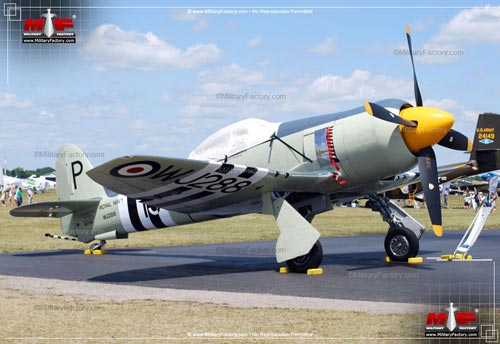
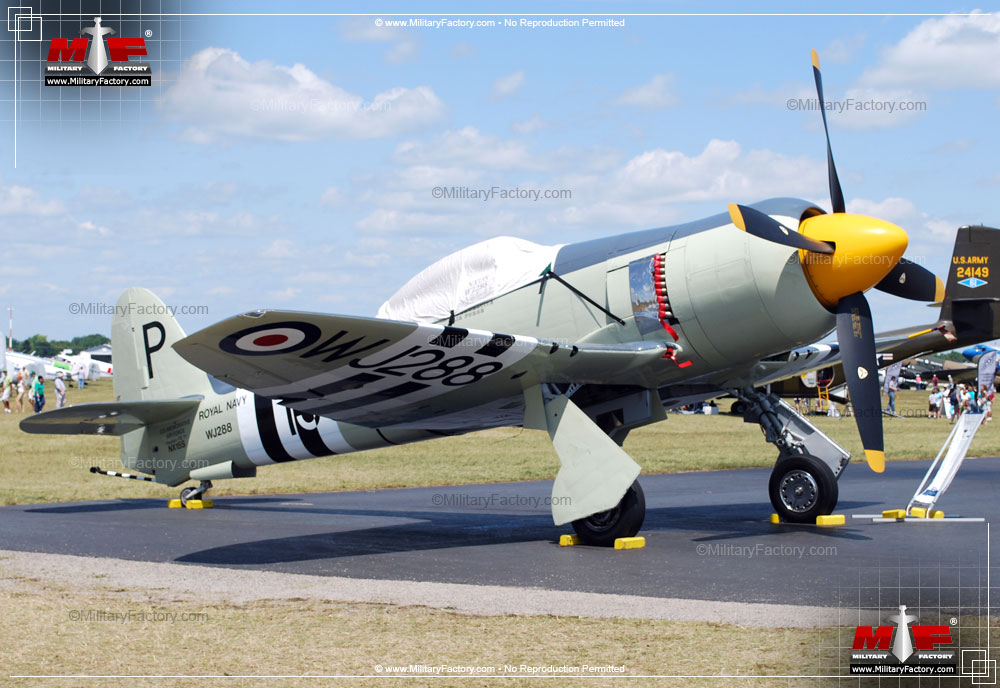
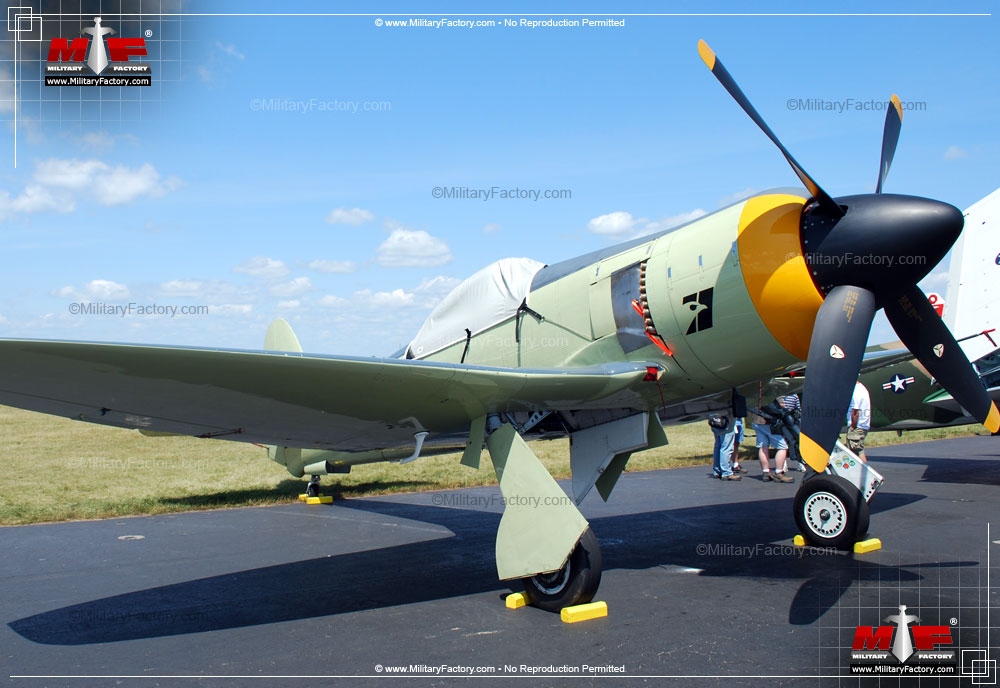
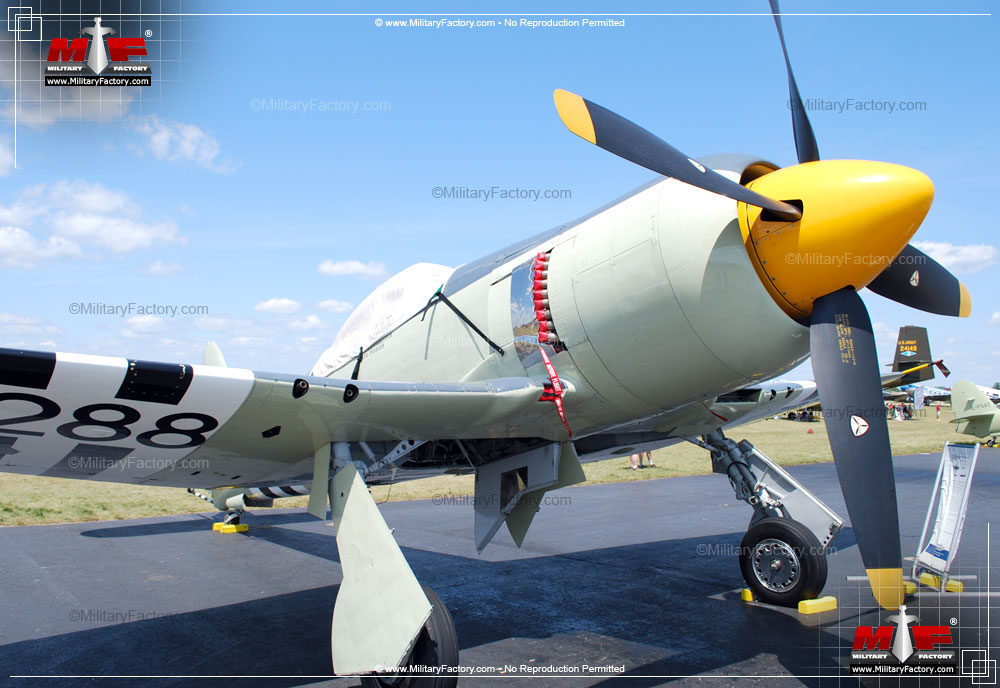
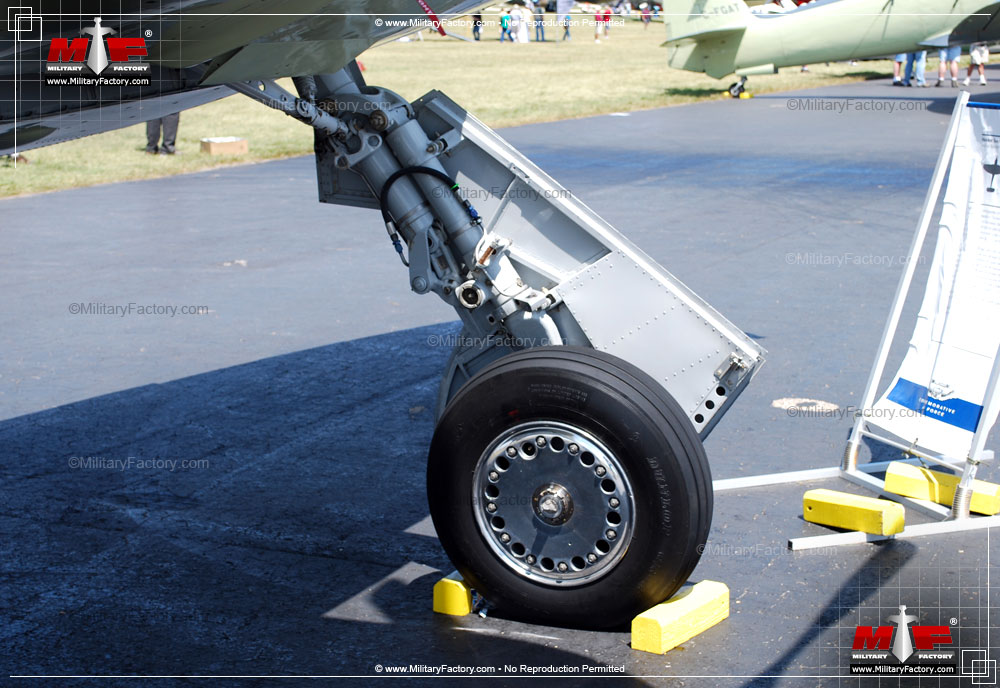
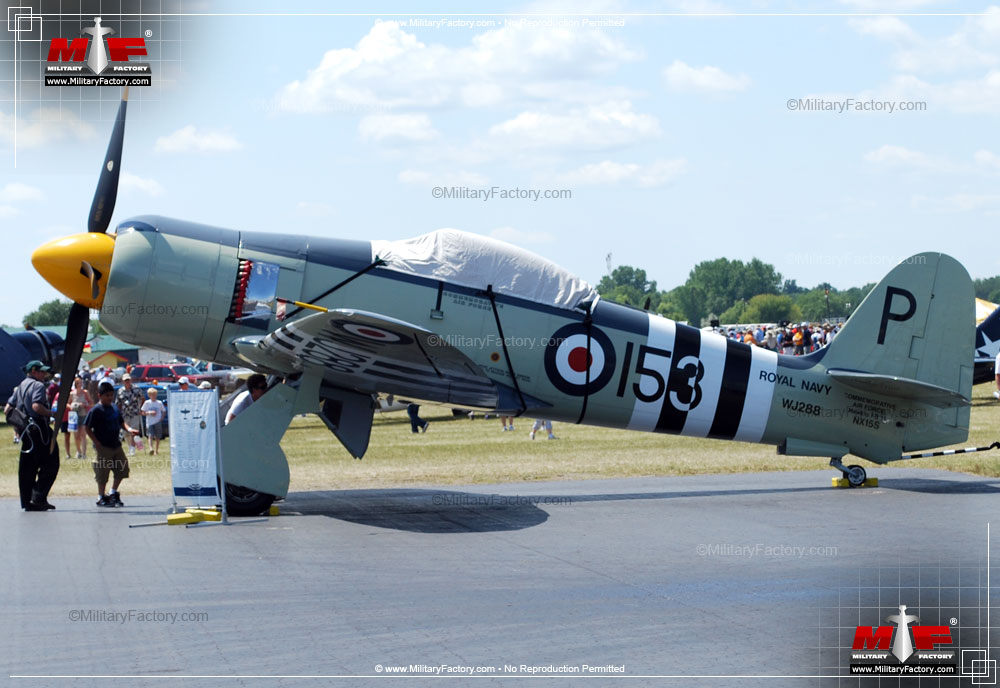
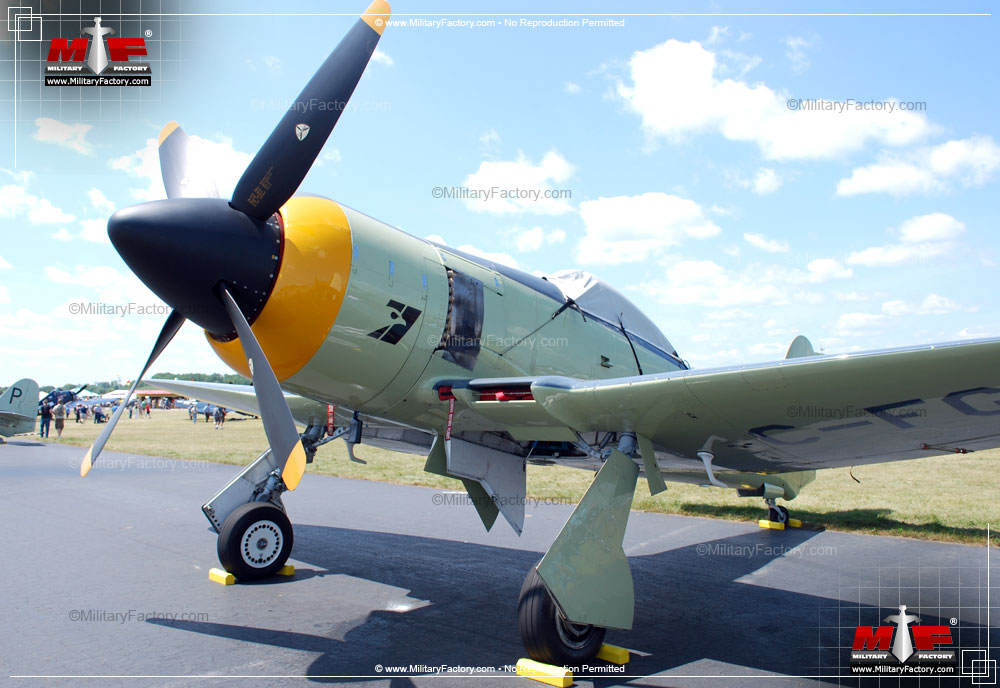
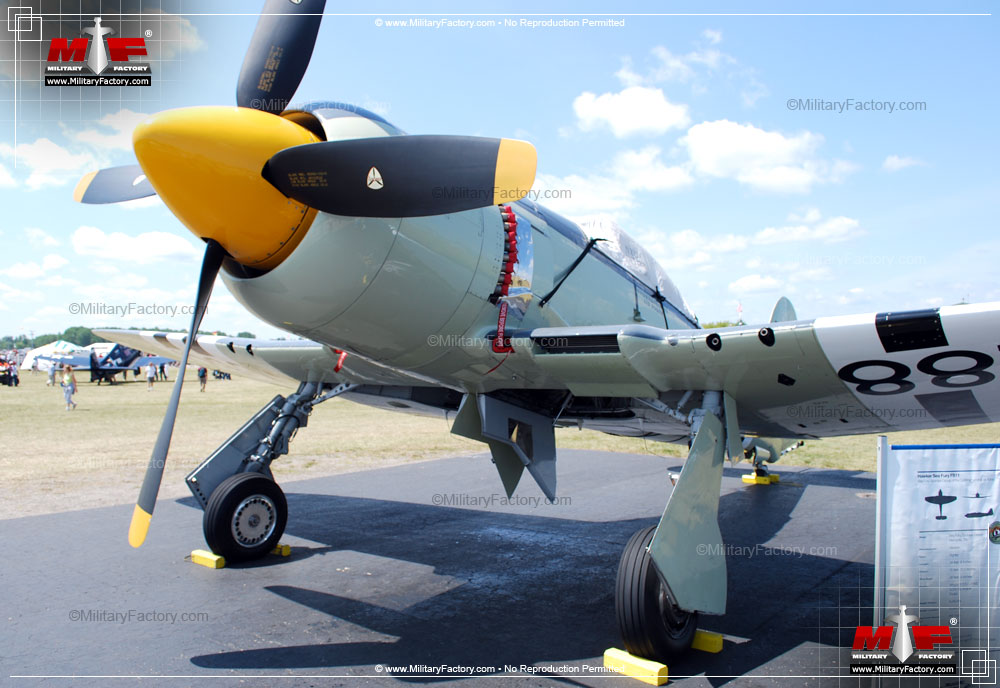
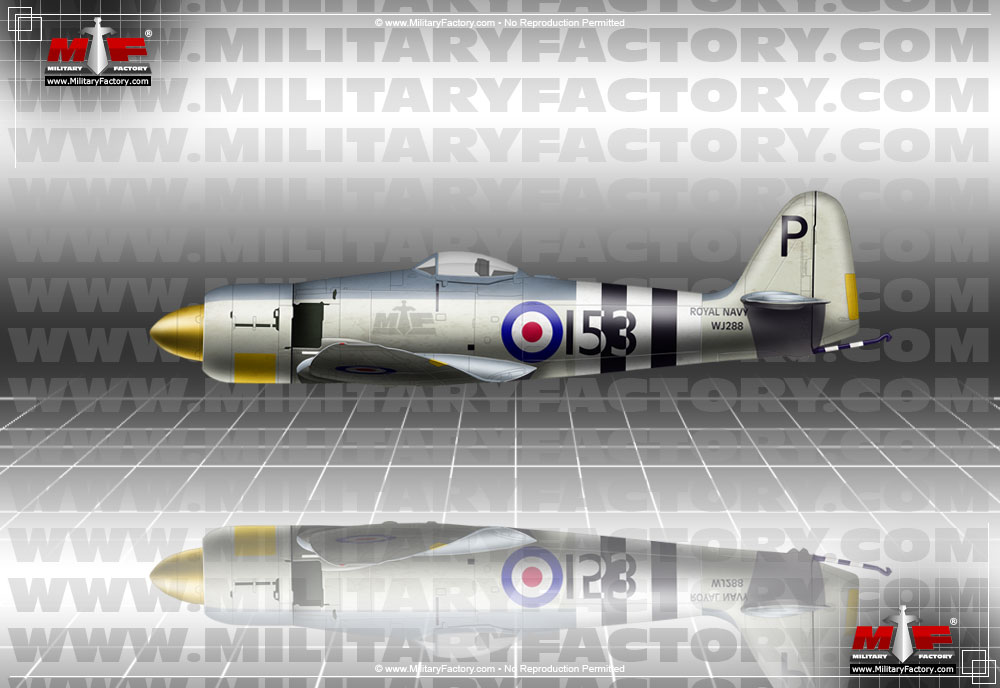
Design-wise, the Sea Fury sported a slim, streamlined monocoque-constructed fuselage. The engine was mounted at the extreme forward portion with a large spinner sitting in front of the radial-engine opening, controlling a five-bladed propeller system. Wings were low-mounted, semi-elliptical monoplanes with straight-edged wingtips while having the ability to fold just outboard of the main landing gears (a must for carrier-oriented operations). The pilots seating position was above and behind the wings and engine, some distance away from the nose of the aircraft but his view from the cockpit was reportedly quite good considering the cockpit was covered over in a tear-drop "bubble" canopy with framing allotted only to the forward windshield portion. The cockpit also sat high on the design, different in the design approach used in the Tempest. The empennage featured a conventional single vertical tail fin and appropriate horizontal planes, all with rounded edges. Being of World War 2 origin, the Sea Fury was fitted with a conventional "tail dragger" undercarriage arrangement consisting of two main forward landing gears and a single tail wheel. All three systems were fully retractable with the forward landing gears recessing inwards towards the centerline of the fuselage. In all respects and despite it being smaller than the Tempest, the Sea Fury was a very large and imposing fighter design even when viewed at rest on the ground.

As a fighter, the Sea Fury pilot was in good hands with the ability to bring 4 x 20mm Hispano Mk V series cannons to bear on his target. Two cannons were mounted to a wing with applicable ammunition stores for each system. In its fighter-bomber role, the Sea Fury could call upon the use of up to 2,000lbs of external mixed ordnance or up to 12 x 3" (76mm) high-velocity, high-explosive rockets mounted under the wings. Drop tanks were also an option for increased ranges.

The definitive and most-produced fighter-bomber FB.Mk 11 was powered by a single Bristol-brand Centaurus XVIIC, 18-cylinder, twin-row, air-cooled, radial piston engine. The engine had a listed output of up to 2,480 horsepower allowing for speeds of approximately 460 miles-per-hour at 18,000 feet. Cruise speeds fell to 390 miles-per-hour. Other reported performance specifications included a service ceiling of 35,800 feet with a rate-of-climb of up to 30,000 feet in just 10.8 minutes. Range was limited to 700 miles though this could be increased up to 1,040 miles with the addition of two wing-mounted fuel drop tanks.

The Hawker Sea Fury was produced in only a handful of major variants. This began with the Sea Fury F.Mk 10, a single-seat fighter version for the British Royal Navy. These first production examples were fitted with Centaurus XV series engines. The definitive and quantitative FB.MK 11 soon followed, this being a dedicated fighter-bomber derivative for use by the Royal Navy, the Royal Australian Navy and the Royal Canadian Navy (No. 871 Squadron of the HMCS Magnificent). Six-Hundred and Fifteen of this type were produced in all with 31 of these going to Australia and 53 of these to Canada. The T.Mk 20 represented a two-seat trainer for the Royal Navy of which 60 examples were produced. Ten of these were later converted as target tugs for West Germany.

The Sea Fury proved popular on the open market as well with the Royal Netherlands Navy taking on delivery of the F.Mk 50 single-seat fighters and the FB.Mk 51 single-seat fighter bombers. The Royal Netherlands Navy took on 24 such models and then acquired license-production rights to build 24 more locally under the Fokker brand. Pakistan utilized the type as the FB.Mk 60 in its single-seat, fighter-bomber guise as well as the two-seat T.Mk 61 trainer - both systems were used by the Pakistani Air Force. Iraq received the Fury F.Mk I for use as a single-seat, land-based fighter up to which some 55 were built and utilized by the Iraqi Air Force. This Fury became unofficially known as the "Baghdad Fury". Additionally, five Furies were delivered to Iraq in their two-seat trainer forms.

Other recipients of the Sea Fury included Burma, Cuba, Egypt and Morocco. Total production was approximately 860 examples of all aircraft with production running from 1945 through 1955.

Upon entering service in October of 1945 with the Royal Navy's Fleet Air Arm, the Sea Fury was quick to replace the Supermarine Seafires that were utilized throughout the Second World War. Supermarine Seafires were navalized versions of the hugely successful land-based Supermarine Spitfires - the "aircraft that won the war" for Britain - but were little more than an interim solution (as were Hawker Sea Hurricanes) for the Royal Navy and not at all dedicated naval fighters/interceptors like the Sea Fury.

The Fleet Air Arm (FAA) was assigned the F.Mk X Sea Fury into five squadrons (Nos. 778, 802, 803, 805 and 807). This was followed by deliveries of the definitive FB.Mk 11 model (designations were officially changed from Roman numerals beginning with this production model) with their Bristol Centaurus 2,480 horsepower engines, longer arrestor hooks and provisions for rocket-assisted take-offs (RATO) to Nos. 802,280, 804, 805 and 807 squadrons. The Royal Navy Volunteer Reserves replaced their Supermarine Seafire Mk 17s in 1951 with Sea Fury FB.11's beginning with Squadron No. 1822 and followed by Nos. 1831, 1833, 1834, 1845 and 1836 squadrons. The Sea Fury would remain a Fleet Air Arm mainstay up until 1953 with the system retired fully from operational service with the Royal Navy by 1955. In FAA service, the Sea Fury was eventually replaced by the more capable Hawker Sea Hawks and Supermarine Attackers.

The Royal Canadian Navy received their first Hawker Sea Furies in 1956. These Sea Furies numbered some 74 models of the fighter-bomber type and operated between 1948 and 1956 with No.871 Squadron from the deck of the HMCS Magnificent (CVL 21). Canada utilized the Sea Fury from land bases as well.

The Sea Fury was fielded in anger in the upcoming Korean War. These were of the FB.Mk 11 fighter-bomber marks where their multi-role capabilities could be put to good use. Sea Furies operated from various British and Australian carriers (HMS Glory, HMS Ocean, HMS Theseus and the HMAS Sydney) and were launched against ground targets across the peninsula often in conjunction with Fairey Fireflies as the Royal Navy's "heavy attack" element. Like their Tempest and Typhoon counterparts of World War 2, Sea Furies in Korea were used to good effect in the ground attack role. Not to be limited, the Sea Fury was also one of the few piston engine fighters to achieved an air kill over a jet when, on August 9th, 1952, a Sea Fury piloted by Lieutenant P "Hoagy" Carmichael successfully engaged and downed a North Korean Mikoyan-Gurevich MiG-15 fighter. This resulted in the only British air kill of the conflict. In any regard, Sea Fury involvement in the war solidified the aircrafts place in aviation history as one of the fastest and most potent piston-engined fighters ever made.

Cuban Air Force Sea Furies were later unleashed in anger in the American-sponsored "Bay of Pigs" invasion.

By all accounts, the Sea Fury proved a stable mount and a perfect crowning achievement to the Hawker aircraft trifecta when including the Typhoon and Tempest. Despite its cancellation by the RAF, Royal Navy use ensured that the legacy of the Sea Fury would continue. The Sea Fury proved its worth in a major world conflict and smaller global battles to follow until its inevitable retirement. Today, it remains a favorite among aviation enthusiasts and airplane racers the world over.
Text ©2003-2013 www.MilitaryFactory.com • All Rights Reserved • No Reproduction Permitted
MilitaryFactory.com does NOT sell equipment/weaponry. Material presented throughout this website is for historical and entertainment value and should not to be construed as usable for hardware restoration, maintenance or general operation. Please consult manufacturers for such information. Our disclaimer. Email corrections / Comments to MilitaryFactory at Gmail dot com.
Picture of Hawker Sea Fury / Fury
Pic of the Hawker Sea Fury / Fury
Image of the Hawker Sea Fury / Fury
View All Images (9)

Specifications for the
Hawker Sea Fury / Fury
Carrierbased Fighter-Bomber


Country of Origin: United Kingdom
Manufacturer: Hawker - UK
Initial Year of Service: 1945
Production: 860


Focus Model: Hawker Sea Fury FB.Mk 11
Crew: 1


Length: 34.65ft (10.56m)
Width: 38.35ft (11.69m)
Height: 15.78ft (4.81m)
Weight (Empty): 9,017lbs (4,090kg)
Weight (MTOW): 12,498lbs (5,669kg)


Powerplant: 1 x Bristol Centaurus 18 2-row sleeve-valve radial engine developing 2,480hp.


Maximum Speed: 460mph (740kmh; 400kts)
Maximum Range: 760miles (1,223km)
Service Ceiling: 36,089ft (11,000m; 6.8miles)
Rate-of-Climb: 4,320 feet per minute (1,317m/min)


Hardpoints: 4
Armament Suite:
4 x 20mm Hispano Mk V cannons

OPTIONAL:
12 x 3" unguided rockets
2 x drop tanks
Up to 2,000lbs of external ordnance


Variants:
Fury - Cancelled Royal Air Force land-based fighter.


Sea Fury - Royal Navy carrier-based fighter; folding wings; arrestor hook.

Sea Fury F.Mk X - Base Naval Fighter; single-seat version for use by British Royal Navy.

Sea Fury FB.Mk 11 - Fighter-Bomber Variant; single-seat; used by British, Australian and Canadian navies.

Sea Fury T.MK 20 - British Royal Navy Two-Seat Trainer.

Sea Fury F.Mk 50 - Netherlands Export Model; Navy single-seat fighter.

Sea Fury FB.Mk 51 - Netherlands Export Model; Navy single-seat fighter-bomber.

Sea Fury FB.Mk 60 - Pakistan Export Model; Air Force single-seat fighter-bomber variant.

Sea Fury T.Mk 61 - Pakistan Export Model; Air Force two-seat trainer variant.

Fury F.Mk I ("Baghdad Fury") - Iraqi Export Model; land-based Air Force single-seat fighter; 55 examples produced.

Fury T.MK I (Trainer) - Iraqi Export Model; land-based Air Force two-seat trainer.


Operators:
Australia; Burma; Canada; Cuba; Egypt; Germany; Morocco; Netherlands; Pakistan; United Kingdom

ALL AIRCRAFT CATEGORIES

BY DECADE:


1900 to 1909
1910 to 1919
1920 to 1929
1930 to 1939
1940 to 1949
1950 to 1959
1960 to 1969
1970 to 1979
1980 to 1989
1990 to 1999
2000 to 2009
2010 to 2019
2020 to 2029
VIEW ALL
Compare Aircraft


BY TYPE:


Anti-Submarine Warfare (ASW)
Attack Helicopters
Bomber Aircraft
Medium Bombers
Heavy Bombers
Close-Air Support (CAS)
Commercial Aircraft
Dive Bombers
Electronic Warfare Aircraft (EWA)
Experimental / X-Planes
Fighter Aircraft
Floatplane Aircraft
Flying Boat Aircraft
Aerial Refueling Tankers
Helicopters (ALL)
Interceptor Aircraft
Multi-Role Aircraft
Navy Carrier Aircraft
Night Fighters
Reconnaissance / Scout
Search & Rescue (SAR)
Scout Helicopters
Special Purpose
Torpedo Bombers
Trainer Aircraft
Transport Aircraft
Transport Helicopters
Unmanned Aerial Vehicles (UAVs)
Unmanned Combat Air Vehicles (UCAVs)


COLLECTIONS:


4th Generation Fighter Aircraft
5th Generation Fighter Aircraft
US X-Planes
Classic US Warbirds
French Military Helicopters
Grumman "Cats"
Howard Hughes Aircraft
Indian Air Force
Israeli Air Force
Libyan Aircraft
Modern Chinese Aircraft
Modern Chinese Fighters
Modern Military Aircraft
Modern North Korean Aircraft
Modern Trainer Aircraft
Modern US Aircraft
Mikoyan Aircraft
Sukhoi Aircraft
Syrian Aircraft
Top 10 Fighter Aircraft of All Time


AIRCRAFT BY CONFLICT:


Arab-Israeli War (1948)
Cuban Missile Crisis (1959-1962)
Falklands War (1982)
Indo-Pak War (1965, 1971)
Iran-Iraq War (1980-1988)
Lebanon War (1982)
Operation Allied Force (1999)
Operation Desert Storm (1991)
Six Day War (1967)
Spanish Civil War (1936)
Soviet-Afghan War (1979-1989)
Yom Kippur War (1973)


MISCELLANEOUS:


Aircraft Cockpits
Aircraft Manufacturers List
Aircraft Production
Aircraft Timeline

WORLD WAR 2:


1939 Aircraft
1940 Aircraft
1941 Aircraft
1942 Aircraft
1943 Aircraft
1944 Aircraft
1945 Aircraft
1946 Aircraft
Australian Aircraft
Battle of Britain Aircraft
Bombers
Four-Engine Bombers
British Aircraft
British Bombers
British Transports
Dive Bombers
Canadian Aircraft
Fighters
Chinese Aircraft
French Aircraft
German Aircraft
German Fighters
German Flying Boats
German Jets
Secret Weapons of the Luftwaffe
Italian Aircraft
Imperial Japanese Aircraft
Imperial Japanese Fighters
Mitsubishi Bombers
Navy Aircraft
Pearl Harbor
Polish Aircraft
Romanian Aircraft
US Aircraft
US Bombers
US Navy Aircraft
Soviet Aircraft
Torpedo Bombers
Trainer Aircraft
Transport Aircraft
Tuskegee Airmen Aircraft
W.A.S.P. Aircraft
WW2 Aircraft Ranked by Speed
VIEW ALL


WORLD WAR 1:


1914 Aircraft
1915 Aircraft
1916 Aircraft
1917 Aircraft
1918 Aircraft
Aircraft Timeline
Austro-Hungarian Aircraft
Bomber Aircraft
British Aircraft
Fighters
Flying Boats
French Aircraft
Imperial German Aircraft
Italian Aircraft
Scout Aircraft
Russian Empire Aircraft
US Aircraft
WW1 Aircraft Ranked by Speed
VIEW ALL


KOREAN WAR:


Australian Aircraft
Korean War Aces
Korean War Jets
North Korean Aircraft
US Military Aircraft
VIEW ALL


VIETNAM WAR:


Helicopters (ALL)
Transport Helicopters
North Vietnam Air Force
US Airpower
VIEW ALL


COLD WAR:


1950s French Aircraft
British V-Bombers
Cold War Bombers
Soviet Aircraft
Soviet Bombers
Soviet Interceptors
Soviet Helicopters
Strategic Air Command
US Aircraft
US Bombers
US Interceptors
VIEW ALL

Site Disclaimer | Privacy Policy | Site Map | MF Origins


©2013 www.MilitaryFactory.com • Content ©2003-2013 MilitaryFactory.com • All Rights Reserved • Site Contact Email: militaryfactory at gmail dot com. The "Military Factory" name and MilitaryFactory.com logo are registered ® trademarks and protected by all applicable domestic and international intellectual property laws.


Top MF Stuff: 2013 Military Pay Scale | Military Ranks | WW2 Weapons | Sniper Rifles | Kts to Mph | WW1 Aircraft | Automatic Rifles | Aircraft Cockpits | Vietnam War Weapons | Main Battle Tanks | Submachine Guns | Shotguns | French Military Victories


Most photographic images appearing on this site are courtesy of the United States Department of Defense and are approved for public use. Other images acquired through the public domain. Digital art work courtesy of Dan Alex. Business Consulting by Kyle Williams. Material presented throughout this website is for historical and entertainment value and should not to be construed as usable for hardware restoration, maintenance or general operation. Please consult manufacturers for such information.


eXTReMe Tracker