Military Factory
Military Pay Chart
Global Firepower
Military Industrial Complex
Second World War
Home
Military Pay Scale
Military Ranks
Small Arms
Aircraft
Land Systems
Navy
Education
Military Factory Facebook Logo
flag of United Kingdom

Royal Aircraft Factory F.E.2 Reconnaissance / Fighter / Night Bomber Aircraft (1915)

Authored By Staff Writer | Last Updated: 11/12/2008

The F.E.2 series was a pivotal Allied performer during the Fokker Scourge and later went on to become a capable night bomber.

The F.E.2 series of aircraft were produced by the Royal Aircraft Factory and had their origins in the F.E.1, a 1910 design by the Farman Brothers of France. Geoffrey de Havilland joined the Royal Aircraft Factory and brought with him this design in the newer F.E.2 form. The F.E.2 series featured a "pusher" type engine layout and tandem seating of a pilot at the rear position and his observer/gunner in the forward cockpit. The type served from 1914 up through the end of the war, playing an instrumental role in turning back the tide of the Fokker Scourge of 1915-1916, and was later relegated to homeland defense and night bombing sorties by the end of its operational tenure as its design was made obsolete. Over 2,300 total F.E.2's were produced.

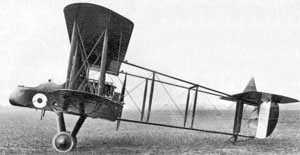
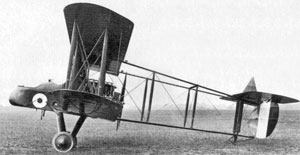
The first F.E.2 appeared in 1911 based in some part on the F.E.1 design with a further F.E.2 development coming in 1913 - the latter eventually lost to a fatal crash. The F.E.2a appeared shortly as a completely new aircraft and designed from the outset as a dedicated fighter platform. The system featured the pusher-type engine layout in which the engine output "pushed" the aircraft forward as opposed to the engine "pulling" the frame. This layout was brought about as a matter of necessity since technology to allow a machine gun to fire through a spinning propeller blade was still on the drawing boards for the Allies (the Germans having early success in solving the issue via Anthony Fokker's interrupter gear). Either the engine was mounted at the rear or the weapon would have to be positioned somewhere over or under the spinning propeller blades with the engine mounted at front. The former method was chosen, forcing the observer/gunner to be placed at the front of the fuselage with his machine gun and the pilot at the rear with the aircrafts main controls. To aid visibility for the pilot, his seating was stepped above his observer's position.

This provided obvious benefits and dangers. The gunner was provided an excellent view of the oncoming action. The pilot was also afforded good vision all around his aircraft due to his lofty position (the strut and wire framework of the aircraft no doubt assisted in this department some). Problems lay in the open-air nature of the layout. In particular, having the propeller exposed to anything that might fly out of either cockpit could prove fatal. Consequently, the spinning propeller blades provided some deflection against enemy bullets from the rear. Should a crash land be imminent, the crew would have to take into consideration the weight of the engine following behind them and the flammable fuel to go along with it. Pusher propellers, as history would eventually show us, have never lived up to the performance capabilities of their puller brethren either, setting up the F.E.2 series at a technological disadvantage from the start.

Principle armament for the observer was a single 7.7mm Lewis machine gun, placed on a trainable mount. With his great field of view and firing arc, the observer was capable of handling most any target ahead of the aircraft. Interestingly enough, a second Lewis machine gun was later added, this one facing to the rear and mounted on the surface of the top wing assembly, requiring the observer to stand in his cockpit to fire the weapon. In theory, this provided the F.E.2 some defense from rear-approaching attackers but in actuality this made for a very dangerous situation for the observer to be in considering any action taken by the pilot could result in the observer being thrown overboard.

The F.E.2a model appeared as a limited production batch, numbering some twelve examples. This was followed by the more capable F.E.2b which replaced the previous Green-brand engines with Beardmore types of 120 horsepower (later upped to 160 horsepower). The F.E.2b became the main production model and was followed by an F.E.2c and F.E.2d model. The former was an experimental platform tested as a night fighter/bomber with switched positions for pilot and observer unlike the F.E.2b layout. The latter was a more powerful type fitted with a Rolls-Royce Eagle engine with an impressive output of some 250 horsepower increasing performance and overall power somewhat. Defensive armament was also increased with additional forward-fixed machine guns operated by the pilot.

Overall, the F.E.2 series lead a long and distinguished career as both fighter and bomber. Though outclassed by later models on both sides, the aircraft still maintained an operational role for quite some time despite this. The F.E.2 proved to be a difference maker during the crucial months of the Fokker Scourge, fielded alongside Bristol Scouts and others. Her apparent limitations as a day-time performer eventually led to her being used successful as a night bomber and night fighter (against the slower-moving German threats like Zeppelins and bombers). The F.E.2 proved a noticeable adversary by war's end, being responsible for the downing of German ace Max Immelmann (though this was disputed by the Germans, accounting his loss to "friendly fire").
Text ©2003-2013 www.MilitaryFactory.com • All Rights Reserved • No Reproduction Permitted
MilitaryFactory.com does NOT sell equipment/weaponry. Material presented throughout this website is for historical and entertainment value and should not to be construed as usable for hardware restoration, maintenance or general operation. Please consult manufacturers for such information. Our disclaimer. Email corrections / Comments to MilitaryFactory at Gmail dot com.
Picture of Royal Aircraft Factory F.E.2
View All Images (1)

Specifications for the
Royal Aircraft Factory F.E.2
Reconnaissance / Fighter / Night Bomber Aircraft


Country of Origin: United Kingdom
Manufacturer: Royal Aircraft Factory / G&J Weir / Bouton & Paul LTD / Ransomes / Sims & Jeffries - UK
Initial Year of Service: 1915
Production: 2,339


Focus Model: Royal Aircraft Factory F.E.2b
Crew: 2


Length: 32.25ft (9.83m)
Width: 47.74ft (14.55m)
Height: 12.63ft (3.85m)
Weight (Empty): 1,993lbs (904kg)
Weight (MTOW): 2,970lbs (1,347kg)


Powerplant: 1 x Beardmore liquid-cooled in-line piston engine developing 120hp.


Maximum Speed: 80mph (129kmh; 70kts)
Maximum Range: 0miles (0km)
Service Ceiling: 9,006ft (2,745m; 1.7miles)
Rate-of-Climb: 0 feet per minute (0m/min)


Hardpoints: 4
Armament Suite:
1 x 7.7mm Lewis trainable machine gun in observer/gunner's cockpit.
1 x 7.7mm Lewis machine gun in upper wing facing rearward.

Up to 517lbs of light external ordnance.

F.E.2d:
1 OR 2 x 7.7mm Lewis machine gun(s) forward-facing (operated by pilot)


Variants:
F.E.2 - Base Series Designation based on the French Farman Brothers F.E.1 design.


F.E.2a - Two-Seat Fighter; initial production model; powered by Green series engine; 12 examples produced.

F.E.2b - Definitive Production Model; powered by Beardmore liquid-cooled in-line piston engine of 120 horsepower (later increased to 160 horsepower); sans airbrake; 1,939 produced; relegated to nightbombing in later years.

F.E.2c - Experimental Nightfighter / Bomber Variant; limited production examples; pilot and gunner seating flipped in this model to have pilot in front cockpit and gunner in rear.

F.E.2d - Fitted with Rolls-Royce Eagle engines of 250 horsepower; increased maximum altitude; improved payload; optional pilot-operated machine guns; 386 examples produced.


Operators:
Australia, China, United Kingdom and the United States of America.

ALL AIRCRAFT CATEGORIES

BY DECADE:


1900 to 1909
1910 to 1919
1920 to 1929
1930 to 1939
1940 to 1949
1950 to 1959
1960 to 1969
1970 to 1979
1980 to 1989
1990 to 1999
2000 to 2009
2010 to 2019
2020 to 2029
VIEW ALL
Compare Aircraft


BY TYPE:


Anti-Submarine Warfare (ASW)
Attack Helicopters
Bomber Aircraft
Medium Bombers
Heavy Bombers
Close-Air Support (CAS)
Commercial Aircraft
Dive Bombers
Electronic Warfare Aircraft (EWA)
Experimental / X-Planes
Fighter Aircraft
Floatplane Aircraft
Flying Boat Aircraft
Aerial Refueling Tankers
Helicopters (ALL)
Interceptor Aircraft
Multi-Role Aircraft
Navy Carrier Aircraft
Night Fighters
Reconnaissance / Scout
Search & Rescue (SAR)
Scout Helicopters
Special Purpose
Torpedo Bombers
Trainer Aircraft
Transport Aircraft
Transport Helicopters
Unmanned Aerial Vehicles (UAVs)
Unmanned Combat Air Vehicles (UCAVs)


COLLECTIONS:


4th Generation Fighter Aircraft
5th Generation Fighter Aircraft
US X-Planes
Classic US Warbirds
French Military Helicopters
Grumman "Cats"
Howard Hughes Aircraft
Indian Air Force
Israeli Air Force
Libyan Aircraft
Modern Chinese Aircraft
Modern Chinese Fighters
Modern Military Aircraft
Modern North Korean Aircraft
Modern Trainer Aircraft
Modern US Aircraft
Mikoyan Aircraft
Sukhoi Aircraft
Syrian Aircraft
Top 10 Fighter Aircraft of All Time


AIRCRAFT BY CONFLICT:


Arab-Israeli War (1948)
Cuban Missile Crisis (1959-1962)
Falklands War (1982)
Indo-Pak War (1965, 1971)
Iran-Iraq War (1980-1988)
Lebanon War (1982)
Operation Allied Force (1999)
Operation Desert Storm (1991)
Six Day War (1967)
Spanish Civil War (1936)
Soviet-Afghan War (1979-1989)
Yom Kippur War (1973)


MISCELLANEOUS:


Aircraft Cockpits
Aircraft Manufacturers List
Aircraft Production
Aircraft Timeline

WORLD WAR 2:


1939 Aircraft
1940 Aircraft
1941 Aircraft
1942 Aircraft
1943 Aircraft
1944 Aircraft
1945 Aircraft
1946 Aircraft
Australian Aircraft
Battle of Britain Aircraft
Bombers
Four-Engine Bombers
British Aircraft
British Bombers
British Transports
Dive Bombers
Canadian Aircraft
Fighters
Chinese Aircraft
French Aircraft
German Aircraft
German Fighters
German Flying Boats
German Jets
Secret Weapons of the Luftwaffe
Italian Aircraft
Imperial Japanese Aircraft
Imperial Japanese Fighters
Mitsubishi Bombers
Navy Aircraft
Pearl Harbor
Polish Aircraft
Romanian Aircraft
US Aircraft
US Bombers
US Navy Aircraft
Soviet Aircraft
Torpedo Bombers
Trainer Aircraft
Transport Aircraft
Tuskegee Airmen Aircraft
W.A.S.P. Aircraft
WW2 Aircraft Ranked by Speed
VIEW ALL


WORLD WAR 1:


1914 Aircraft
1915 Aircraft
1916 Aircraft
1917 Aircraft
1918 Aircraft
Aircraft Timeline
Austro-Hungarian Aircraft
Bomber Aircraft
British Aircraft
Fighters
Flying Boats
French Aircraft
Imperial German Aircraft
Italian Aircraft
Scout Aircraft
Russian Empire Aircraft
US Aircraft
WW1 Aircraft Ranked by Speed
VIEW ALL


KOREAN WAR:


Australian Aircraft
Korean War Aces
Korean War Jets
North Korean Aircraft
US Military Aircraft
VIEW ALL


VIETNAM WAR:


Helicopters (ALL)
Transport Helicopters
North Vietnam Air Force
US Airpower
VIEW ALL


COLD WAR:


1950s French Aircraft
British V-Bombers
Cold War Bombers
Soviet Aircraft
Soviet Bombers
Soviet Interceptors
Soviet Helicopters
Strategic Air Command
US Aircraft
US Bombers
US Interceptors
VIEW ALL

Site Disclaimer | Privacy Policy | Site Map | MF Origins


©2013 www.MilitaryFactory.com • Content ©2003-2013 MilitaryFactory.com • All Rights Reserved • Site Contact Email: militaryfactory at gmail dot com. The "Military Factory" name and MilitaryFactory.com logo are registered ® trademarks and protected by all applicable domestic and international intellectual property laws.


Top MF Stuff: 2013 Military Pay Scale | Military Ranks | WW2 Weapons | Sniper Rifles | Kts to Mph | WW1 Aircraft | Automatic Rifles | Aircraft Cockpits | Vietnam War Weapons | Main Battle Tanks | Submachine Guns | Shotguns | French Military Victories


Most photographic images appearing on this site are courtesy of the United States Department of Defense and are approved for public use. Other images acquired through the public domain. Digital art work courtesy of Dan Alex. Business Consulting by Kyle Williams. Material presented throughout this website is for historical and entertainment value and should not to be construed as usable for hardware restoration, maintenance or general operation. Please consult manufacturers for such information.


eXTReMe Tracker