Military Factory
Military Pay Chart
Global Firepower
Military Industrial Complex
Second World War
Home
Military Pay Scale
Military Ranks
Small Arms
Aircraft
Land Systems
Navy
Education
Military Factory Facebook Logo
flag of Imperial Japan

Mitsubishi Ki-46 (Dinah) Reconnaissance / Heavy Fighter / Bomber Interceptor (1941)

Authored By Staff Writer | Last Updated: 3/2/2012

The Mitsubishi Ki-46 began as a reconnaissance aircraft and was later developed into a heavy fighter intended to intercept Allied bombers.

Find a School Near You
Follow Military Factory on Facebook:
Trending on Military Factory:
Recent Articles:
Since May of 1937, the Empire of Japan - both the Imperial Japanese Army Air Force and the Imperial Japanese Navy Air Service branches - relied on the Mitsubishi Ki-15 aircraft for light bombing and reconnaissance sorties. The aircraft featured an enclosed cockpit for two, a low monoplane wing assembly and spatted main landing gear legs, the latter in a permanently fixed positions. About 500 of these aircraft stocked Japanese inventories and only a few developed variants existed. In December of 1937, a new requirement came down from the Japanese air force for a long-range, fast reconnaissance platform to succeed the outgoing Ki-15.

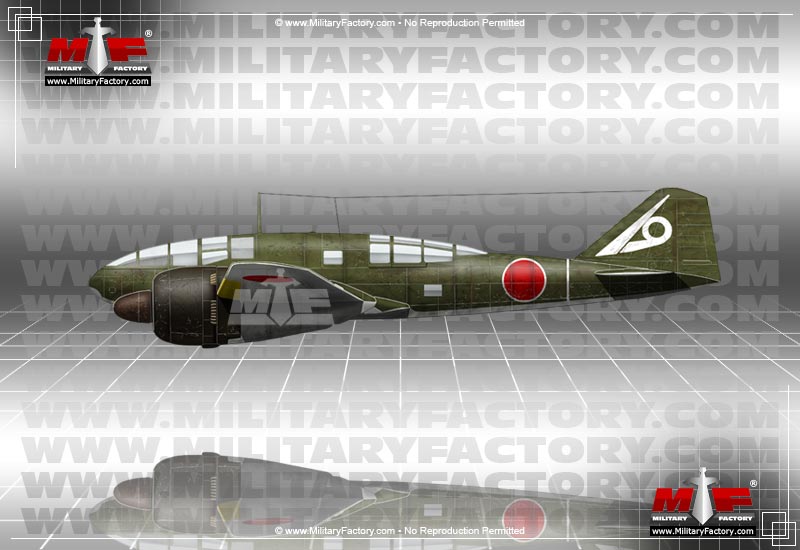
The Mitsubishi concern returned with an all-new design that held some basic similarities to the Ki-15 in that it used two crew and held low-set monoplane wings. The new aircraft sported a well rounded fuselage with each wing fitting a streamlined engine nacelle powering three-bladed propellers. The fuselage design tapered off into the empennage which was capped by a single - rather cropped - vertical tail fin with applicable tailplanes. The crewed would sit in two segregated cockpits - the pilot in a forward compartment and the observer/rear gunner in a rear compartment ahead of the tail. To fulfill the long-range requirement, fuel was stored in multiple locations about the design including a large storage tank fitted between the forward and aft cockpits. Mitsubishi-brand radial piston engines were fitted into specially-designed streamlined nacelles that complimented the aerodynamic qualities of the aircraft. Armament consisted of only a single self-defense Type 89 machine gun set in a rear-firing position to help protect the aircraft's vulnerable "six". Construction of a prototype ensued and produced the "Ki-46" designation.

First flight of the Ki-46 was recorded on November of 1939 which proved her engines lacked the required output power and overall speed envisioned by the IJAAF. Worked continued on the type and a new Mitsubishi powerplant (Ha.26-I radial of 900 horsepower) was fitted while the IJAAF - satisfied with the aircraft's short-term outlook - ordered serial production of the Ki-46. The newer Ki-46-I reconnaissance version was introduced in July of 1941 and immediately made its mark in service to the IJAAF. 34 examples of this type were completed before manufacture switched to the definitive Ki-46-II refined production form of which 1,093 examples were completed.

First combat operations for the Ki-46 saw her acting over both Manchukuo and China before branching out further into the Pacific. Within time, the aircraft proved a regular sight in the skies across other territories for, from the outset, the Ki-46 was an excellent performing aircraft highly suitable for the fast, high-level reconnaissance role originally envisioned. Its inherent speed made her virtually immune to ground-based fire and assault from enemy interceptors. Such dominance allowed a certain feeling of superiority for the IJAAF and this was used to a grand advantage for as long as this dominance lasted. The Ki-46 would go on to become one of the best reconnaissance aircraft of the war.

However, Japanese authorities were not blind to advancements being made on the Allied side. Basic fighter designs were all being put through new paces and completed with evermore improved performance specifications themselves. To stay ahead of the curve, the IJAAF charged Mitsubishi with evolving the Ki-46-II into an improved form through the installation of more capable engines. Mitsubishi engineers also took to refining key aerodynamic features of the airframe including the nose - now sporting a smoother, all-glazed look. The modified version first took to the air in December of 1942 and proved faster than the first incarnation. The aircraft was adopted as the Ki-46-III and 613 examples were delivered.

By the end of the war in 1945, a desperate Japanese defensive campaign saw the ki-46 series converted into an ad hoc heavily-armed interceptor platform. The main threat to the Japanese mainland now came from the high-altitude Boeing B-29 Superfortress which could essentially act with its own level of impunity over Japanese defenses and out of reach of enemy interceptors. As a bomber interceptor, armament of the Ki-46 was upgraded to include 2 x 20mm cannons in the nose and 1 x 37mm cannon in an oblique firing position. The latter armament was intended to engage bombers from the rear and underneath - the most vulnerable area of an enemy bomber when in flight. These versions (Ki-46-III-KAI) proved adequate for the role conversion but were not as successful as anticipated. The airframe was simply not designed for the sustained firing of the large-caliber 37mm cannon, especially in its semi-vertical fitting, and the aircraft had trouble reaching its defined interception altitudes within time. Even when it did reach B-29 bombers, the aircraft lacked any armor protection or self-sealing fuel tanks and essentially made for target fodder against B-29 gunners. The Ki-46-III-KAI appeared in October of 1944 and was in operational service by the following month. When the American aircrews converted over the night operations, the tactical usefulness of the Ki-46-III interceptor was even less for they were never adapted to the night fighter role with radar or similar tracking facilities. The Ki-46-IIIb was a similar III-series mark though developed specifically for the ground attack role and produced sans the oblique-firing 37mm cannon. Several other experimental forms existed to test out engines but these came to naught while still others never materialized from the drawing boards.

The Ki-46 was officially retired in 1945 after the Japanese Empire fell to the Allies. Two were operated by the Chinese after the war for a short time after but their recorded use ended by the mid-1950s.

The formal name of the Ki-46 was "Type 100 Command Reconnaissance Aircraft" and she was known to Allied forces by the codename of "Dinah".
Text ©2003-2013 www.MilitaryFactory.com • All Rights Reserved • No Reproduction Permitted
MilitaryFactory.com does NOT sell equipment/weaponry. Material presented throughout this website is for historical and entertainment value and should not to be construed as usable for hardware restoration, maintenance or general operation. Please consult manufacturers for such information. Our disclaimer. Email corrections / Comments to MilitaryFactory at Gmail dot com.
Picture of Mitsubishi Ki-46 (Dinah)
View All Images (1)

Specifications for the
Mitsubishi Ki-46 (Dinah)
Reconnaissance / Heavy Fighter / Bomber Interceptor


Country of Origin: Imperial Japan
Manufacturer: Mitsubishi - Japan
Initial Year of Service: 1941
Production: 1,742


Focus Model: Mitsubishi Ki-46-III-KAI (Dinah)
Crew: 2


Length: 37.66ft (11.48m)
Width: 48.23ft (14.70m)
Height: 12.73ft (3.88m)
Weight (Empty): 8,446lbs (3,831kg)
Weight (MTOW): 13,730lbs (6,228kg)


Powerplant: 2 x Mitsubishi Ha-112II piston engines developing 1,500hp.


Maximum Speed: 391mph (630kmh; 340kts)
Maximum Range: 1,243miles (2,000km)
Service Ceiling: 34,449ft (10,500m; 6.5miles)
Rate-of-Climb: 1,970 feet per minute (600m/min)


Hardpoints: 0
Armament Suite:
Original:
1 x .303 caliber Type 89 machine gun in rear cockpit.

Ki-46-III-KAI:
2 x 20mm cannons in nose
1 x 37mm oblique-angled cannon in upper central fuselage.

Ki-46-IIIb:
2 x 20mm cannons in nose


Variants:
Ki-46 - Prototype Model Designation


Ki-46 I Type 100 - Reconnaissance Version based on the Army Type 100, or Mark I.

Ki-46 II (Mark 2) - Initial Production Model Designation.

Ki-46 II KAI - Trainer Model; seating for three personnel; based on the Ki-46 II.

Ki-46 III - Prototype Model Designation for improved Ki-46 model series; also serves as designation for Reconnaissance Model based on the Army Type 100, also known as the Mark III.

Ki-46 III KAI - Heavy Fighter / Interceptor Model based on the Army Type 100 model; fitted with 2 x 20mm cannons and 1 x 37mm cannon.

Ki-46 III - Strike Fighter Variant based on Army Type 100 sans 37mm cannon.

Ki-36 IIIb - Dedicated Ground Attack Model

Ki-46 IIIc - Proposed Model; unfinished.

Ki-46 IV - Prototype Model; fitted with 2 x Mitsubishi Ha-112-II RU series engines of 1,500 horsepower; increased fuel capacity; turbocompressor optimized.

Ki-46 IVa/b - Unfinished Reconnaissance/Fighter Platforms.


Operators: China; Imperial Japan

ALL AIRCRAFT CATEGORIES

BY DECADE:


1900 to 1909
1910 to 1919
1920 to 1929
1930 to 1939
1940 to 1949
1950 to 1959
1960 to 1969
1970 to 1979
1980 to 1989
1990 to 1999
2000 to 2009
2010 to 2019
2020 to 2029
VIEW ALL
Compare Aircraft


BY TYPE:


Anti-Submarine Warfare (ASW)
Attack Helicopters
Bomber Aircraft
Medium Bombers
Heavy Bombers
Close-Air Support (CAS)
Commercial Aircraft
Dive Bombers
Electronic Warfare Aircraft (EWA)
Experimental / X-Planes
Fighter Aircraft
Floatplane Aircraft
Flying Boat Aircraft
Aerial Refueling Tankers
Helicopters (ALL)
Interceptor Aircraft
Multi-Role Aircraft
Navy Carrier Aircraft
Night Fighters
Reconnaissance / Scout
Search & Rescue (SAR)
Scout Helicopters
Special Purpose
Torpedo Bombers
Trainer Aircraft
Transport Aircraft
Transport Helicopters
Unmanned Aerial Vehicles (UAVs)
Unmanned Combat Air Vehicles (UCAVs)


COLLECTIONS:


4th Generation Fighter Aircraft
5th Generation Fighter Aircraft
US X-Planes
Classic US Warbirds
French Military Helicopters
Grumman "Cats"
Howard Hughes Aircraft
Indian Air Force
Israeli Air Force
Libyan Aircraft
Modern Chinese Aircraft
Modern Chinese Fighters
Modern Military Aircraft
Modern North Korean Aircraft
Modern Trainer Aircraft
Modern US Aircraft
Mikoyan Aircraft
Sukhoi Aircraft
Syrian Aircraft
Top 10 Fighter Aircraft of All Time


AIRCRAFT BY CONFLICT:


Arab-Israeli War (1948)
Cuban Missile Crisis (1959-1962)
Falklands War (1982)
Indo-Pak War (1965, 1971)
Iran-Iraq War (1980-1988)
Lebanon War (1982)
Operation Allied Force (1999)
Operation Desert Storm (1991)
Six Day War (1967)
Spanish Civil War (1936)
Soviet-Afghan War (1979-1989)
Yom Kippur War (1973)


MISCELLANEOUS:


Aircraft Cockpits
Aircraft Manufacturers List
Aircraft Timeline

WORLD WAR 2:


1939 Aircraft
1940 Aircraft
1941 Aircraft
1942 Aircraft
1943 Aircraft
1944 Aircraft
1945 Aircraft
1946 Aircraft
Australian Aircraft
Battle of Britain Aircraft
Bombers
Four-Engine Bombers
British Aircraft
British Bombers
British Transports
Dive Bombers
Canadian Aircraft
Fighters
Chinese Aircraft
French Aircraft
German Aircraft
German Fighters
German Flying Boats
German Jets
Secret Weapons of the Luftwaffe
Italian Aircraft
Imperial Japanese Aircraft
Imperial Japanese Fighters
Mitsubishi Bombers
Navy Aircraft
Pearl Harbor
Polish Aircraft
Romanian Aircraft
US Aircraft
US Bombers
US Navy Aircraft
Soviet Aircraft
Torpedo Bombers
Transport Aircraft
Tuskegee Airmen Aircraft
W.A.S.P. Aircraft
WW2 Aircraft Ranked by Speed
VIEW ALL


WORLD WAR 1:


1914 Aircraft
1915 Aircraft
1916 Aircraft
1917 Aircraft
1918 Aircraft
Aircraft Timeline
Austro-Hungarian Aircraft
Bomber Aircraft
British Aircraft
Fighters
Flying Boats
French Aircraft
Imperial German Aircraft
Italian Aircraft
Scout Aircraft
Russian Empire Aircraft
US Aircraft
WW1 Aircraft Ranked by Speed
VIEW ALL


KOREAN WAR:


Australian Aircraft
Korean War Aces
Korean War Jets
North Korean Aircraft
US Military Aircraft
VIEW ALL


VIETNAM WAR:


Helicopters
North Vietnam Air Force
US Airpower
VIEW ALL


COLD WAR:


1950s French Aircraft
British V-Bombers
Cold War Bombers
Soviet Aircraft
Soviet Bombers
Soviet Interceptors
Soviet Helicopters
Strategic Air Command
US Aircraft
US Bombers
US Interceptors
VIEW ALL

Site Disclaimer | Privacy Policy | Site Map | MF Origins


©2013 www.MilitaryFactory.com • Content ©2003-2013 MilitaryFactory.com • All Rights Reserved • Site Contact Email: militaryfactory at gmail dot com. The "Military Factory" name and MilitaryFactory.com logo are registered ® trademarks and protected by all applicable domestic and international intellectual property laws.


Top MF Stuff: 2013 Military Pay Scale | Military Ranks | WW2 Weapons | Sniper Rifles | Kts to Mph | WW1 Aircraft | Automatic Rifles | Aircraft Cockpits | Vietnam War Weapons | Main Battle Tanks | Submachine Guns | Shotguns | French Military Victories


Most photographic images appearing on this site are courtesy of the United States Department of Defense and are approved for public use. Other images acquired through the public domain. Digital art work courtesy of Dan Alex. Business Consulting by Kyle Williams. Material presented throughout this website is for historical and entertainment value and should not to be construed as usable for hardware restoration, maintenance or general operation. Please consult manufacturers for such information.


eXTReMe Tracker