Military Factory
Military Pay Chart
Global Firepower
Military Industrial Complex
Second World War
Home
Military Pay Scale
Military Ranks
Small Arms
Aircraft
Land Systems
Navy
Education
Military Factory Facebook Logo
flag of Romania

IAR 80 / IAR 81 Fighter Aircraft (1941)

Authored By Staff Writer | Last Updated: 7/29/2011

Development of the serviceable IAR 80 was slow and, though the fighter was of a capable breed when it first appeared, the system was highly outclassed by 1944.

Find a School Near You
Follow Military Factory on Facebook:
Trending on Military Factory:
Recent Articles:
When first unveiled in 1938, the Romanian-produced I.A.R. 80 (IAR = Industria Aeronautica Romana) piston engine, single-seat fighter was a promising performer even when compared to her contemporaries. The aircraft served with the Royal Romanian Air Force and primarily appeared in two major variants designated simply as the IAR 80 and IAR 81. A total of 346 consisting of both aircraft types were known to be produced and the fighter pressed on into wartime service up to 1944, by which time it was all but made obsolescent by new and more powerful entries appearing on the global stage. The aircraft suffered throughout its production life due to a shortage of adequate armament to fit the design.

Development
The IAR 80 was born out of a 1930's Romanian fighter requirement. IAR was the only one of the three state-created aviation companies to answer the call locally, offering up several complete prototypes for review, while external providers were also considered. Though this original specification eventually netted the Polish company PZL the contract for its high-monoplane PZL P.11 series, IAR was clearly a player on the market. Future contracts were won by PZL over IAR's designs (PZL P.24) but IAR gained valuable knowledge by taking on license production of these Polish aircraft along with French designs as well.

The IAR design team proceeded in its fighter efforts and began "taking apart" the winning PZL P.24 design. The IAR design now incorporated the tail section and front-end fuselage of the PZL design into its own aircraft. The high-monoplane wings of previous PZL production fighters was abandoned in favor of the more modern low-wing monoplane mounting, this wing component said to be taken straight from an Italian Savoia-Marchetti bomber design. In essence, the IAR 80 would be pieced together from various successful working designs and re-engineered into a more capable platform. Even the open cockpit approach of the PZL designs were retained for the prototype.

By 1938, the first prototype was made available for flight, this aircraft sporting a IAR version of the French license-produced Gnome-Rhone 14K II Mistral Major engine - a powerplant brand that IAR had already achieved a good deal of experience constructing at their plant. Follow-up flights shown the IAR prototype to produce favorable results, particularly in the area of maneuverability, with a competently-arranged airframe to boot. The following year would be spent mostly on addressing several issues resulting from these test flights.

The new-look IAR.80 emerged with a new C36 930 horsepower engine in an lengthened fuselage to accommodate the powerplant. This change forced the cockpit position a ways back in the design to which the pilot's seat had to be raised and a bubble canopy added to improve his forward vision - particularly while taxiing along the ground. Along with these changes, additional fuel was added in the newly created fuselage spaces effectively increasing the aircrafts original intended range. Armament was just 2 x FN/Browning 7.92mm machine guns (production models were to mount a full suite of 6 x 7.92mm machine guns, all in the wings - three to a wing). A competition of the IAR 80 versus the impressive Heinkel He 112 series was put forth with the IAR design coming out ahead. Production of the IAR 80 immediately followed with an initial order of 100 examples though these were delayed with the fall of Belgium, as Fabrique-Nationale was the intended armaments supplier for the IAR 80.

The armament issue was somewhat rectified with the inclusion of Romania into the Axis fold. Since control of Belgium fell to the Germans, the alliance netted Romania the much-needed guns for its IAR 80 planes. This finally allowed the IAR 80 to begin its delivery schedule into Romanian air groups for some valuable operational experience. The first IAR 80 was made available in January of 1941, some three years after its first flight in prototype from. Production models were only allowed an armament suite of 4 x 7.92mm machine guns, however, which severely limited the types combat effectiveness to an extent. In-field feedback also resulted in the use of the K14-IV C32 series engine of 960 horsepower as many Romanian pilots felt the aircraft lacked much punch in terms of performance.

As the war progressed in Germany's favor, the IAR 80 benefitted by the delivery of more guns. This resulted in the aircraft now coming off the production lines with its full bevy of 6 x 7.92mm machine guns. A newer 1,025 horsepower engine (K14-1000A) engine was also fitted for improvements in performance and armor plating and a bulletproof windshield was added to the cockpit area. The IAR design in this new form was now designated as the IAR 80A, a production model now more in line with the IAR 80's intended form. These additions, however, came at a lofty price. The added weight of the new engine, extra machine guns and armor no doubt slowed the overall top speed of the aircraft, though these additions were seen as detrimental to improving the type for the long run. Production of IAR 80A models now superseded any of the pre-existing IAR 80 base types. The IAR 80 and IAR 80A were ready by the time of the German invasion of the Soviet Union, pitting the aircraft in actual combat against Soviet designs. The IAR 80A model series clocked in at 316 miles per hour with a 715 mile range and a ceiling of 31,200 feet.

Wartime experience of the IAR 80A showcased the aircraft to be weak in several areas. A follow-up design produced the IAR 80B (deliveries beginning mid-1942) with new longer wings and heavier-caliber 13.2mm machine gun armament for added offensive firepower and provision for underwing 2 x fuel drop tanks or 2 x bombs. The communications suite was also further upgraded. The base IAR 80 could hit 317 miles per hour and ceiling of 34,500 feet while achieving a range of 580 miles.

The similar IAR 81 was designed to fulfill the Romanian need for a dive bomber platform. Modifying the IAR 80A was an economical response to the requirement considering the atmosphere in Europe at the time. This dive bomber derivative eventually sported a centerline bomb rack position for 500lb ordnance and underwing racks mounting 110lb bombs as well. Follow-up variants to this design included the IAR 81A, IAR 81B and IAR 81C, differing mostly in armament types as they became available from the Germans. The IAR 81C hit a top speed of 342 miles per hour, a range of 454 miles and a ceiling of 31,200 feet.

Future variants of the fighter design included the IAR 80M (designation for an armaments upgrade standardization of IAR 80A/80B and IAR 81A/81B models) and the IAR 80DC (post-war trainer models).

Design
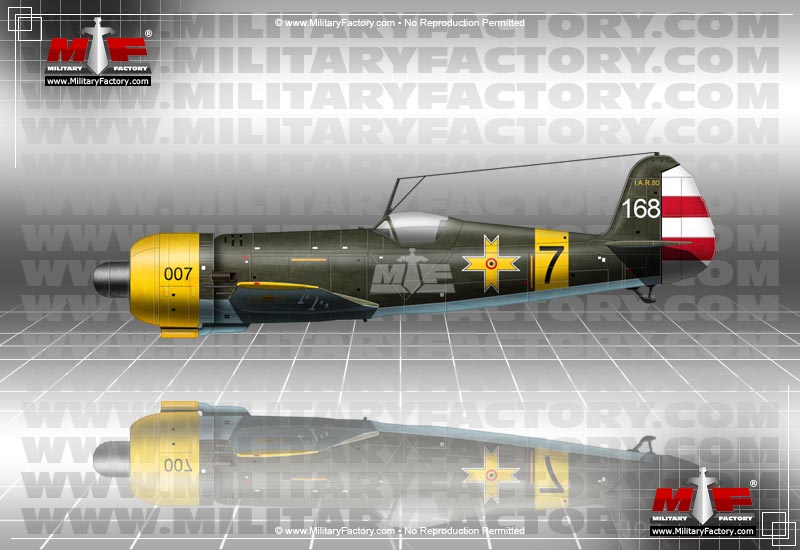
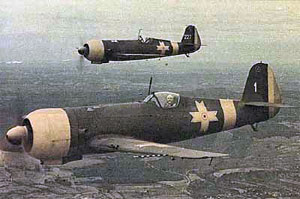
Design-wise, the base IAR 80 fighter displayed a very distinct layout when compared to her contemporaries, with the pilots position located well aft on the pencil-like fuselage, positioned behind of the wing trailing edges. A radial piston engine - a single IAR-produced K.14-IV C32 air-cooled radial, 14-cylinder double row of 960 horsepower - was used and made up a large portion of the forward fuselage. The low-wing monoplanes were fitted behind and below the engine compartment, well ahead of the cockpit - this was a necessity with changes brought about after the initial prototype was revised as mentioned earlier. The single seat cockpit featured a bubble style canopy offering good vision with the forward piece showcasing framing. The fuselage compacted into a tight empennage to which was adorned a traditional rudder and elevator assembly.

Armament
Armament of the base IAR 80 consisted of 4 x FN/Browning 7.92mm machine guns with 50 rounds per gun. These systems were mounted in the wings. The IAR 80A saw this armament increase to 6 x 7.92mm machine guns, again with 500 rounds to a gun. The IAR 81C retained the original 4 x 7.92mm machine gun armament but added 2 x MG 151/20 Mauser cannons to the mix, thanks to Romania's German alliance during the war.

Conclusion
In the end, the IAR 80 as a series was a limited success. With more potential early on to compete with the likes of other fabled designs, the Romanian air industry had to make due with what it could manifest. Tight control of supplies by their German overseers allowed the IAR 80 to suffer and limited production of the fighter to the extent that it played only a minor role in the conflict. The aircraft would serve in the Romanian air forces up until 1952, those these later models were nothing more than modified trainers, themselves replaced by more capable Soviet types. The IAR 80 made up no fewer than nine Romanian Air Force groups - numbering from the 1st to the 9th Fighter Group.
Text ©2003-2013 www.MilitaryFactory.com • All Rights Reserved • No Reproduction Permitted
MilitaryFactory.com does NOT sell equipment/weaponry. Material presented throughout this website is for historical and entertainment value and should not to be construed as usable for hardware restoration, maintenance or general operation. Please consult manufacturers for such information. Our disclaimer. Email corrections / Comments to MilitaryFactory at Gmail dot com.
Picture of IAR 80 / IAR 81
View All Images (1)

Specifications for the
IAR 80 / IAR 81
Fighter Aircraft


Country of Origin: Romania
Manufacturer: Industria Aeronautica Romana (IAR) - Romania
Initial Year of Service: 1941
Production: 346


Focus Model: IAR 80A
Crew: 1


Length: 30.25ft (9.22m)
Width: 29.82ft (9.09m)
Height: 12.53ft (3.82m)
Weight (Empty): 3,565lbs (1,617kg)
Weight (MTOW): 4,956lbs (2,248kg)


Powerplant: 1 x IAR K14-1000A air-cooled, 14-cylinder double row, radial piston engine delivering 1,025hp.


Maximum Speed: 308mph (495kmh; 267kts)
Maximum Range: 715miles (1,150km)
Service Ceiling: 31,168ft (9,500m; 5.9miles)
Rate-of-Climb: 0 feet per minute (0m/min)


Hardpoints: 0
Armament Suite:
4 x 7.92mm FN machine guns in wings


Variants:
IAR 80 - Base Production Model; 4 x 7.92mm machine guns; 170 total IAR 80 examples produced.


IAR 80A - 6 x 7.92mm machine guns; new gun sight; improved armor protection for the pilot.

IAR 80B - Lengthened Wings; improved radio equipment; provision for underwing bombs or fuel tanks; 13.2mm machine guns.

IAR 80M - Redesignated IAR 80A models to IAR 80C weapons standard of 4 x 7.92mm machine guns and 2 x 20mm cannons.

IAR 80DC - Two-Seat Trainer Conversion Model

IAR 81 – Fighter-Bomber Model; 176 IAR 81 examples produced.

IAR 81A - Fighter Model; 13.2mm machine guns

IAR 81B - Redesigned wings to incorporate MG FF/M cannons; self-sealing fuel tanks and improved armor protection for the pilot.

IAR 81C - Fitted with Mauser MG 151/20 guns

IAR 81M - Redesignated IAR 80B models to IAR 80C weapons standard of 4 x 7.92mm machine guns and 2 x 20mm cannons.


Operators: Romania

ALL AIRCRAFT CATEGORIES

BY DECADE:


1900 to 1909
1910 to 1919
1920 to 1929
1930 to 1939
1940 to 1949
1950 to 1959
1960 to 1969
1970 to 1979
1980 to 1989
1990 to 1999
2000 to 2009
2010 to 2019
2020 to 2029
VIEW ALL
Compare Aircraft


BY TYPE:


Anti-Submarine Warfare (ASW)
Attack Helicopters
Bomber Aircraft
Medium Bombers
Heavy Bombers
Close-Air Support (CAS)
Commercial Aircraft
Dive Bombers
Electronic Warfare Aircraft (EWA)
Experimental / X-Planes
Fighter Aircraft
Floatplane Aircraft
Flying Boat Aircraft
Aerial Refueling Tankers
Helicopters (ALL)
Interceptor Aircraft
Multi-Role Aircraft
Navy Carrier Aircraft
Night Fighters
Reconnaissance / Scout
Search & Rescue (SAR)
Scout Helicopters
Special Purpose
Torpedo Bombers
Trainer Aircraft
Transport Aircraft
Transport Helicopters
Unmanned Aerial Vehicles (UAVs)
Unmanned Combat Air Vehicles (UCAVs)


COLLECTIONS:


4th Generation Fighter Aircraft
5th Generation Fighter Aircraft
US X-Planes
Classic US Warbirds
French Military Helicopters
Grumman "Cats"
Howard Hughes Aircraft
Indian Air Force
Israeli Air Force
Libyan Aircraft
Modern Chinese Aircraft
Modern Chinese Fighters
Modern Military Aircraft
Modern North Korean Aircraft
Modern Trainer Aircraft
Modern US Aircraft
Mikoyan Aircraft
Sukhoi Aircraft
Syrian Aircraft
Top 10 Fighter Aircraft of All Time


AIRCRAFT BY CONFLICT:


Arab-Israeli War (1948)
Cuban Missile Crisis (1959-1962)
Falklands War (1982)
Indo-Pak War (1965, 1971)
Iran-Iraq War (1980-1988)
Lebanon War (1982)
Operation Allied Force (1999)
Operation Desert Storm (1991)
Six Day War (1967)
Spanish Civil War (1936)
Soviet-Afghan War (1979-1989)
Yom Kippur War (1973)


MISCELLANEOUS:


Aircraft Cockpits
Aircraft Manufacturers List
Aircraft Timeline

WORLD WAR 2:


1939 Aircraft
1940 Aircraft
1941 Aircraft
1942 Aircraft
1943 Aircraft
1944 Aircraft
1945 Aircraft
1946 Aircraft
Australian Aircraft
Battle of Britain Aircraft
Bombers
Four-Engine Bombers
British Aircraft
British Bombers
British Transports
Dive Bombers
Canadian Aircraft
Fighters
Chinese Aircraft
French Aircraft
German Aircraft
German Fighters
German Flying Boats
German Jets
Secret Weapons of the Luftwaffe
Italian Aircraft
Imperial Japanese Aircraft
Imperial Japanese Fighters
Mitsubishi Bombers
Navy Aircraft
Pearl Harbor
Polish Aircraft
Romanian Aircraft
US Aircraft
US Bombers
US Navy Aircraft
Soviet Aircraft
Torpedo Bombers
Trainer Aircraft
Transport Aircraft
Tuskegee Airmen Aircraft
W.A.S.P. Aircraft
WW2 Aircraft Ranked by Speed
VIEW ALL


WORLD WAR 1:


1914 Aircraft
1915 Aircraft
1916 Aircraft
1917 Aircraft
1918 Aircraft
Aircraft Timeline
Austro-Hungarian Aircraft
Bomber Aircraft
British Aircraft
Fighters
Flying Boats
French Aircraft
Imperial German Aircraft
Italian Aircraft
Scout Aircraft
Russian Empire Aircraft
US Aircraft
WW1 Aircraft Ranked by Speed
VIEW ALL


KOREAN WAR:


Australian Aircraft
Korean War Aces
Korean War Jets
North Korean Aircraft
US Military Aircraft
VIEW ALL


VIETNAM WAR:


Helicopters
North Vietnam Air Force
US Airpower
VIEW ALL


COLD WAR:


1950s French Aircraft
British V-Bombers
Cold War Bombers
Soviet Aircraft
Soviet Bombers
Soviet Interceptors
Soviet Helicopters
Strategic Air Command
US Aircraft
US Bombers
US Interceptors
VIEW ALL

Site Disclaimer | Privacy Policy | Site Map | MF Origins


©2013 www.MilitaryFactory.com • Content ©2003-2013 MilitaryFactory.com • All Rights Reserved • Site Contact Email: militaryfactory at gmail dot com. The "Military Factory" name and MilitaryFactory.com logo are registered ® trademarks and protected by all applicable domestic and international intellectual property laws.


Top MF Stuff: 2013 Military Pay Scale | Military Ranks | WW2 Weapons | Sniper Rifles | Kts to Mph | WW1 Aircraft | Automatic Rifles | Aircraft Cockpits | Vietnam War Weapons | Main Battle Tanks | Submachine Guns | Shotguns | French Military Victories


Most photographic images appearing on this site are courtesy of the United States Department of Defense and are approved for public use. Other images acquired through the public domain. Digital art work courtesy of Dan Alex. Business Consulting by Kyle Williams. Material presented throughout this website is for historical and entertainment value and should not to be construed as usable for hardware restoration, maintenance or general operation. Please consult manufacturers for such information.


eXTReMe Tracker