Military Factory
Military Pay Chart
Global Firepower
Military Industrial Complex
Second World War
Home
Military Pay Scale
Military Ranks
Small Arms
Aircraft
Land Systems
Navy
Education
Military Factory Facebook Logo
flag of Nazi Germany

Blohm and Voss Bv 222 Wiking (Viking) Long Range Reconnaissance / Transport Flying Boat (1941)

Authored By Captain Jack | Last Updated: 5/14/2013

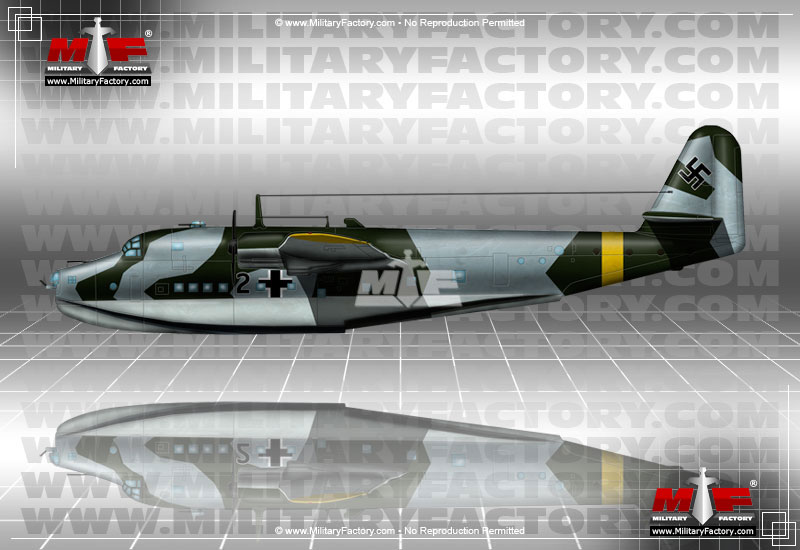
The Bv 222 was a mammoth machine by World War 2 standards, powered by no less than six 1,000 horsepower engines.

Find a School Near You
Follow Military Factory on Facebook:
Trending on Military Factory:
Recent Articles:
The Blohm & Voss Bv 222 Wiking (translating to "Viking") was a large German flying boat design of World War 2. The behemoth system was fielded only in limited numbers and served primarily in the transport role with some reconnaissance sorties as secondary. Transport aircraft generally made strong reconnaissance platforms thanks to their inherently long ranges. The Bv 222 was delayed from production during her development and, once in practice, proved highly susceptible to enemy fighter attacks despite the supplied defensive armament. Some thirteen examples were produced.

Where No Plane Has Gone Before

The Bv 222 scored a few "firsts" during her combat tenure. She became the largest aircraft in the war to score a kill against an enemy aircraft (believed to be an Allied PB4Y Liberator of the USN though sometimes incorrectly stated in sources as an Avro Lancaster) while at the same time becoming the largest aircraft to be downed during the conflict. She also became the biggest flying boat-class aircraft type to achieve operational status in the war.

Bv 222 Origins

The Bv 222 started life from a 1936 design, which in itself was built to a civil airliner specification. While many-an-aircraft were used for the transportation of cross-continental mail deliveries, passenger transports were becoming en vogue and the German airliner corporation of Deutsche Lufthansa was in need of a large aircraft for such an opportunity. Three Bv 222 examples were placed on order and appeared in three respective prototype forms known simply as Bv 222 V1, Bv 222 V2 and Bv 222 V3. Construction of the first of these three systems began in January of 1938. First flight was achieved by prototype V1 on September 7th, 1940. Testing would continue on until December of that year. Early forms fitted the Bramo Fafnir 323-series radial piston engines. These would later be replaced by the Junkers Jumo diesel engines for easier resupply when at sea, with fuel provided for by via fuel-laden U-Boats.

War Comes Calling

However, by 1941, the Bv 222 was placed into service with the German Luftwaffe, ferrying much-needed supplies across the Mediterranean to Afrika Corps forces operating in North Africa. The initial cross-water flight, interestingly enough, was piloted by a civilian aircrew and made use of a fighter escort. The flight depart from Athens, Greece. To dispose of the escorting need - and thusly freeing up the much-needed fighters for combat elsewhere - the Bv 222 V1 was finally armed with an array of defensive machine gun and 20mm cannon positions throughout her design. A single 13mm machine gun was fitted in a nose position while a further four were positioned at fuselage beam windows. A 20mm cannon was added to augment the defensive capabilities, this via a forward-placed dorsal turret. Now that the V1 had officially been baptized in the German war effort, she became the backbone of the new Lufttransportstaffel 222 squadron. The V1 soldiered on until February 1943, to which she was lost at sea following a collision with underwater wreckage upon a landing attempt.

The V2 achieved first flight on August 7th, 1941. After nearly a year of evaluation, she was officially cleared for service. The major difference in the V2 was the addition of the overwing cannon turrets accessed by crew through a tunnel built into the wing spars. In all, the Bv 222 now sported 3 x 20mm MG 151/20 cannons (1 x in dorsal turret; 2 x in wing turrets) and 5 x 13mm MG 131 machine guns (1 x in nose an 4 x in fuselage beam positions). Despite this formidable array, the defensive bubble offered by these weapons was limited at best, especially considering the speed at which the Bv 222 could travel, plus her enormous size making her a tempting target to passing enemy fighters.

V3 was next online, flying first on November 28th, 1941 and entering service in on December 9th. She directly replaced the sunk V1 but was destroyed herself at the hands of the RAF at Biscarrosse in Southwest France in June of 1943. V4 followed and sported a slightly revised (taller) vertical tail unit. V5 was also lost in June of 1943 at Biscarrosse, France. V6 was lost to enemy fire on August 21st, 1942 along the all-important Taranto-to-Tripoli supply route. V7 achieved first flight on April 1st, 1943 and fitted 6 x Junkers Jumo 207C diesel engines of 1,000 horsepower each. V8 was lost on December 10th, 1942 along the same Taranto-to-Tripoli route as the V6.

Ultimately, the Bv 222 V7 prototype was selected as the official production model for the military Bv 222 and appeared with the definitive "Bv 222C" model designation form. The earlier prototypes (V2, V3, V4 and V5) pressed into military service became maritime reconnaissance platforms, differing mainly in defensive armament and some mounting FuG 200 series search radar systems while flying for Fliegerfuhrer Atlantik. Bv 222B was a proposed variant to fit Junkers Jumo 208 series engines but never materialized.

Bv 222 Walk-Around

At its core, the Bv 222C was a dedicated long-range transport. It could carry a full complement of 92 soldiers along with its base 11- to 14-person crew. The pilot and co-pilot sat in a raised flight deck with excellent overhead, side and forward views. All six engines could be accounted for between the two pilots by a simple glance outside. The deep fuselage proved a massive structure and was streamlined from the conical nose assembly to the tapered tail end. The wide-span wing assemblies were shoulder-mounted monoplanes with three Junkers Jumo 12-cylinder engines underslung, three engine nacelles to a wing. Wingtips were rounded edges. The empennage was made up of a single rounded vertical tail fin of large area and complemented by a pair of horizontal planes, also rounded. Crew access doors were found along the fuselage sides near the water line, a pair forward and a pair aft. The cargo hold was accessible via a large square cargo door fitted to the starboard side just aft of the wing assemblies. Including general wartime supplies and soldiers, the cargo hold could also take on wounded personnel in medical litters.

As the forte of any flying boat was its uncanny ability to land on water, the Bv 222 design featured the traditional boat-like hull for cutting and displacing such surfaces. This allowed the Bv 222 the capability to land or take-off from water surfaces with relative ease, provided there was enough straight line distance to do so. Having no undercarriage meant that the Bv 222 was limited to waterborne activities.

The production Bv 222C model maintained a wingspan of nearly 151 feet with a wing area of 2,744.8 square feet. Her height measured in at upwards of 36 feet while her length came in at over 121 feet. When empty, the beast still weighed 67,572lbs and displaced 100,503lbs when loaded. Her maximum take-off weight (MTOW) topped 108,030lbs. Maximum speed was a reported 242 miles per hour at 16,400 feet while she could cruise at 189 miles per hour at sea level. Range was an impressive 3,790 miles. Her service ceiling was limited to just 23,950 feet with a rate-of-climb equal to 473 feet per minute.

The Hammer Ultimately Falls

The Bv 222 fought on through to the end of the war to which several complete examples were taken as prizes by the Allies. The United States retained two of the completed aircraft whilst the United Kingdom brought one home for herself. The RAF actually operated their Bv 222 up until 1947 while the US studied the design and implemented a similar hull on their upcoming Convair R3Y "Tradewind" flying boat transport. Two further remaining Bv 222 examples were scuttled by their German crews prior to the end of the war.
Text ©2003-2013 www.MilitaryFactory.com • All Rights Reserved • No Reproduction Permitted
MilitaryFactory.com does NOT sell equipment/weaponry. Material presented throughout this website is for historical and entertainment value and should not to be construed as usable for hardware restoration, maintenance or general operation. Please consult manufacturers for such information. Our disclaimer. Email corrections / Comments to MilitaryFactory at Gmail dot com.
Picture of Blohm and Voss Bv 222 Wiking (Viking)
View All Images (1)

Specifications for the
Blohm and Voss Bv 222 Wiking (Viking)
Long Range Reconnaissance / Transport Flying Boat


Country of Origin: Nazi Germany
Manufacturer: Blohm and Voss - Germany
Initial Year of Service: 1941
Production: 13


Focus Model: Blohm and Voss Bv 222C-0 Wiking (Viking)
Crew: 11 to 14 plus 92


Length: 121.39ft (37m)
Width: 150.92ft (46.00m)
Height: 35.76ft (10.90m)
Weight (Empty): 67,638lbs (30,680kg)
Weight (MTOW): 110,231lbs (50,000kg)


Powerplant: 6 x Junkers Jumo 207C 12-cylinder diesel engines developing 1,000hp each.


Maximum Speed: 242mph (390kmh; 211kts)
Maximum Range: 3,790miles (6,100km)
Service Ceiling: 23,950ft (7,300m; 4.5miles)
Rate-of-Climb: 472 feet per minute (144m/min)


Hardpoints: 0
Armament Suite:
ORIGINAL:
1 x 13mm machine gun in bow position
1 x 20mm cannon in forward dorsal turret
4 x 13mm machine guns in four fuselage beam positions.

Bv 222C:
1 x 13mm machine gun in nose
1 x 20mm cannon in forward dorsal turret
1 x 20mm cannon in left overwing turret
1 x 20mm cannon in right overwing turret
4 x 13mm machine guns in four fuselage beam positions.


Variants:
BV 222 V1 - Intitial Series Prototype


BV 222 V2 - Prototype Version; coverted to maritime reconnaissance; destroyed by the Allies retaking Norway.

BV 222 V3 - Prototype Model; fitted with gun turrets on top of wings mounting 1 x 20mm cannon each position; destroyed by Allied fighters while docked.

BV 222 V4 - Prototype Version; coverted to maritime reconnaissance.

BV 222 V5 - Prototype Version; coverted to maritime reconnaissance; destroyed by Allied fighters while docked.

BV 222 V7 - Prototype that would go on to become production version.

BV 222A

BV 222B - Fitted with Junkers Jumo 208 series engines.

BV 222C - Production Model Aircraft


Operators: Nazi Germany

ALL AIRCRAFT CATEGORIES

BY DECADE:


1900 to 1909
1910 to 1919
1920 to 1929
1930 to 1939
1940 to 1949
1950 to 1959
1960 to 1969
1970 to 1979
1980 to 1989
1990 to 1999
2000 to 2009
2010 to 2019
2020 to 2029
VIEW ALL
Compare Aircraft


BY TYPE:


Anti-Submarine Warfare (ASW)
Attack Helicopters
Bomber Aircraft
Medium Bombers
Heavy Bombers
Close-Air Support (CAS)
Commercial Aircraft
Dive Bombers
Electronic Warfare Aircraft (EWA)
Experimental / X-Planes
Fighter Aircraft
Floatplane Aircraft
Flying Boat Aircraft
Aerial Refueling Tankers
Helicopters (ALL)
Interceptor Aircraft
Multi-Role Aircraft
Navy Carrier Aircraft
Night Fighters
Reconnaissance / Scout
Search & Rescue (SAR)
Scout Helicopters
Special Purpose
Torpedo Bombers
Trainer Aircraft
Transport Aircraft
Transport Helicopters
Unmanned Aerial Vehicles (UAVs)
Unmanned Combat Air Vehicles (UCAVs)


COLLECTIONS:


4th Generation Fighter Aircraft
5th Generation Fighter Aircraft
US X-Planes
Classic US Warbirds
French Military Helicopters
Grumman "Cats"
Howard Hughes Aircraft
Indian Air Force
Israeli Air Force
Libyan Aircraft
Modern Chinese Aircraft
Modern Chinese Fighters
Modern Military Aircraft
Modern North Korean Aircraft
Modern Trainer Aircraft
Modern US Aircraft
Mikoyan Aircraft
Sukhoi Aircraft
Syrian Aircraft
Top 10 Fighter Aircraft of All Time


AIRCRAFT BY CONFLICT:


Arab-Israeli War (1948)
Cuban Missile Crisis (1959-1962)
Falklands War (1982)
Indo-Pak War (1965, 1971)
Iran-Iraq War (1980-1988)
Lebanon War (1982)
Operation Allied Force (1999)
Operation Desert Storm (1991)
Six Day War (1967)
Spanish Civil War (1936)
Soviet-Afghan War (1979-1989)
Yom Kippur War (1973)


MISCELLANEOUS:


Aircraft Cockpits
Aircraft Manufacturers List
Aircraft Timeline

WORLD WAR 2:


1939 Aircraft
1940 Aircraft
1941 Aircraft
1942 Aircraft
1943 Aircraft
1944 Aircraft
1945 Aircraft
1946 Aircraft
Australian Aircraft
Battle of Britain Aircraft
Bombers
Four-Engine Bombers
British Aircraft
British Bombers
British Transports
Dive Bombers
Canadian Aircraft
Fighters
Chinese Aircraft
French Aircraft
German Aircraft
German Fighters
German Flying Boats
German Jets
Secret Weapons of the Luftwaffe
Italian Aircraft
Imperial Japanese Aircraft
Imperial Japanese Fighters
Mitsubishi Bombers
Navy Aircraft
Pearl Harbor
Polish Aircraft
Romanian Aircraft
US Aircraft
US Bombers
US Navy Aircraft
Soviet Aircraft
Torpedo Bombers
Transport Aircraft
Tuskegee Airmen Aircraft
W.A.S.P. Aircraft
WW2 Aircraft Ranked by Speed
VIEW ALL


WORLD WAR 1:


1914 Aircraft
1915 Aircraft
1916 Aircraft
1917 Aircraft
1918 Aircraft
Aircraft Timeline
Austro-Hungarian Aircraft
Bomber Aircraft
British Aircraft
Fighters
Flying Boats
French Aircraft
Imperial German Aircraft
Italian Aircraft
Scout Aircraft
Russian Empire Aircraft
US Aircraft
WW1 Aircraft Ranked by Speed
VIEW ALL


KOREAN WAR:


Australian Aircraft
Korean War Aces
Korean War Jets
North Korean Aircraft
US Military Aircraft
VIEW ALL


VIETNAM WAR:


Helicopters
North Vietnam Air Force
US Airpower
VIEW ALL


COLD WAR:


1950s French Aircraft
British V-Bombers
Cold War Bombers
Soviet Aircraft
Soviet Bombers
Soviet Interceptors
Soviet Helicopters
Strategic Air Command
US Aircraft
US Bombers
US Interceptors
VIEW ALL

Site Disclaimer | Privacy Policy | Site Map | MF Origins


©2013 www.MilitaryFactory.com • Content ©2003-2013 MilitaryFactory.com • All Rights Reserved • Site Contact Email: militaryfactory at gmail dot com. The "Military Factory" name and MilitaryFactory.com logo are registered ® trademarks and protected by all applicable domestic and international intellectual property laws.


Top MF Stuff: 2013 Military Pay Scale | Military Ranks | WW2 Weapons | Sniper Rifles | Kts to Mph | WW1 Aircraft | Automatic Rifles | Aircraft Cockpits | Vietnam War Weapons | Main Battle Tanks | Submachine Guns | Shotguns | French Military Victories


Most photographic images appearing on this site are courtesy of the United States Department of Defense and are approved for public use. Other images acquired through the public domain. Digital art work courtesy of Dan Alex. Business Consulting by Kyle Williams. Material presented throughout this website is for historical and entertainment value and should not to be construed as usable for hardware restoration, maintenance or general operation. Please consult manufacturers for such information.


eXTReMe Tracker