Military Factory
Military Pay Chart
Global Firepower
Military Industrial Complex
Second World War
Home
Military Pay Scale
Military Ranks
Small Arms
Aircraft
Land Systems
Navy
Education
Military Factory Facebook Logo
flag of United Kingdom

Saro A27 London Reconnaissance Flying Boat (1936)

Authored By Staff Writer | Last Updated: 11/3/2011

Saro Londons were pressed into service at the beginning of World War 2 and some thirty examples were ultimately produced.

Find a School Near You
Follow Military Factory on Facebook:
Trending on Military Factory:
Recent Articles:
The Saro London borrowed much from the British flying boat designs peppering the 1920s and, in many ways, her retirement was something of an end to the era - aviation's "golden age" if you will. Pressed into wartime service during World War 2, the London served for only a limited time in equally limited numbers while charged with keeping an eye on the waters off England and over the Mediterranean Sea. Like so many other outclassed aircraft appearing in the middle 1930s and called to fight, the Saro London would go down in aviation history as one of the many unsung heroes doing their part in the early years of the war.

Origins of the London lay in a pre-war British Air Ministry Specification - designated R24/31 - which called for a multi-role flying boat. The firm of Saunders-Roe (or simply "Saro") delivered a design based on their previous failed Saunders A.7 "Severn" attempt, a three-engine flying boat designed for maritime patrol duties of which only one was ever built. The new design was designated as the A.27 London and saw a first prototype completed and flown sometime in 1934. The aircraft was fitted with a pair of Bristol Pegasus II radial piston engines mounted on an uneven-span (sesquiplane) biplane wing assembly. This single prototype actively operated until 1936 to which production forms officially appeared from the assembly lines in March. The initial production models were designated as London Mk.I, the major difference being their use of Bristol Pegasus III-series 820 horsepower radial piston engines.

Ten such examples were produced before the introduction of the Bristol Pegasus X engines of 915 horsepower forced the new designation of London "Mk.II" to be used. All of the early-production Mk.I models were brought up to the new Mk.II standard and redesignated to the new mark in the process. Some twenty Mk.II aircraft were ultimately built. In all, a total of thirty London Saros were constructed and delivered (not including the single prototype).

The Saro London was crewed by a complement of six personnel. She held a wingspan of 80 feet with a running length of over 56 feet. Her height measured in at nearly 19 feet. Total win area was 1,425 square feet. When empty, the London weighed in at 11,100lbs and roughly 18,400 loaded. Her maximum take-off weight (MTOW) was reported to be around 22,000lbs. Maximum speed was 155 miles per hour while cruise speed was listed at 128 miles per hour. Range topped out around 1,100 miles and her service ceiling was limited to just under 20,000 feet. She maintained a rate of climb equal to 1,180 feet per minute.

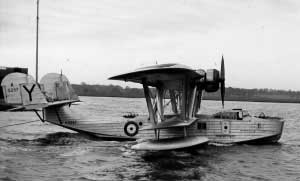
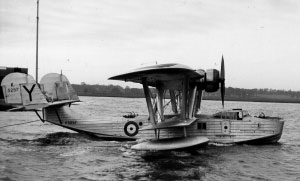
External design of the Saro London was typical of mid-sized flying boats of the time. Most distinct of this class of aircraft was the boat-shaped hull running from the nose of the airframe to the base of the empennage (tail section). It was this design element that allowed the London the capability to slice through water for landings and take-off but, at the same time, limited such activity to the water - that is, the London retained no undercarriage for operating from land bases. While her lower half maintained the appearance of an ocean-going vessel, her upper half was all aircraft. She sported a slightly curved nose section with slab and noticeably ribbed siding. The cockpit was set just aft of the nose assembly and elevated from the airframe to provide for good all-around views through a framed glass housing. Entry was via a rectangular hatch along the starboard fuselage side just below and aft of the flightdeck. The slab-sided fuselage tapered into a large "Tee" style tail assembly, made up of two large vertical tail fins set upon a horizontal plane. The biplane wing arrangement consisted of a lower span, which was shoulder-mounted onto the fuselage, and the upper span held in place by large angled struts. Each lower wing assembly held a single underslung float to help control the aircraft's sway when on the water. The wings ran through the two high-mounted engine nacelles housing the powerplants. The powerplants were raised a distance away from the airframe and fitted above and behind the flightdeck in an effort to keep the engines free of the corrosive effects of water spray during take-off and landing activities. Fuselage construction was of all-metal while the wings were covered over in fabric.

As a reconnaissance platform, flying boats like the Saro London were prime targets for patrolling enemy fighters. Though this class of aircraft maintained a healthy operational range from which to operate in, she made for a large, slow moving target. As such, she was fitted with up to three Lewis-brand 7.7mm machine guns for defensive purposes. One was positioned forward at the bow while another was positioned aft, both emplacements were open-air with the guns on ring-mounts. The third machine gun was situated amidships. Her offensive prowess when combating surface ships was limited to 2,000lbs of ordnance - this in the form of either depth charges, conventional drop bombs or mines - mounted near the wing roots of the lower span. An optional dorsal fuel tank could be installed to help improve operational range (many existing Saro London photographs feature this elongated tank structure just aft of the cockpit).

Operators ultimately included the Royal Canadian Air Force and No. 201, No. 202, No. 204, No. 209, No. 210, No. 228 and No. 240 squadrons of the Royal Air Force. Beyond these users, the London was never in service with another nation in her tenure let alone exported to customers.

At the beginning of World War 2, Londons were pressed into action with RAF Coastal Command, eventually seeing action over the North Sea and across the Mediterranean Sea. They served well in running active reconnaissance patrols as called upon and were ready to engage surface ships if needed. Despite her seemingly archaic appearance, there were many biplanes utilized in these early years of World War 2 that served valiantly when the need called for it. They preserved the status quo of the war until newer and better systems could be made ready and available. The tour of the London began to end sometime in 1940 while the last active group operated around Gibraltar until June of 1942.
Text ©2003-2013 www.MilitaryFactory.com • All Rights Reserved • No Reproduction Permitted
MilitaryFactory.com does NOT sell equipment/weaponry. Material presented throughout this website is for historical and entertainment value and should not to be construed as usable for hardware restoration, maintenance or general operation. Please consult manufacturers for such information. Our disclaimer. Email corrections / Comments to MilitaryFactory at Gmail dot com.
Picture of Saro A27 London
View All Images (1)

Specifications for the
Saro A27 London
Reconnaissance Flying Boat


Country of Origin: United Kingdom
Manufacturer: Saunders Roe (Saro) - UK
Initial Year of Service: 1936
Production: 31


Focus Model: Saro London Mk II (A.27)
Crew: 6


Length: 56.79ft (17.31m)
Width: 79.99ft (24.38m)
Height: 18.73ft (5.71m)
Weight (Empty): 11,100lbs (5,035kg)
Weight (MTOW): 22,000lbs (9,979kg)


Powerplant: 2 x Bristol Pegasus X 9-cylinder air-cooled radial engines developing 920hp each.


Maximum Speed: 142mph (228kmh; 123kts)
Maximum Range: 1,740miles (2,800km)
Service Ceiling: 19,898ft (6,065m; 3.8miles)
Rate-of-Climb: 1,180 feet per minute (360m/min)


Hardpoints: 2
Armament Suite:
STANDARD:
1 x 7.7mm Lewis machine gun in bow position
1 x 7.7mm Lewis machine gun in midship position
1 x 7.7mm Lewis machine gun in tail position

OPTIONAL:
Up to 2,000lbs (907kg) of externally carried stores including bombs, depth charges or mines.


Variants:
London A.27 - Single Prototype Example


London Mk.I - Fitted with Bristol Pegasus III series engines of 820 horsepower each; two-blade propeller systems; 10 examples produced; later to be brought up to Mk II standard.

London Mk.II - Fitted with Bristol Pegasus X series engines of 915 horsepower each; four-bladed propeller systems; 20 examples produced.


Operators: Canada; United Kingdom

ALL AIRCRAFT CATEGORIES

BY DECADE:


1900 to 1909
1910 to 1919
1920 to 1929
1930 to 1939
1940 to 1949
1950 to 1959
1960 to 1969
1970 to 1979
1980 to 1989
1990 to 1999
2000 to 2009
2010 to 2019
2020 to 2029
VIEW ALL
Compare Aircraft


BY TYPE:


Anti-Submarine Warfare (ASW)
Attack Helicopters
Bomber Aircraft
Medium Bombers
Heavy Bombers
Close-Air Support (CAS)
Commercial Aircraft
Dive Bombers
Electronic Warfare Aircraft (EWA)
Experimental / X-Planes
Fighter Aircraft
Floatplane Aircraft
Flying Boat Aircraft
Aerial Refueling Tankers
Helicopters (ALL)
Interceptor Aircraft
Multi-Role Aircraft
Navy Carrier Aircraft
Night Fighters
Reconnaissance / Scout
Search & Rescue (SAR)
Scout Helicopters
Special Purpose
Torpedo Bombers
Trainer Aircraft
Transport Aircraft
Transport Helicopters
Unmanned Aerial Vehicles (UAVs)
Unmanned Combat Air Vehicles (UCAVs)


COLLECTIONS:


4th Generation Fighter Aircraft
5th Generation Fighter Aircraft
US X-Planes
Classic US Warbirds
French Military Helicopters
Grumman "Cats"
Howard Hughes Aircraft
Indian Air Force
Israeli Air Force
Libyan Aircraft
Modern Chinese Aircraft
Modern Chinese Fighters
Modern Military Aircraft
Modern North Korean Aircraft
Modern Trainer Aircraft
Modern US Aircraft
Mikoyan Aircraft
Sukhoi Aircraft
Syrian Aircraft
Top 10 Fighter Aircraft of All Time


AIRCRAFT BY CONFLICT:


Arab-Israeli War (1948)
Cuban Missile Crisis (1959-1962)
Falklands War (1982)
Indo-Pak War (1965, 1971)
Iran-Iraq War (1980-1988)
Lebanon War (1982)
Operation Allied Force (1999)
Operation Desert Storm (1991)
Six Day War (1967)
Spanish Civil War (1936)
Soviet-Afghan War (1979-1989)
Yom Kippur War (1973)


MISCELLANEOUS:


Aircraft Cockpits
Aircraft Manufacturers List
Aircraft Timeline

WORLD WAR 2:


1939 Aircraft
1940 Aircraft
1941 Aircraft
1942 Aircraft
1943 Aircraft
1944 Aircraft
1945 Aircraft
1946 Aircraft
Australian Aircraft
Battle of Britain Aircraft
Bombers
Four-Engine Bombers
British Aircraft
British Bombers
British Transports
Dive Bombers
Canadian Aircraft
Fighters
Chinese Aircraft
French Aircraft
German Aircraft
German Fighters
German Flying Boats
German Jets
Secret Weapons of the Luftwaffe
Italian Aircraft
Imperial Japanese Aircraft
Imperial Japanese Fighters
Mitsubishi Bombers
Navy Aircraft
Pearl Harbor
Polish Aircraft
Romanian Aircraft
US Aircraft
US Bombers
US Navy Aircraft
Soviet Aircraft
Torpedo Bombers
Transport Aircraft
Tuskegee Airmen Aircraft
W.A.S.P. Aircraft
WW2 Aircraft Ranked by Speed
VIEW ALL


WORLD WAR 1:


1914 Aircraft
1915 Aircraft
1916 Aircraft
1917 Aircraft
1918 Aircraft
Aircraft Timeline
Austro-Hungarian Aircraft
Bomber Aircraft
British Aircraft
Fighters
Flying Boats
French Aircraft
Imperial German Aircraft
Italian Aircraft
Scout Aircraft
Russian Empire Aircraft
US Aircraft
WW1 Aircraft Ranked by Speed
VIEW ALL


KOREAN WAR:


Australian Aircraft
Korean War Aces
Korean War Jets
North Korean Aircraft
US Military Aircraft
VIEW ALL


VIETNAM WAR:


Helicopters
North Vietnam Air Force
US Airpower
VIEW ALL


COLD WAR:


1950s French Aircraft
British V-Bombers
Cold War Bombers
Soviet Aircraft
Soviet Bombers
Soviet Interceptors
Soviet Helicopters
Strategic Air Command
US Aircraft
US Bombers
US Interceptors
VIEW ALL

Site Disclaimer | Privacy Policy | Site Map | MF Origins


©2013 www.MilitaryFactory.com • Content ©2003-2013 MilitaryFactory.com • All Rights Reserved • Site Contact Email: militaryfactory at gmail dot com. The "Military Factory" name and MilitaryFactory.com logo are registered ® trademarks and protected by all applicable domestic and international intellectual property laws.


Top MF Stuff: 2013 Military Pay Scale | Military Ranks | WW2 Weapons | Sniper Rifles | Kts to Mph | WW1 Aircraft | Automatic Rifles | Aircraft Cockpits | Vietnam War Weapons | Main Battle Tanks | Submachine Guns | Shotguns | French Military Victories


Most photographic images appearing on this site are courtesy of the United States Department of Defense and are approved for public use. Other images acquired through the public domain. Digital art work courtesy of Dan Alex. Business Consulting by Kyle Williams. Material presented throughout this website is for historical and entertainment value and should not to be construed as usable for hardware restoration, maintenance or general operation. Please consult manufacturers for such information.


eXTReMe Tracker