Military Factory
Military Pay Chart
Global Firepower
Military Industrial Complex
Second World War
Home
Military Pay Scale
Military Ranks
Small Arms
Aircraft
Land Systems
Navy
Education
Military Factory Facebook Logo
flag of China

Nanchang Q-5 (Fantan) Ground Attack / Close-Air Support Aircraft (1970)

Authored By Staff Writer | Last Updated: 8/1/2011

The Nanchang Q-5 Fantan is a Chinese evolution of the Soviet Mikoyan-Gurevich MiG-19 Farmer with some obvious physical changes.

Find a School Near You
Follow Military Factory on Facebook:
Trending on Military Factory:
Recent Articles:
As a long time Soviet equipment user, the Chinese were already building the twin-engine Mikoyan-Gurevich MiG-19 "Farmer" jet fighters in quantity locally as the Shenyang J-6. It was soon given thought that the F-6 should be modified for the strike role which gave birth to the Nanchang Q-5 "Fantan" series of aircraft. The basic MiG-19 form was retained in the Shenyang F-6 but, to revise the latter for the attack role, some modifications were naturally required. This included an all new nose to fit the attack radar as well as split air intakes along the fuselage sides for the MiG-19 design featured its intake in the nose. An internal bomb bay was also fitted. Overall, however, little of the aft fuselage and wings were to change in the new Chinese endeavor.

Shenyang designed a new strike aircraft version of the F-6 in March of 1958. However, their facilities were largely committed to modernization of existing MiG-15s and serial production of the MiG-17 and MiG-19. Chinese authorities directed development of the new aircraft to Nanchang with Shenyang still playing a major role. Up to this point, Nanchang had held some experience in the production of MiG-19 variants but was mostly tied to light-class transport aircraft and piston-powered trainer aircraft.

Development proceeded in August of 1958 to which a prototype - designated as the Qiangjiji-5 - was begun. The design brought together engineers from both the Shenyang and Nanchang concerns with the MiG-19 selected as the starting point. The basic MiG-19 fuselage was reworked to include two side-mounted intake openings to aspirate the twin engine design. The nose intake of the original jet would be covered over in a nose cone assembly that would take in an advanced attack radar and avionics. The fuselage was now area-ruled to reduce inherent drag at transonic and supersonic speeds. The nose gear was revised to fold sideways under the cockpit floor. The wings were revised with less sweep than on the MiG-19 design while anti-flutter attachments were added to the horizontal tailplanes. The single vertical tail fin had its area expanded for improved stability. The Soviet-era fighter design now evolved into a decidedly Chinese product with the completed mockup built and sent to Beijing for review in October of 1958. The prototype was finally completed in 1960 and wind tunnel testing revealed several drawbacks that necessitated reworking of the diagram designs.

In 1961, economic hardship found the burgeoning program and official work on the new strike aircraft was halted. The 300-strong design team was disbanded and the project canceled for the near future. Despite this measure, 15 of the original team proceeded to work on the project during this period and forged ahead in attempting to develop the aircraft. In 1963, the program was reinstated and development picked up once again. On June 4th, 1965, the aircraft went airborne for the first time and successfully completed it maiden test flight. Additional evaluations forced the reworking of several key systems and production of two more flyable prototypes. The completed design finally entered serial production at the end of 1969. She was formally accepted into service with the People's Liberation Army Air Force in 1970 with deliveries forthcoming. Production has since been ongoing with roughly 1,300 examples delivered including those serving in the foreign forces of Bangladesh, Myanmar, North Korea, Pakistan and Sudan. Pakistan operated the type up until 2010. Export versions were designated as "A-5". The Q-5 received the NATO reporting name of "Fantan" once it was identified as a new Chinese offering.

While the Q-5's new nose cone assembly was intended to accept a new attack radar, the system was never fitted in main production models.

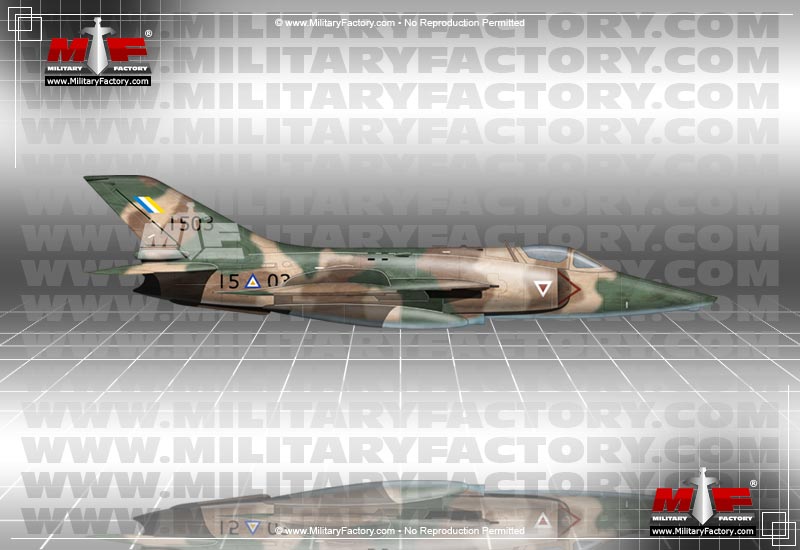
The base Q-5 was crewed by a single personnel. It retained much of the MiG-19s general shape with the exception of the new nose and relocated intakes and bared an uncanny resemblance to the American Republic F-105 Thunderchief. The fuselage was oblong when viewed in the forward profile and well-rounded along its edges. The cockpit sat aft of the nose assembly and featured thick framing under a two-piece canopy. Visibility was somewhat restricted due to the type's raised fuselage spine. The intakes straddled either side of the cockpit and aspirated the dual engine configuration fitted deep within the middle-to-aft fuselage. Wings were mid-mounted assemblies with high sweep along their leading and trailing edges and designed to hold much of the external weapons loads. Large boundary layer fencing along the wing top sides are consistent with Soviet-era jet designs. The empennage tapered off, fitting snuggly around the engine installation and capped by a large exhaust ring. The tail was characterized by its single large vertical tail fin as well as a pair of horizontal tail planes. Ventral strakes (shallower than on the MiG-19) were also noted along the aft-fuselage underside. The undercarriage was fully retractable and consisted of two main landing gear legs as well as a nose leg. All legs were single-wheeled with the main legs retracting into each wing underside toward the fuselage centerline while the nose leg retracted forwards under the cockpit floor. When at rest, the design held a pronounced "nose up" appearance. An ejection seat was afforded to the pilot and provided for safe ejection from the aircraft at any altitude and at any speed. Basic internal fuel stored consisted of three forward- and two rear-set fuel tanks, this augmented by external fuel tanks as well as the internal bomb bay converted for use as an internal fuel store.

Power for the Q-5 was supplied by way of a dual engine arrangement made up of 2 x Liming Wopen-6A (Wopen-6) afterburning turbojet installations. These engines were Chinese copies of the Soviet Mikulin RD-9BF turbojets rated at 5,732lbs of thrust, supplying the mount with a top speed of 752 miles per hour (Mach 1.12 at altitude) as well as an operational range equivalent to 1,200 miles - much less under a full combat load. Rate-of-climb was 20,300 feet per minute with a service ceiling of about 54,000 feet. Performance-wise, the Q-5 exhibited much of the low-level prowess of the MiG-19 before it, though - based on the fuselage edits and additions - suffered in high-altitude performance but this was to be expected. A brake parachute was initially installed at the tail fin to help with shorter landing sequences. This installation was eventually relocated to the tail fin base.

The Q-5 fitted a standard internal cannon arrangement made up of 2 x Norinco Type 23-2K cannon systems (replacing the MiG-19's original 30mm installations) with 100 rounds afforded to each gun, these buried at each leading edge wing roots. The original Q-5 production model sported six hardpoints as well as an internal weapons bay while later models saw up to ten hardpoints and the internal bomb bay given up for fuel. Two underwing positions were also plumbed for external fuel tanks and these became seemingly standard fixtures on all future Q-5 ordnance loads to help offset the aircraft's inherently short operational range when hauling a full combat payload. Beyond the standard cannon armament, the Q-5 could be outfitted with various air-to-air missiles (primarily for short-ranged self-defense), rocket pods (unguided types in various calibers) and drop bombs - initially these being only conventional types though, later, laser-guided versions were introduced. Naturally, the weapons delivery capabilities of the Q-5 evolved within time to accept more modern weapon types.

The initial production models were known simply as "Q-5" and fielded a total of six weapons hardpoints for the carrying of various munitions (including an internal bomb bay). The Q-5A model then followed in limited production quantities and brought about capabilities for a nuclear-tipped payload in a recessed fuselage fitting under the aircraft. In January of 1972, one such aircraft was used to drop a nuclear bomb during testing. A navalized version of the Q-5 was also developed and included a gun ranging radar system but, again, these saw only limited production.

In 1976, it was ever more apparent that the Q-5 suffered from extremely limited operating ranges under a full load. Thusly, the Q-5I was developed from the Q-5A production model and had its internal weapons bay deleted in favor of more internal fuel storage for much improved range. The landing gear were also revised and a Type 1 ejection seat was installed. The drag chute dispenser was relocated from the tail fin to the tail fin base while Wopen WP-6A series turbojet engines were introduced for better performance. The initial Q-5I prototype went airborne in the latter part of 1980.

Nanchang was not done with the Q-5 evolution. The Q-5I was furthered in the Q-5IA production model which brought about an improved navigational suite, an integrated laser rangefinder and a weapons sighting device that allowed for greater angles of attack. Electronic CounterMeasures were further improved as a 360-degree Radar Warning Receiver coverage system was brought online. In all, the Q-5 saw her operational ranges increased as well as her ordnance carrying capabilities broadened to produce a more potent strike aircraft while her runway requirements were significantly reduced. The Q-5I production model would go on to represent the main Chinese Air Force Q-5 service model and definitive Q-5 mark.

The Chinese Navy took interest in the Q-5 and received a navalized version as the Q-5II. She was completed with Radar Warning Receiver protection to alert the pilot of incoming enemy threats as well as a revised laser rangefinder and new sighting device for improved weapons delivery accuracy. The cockpit was raised for a better vantage point while the nose cone assembly was slanted further down to increase vision out over the nose. The Q-5II was cleared to field anti-ship torpedoes for its dedicated maritime strike role.

The Q-5IA was modernized to become the Q-5III, incorporating an inertial navigation system (of Chinese origin) as well as a Heads-Up Display system comparable to similar Western offerings. Weapons pylons were improved and avionics were brought to a new standard. The Q-5 was also now a modular weapons platform of sorts, able to accept both Chinese- and Western-based weapon systems. Nanchang received the official development contract in April of 1981 three prototypes were produced in response. The Q-5III was cleared for serial production and saw subsequent deliveries to the air forces of Bangladesh, Myanmar, North Korea and Pakistan in January of 1983. However, it is notable that the Q-5III production model was only reserved for export customers (under the designation of A-5C) and not formally accepted into the inventory of the PLAAF.

The Q-5IV (also known as the "Q-5D") was a vastly revised Q-5 form and upgraded the Radar Warning Receivers as well as digital processing. A new HUD and laser rangefinder were also introduced. The Q-5A increased external weapons carrying capabilities by introducing more pylons (now eight in number) which allowed the aircraft to defend itself with air-to-air missiles while also carrying a strike load. The Q-5D was an ELlectronic INTelligence (ELINT) conversion model not to be confused with the Q-5D attack model variant. The Q-5IV was further evolved into the Q-5E and given facilities to manage laser-guided munitions. A new GPS-based navigation system was also brought online as was self-designation of enemy ground targets - the aircraft no longer requiring the designation from another allied source. The Q-5J was a two-seat development intended for pilot training and Forward Air-Control (FAC) duties with an all new cockpit arrangement, canopy unit and communications transfer suite.

The Q-5M export model (A-5M), with a different nose design, was to feature Italian-based avionics but the endeavor was dropped after Tiananmen. This project was to partner Nanchang with Aeritalia and introduce a new avionics suite, an additional two underwing pylons, an integrated Identification Friend or Foe (IFF) system, ranging radar, modernized HUD and inertial navigation system. Two prototypes were completed though one was lost to accident. First flight was achieved on August 30th, 1988.


Similarly, the Q-5K "Kong Yun", which took existing Q-5II models and - with French assistance - attempted to modernized the Q-5 line. Thompson-CSF was to join Nanchang to the effort and fit new avionics, a nose-mounted laser range finder, new inertial navigation system and improved HUD. These would have been differentiated by their chisel-shaped noses. However, this initiative was shelved after the events of Tiananmen Square in 1989. Two prototypes were in fact produced but never furthered due to subsequent arms embargoes against China.

Both the Q-5M and Q-5K prototypes were tested against one another and data collected during these trials are thought to have been used in indigenous modernization efforts concerning newer Q-5 developments.

Regardless, the Q-5 was developed into export models by 2000, this effort producing the A-5 forms. These were delivered to North Korea. Myanmar took delivery of the A-5B, which was based on the Q-5II series, and fitted with a Western-capable weapons delivery suite. Bangladesh and Pakistan took on delivery of the A-5C which incorporated evermore Western functionality including weapons delivery, instrument panel and Martin-Baker Mk 10 "Zero-Zero" ejection seats.

Hongdu headed up development of a dedicated strike variant known under the designation of "Q-5D". This form brought about marked improvements in the laser rangefinder and targeting systems as well as improved cockpit functionality through a revised HUD, chaff/flare dispensers and TV/FLIR support. This version also utilized laser-guided bombs.

As of this writing, about 20 A-5C models remain in service with the Myanmar Air Force while less than 10 examples serve with the Bangladesh Air Force. It is unknown how many Fantans currently serve with the North Korean Air Force or Sudanese Air Force. Pakistan made widespread use of the A-5C production models from 1983 to 2010 across three squadrons (No. 7, No. 16 and No. 26), ultimately giving them up in favor of the more advanced JF-17 "Thunder" - a joint Chinese-Pakistani multi-role combat aircraft in the same vein as the Western Lockheed F-16 Fighting Falcon.

All told, the Nanchang Q-5/A-5 is regarded by some as an aged and outmoded strike aircraft when compared to the latest of 5th Generation mounts. However, to the discerning budget-conscious customer, the Q-5 retains robust battlefield qualities, low procurement and maintenance costs, high speed performance and good handling qualities at low levels. Her avionics and weapons delivery suites have been exceedingly upgraded to content with modern sortie requirements and her power in numbers still make her a notable addition to any fighting force. This does not preclude its owners from looking towards the near future for newer, more modern solutions when economics permit. While China has continued support of their Q-5 line with production ongoing and modernization programs in check, she is still developing more modern systems to make the Q-5's future limited at best.
Text ©2003-2013 www.MilitaryFactory.com • All Rights Reserved • No Reproduction Permitted
MilitaryFactory.com does NOT sell equipment/weaponry. Material presented throughout this website is for historical and entertainment value and should not to be construed as usable for hardware restoration, maintenance or general operation. Please consult manufacturers for such information. Our disclaimer. Email corrections / Comments to MilitaryFactory at Gmail dot com.
Picture of Nanchang Q-5 (Fantan)
View All Images (1)

Specifications for the
Nanchang Q-5 (Fantan)
Ground Attack / Close-Air Support Aircraft


Country of Origin: China
Manufacturer: Nanchang - China
Initial Year of Service: 1970
Production: 1,300


Focus Model: Nanchang A-5C (Fantan)
Crew: 1


Length: 51.35ft (15.65m)
Width: 31.76ft (9.68m)
Height: 14.21ft (4.33m)
Weight (Empty): 14,054lbs (6,375kg)
Weight (MTOW): 26,081lbs (11,830kg)


Powerplant: 2 x Shenyang WP6 turbojet engines developing 7,165lbs of thrust each with afterburner.


Maximum Speed: 739mph (1,190kmh; 643kts)
Maximum Range: 1,243miles (2,000km)
Service Ceiling: 54,134ft (16,500m; 10.3miles)
Rate-of-Climb: 20,275 feet per minute (6,180m/min)


Hardpoints: 6 to 10
Armament Suite:
STANDARD:
2 x 23mm NORINCO Type 23-2K cannons in wing roots.

OPTIONAL:
Up to 4,400lbs of stores (external or internal depending on model) including nuclear-tipped, homing air-to-air missiles, guided and conventional drop bombs, rocket pods (unguided) and torpedoes (PLA Navy version).


Variants:
Qiangjiji-5 - Initial Project Designation under Shenyang.


Q-5 - Initial Production Form; six weapon hardpoints; limited-production nuclear-capable and maritime strike versions also completed.

Q-5I - Based on Q-5A production model; sans internal weapons bay in favor of internal fuel storage; improved operational ranges.

Q-5IA - Revised weapons sight; revised navigation suite; laser rangefinder installed.

Q-5II - PLA Navy Variant; Radar Warning Receiver installed; all new laser rangefinder; revised weapon sight device; redesigned nose section and raised cockpit; improved navigation.

Q-5III - Upgraded Q-5II; Chinese-based inertial navigation system and HUD; export only model.

Q-5IV - Modernized Q-5; twin digital computer processing; new RWR, HUD and laser rangefinder.

Q-5A - Eight weapon hardpoints; air-to-air missile support.

Q-5D (Q-5D) - Dedicated ELINT variant.

Q-5E - Based on the Q-5IV model; laser-guided munitions capability.

Q-5F - Based on the Q-5E; improved GPS navigation; self-designation of targets.

Q-5J - Two-Seat Variant; for training or Forward Air Control.

Q-5K "Kong Yun" - Proposed Chinese-French upgrade; cancelled.

Q-5M - Proposed Chinese-Italian upgrade for export; cancelled.

Q-5D (Hongdu) - Dedicated attack model headed up by Hongdu concern; improved targeting capabilities and cockpit functionality.

A-5 - Export Models to North Korea

A-5B - Export Models to Myanmar

A-5C - Export Models to Bangladesh and Pakistan; fitting Western systems.

A-5D - Abandoned Export Model

A-5K - Abandoned Export Model; French (Thompson-CSF) avionics in redesigned chisel-shaped nose.

A-5M - Abandoned Export Model; Italian (Aeritalia) avionics in redesigned nose.


Operators: Bangladesh; China; North Korea; Pakistan; Mayanmar

ALL AIRCRAFT CATEGORIES

BY DECADE:


1900 to 1909
1910 to 1919
1920 to 1929
1930 to 1939
1940 to 1949
1950 to 1959
1960 to 1969
1970 to 1979
1980 to 1989
1990 to 1999
2000 to 2009
2010 to 2019
2020 to 2029
VIEW ALL
Compare Aircraft


BY TYPE:


Anti-Submarine Warfare (ASW)
Attack Helicopters
Bomber Aircraft
Medium Bombers
Heavy Bombers
Close-Air Support (CAS)
Commercial Aircraft
Dive Bombers
Electronic Warfare Aircraft (EWA)
Experimental / X-Planes
Fighter Aircraft
Floatplane Aircraft
Flying Boat Aircraft
Aerial Refueling Tankers
Helicopters (ALL)
Interceptor Aircraft
Multi-Role Aircraft
Navy Carrier Aircraft
Night Fighters
Reconnaissance / Scout
Search & Rescue (SAR)
Scout Helicopters
Special Purpose
Torpedo Bombers
Trainer Aircraft
Transport Aircraft
Transport Helicopters
Unmanned Aerial Vehicles (UAVs)
Unmanned Combat Air Vehicles (UCAVs)


COLLECTIONS:


4th Generation Fighter Aircraft
5th Generation Fighter Aircraft
US X-Planes
Classic US Warbirds
French Military Helicopters
Grumman "Cats"
Howard Hughes Aircraft
Indian Air Force
Israeli Air Force
Libyan Aircraft
Modern Chinese Aircraft
Modern Chinese Fighters
Modern Military Aircraft
Modern North Korean Aircraft
Modern Trainer Aircraft
Modern US Aircraft
Mikoyan Aircraft
Sukhoi Aircraft
Syrian Aircraft
Top 10 Fighter Aircraft of All Time


AIRCRAFT BY CONFLICT:


Arab-Israeli War (1948)
Cuban Missile Crisis (1959-1962)
Falklands War (1982)
Indo-Pak War (1965, 1971)
Iran-Iraq War (1980-1988)
Lebanon War (1982)
Operation Allied Force (1999)
Operation Desert Storm (1991)
Six Day War (1967)
Spanish Civil War (1936)
Soviet-Afghan War (1979-1989)
Yom Kippur War (1973)


MISCELLANEOUS:


Aircraft Cockpits
Aircraft Manufacturers List
Aircraft Timeline

WORLD WAR 2:


1939 Aircraft
1940 Aircraft
1941 Aircraft
1942 Aircraft
1943 Aircraft
1944 Aircraft
1945 Aircraft
1946 Aircraft
Australian Aircraft
Battle of Britain Aircraft
Bombers
Four-Engine Bombers
British Aircraft
British Bombers
British Transports
Dive Bombers
Canadian Aircraft
Fighters
Chinese Aircraft
French Aircraft
German Aircraft
German Fighters
German Flying Boats
German Jets
Secret Weapons of the Luftwaffe
Italian Aircraft
Imperial Japanese Aircraft
Imperial Japanese Fighters
Mitsubishi Bombers
Navy Aircraft
Pearl Harbor
Polish Aircraft
Romanian Aircraft
US Aircraft
US Bombers
US Navy Aircraft
Soviet Aircraft
Torpedo Bombers
Transport Aircraft
Tuskegee Airmen Aircraft
W.A.S.P. Aircraft
WW2 Aircraft Ranked by Speed
VIEW ALL


WORLD WAR 1:


1914 Aircraft
1915 Aircraft
1916 Aircraft
1917 Aircraft
1918 Aircraft
Aircraft Timeline
Austro-Hungarian Aircraft
Bomber Aircraft
British Aircraft
Fighters
Flying Boats
French Aircraft
Imperial German Aircraft
Italian Aircraft
Scout Aircraft
Russian Empire Aircraft
US Aircraft
WW1 Aircraft Ranked by Speed
VIEW ALL


KOREAN WAR:


Australian Aircraft
Korean War Aces
Korean War Jets
North Korean Aircraft
US Military Aircraft
VIEW ALL


VIETNAM WAR:


Helicopters
North Vietnam Air Force
US Airpower
VIEW ALL


COLD WAR:


1950s French Aircraft
British V-Bombers
Cold War Bombers
Soviet Aircraft
Soviet Bombers
Soviet Interceptors
Soviet Helicopters
Strategic Air Command
US Aircraft
US Bombers
US Interceptors
VIEW ALL

Site Disclaimer | Privacy Policy | Site Map | MF Origins


©2013 www.MilitaryFactory.com • Content ©2003-2013 MilitaryFactory.com • All Rights Reserved • Site Contact Email: militaryfactory at gmail dot com. The "Military Factory" name and MilitaryFactory.com logo are registered ® trademarks and protected by all applicable domestic and international intellectual property laws.


Top MF Stuff: 2013 Military Pay Scale | Military Ranks | WW2 Weapons | Sniper Rifles | Kts to Mph | WW1 Aircraft | Automatic Rifles | Aircraft Cockpits | Vietnam War Weapons | Main Battle Tanks | Submachine Guns | Shotguns | French Military Victories


Most photographic images appearing on this site are courtesy of the United States Department of Defense and are approved for public use. Other images acquired through the public domain. Digital art work courtesy of Dan Alex. Business Consulting by Kyle Williams. Material presented throughout this website is for historical and entertainment value and should not to be construed as usable for hardware restoration, maintenance or general operation. Please consult manufacturers for such information.


eXTReMe Tracker