|
|
| |
|
Yakovlev Yak-1 (Krasavyets)
The Yak-1, and its related Yak-3, Yak-7 and Yak-9 series, are often a forgotten breed when comparing the best piston engine fighters of World War 2, surpassing some 36,000 aircraft built.
By Staff Writer
Often overshadowed by its contemporaries in the West (to include the Supermarine Spitfire, North American P-51 Mustang, Messerschmitt Bf 109 and the Focke-Wulf Fw 190) the early production Yakovlev fighter aircraft were some of the best fielded in the war. When production of the Yak-1, Yak-3, Yak-7 and Yak-9 is combined (all were essentially modified variants of the initial Yak-1) these early Yakovlev creations become the most produced fighter aircraft of World War 2. Enough cannot be said about the Soviet response to the German incursion of 1941 as a nation was pushed to the brink of defeat with only a thin line of ill-equipped soldiers and airmen to stem the tide. Yakovlev set about to produce what would become one of the three fighter designs that would bring the Soviet Air Force into the realm of respectability, these three often referred to as the first true "modern" aircraft designs (the other two besides the Yak-1 being the Mikoyan-Gurevich MiG-3 and the Lavochkin LaGG-3).
The Yak-1 was first born in the mind of Alexander Yakovlev, designed to a Soviet requirement of 1938 requesting a fighter of mostly wood construction for ease of maintenance and more importantly - production. The initial design was known as the Ya-26 Krasavec and flew in 1939. Upon acceptance of his most excellent design attempt, the system was redesignated as the I-26 and ordered into production. Once production had begun, the aircraft was further redesignated to the more common Yak-1. The acceptance of the Yak-1 would spawn several other successful Yakovlev designs and place the bureau in the elite class of aircraft design and production for decades to follow. In any case, the Yak-1 finally put the Soviet Air Force at least on par with German designs of the time and opened the door to better designs and tactics thanks to ever expanding capabilities by design.
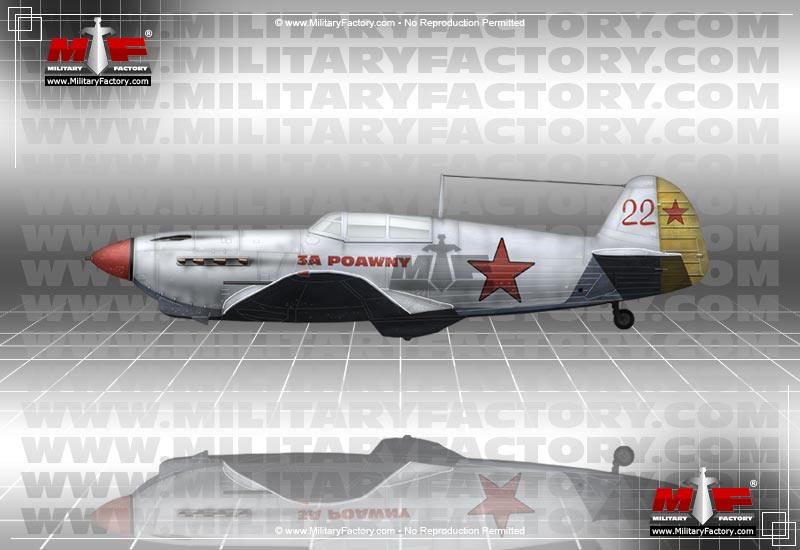
At first glance, the outwardly design of the Yak-1 “Krasavyets” (meaning “Little Beauty”) proves to be very utilitarian with a basic slender fuselage design, mid-set canopy and a low-cut vertical tail surface. Though the initial Yak-1 would feature an integrated design cockpit, the Yak-1b quickly followed suit with an unobstructed bubble-type design. Construction consisted of a combination of plywood and fabric materials that made the Yak-1 both easy to produce in large numbers and generally easier to maintain as a result. Power was derived from a single Klimov-brand engine developing some 1,100 horsepower or more depending on the model. Either way, the Yak-1 was a highly capable performer that quickly endeared herself to her pilots. Initial production totals in 1940 were slow to mount though the German invasion of 1941 put the project into top gear of what would become one of the more celebrated Soviet piston-engine designs of the war.
The Yak-3 appeared as a lighter version of the Yak-1 in an effort to increase performance. The Yak-7 followed thereafter and design eventually culminated with the fabulous Yak-9 "Frank", itself a further development of the Yak-1 trainer. This particular model would spawn a plethora of battlefield-necessitated designs including a dedicated tank buster, fighter-bomber and long-range fighter. In all, the Yakovlev designs would prove to be some of the more instrumental and best performing of the entire war. Total production of the Yak-1 alone exceeded some 8,700 examples.
In an interesting side note regarding war time use of the Yak-1, the aircraft was known to serve with an all-female Soviet air unit (the 586 IAP) that would produce two of the world’s only female air aces - Lydia Litvyak and Katya Budanova - collecting 12 and 11 air victories respectively.
Text ©2003-2009 www.MilitaryFactory.com • All Rights Reserved •
No Reproduction Without Permission • Corrections / Comments to MilitaryFactory at Gmail dot com
|
| |
|
|
| |
| Specifications for the Yakovlev Yak-1B (Krasavyets) |
Dimensions: |
Length: 27.89ft (8.50m)
Width:32.81ft (10.00m)
Height: 8.66ft (2.64m)
|
Performance: |
About MACH |
Max Speed: 368mph (592kmh; 320kts)
Max Range: 435miles (700km)
Rate-of-Climb: 3,038ft/min (926m/min)
Service Ceiling: 34,465ft (10,505m; 6.5miles)
|
|
Structure: |
Accommodation: 1
Hardpoints: 2
Empty Weight: 5,278lbs (2,394kg)
MTOW: 6,356lbs (2,883kg)
|
Powerplant: |
| Engine(s): 1 x Klimov M-105P V12 liquid-cooled engine delivering 1,180hp. |
|
Armament Suite: |
1 x 20mm ShVAK cannon in propeller hub
1 x 12.7mm Berezin UBS machine gun OR 2 x 7.62mm machine guns in forward fuselage.
Up to 441lbs of external stores including both bombs and rockets.
|
|
|
| Special Aircraft Collections |
|
|
| Recent Military Aircraft Additions |
|
| Contacting MilitaryFactory.com |
| We can only get better if you tell us how. You can contact MilitaryFactory.com at MilitaryFactory at gmail dot com (replace "at" with "@" and "dot with ".") with any questions, comments or corrections. We also accept related military imagery that you approve for us to use on our website. Keep in mind, however, that due to volume, we may not directly respond to your inquiry. Please add us to your list of non-blocked recipients! |
|
|

Aircraft Quick Profile |

Image courtesy of Dan Alex.
|
 |
 |
| 1940 |
Designation: Yakovlev Yak-1 (Krasavyets)
Classification Type: Fighter Aircraft
Contractor: Yakovlev - Soviet Union
Country of Origin: Soviet Union
Production Total: 8,700 |
 |
|
Operators: France (Free French), Poland and the Soviet Union.
|
|
|
|
| Variants |
Ya-26 "Krasavec" - First Model Design by Alexander Yakovlev to the 1938 fighter requirement.
I-26 - Initial Production Model Designation; lated redesignated to the Yak-1.
Yak-1 - Initial Production Model Designation
Yak-1b - "Improved" Yak-1 featuring improved armor protection, retractable tail wheel, improved engine, improved weapons system and bubble-type canopy; 4,188 examples produced.
Yak-1M - Two examples produced; uprated engine, smaller wings and improvements initiated throughout.
I-28 - Prototype Yak-5 High-Altitude Interceptor; design used in Yak-7 and Yak-9.
I-30 - Prototype with improvements to design and construction throughout.
Yak-3 - Lightened Version of the base Yak-1.
Yak-7
Yak-9 - "Definitive Yak" capable of countering the latest Messerschmitt Bf 109 incarnations.
|
|
|