Military Factory
Military Pay Chart
Global Firepower
Military Industrial Complex
Second World War
Home
Military Pay Scale
Military Ranks
Small Arms
Aircraft
Land Systems
Navy
Education
Military Factory Facebook Logo
flag of United States

Northrop XP-79 Flying Ram / Bomber Interceptor (1945)

Authored By Staff Writer | Last Updated: 11/4/2011

The Northrop XP-79 jet-powered flying wing project was cancelled after the single prototype was lost to accident.

Find a School Near You
Follow Military Factory on Facebook:
Trending on Military Factory:
Recent Articles:
The concept of the flying wing had been around since the dawn of flight and made more so intriguing throughout the 1920s and 1930s. Both the Germans and Americans attempted its development prior to and during World War 2 with different levels of success. Therefore, it was never any secret that famed American aircraft engineer John Northrop held a sort of inherent obsession with developing such a viable flying wing aircraft and it was technically not be realized until the advent of the Northrop B-2 Spirit stealth bomber to which Mr. Northrop saw before his death. The simple winged shape, doing away with all of the drag-inducing tail surfaces of conventional aircraft as well as lack of a true defined fuselage, would have been characterized by its single-piece approach in which the wing and its integrated fuselage section could allow for exceptionally natural lift qualities, expansive internal storage space for fuel, systems and weapons and allow the structure to undertake more violent pressures than a traditionally designed aircraft frame. The XP-79 project represented one of Northrop's failed flying wing forays that eventually yielded much valuable information during its development.

The war in Europe showcased certain items of note in its opening stages. Several key indicators included the value of massed formations of bombers coupled with hundreds of attacking fighters. At the early-to-middle stages of the war, little was a given to Allied warplanners so every attempt at gaining the advantage was entertained. To stem the tide of the enemy using his formations of bombers against Allied targets, aircraft would have to be developed to counter the threat. As the war machine in the United States grew to a feverish pitch, the money flowed to contractors from coast to coast. This flow also helped to develop new military requirements and allowed engineers to produce on seemingly blank canvases, giving rise to some of the most wild concepts ever devised.

Jack Northrop happened to work for soon-to-be-competing Lockheed and lent his talents to the design of the hugely successful Vega in time. From there, he attempted to strike out on his own in 1928 and formed the "Avion Corporation". One of his projects there finally became a dedicated flying wing prototype with twin-booms utilizing a "puller" engine configuration. Once constructed, the aircraft was actually successfully tested within a limited scope in 1929. The design was then rearranged to accept a "pusher" engine configuration and went on to complete more tests and ultimately prove itself a viable flying wing concept. Northrop then formed Avion into the Northrop Aircraft Corporation but the firm fell under the overseeing banner of United Aircraft and Transport Corporation which forced Northrop to strike out anew in 1939 and begin his now-world famous Northrop Aircraft, Incorporated. However, times could not have been more poor for the economics of the Great Depression pushed Northrop's dream of a flying wing to the back burner.

With some much needed funding secured through other, more conventional, routes, Jack Northrop began work on a new side project that became his twin-engine (pusher configuration) "N-1M" flying wing prototype of 1940. First flight was then recorded on July 3rd and results were, again, promising to the point that Northrop felt inclined to broaden his flying wing design approach and push the envelope a bit more. On December 7th, 1941, the Empire of Japan attacked Pearl Harbor and trust America to global war. When the war came to American industry, so too did the funding needed to enact projects that were seemingly too revolutionary in a peaceful setting and Northrop would move on to get his share of the pot.

It was the Northrop firm that was initially tapped by government authorities to produce the country's first rocket-powered airframe. Rocket-fueled powerplants lay as a bridge between propeller-driver aircraft and upcoming turbojet inspired designs. Rockets were thirsty implements and only allowed for limited flight times but they proved powerful and fast, requiring only a suitable airframe and trained pilot to succeed. One of the most famous of World War 2 rocket-powered aircraft became the German Messerschmitt Me 163 "Komet" which actually did go on to see combat service in the latter stages of the war.

The government program with Northrop was initiated in 1943 and produced the internal "Project 12" codename along with the "MX-334" aircraft designation. The program would, of course, move along under intense and very strict cover to help protect the technologically-advanced end-product from spying eyes. The MX-334 was also paired with the powerless MX-324 glider which was to be used in conjunction with the powered MX-334 airframe during testing. In both forms, the pilot lay prone as this was believed to allow the human body to undertake more in the way of G-forces incurred during high-speed maneuvers. The design was characterized as a "true" flying wing for it lacked a distinct fuselage and anything in the way of vertical tail surfaces. The cockpit was set in the nose of the aircraft made up of the triangle's apex while the wing surface dominated the sides and rear of the design. A tricycle undercarriage ensured a level form when the aircraft was at rest and the powerplants were buried deep within the fuselage aft. Despite the fact that the MX program never formally held direct military value, it was the research data that would be garnered through testing that would become useful in later developments.

The powered MX-334 first went airborne on October 2nd, 1943 - though without its Aerojet engines for these were still under development - facing much delay for their technology was rather infant and problematic as a result. Aerojet engineered worked hard to produce their XCAL-200 rocket-fueled powerplant which involved use of nitric acid and monoethylaniline. As rocket fuel burned quickly, a flight time of just 3.5 minutes was estimated - while not much in the grand scope of things, it proved serviceable for testing purposes. It was not until the middle of 1944 that the powerplants were made ready and tested within the MX-334 airframe. The MX-334 went airborne under its own power on June 23rd, 1944, becoming America's first rocket-powered aircraft in the process.

Alongside the development of the MX-334 was the Northrop "XP-79". The XP-79 held more military production value from the outset and was being developed to an exact military specification. Like the MX-334 before it, the XP-79 would also be reliant on a rocket-fueled engines and would also see the pilot laying prone in the cockpit to take on the expected 500 miles per hour speeds. A pressurized cabin would ensure survival in the estimated 40,000 feet ceilings. Interestingly, the body of the aircraft would be constructed with heavy-gauge magnesium.

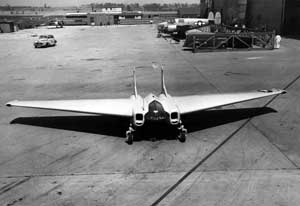
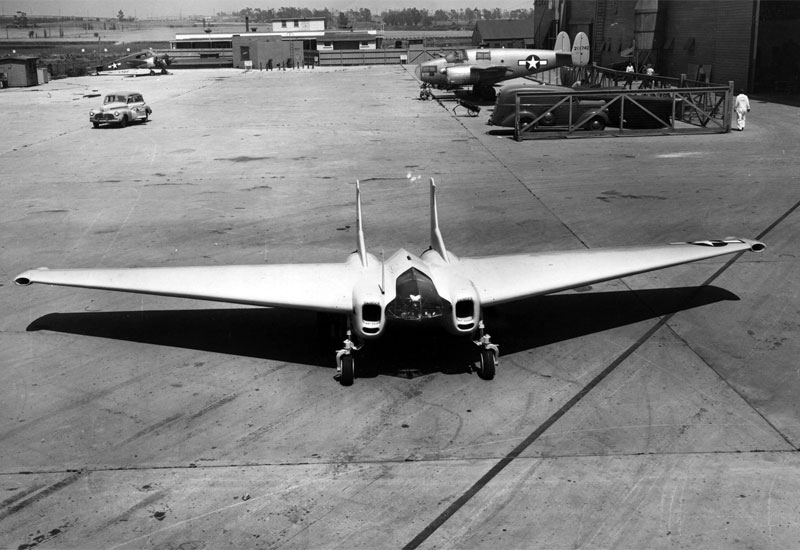
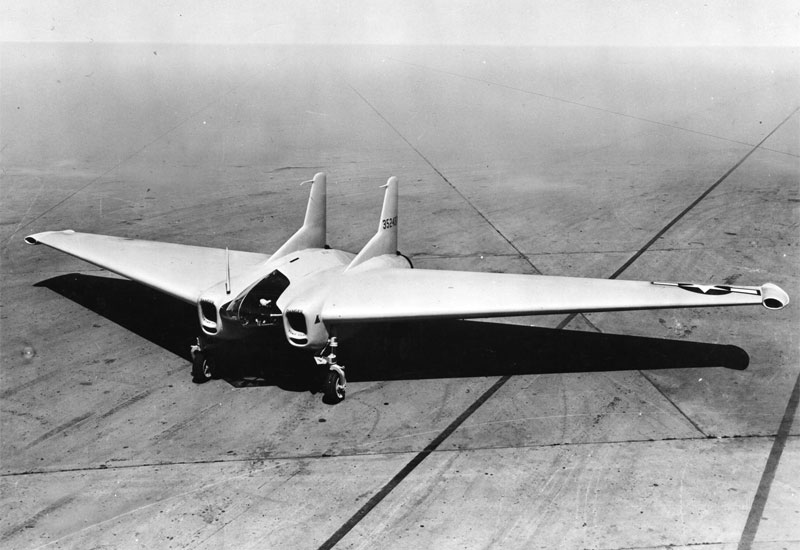
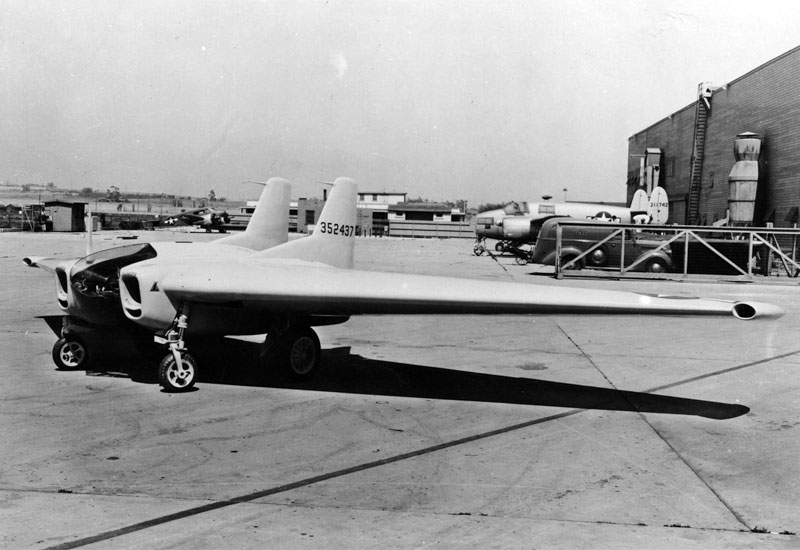
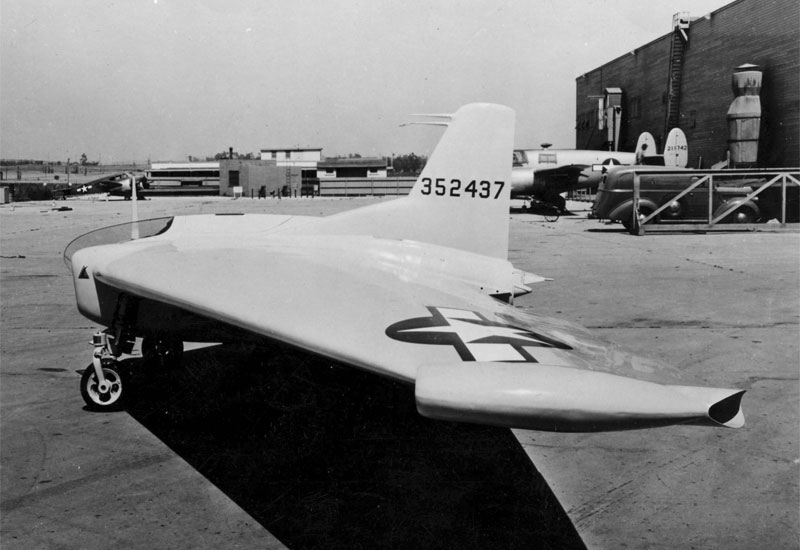
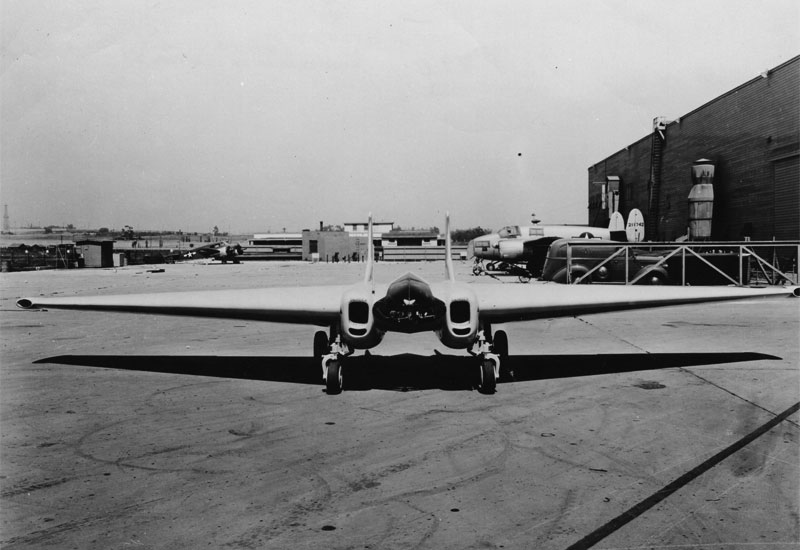
One of the key design requirements as put forth by American authorities was that the new flying wing would be capable of "ramming" enemy bombers clear from the sky with little to no damage brought onto itself. As strange a requirement as this may have seemed, it was not without merit for even the Germans tested "flying ram" concepts in actual combat with mixed results. At any rate, it was a lethal approach that, by modern standards, makes little sense. The XP-79 itself would field a large swept wing surface area though, in contrast with true flying wings, would utilized a pair of vertical tail fins at the rear of the design for added stabilization and maneuverability. The cockpit was centered at the triangle's apex and straddled on either side by twin intakes to aspirate the intended twin engines. The undercarriage included four landing gear legs in a quad arrangement instead of the more conventional three-legged form. All told, the mighty little XP-79 was an impressive and futuristic aircraft design by any account - though its "ramming" quality had already destined it for failure as the concept would ultimately prove exceedingly absurd.

In practice, the XP-79 would launch from nearby Allied air bases against a fight of incoming enemy bombers. It would have launched quickly through use of rocket boosters (known as JATO - "Jet-Fuel Assisted Take-Off") and reach a high altitude within minutes. With no armament intended for the design, the XP-79 pilot was expected to make several high speed passes through the enemy formation and utilize the reinforced wing leading edges to effectively "slice" through the frames of enemy bombers themselves. As the XP-79 would have moved at such high speeds, enemy gunners could theoretically not targeted and fire upon the aircraft within time so very little danger was apparent to the XP-79 pilot - aside from the fact he was expected to ram his exceptional aircraft into the enemy. An armored glass mounting at the cockpit would protect the pilot's head and face during dives while the leading wing edges were reinforced with armor plating to absorb impact.

The US government handed down the formal defense contract to Northrop for three XP-79 aircraft in January of 1943. When trouble emerged with the Aerojet rocket boosters, the military dropped consideration of two of these three aircraft and instead looked to Westinghouse to produce all-new turbojet-minded engines for its new craft. Westinghouse delivered a pair of 19-B series axial flow turbojets each rated for an output of 1,150lbs thrust. The flying ram concept was also beginning to lose some steam for it was then ordered that the XP-79 be modestly armed with a battery of 4 x 0.50 caliber Browning M2 heavy machine guns. With armament, the tactical doctrine of the XP-79 could then change from flying ram to high-powered interceptor and be operated in a more conventional fashion. The single prototype under consideration was also further defined with the assigning of the "XP-79B" designation. She was constructed and made ready for testing, being delivered in June of 1945. The aircraft achieved first flight on September 12th, 1945 at its Northrop facility.

To put the timeline of war into perspective by this point, Hitler was dead by suicide and Germany capitulated by the end of May 1945. In the Pacific, it was not until after the dropping of the atomic bombs on Hiroshima and Nagasaki by American B-29s that the world war was truly over at the end of August of 1945. As it stood, the XP-79 was being readied for a requirement that no longer stood - a fate shared by many-a-late-war-project that would soon see the chopping block and their ultimate ends. Additionally, enemy bomber formations from the German Luftwaffe never materialized in the mid-to-late war years. Any value that Hitler's bombers held was seen in their true glory in the "Battle of Britain". After the failed initiative to take the British Isles, more attention was given by the German war industry to produce fighters over that of new bombers. Therefore, the massed formations of German bombers that Allied warplanners feared was never to be - making developments of such "bomber destroyers" as the XP-79 a moot point. Air superiority was eventually reached over both Europe and the Pacific where Allied bombers and strike aircraft could attack German soil and the Japanese mainland at will. In either case, the enemy only ever fielded capable light-and medium-class bombers - nothing in the scope of the Allied Lancasters, Flying Fortresses, Superfortresses and Liberators appearing in thousands strong.

The XP-79B's first flight would become its last. Launching from the solitude of the Muroc Dry Lake facility, the XP-79Bs engines roared to life with test pilot Harry Crosby once again at the controls. However, as Crosby made his way down the line, a US Army fire truck - for whatever reason - managed to cross his launch path, forcing Crosby to cut back on the throttle and time the passing of the truck. Once clear, he throttled the XP-79B on full and went airborne. After approximately 14 minutes in the air, Crosby attempting his first banking maneuver and it was seen that the XP-79B lost control and entered into an irrecoverable spin towards the earth from approximately 10,000 feet up. With all control lost, Crosby existed the aircraft through the available access hatch atop the mid-section of the fuselage and attempted a traditional bail out by parachute - only to be struck by one of the spinning wings of the now-pilotless XP-79B. Both pilot and machine then came crashing down into the desert floor, the XP-79B exploding into bright flames and Crosby being killed in the process (the assumption being that he was either unconscious or already dead after being struck in mid-air. The XP-79 program had proven a total loss in more ways than one and nothing more of the endeavor surfaced thereafter. The XP-79 therefore fell to the pages of history and took with it one of the more storied test pilots with it.

Performance specifications for the XP-79B with its Westinghouse powerplants included a top speed of 525 miles per hour, a service ceiling of 40,000 feet and a rate-of-climb near 6,000 feet per minute. Empty weight was listed at 5,840lbs while loaded weight was 8,670lbs.
Text ©2003-2013 www.MilitaryFactory.com • All Rights Reserved • No Reproduction Permitted
MilitaryFactory.com does NOT sell equipment/weaponry. Material presented throughout this website is for historical and entertainment value and should not to be construed as usable for hardware restoration, maintenance or general operation. Please consult manufacturers for such information. Our disclaimer. Email corrections / Comments to MilitaryFactory at Gmail dot com.
Picture of Northrop XP-79
Pic of the Northrop XP-79
Image of the Northrop XP-79
View All Images (5)

Specifications for the
Northrop XP-79
Flying Ram / Bomber Interceptor


Country of Origin: United States
Manufacturer: Northrop Aircraft, Incorporated - USA
Initial Year of Service: 1945
Production: 1


Focus Model: Northrop XP-79B
Crew: 1


Length: 13.98ft (4.26m)
Width: 37.99ft (11.58m)
Height: 7.58ft (2.31m)
Weight (Empty): 5,838lbs (2,648kg)
Weight (MTOW): 8,669lbs (3,932kg)


Powerplant: 2 x Westinghouse 19-B axial flow turbojet engines delivering 1,150lbs thrust each.


Maximum Speed: 547mph (880kmh; 475kts)
Maximum Range: 0miles (0km)
Service Ceiling: 40,026ft (12,200m; 7.6miles)
Rate-of-Climb: 6,000 feet per minute (1,829m/min)


Hardpoints: 0
Armament Suite:
INITIAL:
None

LATER (proposed):
4 x 0.50 caliber (12.7mm) Browning M2 heavy machine guns.


Variants:
XP-79 - Base Series Designation.


XP-79A - 2 x Aerojet rocket-powered variant; canceled and never produced.

XP-79B - Jet-powered variant; fitted with 2 x Westinghouse 19-B axial flow turbojet engines; single example produced and lost to accident; serial 43-52437.


Operators: United States

ALL AIRCRAFT CATEGORIES

BY DECADE:


1900 to 1909
1910 to 1919
1920 to 1929
1930 to 1939
1940 to 1949
1950 to 1959
1960 to 1969
1970 to 1979
1980 to 1989
1990 to 1999
2000 to 2009
2010 to 2019
2020 to 2029
VIEW ALL
Compare Aircraft


BY TYPE:


Anti-Submarine Warfare (ASW)
Attack Helicopters
Bomber Aircraft
Medium Bombers
Heavy Bombers
Close-Air Support (CAS)
Commercial Aircraft
Dive Bombers
Electronic Warfare Aircraft (EWA)
Experimental / X-Planes
Fighter Aircraft
Floatplane Aircraft
Flying Boat Aircraft
Aerial Refueling Tankers
Helicopters (ALL)
Interceptor Aircraft
Multi-Role Aircraft
Navy Carrier Aircraft
Night Fighters
Reconnaissance / Scout
Search & Rescue (SAR)
Scout Helicopters
Special Purpose
Torpedo Bombers
Trainer Aircraft
Transport Aircraft
Transport Helicopters
Unmanned Aerial Vehicles (UAVs)
Unmanned Combat Air Vehicles (UCAVs)


COLLECTIONS:


4th Generation Fighter Aircraft
5th Generation Fighter Aircraft
US X-Planes
Classic US Warbirds
French Military Helicopters
Grumman "Cats"
Howard Hughes Aircraft
Indian Air Force
Israeli Air Force
Libyan Aircraft
Modern Chinese Aircraft
Modern Chinese Fighters
Modern Military Aircraft
Modern North Korean Aircraft
Modern Trainer Aircraft
Modern US Aircraft
Mikoyan Aircraft
Sukhoi Aircraft
Syrian Aircraft
Top 10 Fighter Aircraft of All Time


AIRCRAFT BY CONFLICT:


Arab-Israeli War (1948)
Cuban Missile Crisis (1959-1962)
Falklands War (1982)
Indo-Pak War (1965, 1971)
Iran-Iraq War (1980-1988)
Lebanon War (1982)
Operation Allied Force (1999)
Operation Desert Storm (1991)
Six Day War (1967)
Spanish Civil War (1936)
Soviet-Afghan War (1979-1989)
Yom Kippur War (1973)


MISCELLANEOUS:


Aircraft Cockpits
Aircraft Manufacturers List
Aircraft Timeline

WORLD WAR 2:


1939 Aircraft
1940 Aircraft
1941 Aircraft
1942 Aircraft
1943 Aircraft
1944 Aircraft
1945 Aircraft
1946 Aircraft
Australian Aircraft
Battle of Britain Aircraft
Bombers
Four-Engine Bombers
British Aircraft
British Bombers
British Transports
Dive Bombers
Canadian Aircraft
Fighters
Chinese Aircraft
French Aircraft
German Aircraft
German Fighters
German Flying Boats
German Jets
Secret Weapons of the Luftwaffe
Italian Aircraft
Imperial Japanese Aircraft
Imperial Japanese Fighters
Mitsubishi Bombers
Navy Aircraft
Pearl Harbor
Polish Aircraft
Romanian Aircraft
US Aircraft
US Bombers
US Navy Aircraft
Soviet Aircraft
Torpedo Bombers
Trainer Aircraft
Transport Aircraft
Tuskegee Airmen Aircraft
W.A.S.P. Aircraft
WW2 Aircraft Ranked by Speed
VIEW ALL


WORLD WAR 1:


1914 Aircraft
1915 Aircraft
1916 Aircraft
1917 Aircraft
1918 Aircraft
Aircraft Timeline
Austro-Hungarian Aircraft
Bomber Aircraft
British Aircraft
Fighters
Flying Boats
French Aircraft
Imperial German Aircraft
Italian Aircraft
Scout Aircraft
Russian Empire Aircraft
US Aircraft
WW1 Aircraft Ranked by Speed
VIEW ALL


KOREAN WAR:


Australian Aircraft
Korean War Aces
Korean War Jets
North Korean Aircraft
US Military Aircraft
VIEW ALL


VIETNAM WAR:


Helicopters
North Vietnam Air Force
US Airpower
VIEW ALL


COLD WAR:


1950s French Aircraft
British V-Bombers
Cold War Bombers
Soviet Aircraft
Soviet Bombers
Soviet Interceptors
Soviet Helicopters
Strategic Air Command
US Aircraft
US Bombers
US Interceptors
VIEW ALL

Site Disclaimer | Privacy Policy | Site Map | MF Origins


©2013 www.MilitaryFactory.com • Content ©2003-2013 MilitaryFactory.com • All Rights Reserved • Site Contact Email: militaryfactory at gmail dot com. The "Military Factory" name and MilitaryFactory.com logo are registered ® trademarks and protected by all applicable domestic and international intellectual property laws.


Top MF Stuff: 2013 Military Pay Scale | Military Ranks | WW2 Weapons | Sniper Rifles | Kts to Mph | WW1 Aircraft | Automatic Rifles | Aircraft Cockpits | Vietnam War Weapons | Main Battle Tanks | Submachine Guns | Shotguns | French Military Victories


Most photographic images appearing on this site are courtesy of the United States Department of Defense and are approved for public use. Other images acquired through the public domain. Digital art work courtesy of Dan Alex. Business Consulting by Kyle Williams. Material presented throughout this website is for historical and entertainment value and should not to be construed as usable for hardware restoration, maintenance or general operation. Please consult manufacturers for such information.


eXTReMe Tracker