Military Factory
Military Pay Chart
Global Firepower
Military Industrial Complex
Second World War
Home
Military Pay Scale
Military Ranks
Small Arms
Aircraft
Land Systems
Navy
Education
Military Factory Facebook Logo
flag of Nazi Germany

Heinkel He 111 Z (Zwilling) Utility Transport (1942)

Authored By Staff Writer | Last Updated: 11/15/2010

The large-span, five-engine He 111 Zwilling was specifically designed as a heavy transport powerful enough to tow the large Messerschmitt Me 321 gliders.

Find a School Near You
Follow Military Factory on Facebook:
Trending on Military Factory:
Recent Articles:
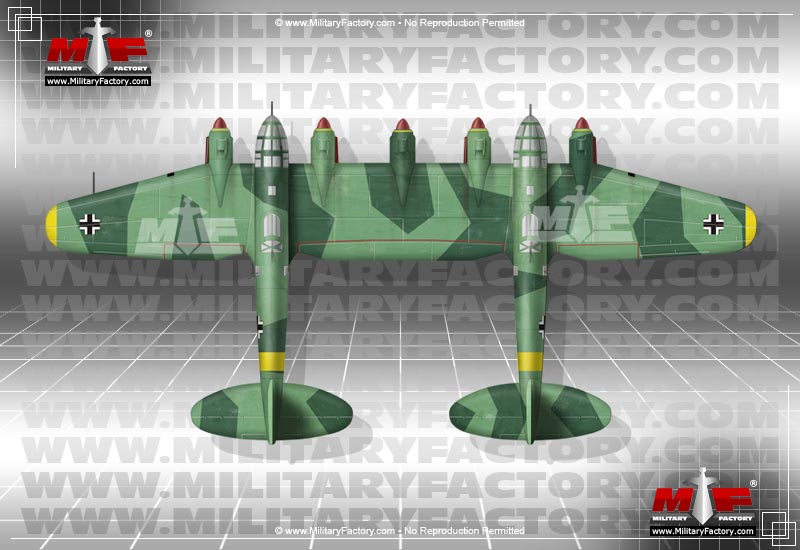
The He 111 Z (or "Zwilling") was an interesting, albeit bizarre, joining of two He 111 medium bombers (detailed elsewhere on this site). In an attempt to bring together existing designs to produce a large enough transport capable of towing the Me 321 glider, the He 111 Z was conceived of as such a solution with the intent that a large wing area and five powerplants would be sufficient. Externally, the creation appeared as nothing more than two He 111 airframes joined at a wing with an extra (fifth) engine fitted to the joining structure.

A pair of twin-engine He 111 H-6's served as base conversion models for the new Zwilling design. Two He 111 Z prototypes were then constructed, with the He 111 H-6's joined by a center wing chord structure containing a fifth engine, and the response was good when evaluated by pilots at Rechlin. This was then followed by ten production He 111 Z's. The portside fuselage accommodated the pilot, primary mechanic, gunner and a radio operator/navigator while the starboard fuselage held the co-pilot, secondary mechanic and another gunner bringing the total crew count to seven (the co-pilot could double as a navigator if the situation pressed). The pilot was afforded full instrumentation while the co-pilot was allowed a limited collection of gauges. As such there was no real redundancy to the system as one might expect. The pilot was afforded five throttle levers for complete control over the engines. Control for the radiator flaps was divvied up between the port and starboard cockpits with each man having control of the radiator flaps on his own side. Undercarriage control could be handled by either cockpit. Self-defense was accomplished through a variety of machine gun arrangements mostly centering on 7.7mm MG- and/or 13mm MG-series machine guns and 20mm cannons. Armament varied, however, and was primarily dependent on what the "donor" He 111 H-6 brought along with it.

The engine arrangement was made up of Junkers-brand Jumo 211 F-series 12-cylinder, liquid-cooled, inverted Vee engines of up to 1,340 horsepower each. These engines were fitted into five nacelles, three along the center wing chord and two held outboard on either side. Despite this multi-engined layout, the He 111 Z was still in need of help when attempting to pull a fully-loaded Me 321 glider. This was rectified in the use of rockets for additional thrust (as in "RATO" - Rocket Assisted Take-Off) - not a wholly uncommon sight even at the beginning of the jet age. The Zwilling could, however, maintain flight if any or all of the three central wing cord engines failed. Range could be augmented by four external drop tanks.

By the end of the war, only four He 111 Zwillings were known to exist in operational condition despite some 12 total ultimately produced. The unaccounted for Zwillings were reportedly lost to Allied action while either in the air or still grounded. In any case, the Zwilling proved a limited success to an extent, able to ferry about dozens of injured German soldiers while being able to supply the massive Messerschmitt Me 321 gliders with a much-needed glider tug.

Only the H2 111 Z-1 ever saw any level of quantitative production while the proposed Z-2 long-range bomber and Z-3 long-range reconnaissance aircraft never came to fruition - both variants were based on the Z-1 production model.
Text ©2003-2013 www.MilitaryFactory.com • All Rights Reserved • No Reproduction Permitted
MilitaryFactory.com does NOT sell equipment/weaponry. Material presented throughout this website is for historical and entertainment value and should not to be construed as usable for hardware restoration, maintenance or general operation. Please consult manufacturers for such information. Our disclaimer. Email corrections / Comments to MilitaryFactory at Gmail dot com.
Picture of Heinkel He 111 Z (Zwilling)
View All Images (1)

Specifications for the
Heinkel He 111 Z (Zwilling)
Utility Transport


Country of Origin: Nazi Germany
Manufacturer: Heinkel - Germany
Initial Year of Service: 1942
Production: 12


Focus Model: Heinkel He 111 Z (Zwilling)
Crew: 7 - 9


Length: 54.79ft (16.7m)
Width: 115.49ft (35.20m)
Height: 13.12ft (4.00m)
Weight (Empty): 47,399lbs (21,500kg)
Weight (MTOW): 62,556lbs (28,375kg)


Powerplant: 5 x Junkers Jumo 211F-2 inverted V-12 liquid-cooled engines delivering 1,300hp each.


Maximum Speed: 296mph (477kmh; 258kts)
Maximum Range: 1,174miles (1,890km)
Service Ceiling: 16,010ft (4,880m; 3.0miles)
Rate-of-Climb: 0 feet per minute (0m/min)


Hardpoints: 4
Armament Suite:
Mix of 7.7mm and 13mm machine guns with the occasional 20mm cannon depending on what was kept from the original base aircraft utilized for the conversions.


Variants:
He 111 H-6 - Base Bomber Model on which the "Zwilling" is based on.


He 111 Z - Model Series and Prototype Models Designation; 2 examples produced.

He 111 Z-1 - "Zilling" twin He 111 fuselage model; heavy-lift transport model; 10 examples produced.

He 111 Z-2 - Proposed Long-Range Bomber Variant based on the production Z-1 model; never produced.

He 111 Z-3 - Proposed Long-Range Reconnaissance Variant based on the production Z-1 model; never produced.


Operators: Nazi Germany

ALL AIRCRAFT CATEGORIES

BY DECADE:


1900 to 1909
1910 to 1919
1920 to 1929
1930 to 1939
1940 to 1949
1950 to 1959
1960 to 1969
1970 to 1979
1980 to 1989
1990 to 1999
2000 to 2009
2010 to 2019
2020 to 2029
VIEW ALL
Compare Aircraft


BY TYPE:


Anti-Submarine Warfare (ASW)
Attack Helicopters
Bomber Aircraft
Medium Bombers
Heavy Bombers
Close-Air Support (CAS)
Commercial Aircraft
Dive Bombers
Electronic Warfare Aircraft (EWA)
Experimental / X-Planes
Fighter Aircraft
Floatplane Aircraft
Flying Boat Aircraft
Aerial Refueling Tankers
Helicopters (ALL)
Interceptor Aircraft
Multi-Role Aircraft
Navy Carrier Aircraft
Night Fighters
Reconnaissance / Scout
Search & Rescue (SAR)
Scout Helicopters
Special Purpose
Torpedo Bombers
Trainer Aircraft
Transport Aircraft
Transport Helicopters
Unmanned Aerial Vehicles (UAVs)
Unmanned Combat Air Vehicles (UCAVs)


COLLECTIONS:


4th Generation Fighter Aircraft
5th Generation Fighter Aircraft
US X-Planes
Classic US Warbirds
French Military Helicopters
Grumman "Cats"
Howard Hughes Aircraft
Indian Air Force
Israeli Air Force
Libyan Aircraft
Modern Chinese Aircraft
Modern Chinese Fighters
Modern Military Aircraft
Modern North Korean Aircraft
Modern Trainer Aircraft
Modern US Aircraft
Mikoyan Aircraft
Sukhoi Aircraft
Syrian Aircraft
Top 10 Fighter Aircraft of All Time


AIRCRAFT BY CONFLICT:


Arab-Israeli War (1948)
Cuban Missile Crisis (1959-1962)
Falklands War (1982)
Indo-Pak War (1965, 1971)
Iran-Iraq War (1980-1988)
Lebanon War (1982)
Operation Allied Force (1999)
Operation Desert Storm (1991)
Six Day War (1967)
Spanish Civil War (1936)
Soviet-Afghan War (1979-1989)
Yom Kippur War (1973)


MISCELLANEOUS:


Aircraft Cockpits
Aircraft Manufacturers List
Aircraft Timeline

WORLD WAR 2:


1939 Aircraft
1940 Aircraft
1941 Aircraft
1942 Aircraft
1943 Aircraft
1944 Aircraft
1945 Aircraft
1946 Aircraft
Australian Aircraft
Battle of Britain Aircraft
Bombers
Four-Engine Bombers
British Aircraft
British Bombers
British Transports
Dive Bombers
Canadian Aircraft
Fighters
Chinese Aircraft
French Aircraft
German Aircraft
German Fighters
German Flying Boats
German Jets
Secret Weapons of the Luftwaffe
Italian Aircraft
Imperial Japanese Aircraft
Imperial Japanese Fighters
Mitsubishi Bombers
Navy Aircraft
Pearl Harbor
Polish Aircraft
Romanian Aircraft
US Aircraft
US Bombers
US Navy Aircraft
Soviet Aircraft
Torpedo Bombers
Transport Aircraft
Tuskegee Airmen Aircraft
W.A.S.P. Aircraft
WW2 Aircraft Ranked by Speed
VIEW ALL


WORLD WAR 1:


1914 Aircraft
1915 Aircraft
1916 Aircraft
1917 Aircraft
1918 Aircraft
Aircraft Timeline
Austro-Hungarian Aircraft
Bomber Aircraft
British Aircraft
Fighters
Flying Boats
French Aircraft
Imperial German Aircraft
Italian Aircraft
Scout Aircraft
Russian Empire Aircraft
US Aircraft
WW1 Aircraft Ranked by Speed
VIEW ALL


KOREAN WAR:


Australian Aircraft
Korean War Aces
Korean War Jets
North Korean Aircraft
US Military Aircraft
VIEW ALL


VIETNAM WAR:


Helicopters
North Vietnam Air Force
US Airpower
VIEW ALL


COLD WAR:


1950s French Aircraft
British V-Bombers
Cold War Bombers
Soviet Aircraft
Soviet Bombers
Soviet Interceptors
Soviet Helicopters
Strategic Air Command
US Aircraft
US Bombers
US Interceptors
VIEW ALL

Site Disclaimer | Privacy Policy | Site Map | MF Origins


©2013 www.MilitaryFactory.com • Content ©2003-2013 MilitaryFactory.com • All Rights Reserved • Site Contact Email: militaryfactory at gmail dot com. The "Military Factory" name and MilitaryFactory.com logo are registered ® trademarks and protected by all applicable domestic and international intellectual property laws.


Top MF Stuff: 2013 Military Pay Scale | Military Ranks | WW2 Weapons | Sniper Rifles | Kts to Mph | WW1 Aircraft | Automatic Rifles | Aircraft Cockpits | Vietnam War Weapons | Main Battle Tanks | Submachine Guns | Shotguns | French Military Victories


Most photographic images appearing on this site are courtesy of the United States Department of Defense and are approved for public use. Other images acquired through the public domain. Digital art work courtesy of Dan Alex. Business Consulting by Kyle Williams. Material presented throughout this website is for historical and entertainment value and should not to be construed as usable for hardware restoration, maintenance or general operation. Please consult manufacturers for such information.


eXTReMe Tracker