The Sikorsky UH-60 Black Hawk has become a workhorse for the United States and other military forces the world over. Its capabilities have increased her roles to include Special Operations assignments, assault, MedEvac, Command and Control and VIP transport duty on top of her inherent troop-transport capabilities. The first production Black Hawk entered service in 1979 and remains a primary fixture for many an army even today - two decades after its inception. Some 2,600 total Black Hawks have been delivered worldwide.
The Black Hawk was born out of the Sikorsky S-70 project designed to the United States Army's Utility Tactical Transport Aircraft System (UTTAS) specification that began in the latter part of the 1960's. The specification itself originated on the data collected from wartime use of the UH-1 "Huey" Iroquois helicopters pulling multiple duties across the war zone. Review of this experience brought about a need for capable replacement system for the immediate future. This design specification also coincided with development of the new General Electric turboshaft engine series designated as the T700. US Army feelers went out in 1972 with both Sikorsky and Boeing-Vertol both answering the call. The Sikorsky design was chosen ahead of the Boeing-Vertol YUH-61A attempt and the Sikorsky YUH-60A prototype achieved first flight on November 29th, 1974. The production contract was handed to Sikorsky in late 1976 with first deliveries of the Black Hawk system beginning on an October day two years later. The Black Hawk was officially introduced into service in the middle of 1979 with the US Army 101st Airborne Division, replacing the venerable UH-1 Hueys.
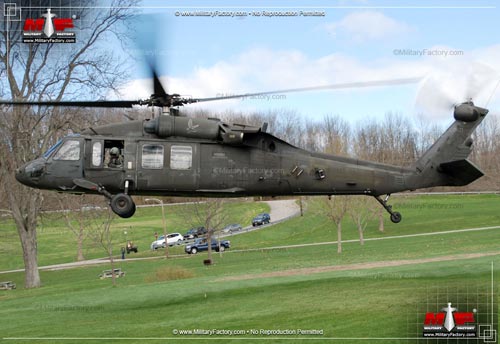
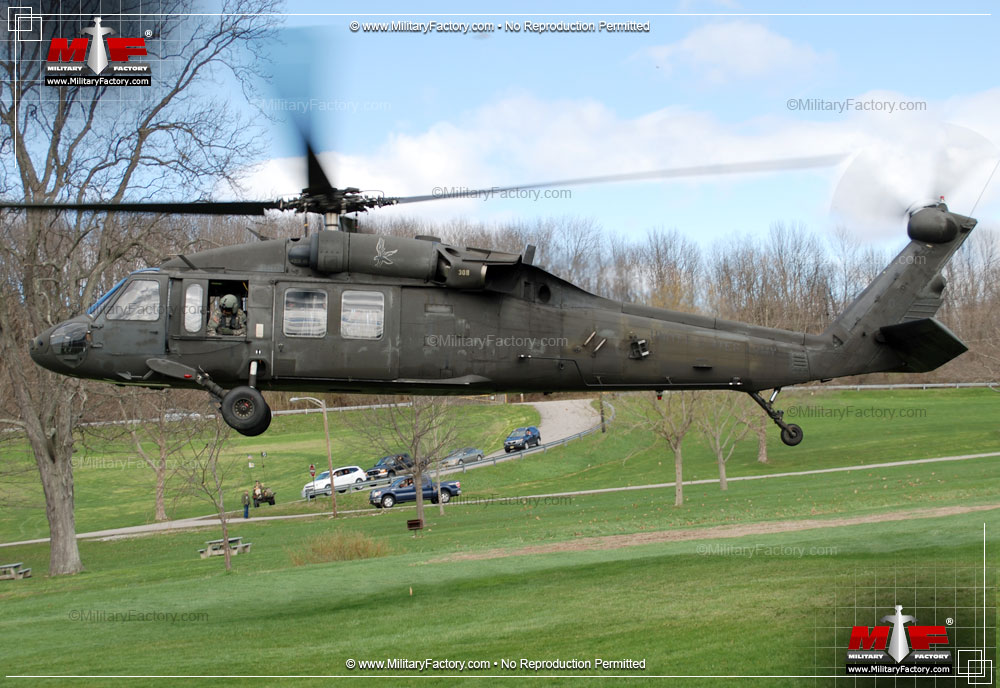
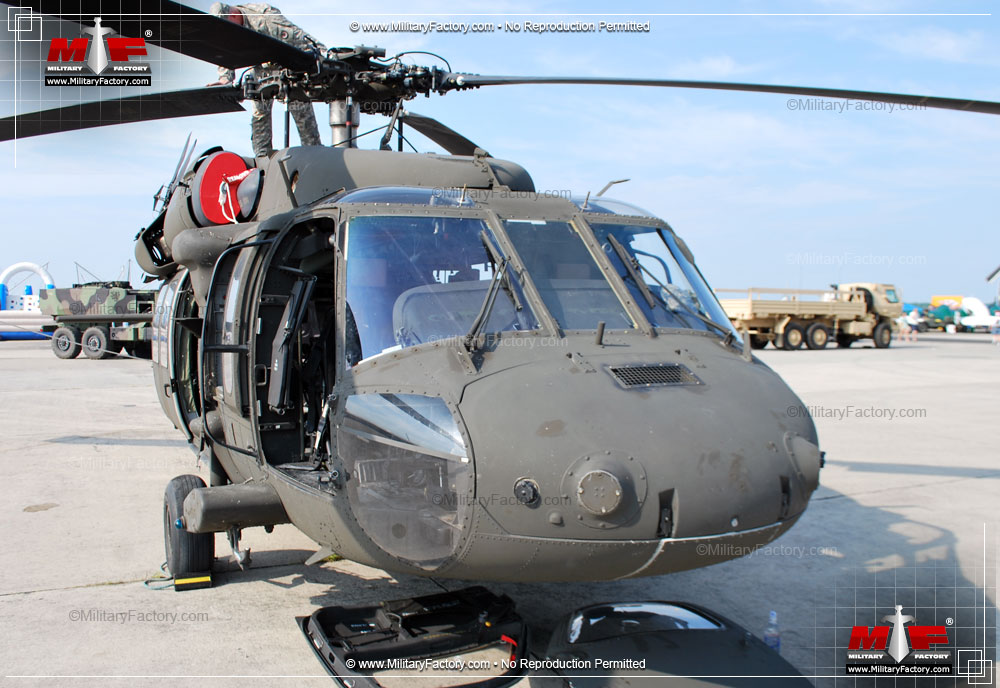
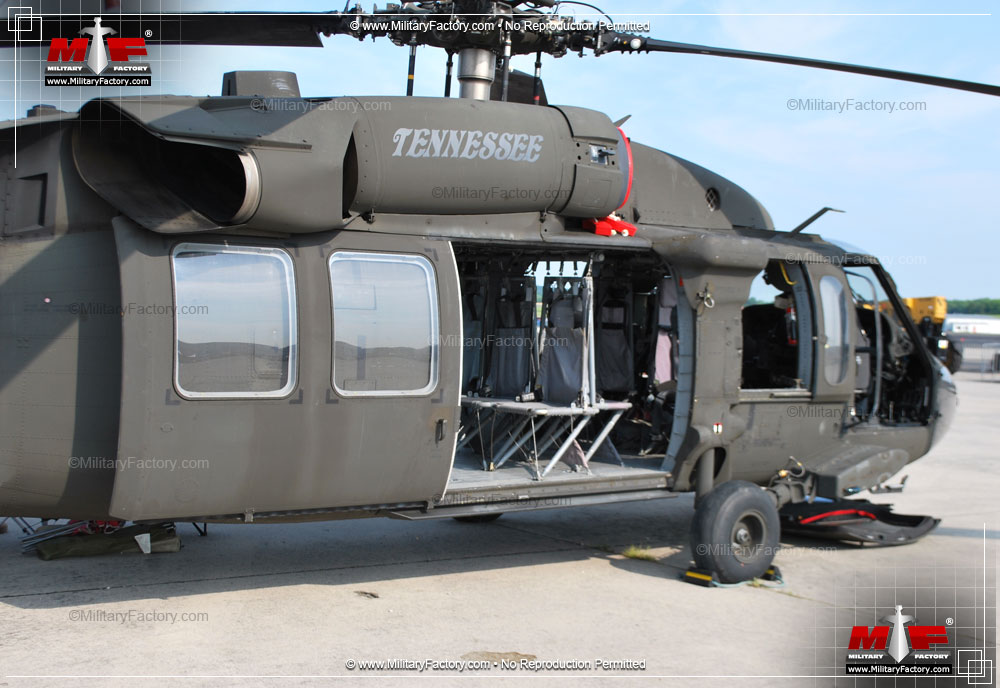
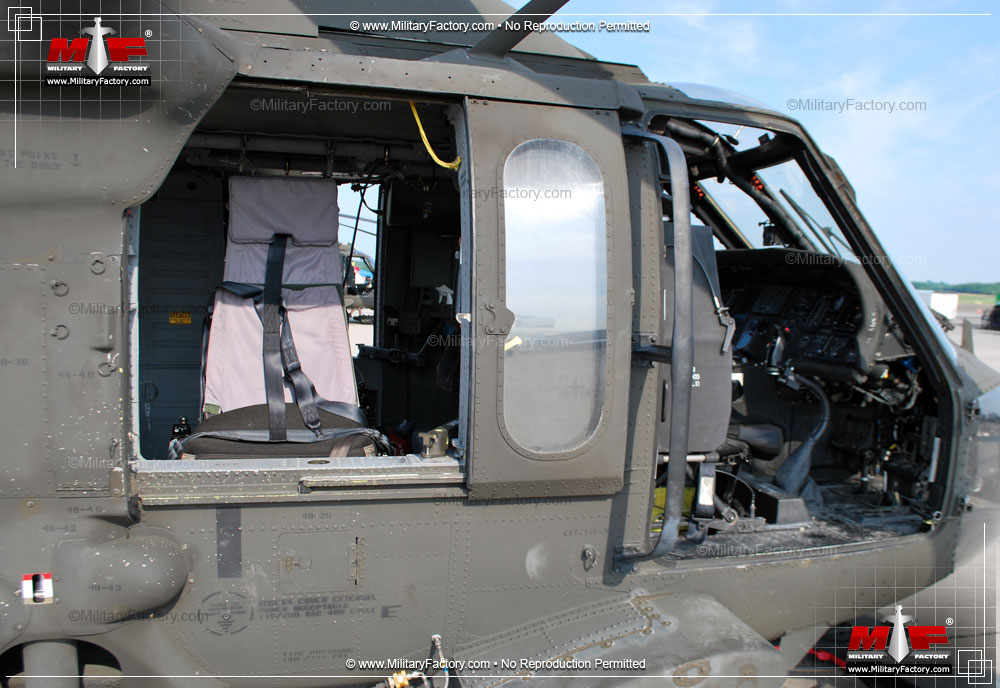
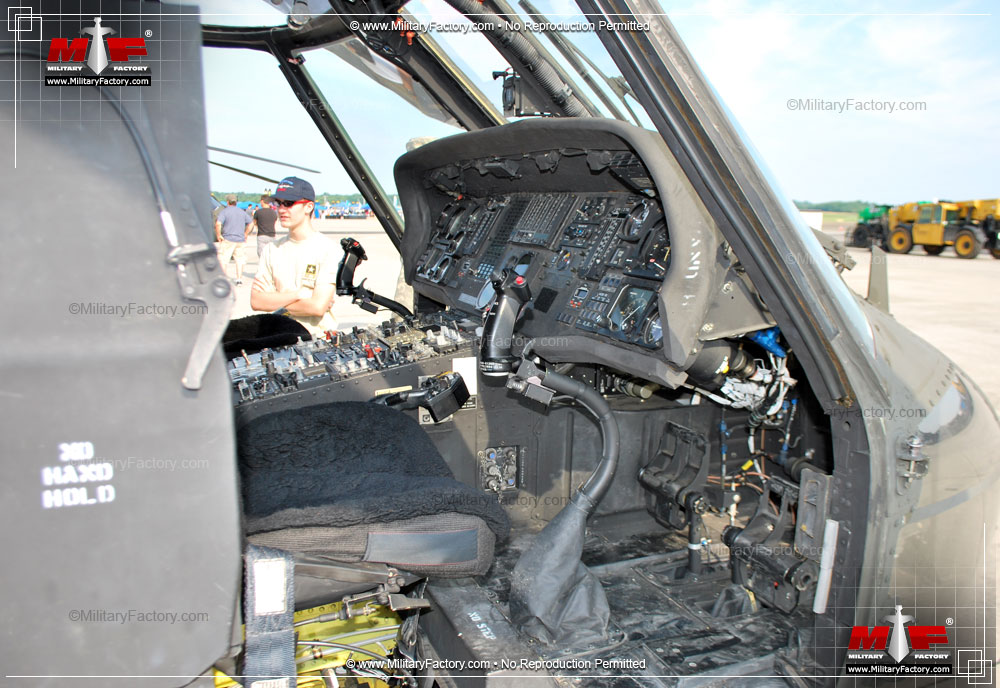
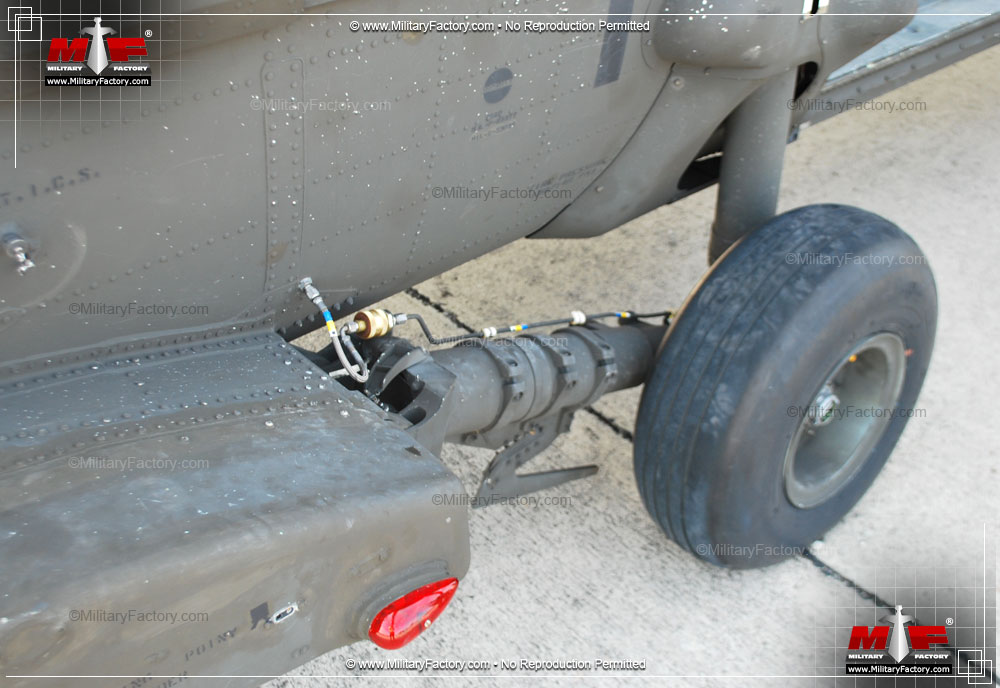
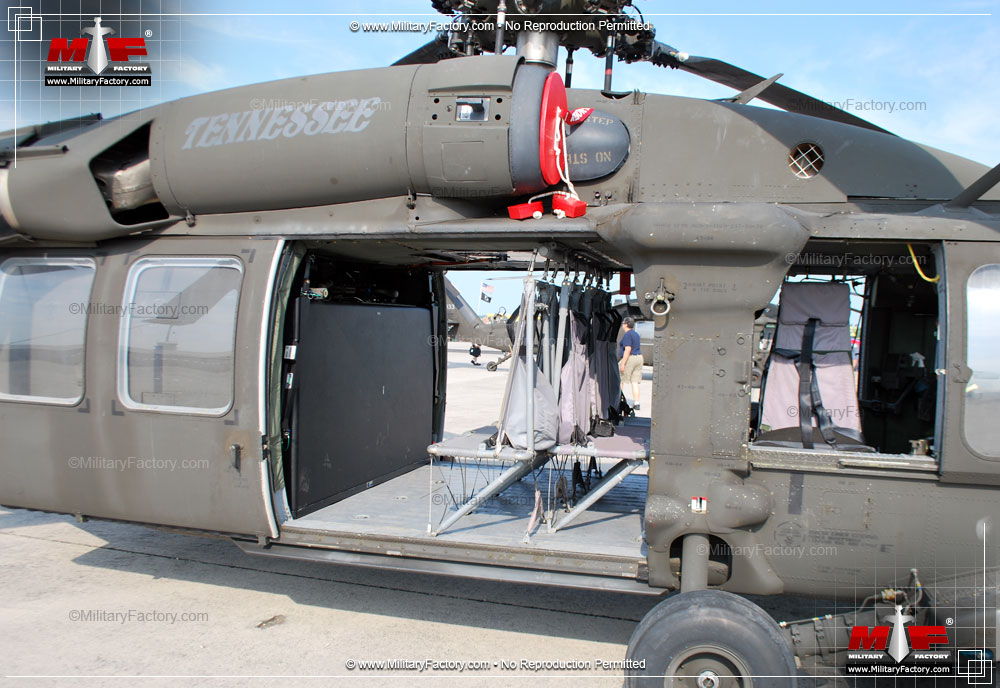
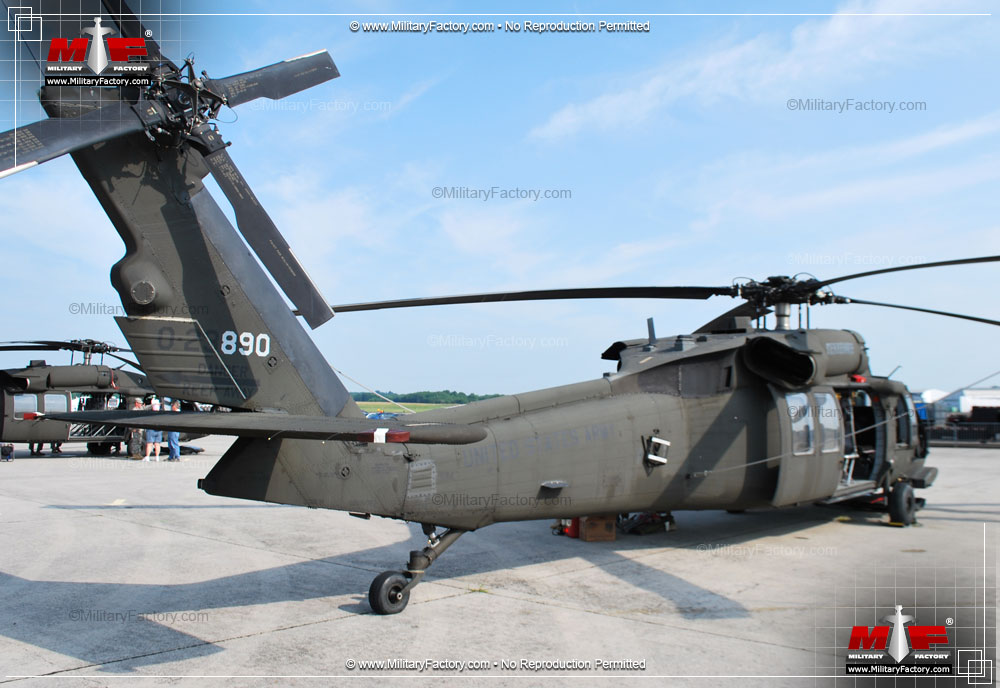
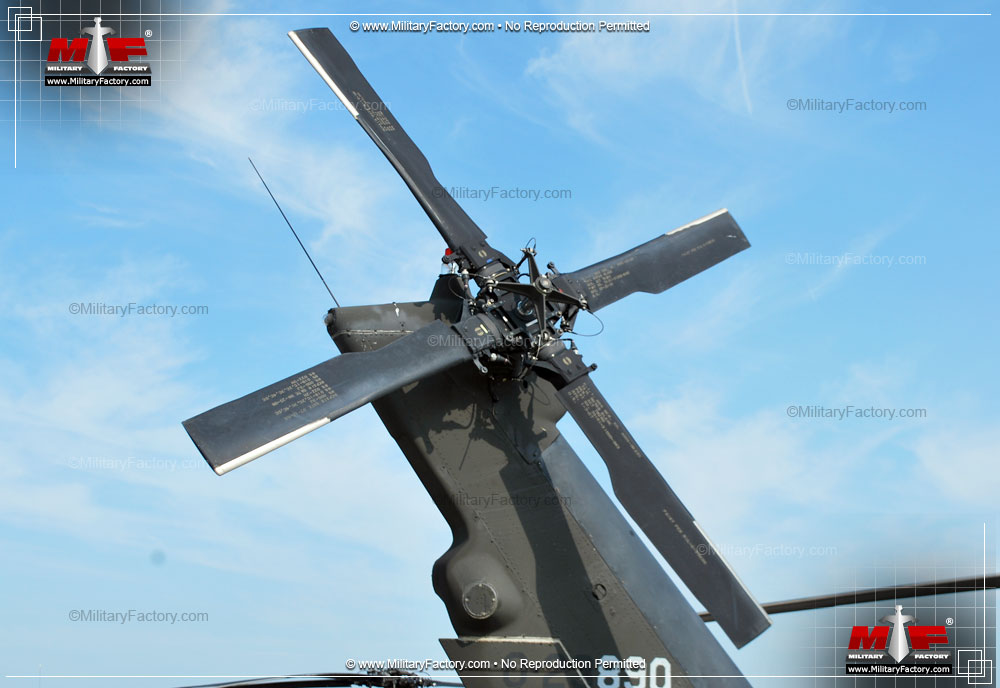
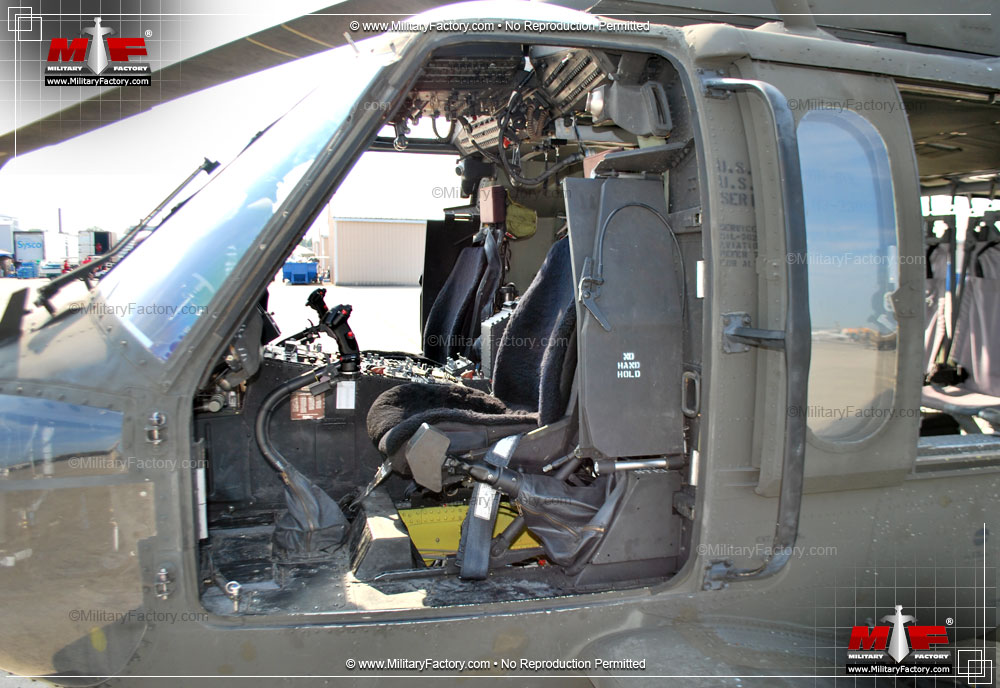
Black Hawks have a distinct look about them making them highly recognizable even when compared to her contemporaries. The forward portion of the fuselage contains seating positions for the pilot and co-pilot (collectively known as the flight crew) with windowed panels above, forward-below and to the sides. Each crew position is afforded an entry-exit door. Directly behind the cockpit is the cabin that allows for seating of some 11 personnel (depending on the version) with entry/exit made by two double-windowed sliding doors. The General Electric series turboshaft engines sit atop either side of the middle-fuselage with the four-blade main rotor extending up between them. The empennage is of conventional design and layout, featuring a four-blade tail rotor positioned to the starboard side, single vertical fin structure and horizontal plane. The undercarriage is fixed and features to main landing gears forward (complete with wire cutters ahead of each component) and a single tail wheel fitted under the fuselage area between the cabin and extreme edge of the tail.
Performance from the twin turboshaft engines provide for a top approximate speed of 183 miles per hour with a "never exceed" speed of up to 222 miles per hour. Cruise speeds are typically 173 miles per hour. A combat radius of 368 miles is possible with a ferry range of 1,380 miles. The service ceiling is reported at 19,000 feet with a 700 feet-per-minute rate-of-climb. Cargo hauling capacity is 2,640lb of freight held internally. An 8,000lb freight limit is imposed for external hauling.
As expected, the Black Hawk helicopter can accomplish just about any battlefield-related task it is assigned. This includes its standard role as a troop-carrying implement but can also be expanded to include cargo/artillery transport, offensive assault, Special Operations insertion/extraction along with Search & Rescue and MedEvac. Several Black Hawks have been modified for VIP transport roles for the US government and take on the call sign of "Marine One" when specifically transporting the President of the United States.
Variants range from utility based to specialty models. The original US Army production Balck Hawk became the UH-60A while the UH-60L appeared with upgraded T700-GE-701C engines and other updates. The UH-60M appeared with further improvements and replaced original production Black Hawks. MedEvac versions included the UH-60Q while Special Operations Forces were given the specialized and armed MH-60K and MH-60L models. VIP models in US service were the VH-60D "Nighthawk" and VH-60N "Whitehawk" variants.
Sikorsky S-70 is the company designation for the series. UH-60 "Black Hawk" is generally the US Army designation while HH-60 "Pave Hawk" is the United States Air Force designation. The US Coast Guard uses the helicopter in its specially developed HH-60 "Jayhawk" guise. The United States Navy operates the SH-60 "Seahawk". Many export versions of the Black Hawk have surfaced as well with most under the base S-70 designation (see variants list for complete details).
When armed, the Black Hawk can take on firepower in the form of 30mm chain guns, machine gun pods, heavy caliber and general purpose machine guns and miniguns. Additionally, optional wing stubs can provide for the use of external fuel tanks (coming in two sizes - see armaments suite for specifics) for increased operational ranges or Hellfire anti-tank missiles and 2.75" rocket pods for increased lethality.
The UH-60 Black Hawk made its US combat debut in the 1983 Invasion of Grenada and later in the 1989 Invasion of Panama. The Black Hawk was put to good use in the 1991 coalition offensive of the 1991 Persian Gulf War to remove Saddam Hussein's invasion force from Kuwaiti soil. Perhaps the Black Hawks involvement in the assault on the capital city of Mogadishi in Somalia is what most observers will forever remember in regards to the helicopter's history. In the assault, two Black Hawk helicopters were shot down by enemy rocket-propelled grenades, leading to the horrifically televised display of the loss of American lives (18 in all, including one captured and 73 wounded), effectively signaling the beginning of the end of US involvement in that country. At the turn of the century, 9/11 forced direct American involvement in Afghanistan and - later - Iraq, extending the, yet, unwritten history of the Black Hawk helicopter into tomorrow.
The UH-60M represents the current Black Hawk production model. Operators of the Black Hawk range from the Pacific Rim to South America, the Middle East to Europe. Some of the largest operators include the United States, Columbia, South Korea, Turkey and Australia.
With thousands of units in circulation worldwide, the UH-60 Black Hawk, in all its varied forms, should continue to see active service throughout the 2020s.
A "stealthified" version of the UH-60 Black Hawk is said to have been used in the successful May 2011 assault on Osama Bin Laden's compound in Pakistan by forces of the United States Navy SEALs. The helicopter is said to be outfitted with a myriad of high-level technology that diminishes the aircraft's radar signature and noise levels, the former through a special fabric coating or "skin" and the latter by way of a dish-shaped installation over the tail rotor bub and (possibly) engine housings. These Black Hawks managed to remain undetected during the entire operation though one was lost to a malfunction and blown up while on the ground prior to mission's end. The operation resulted in the death of the 9/11 mastermind. However, remnants of the exploded helicopter were then picked up by the Pakistani government and hauled away to an unknown location. Of note is that the Chinese government maintains a close working relationship with the Pakistani government and may be in the market for such technology to further their own stealth programs.
June 2016 - It was announced that Turkey has signed an agreement with Sikorsky to locally-produce the export version of the Black Hawk helicopter, designated the "T-70" and based on the S-70i export model. Work will be handled by Turkish Aerospace Industries (TAI) and include assembly of GE T700 turboshaft engines as well. Deliveries of the new systems are expected to begin in 2021 and run until 2026 - increasing UH-60 numbers for the various Turkish armed services committed to the type already.
September 2016 - Chile has committed to purchasing six S-70i International Black Hawk helicopters to cover a running medium-lift requirement.
February 2017 - The first UH-60L with new Northrop Grumman cockpit completed an initial flight on January 19th, 2017. This equipment change creates the new UH-60V standard of which some 760 of the U.S. Army stock of UH-60L helicopters will be brought up to.
July 2017 - Thailand is set to ink a deal to order more UH-60 Black Hawk helicopters from the United States.
September 2017 - It was revealed that Sierra Nevada Corporation plans to interest the United States Air Force on the "Force Hawk" for the services UH-1N Replacement Program. This platform is an upgraded model based on ex-U.S. Army Sikorsky UH-60A mounts. Sierra Nevada Corp is already part of the UH-60L upgrade program.
September 2017 - The Afghan Air Force received its first two UH-60A Black Hawk transport helicopters. These are ex-U.S. Army models of which some 150 will ultimately be delivered - about 58 of the fleet being armed versions. The fleet will be used to succeed the aging line of Soviet-era Mil Mi-17 transport helicopters currently in service. Additional marks set to be delivered include the UH-60FFF (Fixed Forward-Firing) variant (with 12.7mm and 2.75" rocket support) with training provided by American personnel in both the United States and in Afghanistan.
August 2018 - The nation of Latvia seeks four UH-60 Black Hawk transport helicopters to replace an equal number of aging Soviet-era Mil Mi-8 helicopters in same role.
December 2018 - The Philippines has moved closer to the purchase of sixteen UH-60 Black Hawk helicopters from the United States. Other platforms under consideration were the Sikosrky S-70 (of which the UH-60 is based in), the Russian Mi-171 (Mi-17), the "Surion" of South Korea, and the Leonardo AW139 utility type.
February 2019 - At IDEX 2019, the United Arab Emirates (UAE) has unveiled a locally-modified gunship variant of the long-running and far-reaching UH-60 Black Hawk helicopter line.
March 2019 - A heavily-armed version of the UH-60 is being proposed by Mitsubishi Heavy Industries to satisfy a new Japanese Defense requirement for the New Attack Helicopter (NAH).
May 2019 - The Czech Republic is eyeing the Bell UH-1Y, Bell AH-1Z, and Sikorsky UH-60M "Black Hawk" helicopters as potential replacements for its aging fleet of Soviet-era Mi-24 helicopters.
May 2019 - Sikorsky engineers successfully completed a first-flight of an "optionally piloted" UH-60A helicopter on May 29th, 2019. The helicopter has been modified through an autonomous flight control kit being installed into the existing framework. The flight took place at the Sikorsky Palm Beach, Florida location.
July 2019 - The Philippines government is set to receive Black Hawk helicopters some time in 2020.
October 2019 - The optionally-piloted UH-60A demonstrator has completed nearly 55 hours of flying time to date.
December 2019 - Croatia has become a UH-60 operator as it seeks to replace its aging fleet of Mi-8 'Hip' transport helicopters. Four UH-60M models have been delivered with more expected to follow.
April 2020 - The UH-60V variant has completed its Initial Operational Testing and Evaluation (IOTE) phase.
June 2020 - Sikorsky will be promoting an armed direct-attack variant of its venerable UH-60 "Black Hawk" line to the nation of the Philippines. The Philippine Air Force is currently in the market for an attack helicopter to bolster its ground attack / Close-Air Support capabilities. A direct-attack version would presumably be outfitted with enhanced countermeasures, ATGM support, broadened general weapons support, and advanced optics in a traversing chin turret.
June 2020 - The U.S. State Department has approved the sale of six UH-60M helicopters to the nation of Lithuania.
September 2020 - The United States Army has received its first UH-60V "Victor" modernized Black Hawk variant for service. The transfer took place on September 29th, 2020.
November 2020 - The Philippines has taken deliver of an initial stock of five S-70i Black Hawk helicopters.
November 2020 - Lithuania has ordered 4+2 UH-60M helicopters from the United States to succeed an aging line of Soviet-era helicopters in same role.
June 2021 - The Philippine Air Force has taken delivery of five more S-70i Black Hawk platforms.
August 2021 - The United States National Guard (Pennsylvania) has taken delivery of its first UH-60V variant (UH-60L with Northrop Grumman avionics fit).
November 2021 - Romanian authorities have approved the purchase of twelve Black Hawk helicopters for its emergency services units.
February 2022 - Croatia has taken deliver of the first two of four UH-60M multi-mission helicopters for its Croatian Air Force service.
February 2022 - DARPA has successfully flown an unmanned UH-60 helicopter in testing out of Fort Campbell.
January 2023 - Sikorsky has delivered its 5,000th Black Hawk airframe.
February 2023 - A UH-60 was photographed in-hangar in Ukrainian livery under ownership of the intelligence Special Forces (GUR) service.
Power & Performance Those special qualities that separate one aircraft design from another. Performance specifications presented assume optimal operating conditions for the Sikorsky UH-60L Black Hawk Medium-Lift, Multi-Mission Helicopter.
2 x General Electric T700-GE-701C turboshaft engines developing 1,800 shaft horsepower while driving a four-blade main rotor and four-blade tail rotor. Propulsion
183 mph 295 kph | 159 kts Max Speed
18,996 ft 5,790 m | 4 miles Service Ceiling
363 miles 584 km | 315 nm Operational Range
1,550 ft/min 472 m/min Rate-of-Climb
Structure The nose-to-tail, wingtip-to-wingtip physical qualities of the Sikorsky UH-60L Black Hawk Medium-Lift, Multi-Mission Helicopter.
2 (MANNED) Crew
50.1 ft 15.26 m O/A Length
53.7 ft (16.36 m) O/A Width
12.3 ft (3.76 m) O/A Height
11,517 lb (5,224 kg) Empty Weight
24,500 lb (11,113 kg) MTOW
Armament Available supported armament and special-mission equipment featured in the design of the Sikorsky UH-60 Black Hawk Medium-Lift, Multi-Mission Helicopter provided across 4 hardpoints.
OPTIONAL:
External Stores Support System (ESSS) offering up to four hardpoints.
2 x 7.62mm General Purpose Machine Guns (GPMGs) on side-facing cabin pintle mounts.
Also:
16 x Hellfire Anti-Tank Guided Missiles (ATGMs).
2 x External 230 gallon fuel tanks.
2 x External 450 gallon fuel tanks.
2 x GAU-19 12.7mm Gatling Guns.
2 x M240H 7.62mm GPMGs.
Mine Dispersal Systems.
SPECIAL OPERATIONS BLACKHAWK (MH-60L DAP):
2 x M134D Gatling Guns (fixed, forward-firing or at door mountings).
2 x 2.75" FFAR rocket pods.
1 x 30mm chain gun.
X
X
X
X
Hardpoints Key:
Centerline
Wingroot(L)
Wingroot(R)
Wing
Wingtip
Internal
Not Used
Variants Notable series variants as part of the Sikorsky UH-60 Black Hawk family line.
YUH-60A - Prototype Model Designation.
UH-60 - Main Model Series Designation.
UH-60A - Base US Army Model Designation; fitted with General Electric T700-GE-700 engines.
UH-60A RASCAL - Rotorcraft-Aircrew Systems Concepts Airborne Laboratory for use by NASA.
UH-60C - Command and Control (C2) variant.
UH-60E - Proposed Troop Transport Variant for USMC
UH-60FFF (Fixed Forward-Firing) - Variant configured with support for 12.7mm heavy machine guns and 2.75" rocket pods.
UH-60J (S-70-12) - Export model for Japanese Air/Maritime Self Defense Forces; produced under license by Mitsubishi.
UH-60JA - Export model for Japanese Ground Self Defense Force; produced under license by Mitsubishi.
UH-60L - Improved UH-60A featuring T700-GE-701C engines, revised gearbox, and flight control system.
UH-60M - Standardized version featuring new avionics systems, improved composite main rotor with wider chord, improved gearbox, revised cockpit instrumentation with IVHMS computer and reinforced fuselage.
UH-60P - Export model for South Korea based on UH-60L.
UH-60Q "Dustoff" - MedEvac model; becoming the HH-60A.
EH-60A - ECM Jammer configuration; since brought back to UH-60A standard.
UH-60V - Modernized standard from UH-60L stock with Northrop Grumman cockpit.
YEH-60B - Prototype Model fitted with specialized radar systems and avionics.
EH-60C - Specialized Equipment and Antenna; since reverted back to UH-60A standard.
EUH-60L - Fitted with specialized equipment for Army Airborne Command and Control.
EH-60L - Upgraded EH-60A model.
HH-60G - Combat Rescue model
HH-60L - Modified UH-60L model for MedEvac
HH-60M - UH-60M model modified for MedEvac role.
MH-60A - FLIR-equipped for special mission use; updated avionics and navigation system; air-to-air refueling capability; fitted with General Electric T700-GE-701 series engines.
MH-60K - Special Operations Black Hawk for 160th Special Operations Aviation Regiment; fitted with in-flight refueling probe; terrain-following radar.
MH-60L "Direct Action Penetrator" - Special Operations Blackhawk for 160th Special Operations Aviation Regiment; fitted with 30mm chain gun, 2.75" rocket pods and M134D Gatling guns (door mounted or fixed forward).
MH-60R - Converted SH-60B model
MH-60S - United States Navy development; combat SAR duty; formerly designated as CH-60; fusion of SH-60 automatic flight control system and folding airframe elements for carrier storage and the base UH-60 airframe.
HH-60 "Pave Hawk" - USAF model series designation.
SH-60 "Seahawk" - USN model series designation.
VH-60D "Nighthawk" - USMC VIP HH-60D models for use as Presidential transport; fitted with T700-GE-401C engines.
VH-60N "Whitehawk" - USMC VIP UH-60A model for use as Presidential transport; nine examples produced.
AH-60L "Arpia III" - Export model for use by Columbia; fitted with FLIR, revised electronics and radar; provision for rockets and machine guns; developed to Columbian Air Force specifications.
AH-60L "Battle Hawk" - Proposed Export Model for use by Australian Army; never produced.
S-70A - Sikorsky Military Export Model Series Designation
S-70A-1 "Desert Hawk" - Export model for Saudi Arabian Army
S-70A-L1 "Desert Hawk" - Export MedEvac model for Saudi Arabian Army
S-70-5 - Philippine Air Force Export Model.
S-70A-9 - Australian Army Export Model.
S-70-11 - Jordanian Air Force Export Model.
S-70-12 - Japanese Air/Maritime Self Defense Forces Search and Rescue (SAR) Export Model.
S-70-14 - Brunei Export Model.
S-70-16 - Developmental Test Model for Rolls-Royce/Turbomeca RTM 332 series engines.
S-70-17 - Turkish Export Model.
S-70-19 (WS-70) - Westland license-production Black Hawk built in UK.
S-70-21 - Egyptian Export Model.
S-70-24 - Mexican Export Model.
S-70-26 - Moroccan Export Model.
S-70-27 - Hong Kong Export Model.
S-70A-42 - Austrian Export Model.
S-70i - Export variant.
T-70 - Local Turkish-produced model based on the S-70i export variant.
Operators Global customers who have evaluated and/or operated the Sikorsky UH-60 Black Hawk. Nations are displayed by flag, each linked to their respective national aircraft listing.
Total Production: 5,000 Units Contractor(s): Sikorsky Aircraft - USA / PZL - Poland / Turkish Aerospace Industries (TAI) - Turkey
[ Afghanistan; Argentina; Australia; Austria; Bahrain; Brazil; Brunei; Chile; China; Colombia; Croatia; Egypt; Iraq; Israel; Japan; Jordan; Lithuania; Malaysia; Mexico; Morocco; Philippines; Poland; Portugal; Qatar; Romania; Saudi Arabia; South Korea; Sweden; Taiwan; Thailand; Turkey; Ukraine; United Arab Emirates; United States ]
1 / 10
Image copyright www.MilitaryFactory.com; No Reproduction Permitted.
2 / 10
Image copyright www.MilitaryFactory.com; No Reproduction Permitted.
3 / 10
Image copyright www.MilitaryFactory.com; No Reproduction Permitted.
4 / 10
Image copyright www.MilitaryFactory.com; No Reproduction Permitted.
5 / 10
Image copyright www.MilitaryFactory.com; No Reproduction Permitted.
6 / 10
Image copyright www.MilitaryFactory.com; No Reproduction Permitted.
7 / 10
Image copyright www.MilitaryFactory.com; No Reproduction Permitted.
8 / 10
Image copyright www.MilitaryFactory.com; No Reproduction Permitted.
9 / 10
Image copyright www.MilitaryFactory.com; No Reproduction Permitted.
10 / 10
Image copyright www.MilitaryFactory.com; No Reproduction Permitted.
The "Military Factory" name and MilitaryFactory.com logo are registered ® U.S. trademarks protected by all applicable domestic and international intellectual property laws. All written content, illustrations, and photography are unique to this website (unless where indicated) and not for reuse/reproduction in any form. Material presented throughout this website is for historical and entertainment value only and should not to be construed as usable for hardware restoration, maintenance, or general operation. We do not sell any of the items showcased on this site. Please direct all other inquiries to militaryfactory AT gmail.com. No A.I. was used in the generation of this content.