Global Firepower | Military Industrial Complex | Second World War History
Home | Military Pay Scale Chart | Infantry Weapons | Military Aircraft | Vehicles | Navy Ships | Military Education | Military Ranks | WW2 Weapons | French Military Victories
Military Factory Latest from Military Factory
Thumbnail picture of the Arado Ar TEW 16/43-19
Arado TEW 16/43-19
Thumbnail picture of the Winchester Model 1866 Rifle
Winchester Model 1866
Thumbnail picture of the HMAS Brisbane destroyer
HMAS Brisbane
Thumbnail picture of the Henry Model 1860 Rifle
Henry Model 1860
Thumbnail picture of the USNS Henson survey ship
USNS Henson
Thumbnail picture of the FGS Schleswig-Holstein destroyer
Schleswig-Holstein
2010 Military Pay Scale Chart - for Army, Navy, Air Force and Marines
  BY DECADE
  · 1900 to 1909
  · 1910 to 1919
  · 1920 to 1929
  · 1930 to 1939
  · 1940 to 1949
  · 1950 to 1959
  · 1960 to 1969
  · 1970 to 1979
  · 1980 to 1989
  · 1990 to 1999
  · 2000 to 2009
  · 2010 to 2019
  · View All Aircraft
  BY TYPE
  · Attack Helicopters
  · Bombers
  · Close-Support
  · Commercial
  · Dive Bombers
  · Experimental
  · Fighters
  · Floatplanes
  · Flying Boats
  · Fuel Tankers
  · Helicopters
  · Interceptors
  · Multi-Role
  · Navy Aircraft
  · Night-Fighters
  · Recon Aircraft
  · Recon Helos
  · Special Purpose
  · Torpedo Bombers
  · Trainer Aircraft
  · Transport Aircraft
  · Transport Helos
  · UAVs
  WORLD WAR 2
  · Full List
  · 1939
  · 1940
  · 1941
  · 1942
  · 1943
  · 1944
  · 1945
  · Australia
  · Battle of Britain
  · Bombers
  · Britain
  · Dive Bombers
  · Canada
  · Fighters
  · China
  · France
  · Germany
  · German Fighters
  · German Flying Boats
  · German Jets
  · Italy
  · Japan
  · Mitsubishi Bombers
  · Poland
  · USA Aircraft
  · USA Bombers
  · Soviet Union
  · Torpedo Bombers
  WORLD WAR 1
  · Full List
  · 1914
  · 1915
  · 1916
  · 1917
  · 1918
  · Aces
  · Austria-Hungary
  · Bombers
  · Britain
  · Fighters
  · France
  · Germany
  · Italy
  · Recon Aircraft
  · Russia
  · USA
  KOREAN WAR
  · Full List
  · Aces
  · Australia
  · USA
  · North Korea
  VIETNAM WAR
  · Full List
  · United States
  · North Vietnam

Military Factory > Military Aircraft > McDonnell Douglas / Boeing F-15E Strike Eagle
 
 
More Pictures Cockpit View 3 View Plan QuickGraphs StatsCentral

McDonnell Douglas / Boeing F-15E Strike Eagle

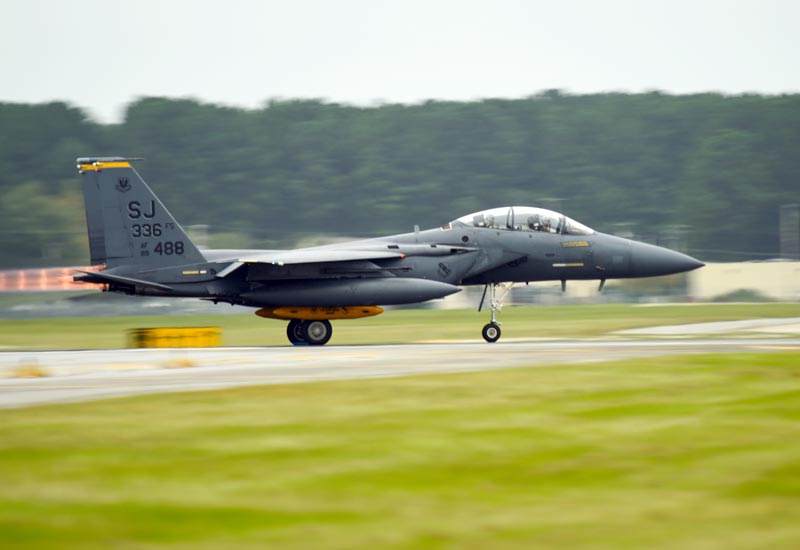
The McDonnell Douglas F-15E Strike Eagle is a more potent multi-role form of the F-15 Eagle air superiority fighter.
By Staff Writer

Bookmark and Share

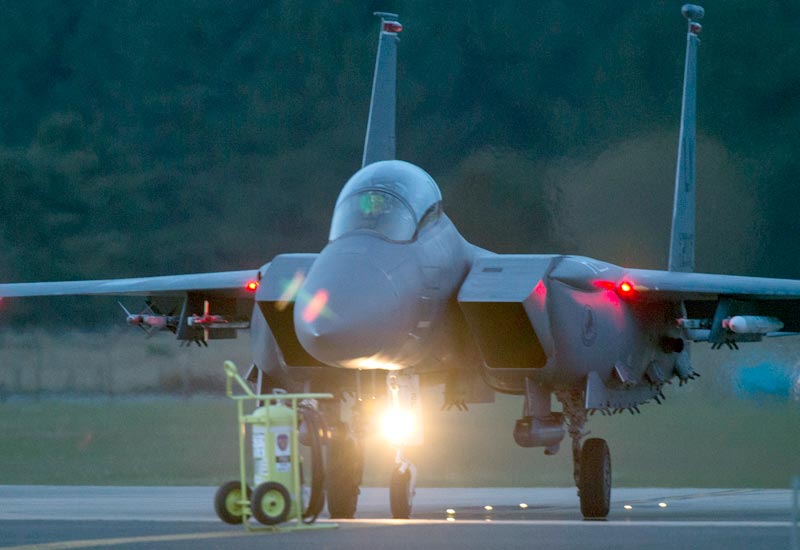
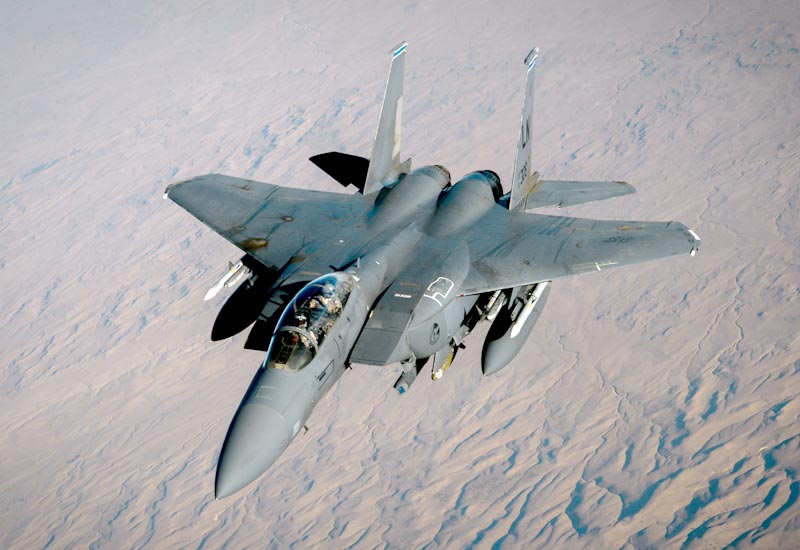
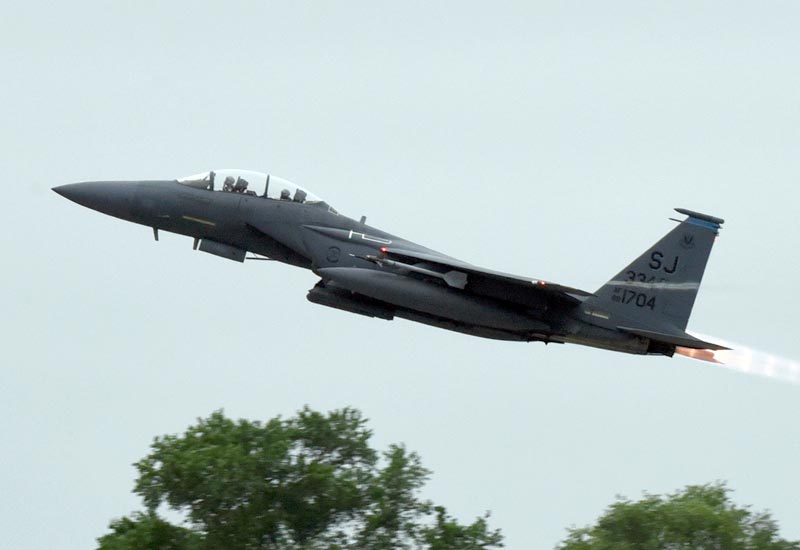
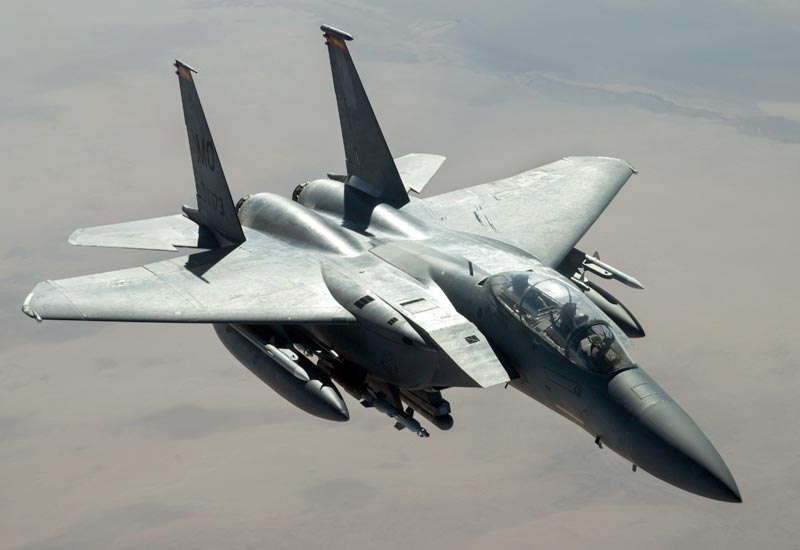
The F-15E "Strike Eagle" is a dual-role version of the highly successful base F-15 air superiority fighter. The Strike Eagle is intended to fulfill both roles of air-to-air superiority and ground strike with the capability to operate in all weather, low altitude and day/night sorties thanks to a battery of improved internal systems. Maintaining the same qualities that have made the original F-15 Eagle before it such a success, the F-15E Strike Eagle incorporates enough new elements to make it stand apart from the preceding designs. As a whole, the Strike Eagle provides the USAF with a system that can fight its way into enemy territory, destroy its assigned ground targets, and then fight its way back out all on its own without the need for dedicated air support elements. The initial F-15A first flew in 1972 with deliveries to the USAF beginning in November of 1974 - eventually including the F-15B model. Improved Eagles emerged as the F-15C and F-15D (two-seat) models and began delivery in 1979. The F-15E followed, seeing first deliveries to the 405th Tactical Training Wing in Arizona by April 1988.

Unlike the original F-15 Eagle design, the Strike Eagle features a two-seat cockpit with tandem seating for the pilot (front seat) and Weapons Systems Officer (rear seat). The forward cockpit is dominated by three multi-function screens capable of showcasing various modes. This is accentuated by the informational Heads-Up Display (HUD) system presented in a transparent glass fixture above the instrument panel. The advanced HUD allows the pilot to keep his eyes on the area ahead without having to look down at the instrument panel as the HUD displays a bevy of flight-related information. Night operations are further enhanced by the HUD, as it can display a clear, seemingly day lit, view of the area ahead. The rear cockpit of the WSO features four large screens that are customizable, allowing the officer to select which monitor will display the desired system mode. These modes run the gamut of weapons, available threats, a real-time moving map, target selection, electronic warfare, radar and various other aircraft systems.

The Strike Eagle is fitted with the powerful APG-70 series radar system. The system allows the pilot to engage any air threats while the weapons system officer concentrates on locating and homing in on ground targets of opportunity - all occurring at the safety of long range. A Global Positioning System allows for real-time navigation and situational updates to be processed into a central onboard computer. Both cockpits have access to the digital onboard map.

LANTIRN (Low-Altitude Navigation and Targeting Infrared for Night) system is what allows the Strike Eagle the ability to fly in low altitudes through adverse weather and at night. This system also allows the aircraft to still target and engage enemy targets regardless of the interference being presented by the amount of daylight or the weather. The LANTIRN system is made possible by the use of two underfuselage pods consisting of a targeting system and a navigational system. The targeting system naturally handles the targeting of designated targets and relays this information to the other onboard computer systems, (including armaments). The navigational pod utilizes a terrain-following system allowing for assisted low level flight.

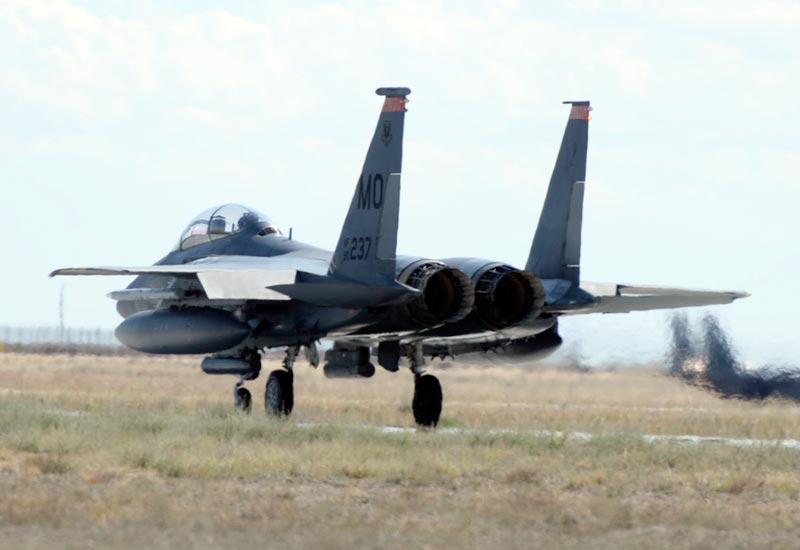
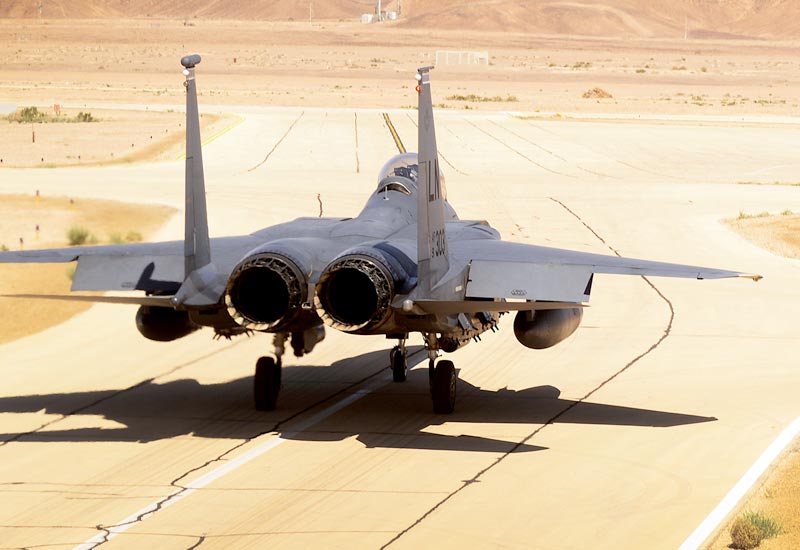
Strike Eagles are powered by a pair of Pratt & Whitney F100-PW-220 or 229 series engines of about 25,000lbs and 29,000lbs thrust each respectively with afterburner capability. The engines provide for a combined power output of 50,000lbs of thrust with the 220 series engines and 58,000lbs of thrust with the 229 series engines. The engines were integrated with advanced technology to the rest of the aircraft through a digital electronic engine control system. The base F-15 design featured a high engine thrust-to-weight ratio, allowing the aircraft to accelerate even in a steep climb. This capability is retained in the E-model.

As a dual-role performer, the Strike Eagle was envisioned to carry a collection of munitions for both the air-to-air or air-to-surface role. As such, the system can field most any of the available USAF munitions as needed. This provides the USAF with a multi-role platform capable of handling many different types of mission sorties as needed with little modification. Standard armament is a 20mm multi-barrel cannon with 500 rounds of ammunition For short-range, air-to-air engagements, the Strike Eagle is armed with the AIM-9 (M-model) Sidewinder missile. Medium air-to-air engagements can be attacked by using the AIM-7 (F/M-models) Sparrow missiles and its successor - the AIM-120 AMRAAM (Advanced Medium Range Air-to-Air Missile).The Strike Eagle can mount 4 x AIM-9 Sidewinders and 4 x AIM-7 Sparrows or 8 x AIM-120 AMRAAM missiles in a typical arrangement. The air superiority component inherent in the base F-15 design carries over into the F-15E models. Due to the designs low-wing loading, maneuverability is not sacrificed, allowing the aircraft the ability to complete tight turns without much loss to airspeed.

Air-to-surface sorties for the F-15E can be fulfilled through any nuclear or conventional USAF weapon available including air-to-surface missiles (AGM-65 Maverick), Laser-Guided Bombs, conventional drop bombs and area denial weapons. Underfuselage hardpoints can also be reserved by 2 x 750 gallon fuel tanks to further enhance the range of the Strike Eagle. These tanks are designed as low-drag conformal systems intended to not detract from the sleek aerodynamic contours of the base airframe.

Performance of this excellent aircraft include a top speed of Mach 2.5 plus (1,875 miles per hour), a range of 2,400 miles and a ceiling of 60,000 feet. Fuel capacity is equal to 35,550lbs when sporting the conformal fuel tanks with 3 x external fuel tanks. The maximum take-off weight for the aircraft is listed at 81,000lbs. The principle contractor is McDonnell Douglas Corporation, today, a subsidiary of The Boeing Company. The Strike Eagle is operated by the United States, Israel, South Korea, Saudi Arabia and Singapore.

The F-15E Strike Eagle first saw combat use in Operation Desert Shield and Operation Desert Storm. Initial strikes included facilities while later strikes targeted armored vehicles and SCUD hunting. This was later followed by inclusion in the Operation Northern Watch and Operation Southern Watch initiatives post Gulf War.

Operation Deny Flight and Operation Allied Force was another no-fly zone initiative in which the Strike Eagle performed in. Serb ground targets in the conflict were met with a collection of guided and unguided bombs as needed, though Strike Eagle pilots kept a watchful eye on the many surface-to-air missile systems dotted across the battlefield (an F-117 Nighthawk stealth fighter had been lost to such previously).

Naturally, the aircraft was later showcased in Operation Enduring Freedom and Operation Iraqi Freedom. In Afghanistan, F-15E's utilized guided and unguided bombs to devastating effect on Taliban ground forces and establishments. In Iraq, Strike Eagles manhandled the Iraqi Medina Republican Guard, attacking defended areas and destroying ground targets (including some 65 grounded MiG aircraft) at will.

Despite its roots in the 1970's, the F-15 Eagle series as a whole will live on for some time thanks to its versatility, allowing for it to evolve with new requirements being passed down. The Strike Eagle owns a distinct advantage in retaining those qualities from its famous F-15 fighter pedigree without loss to performance even when considering the loads the airframe is under during long range heavy strike sorties. With this in mind, it will be of some time before the Strike Eagle (or Eagle for that matter) is replaced in frontline service world wide.

Text ©2003-2010 www.MilitaryFactory.com • All Rights Reserved • No Reproduction Without Permission • Corrections / Comments to MilitaryFactory at Gmail dot com

Last Revision: 7/21/2009


  Specifications for the McDonnell Douglas / Boeing F-15E Strike Eagle
arrow downDimensions:
Length: 63.65ft (19.40m)
Width:42.81ft (13.05m)
Height: 18.47ft (5.63m)

arrow downPerformance: About MACH
Max Speed: 1,653mph (2,660kmh; 1,436kts)
Max Range: 2,423miles (3,900km)
Rate-of-Climb: 50,000ft/min (15,240m/min)
Service Ceiling: 59,711ft (18,200m; 11.3miles)

arrow downStructure:
Accommodation: 2
Hardpoints: 7
Empty Weight: 31,526lbs (14,300kg)
MTOW: 80,910lbs (36,700kg)

arrow downPowerplant:
Engine(s): 2 x Pratt & Whitney F100-PW-220 or 229 turbofan engines with afterburner generating 25,000lbs - 29,000lbs each.
arrow downArmament Suite:
1 x 20mm cannon

Mission-specific armament can include a combination of any of the following munitions:

4 x AIM-7F/M Sparrow missiles
4 x AIM-9L/M Sidewinder missiles
8 x AIM-120 AMRAAM missiles

Any air-to-surface weapon in the Air Force inventory (nuclear and conventional) including Maverick missiles, laser-guided bombs, guided munitions and unguided bombs.

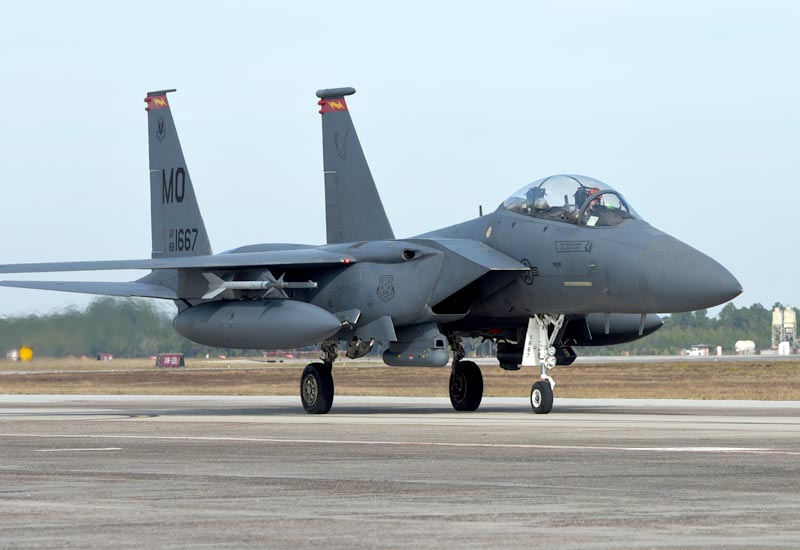
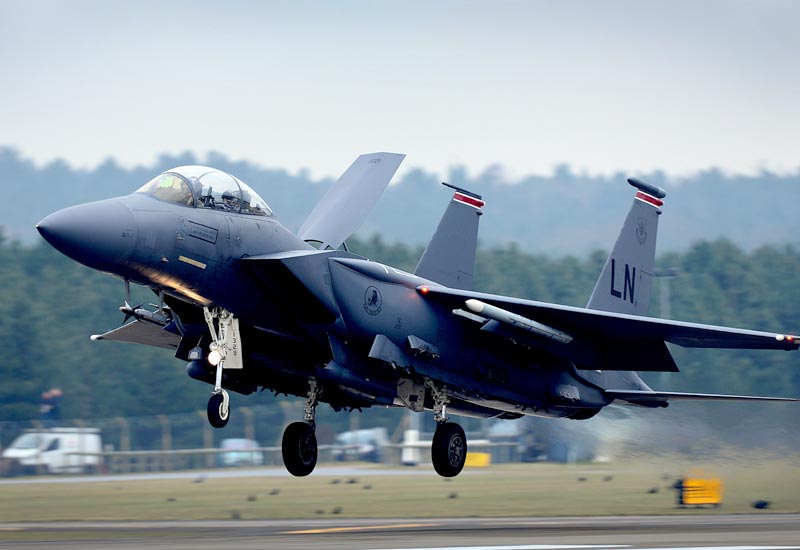
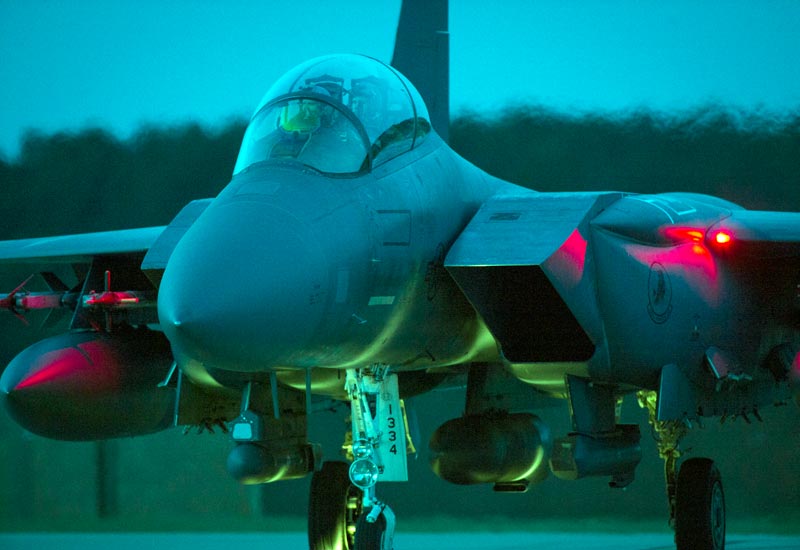
  Pictures of the McDonnell Douglas / Boeing F-15E Strike Eagle
     
Picture of McDonnell Douglas / Boeing F-15E Strike Eagle
Picture of the McDonnell Douglas / Boeing F-15E Strike Eagle
Image of the McDonnell Douglas / Boeing F-15E Strike Eagle
     
arrow upView All 5 Images

CompareX2 CompareX4 Conversions Dictionary Acronyms

Compare and Contrast Military Aircraft Specifications

  Special Aircraft Collections
Aircraft by Conflict:
Falklands War
Indo-Pak War
Operation Allied Force
Operation Desert Storm
Six Day War
Yom Kippur War

Special Collections:
American X-Planes
Classic US Warbirds
Grumman "Cats"
Indian Air Force
Israeli Air Force
Mikoyan-Gurevich
British V-Bombers


Korean Air War:
Korean War Aircraft
Aces
Australia
United States
North Korea

Vietnam Air War:
Vietnam War Aircraft

Cold War
Cold War Aircraft
United States
Soviet Union
Soviet Bombers of the Cold War

Modern Aircraft
Modern Military Aircraft
United States

Miscellaneous
MiG-15 Versus Sabre
Top 10 Fighters of All Time
WW2 Aircraft Ranked by Speed
Aircraft Cockpits


  Recent Military Aircraft Additions
Thumbnail picture of the Arado Ar TEW 16/43-19
Arado TEW 16/43-19
Thumbnail picture of the Antonov An-2 Colt
Antonov An-2 Colt
Thumbnail picture of the Kyushu K11W Shiragiku bomber trainer
Kyushu Shiragiku

  Contacting MilitaryFactory.com
We can only get better if you tell us how. You can contact MilitaryFactory.com at MilitaryFactory at gmail dot com (replace "at" with "@" and "dot with ".") with any questions, comments or corrections. We also accept related military imagery that you approve for us to use on our website. Keep in mind, however, that due to volume, we may not directly respond to your inquiry. Please add us to your list of non-blocked recipients!

  Aircraft Quick Profile


Picture of the McDonnell Douglas / Boeing F-15E Strike Eagle
Image courtesy of the United States Air Force.

View More Images

flag of United States
1988

Designation: McDonnell Douglas / Boeing F-15E Strike Eagle
Classification Type: Air Superiority / Ground Attack Aircraft
Contractor: McDonnell Douglas Corporation / Boeing - USA

Country of Origin: United States
Production Total: 203

Operators: Israel; South Korea; Saudi Arabia; Singapore; United States of America


  Variants
YF-15A - Prototype Model Designation

F-15A - Single-Seat Variant; initial fighter production model.

F-15B - Dual-Seat Variant; initially designated as the TF-15A.

F-15C - "Improved" single seat model fitted with F100-P-220 23,450lb engines; updated systems throughout; improved APG-70 radar system; increased fuel capacity.

F-15D - "Improved" two-seat model fitted with F100-P-220 23,450lb engines; updated systems throughout; improved AGP-70 radar system; increased fuel capacity.

F-15E "Strike Eagle" - Strengthened airframe; improved advanced air-to-air capabilities; improved ground attack capabilities; two-seat tandem placement.

TF-15A - Initial Designation for the twin-seat F-15B model.

F-15J - License-produced Japanese single-seat model based on the F-15C.

F-15DJ - License-produced Japanese two-seat model based on the F-15D.

F-15I Ra'am ("Thunder") - Israeli Export Model produced in the United States based on the F-15E.

F-15K "Slam Eagle" - Korean Designation of F-15E.

F-15S - Saudi export variant of F-15E.

F-15SG - Singapore export variant of F-15E.

F-15H "Strike Eagle" - Proposed Greece export version of F-15E.

  Collections
  • Sons of Empire - WW2 Aircraft of Japan
  • Aircraft of the Battle of Britain
  • X-Planes Throughout History
  • French Aircraft of World War 1
  • The German Luftwaffe in World War 2
  • Nightfighters - In a Class All Themselves
  • The Top Ten Fighters of All Time
  • Carrier "Born" Aircraft - Navy Mounts
  • If Boats Could Fly - Flying Boat Aircraft
  • World War 1 Aircraft Ranked by Speed
  • World War 2 Aircraft Ranked by Speed


Top MF Stuff: 2010 Military Pay Scale Chart | Military Ranks | World War 2 Weapons | Sniper Rifles | Conversion Calculators


Site Disclaimer | Privacy Policy | Site Map | MF Origins

©2010 www.MilitaryFactory.com • Content ©2003-2010 MilitaryFactory.com • All Rights Reserved • Site Contact Email: militaryfactory at gmail dot com (replace "at" with "@" and "dot" with ".")

eXTReMe Tracker

Most photographic images appearing on this site are courtesy of the United States Department of Defense and are approved for public use. Other images acquired through the public domain. Digital art work courtesy of Dan Alex. Business Consulting by Kyle Williams

Material presented throughout this website is for historical and entertainment value and should not to be construed as usable for hardware restoration, maintenance or general operation. Please consult manufacturers for such information.