The AH-6/MH-6 "Little Bird" forms an oft-overlook yet wholly vital part of American Special Operations services. This highly maneuverable and diminutive machine has taken part in both major and minor military operations the world over and has proven something of a lifeline to those ground-based operatives whose very lives depend on the actions of the Little Birds and her trained crews. The Little Bird was introduced in 1980 as a modified form of the Vietnam-era OH-6 Cayuse and has continually seen direct action since her inception.
Little Bird Origins
Little Bird development stemmed from a 1960 US Army requirement looking for a versatile transport and light attack helicopter. This requirement fell under "Technical Specification 153" and itself was part of the US Army's/US Navy's Light Observation Helicopter (LOH) program. Hughes submitted their Model 369 as one of a dozen firms totaling some 19 design proposals (25 firms were initially solicited). By October of 1961, the US Army, with input from the US Navy, selected three of the designs for further evaluation - these being the Bell D-250, the Hiller Model 1100 and the Hughes Model 369. The US Army liked what it had in the Bell D-250 while the US Navy was interested in the Hiller Model 1100. All three were assigned respective new designations as the YHO-4, YHO-5 and YHO-6 and constructed as five evaluation prototypes. Flight testing occurred at Camp Rucker, Alabama. All systems were later redesignated under the new DoD system in 1962 as the YOH-4, YOH-5 and YOH-6.
The Bell YHO-4 was eventually eliminated from contention to which the Hiller YOH-5 and Hughes YOH-6 were left to battle it out. Ultimately, Hughes was awarded the production contract in 1965 and the YOH-6 now became the OH-6A "Cayuse". An initial order for 714 production systems was later increased to 1,300. In civilian form, the OH-6 was marketed as the Hughes 500, to which several military forms were developed for export - the first of these becoming the Hughes 500M to Columbia.
Production Labeling
Original production fell under the Hughes Helicopters, Incorporated banner but McDonnell Douglas' purchase of Hughes in 1984 forced a renaming of the brand to McDonnell Douglas Helicopter Company. In 1985, the company was renamed yet again as McDonnell Douglas Helicopter Systems. In 1997, McDonnell Douglas merged with Boeing Company. Boeing proceeded to sell the civilian portion of the helicopter line to MD Helicopter Holdings, Incorporated. In 2005, Patriarch Partners LLC bought the company and reinvented it as the independent MD Helicopters, Incorporated.
The New Requirement
By 1980, the need for a lightweight, easily transportable helicopter system to be crewed by specially-trained personnel operating as a part of the special forces was realized. The OH-6A was evolved into a specialized form to be known as "Little Bird". Select pilots were trained and soon placed into the newly-formed 160th Aviation Battalion (aka "Night Stalkers"). Two Little Bird forms were then developed - one to assist in transporting a small group of operatives into and out of hot zones (the MH-6) and another to support such actions in a light attack role (the AH-6).
Little Bird Walk-Around
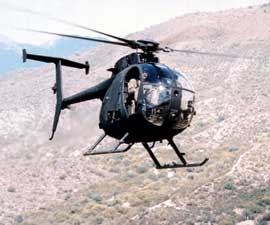
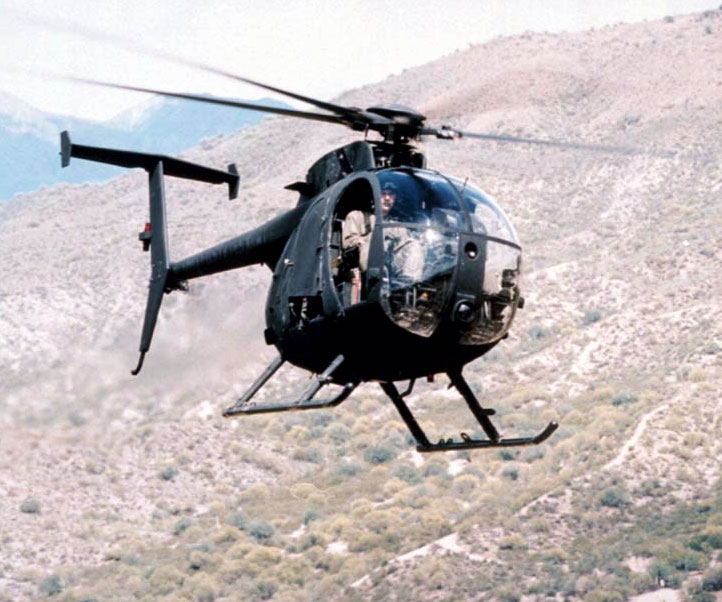
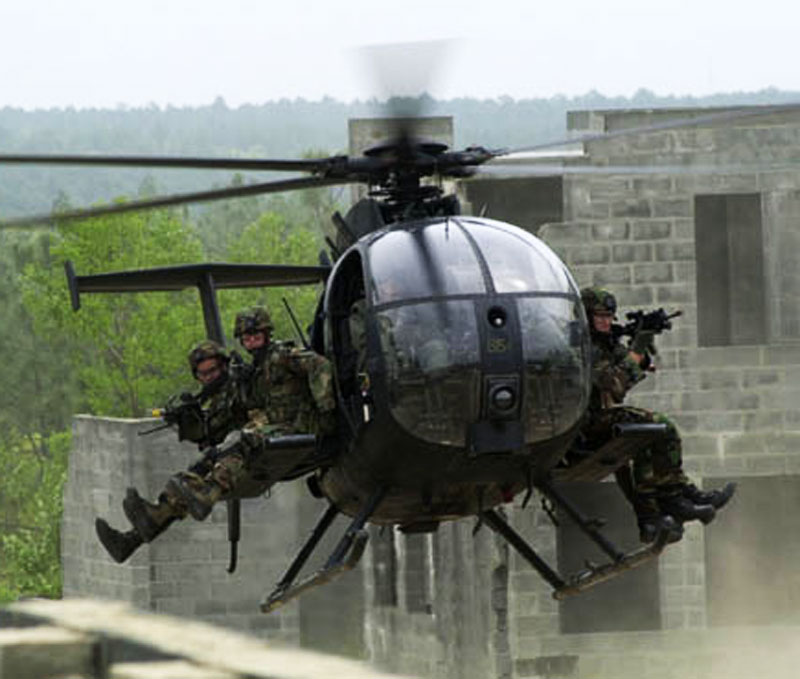
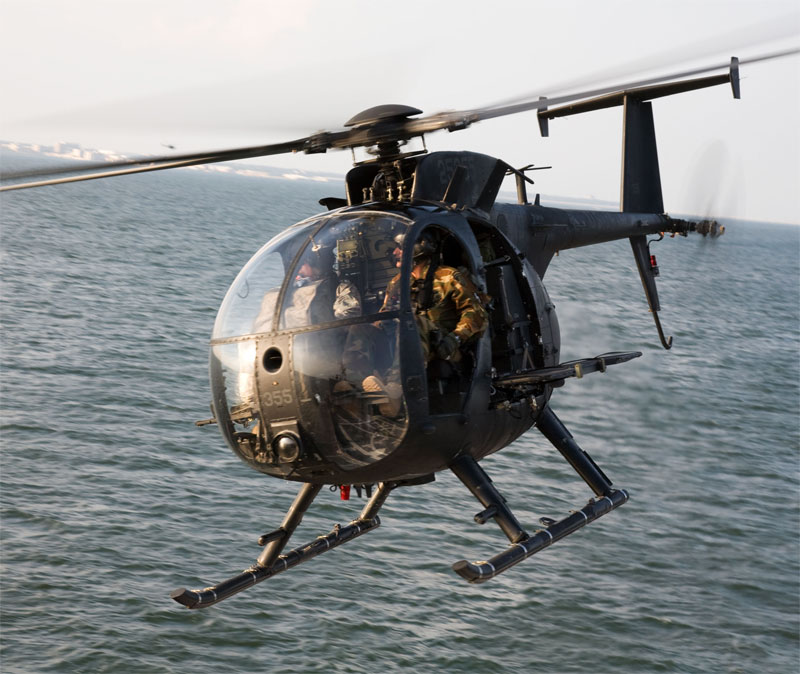
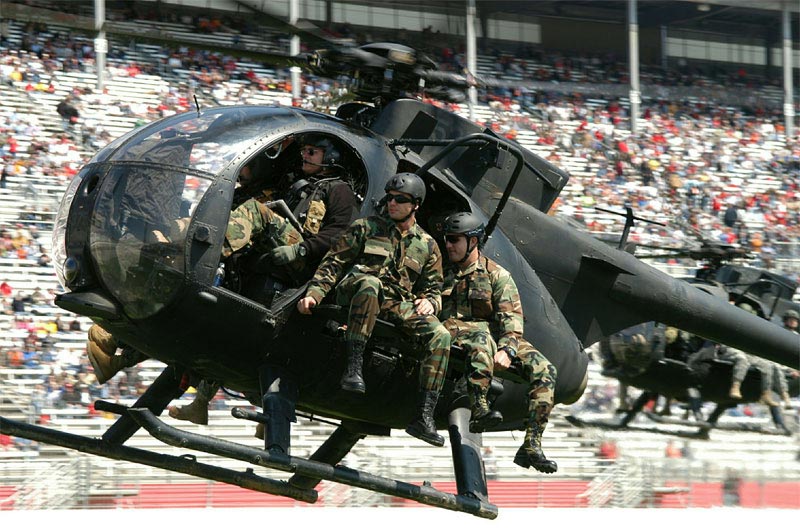
The external appearance of the Little Bird is as utilitarian as it gets. The design is dominated by the large bubble-type framed glass cockpit that allows for excellent visibility out of the two-man cockpit. The cockpit resides just forward of a small crew cabin area (MH-6) with placement for up to 6 combat-ready operatives on "bench" type seating along the outboard sides of the cabin fuselage. Rear of that is the housing for the powerplant. The powerplant consists of a single Allison-brand T63-A-5A or T63-A-700 series turboshaft engine rated at 650 full horsepower and powering a five- or -six blade main rotor (depending on the model) as well as a two- or four-blade tail rotor. The main rotor sits atop the fuselage on a short mast while the tail rotor is set to the portside of the aircraft off of the slender and short tail section. The tail is characterized by the complex "T" style assembly made up of a single vertical tail fin topped by a horizontal plane, itself affixed with two small vertical planes. The engine exhaust port, though typically fitted above the tail section in most other helicopters, actually sits under the empennage base in the Little Bird. The weight of the entire aircraft when on the ground is displaced across two rudimentary skids braced in two locations. The skids serve the Little Bird well in providing a handy step area for operatives hitching a ride. Little Birds are commonly painted over in black to reflect their clandestine operation suite.
Performance specifications from the single engine allow the Little Bird a top speed of 175 miles per hour with a cruise speed of 155 miles per hour. Her range is listed at 267 miles with a service ceiling of 18,700 feet and a rate-of-climb equaling 2,061 feet per minute. Internal fuel is reported at 62 US gallons. Operating weight is 1,509lb with a maximum takeoff limit of 3,100lb. When completely "clean", the Little Bird weighs in at a respectable 1,591lb. Its size and weight make it a relatively easy transportable system when moved via the existing American aircraft transports on hand.
Armament
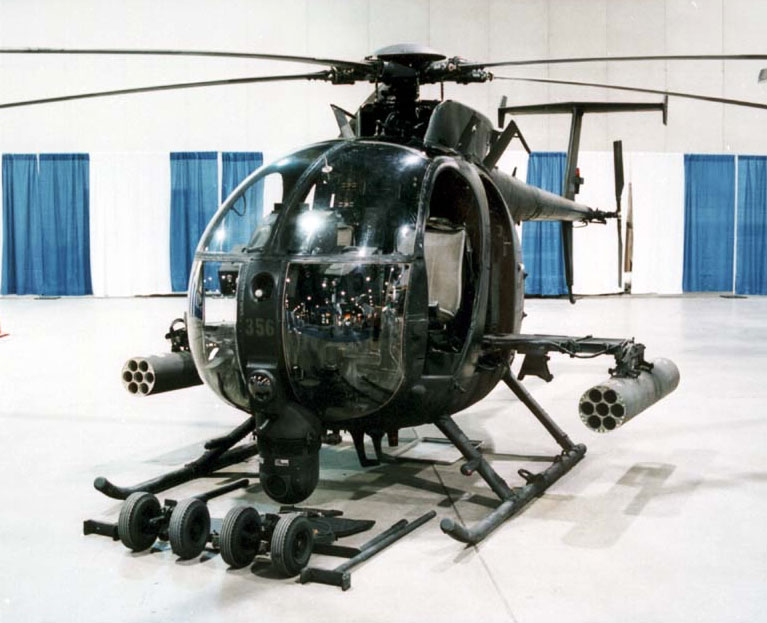
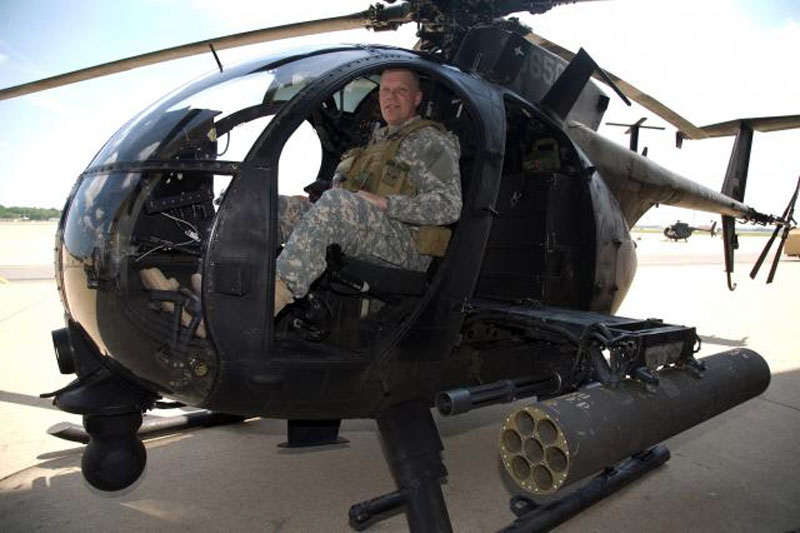
Perhaps the most important versatile facet of the light attack version of the Little Bird is its use of two lightweight universal mounts to either side of the fuselage, allowing the nimble system to make use of several potent weapon options made up of gun pods, rocket pods and guided missiles. The Little Bird can mount a single M230 series Chaingun or the7.62mm M134 Minigun and the 12.7mm GAU-19 heavy caliber Gatling-type machine gun as pairs. The Mk 19 40mm automatic grenade launcher is also an option, no doubt based on operating experiences from gunships used over Vietnam. For rocket delivery, the Little Bird makes use of a pair of standard 7-shot, 2.75-inch, Hydra 70 rocket pods. For anti-tank/anti-armor defense, the Little Bird is cleared for use with the Hellfire or TOW anti-tank guided missile systems. Additionally, the helicopter can make use of the Stinger short-range, air-to-air missile self-defense against low-flying enemy aerial targets.
Duty Calls
The Little Bird was first used in a combat environment during the 1983 Invasion of Grenada. Pilots maneuvered their Little Birds from bases within Barbados to the island nation of Grenada, Their misison primarily revolved around the evacuation of the injured personnel during Operation Urgent Fury. These Little Birds were flown in from the 'States via Lockheed C-130 Hercules transport aircraft and operated from land and sea bases once in the region. 1983 also saw the Little Bird placed into clandestine operations in support of the contras, with these aircraft flying in to Nicaragua from bases within Honduras. Several Little Birds of the 160th were used in pre-invasion actions during Operation Just Cause in late1989. Both MH-6s and AH-6s were used to good effect in actions that eventually contributed to the capture of General Manuel Noriega.
Black Hawk Down
Perhaps the best known use of the Little Bird was in the 1993 Battle of Mogadishu in Somalia. MH-6 models were used to shuttle Delta Force operatives into action during the operation. AH-6 gunship counterparts provided fire support to both Delta Force and Army Ranger elements attempting to reach one of the Blackhawk crash sites. In the ensuing action, the crew of a MH-6 succeeded in rescuing two injured US service personnel by landing near one of the crash sites - one crewmember left the aircraft on foot with the other supplied suppressive fire with his automatic weapon from the cockpit of the awaiting helicopter. Though the Battle of Mogadishu brought about a rather dark moment in the history of the American military, one cannot gloss over the level of sheer self-sacrifice that drove all personnel involved in the operation to do what they did for one another. Little Birds worked tirelessly throughout the night to keep Mohammad Farrah Aidid's cronies at bay. On a related note here is that several AH-6 Little Bird models returned to Somalia in September of 2009 and successfully killed terrorist Saleh Ali Saleh Nabhan.
More Recent Actions
MH-6s and AH-6s have continually operated throughout Iraq since the 2003 invasion began. Be it fire support or rescue operations, the mighty little helicopters and their expertly-trained crews have been responsible for the safety of numerous personnel including foreign contractors and friendlies. The much-publicized rescue of US Army Private Jessica Lynch was made possible through the actions of armed AH-6 Little Birds.
Little Bird Variants
From its OH-6 Cayuse roots, the Little Bird has itself evolved into several useful and equally-capable battlefield variants. The AH-6C is a special forces attack model and is essentially an OH-6A modified to carry weaponry with use by the 160th Special Operations Aviation Regiment known as the "Night Stalkers". An electronic warfare/aerial command post variant exists as the EH-6E while the MH-6E is used to designate an improved attack/transport model. The AH-6F, AH-6G and MH-6H are all Special Forces attack and transport-capable platforms. The J-model (AH-6J/MH-6J) represents a new form with improved GPS, FLIR and engine systems and is based on the MD 530MG model. Likewise, the AH-6M and MH-6M is based on the MD 530 commercial series and are improved variants of the AH-6J and MH-6J models respectively. These have been heavily modified for Special Forces use and are sometimes noted as the "Mission Enhanced Little Bird" (or MELB).
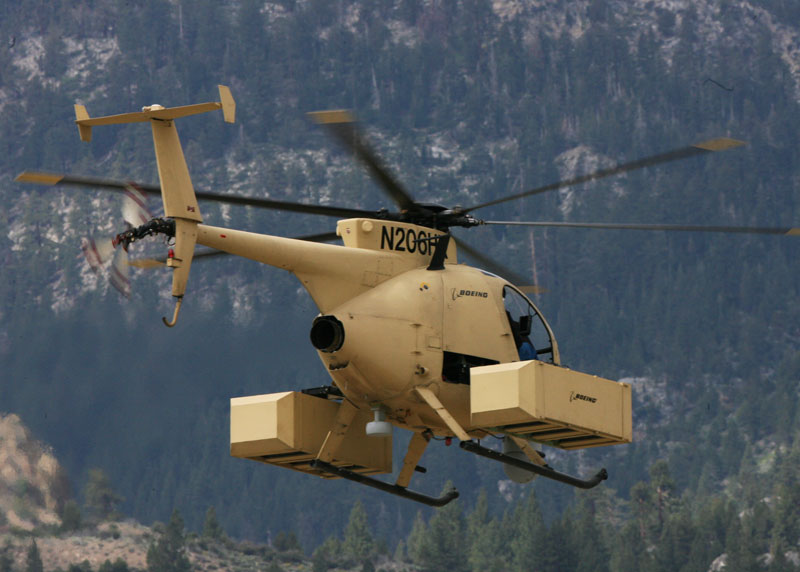
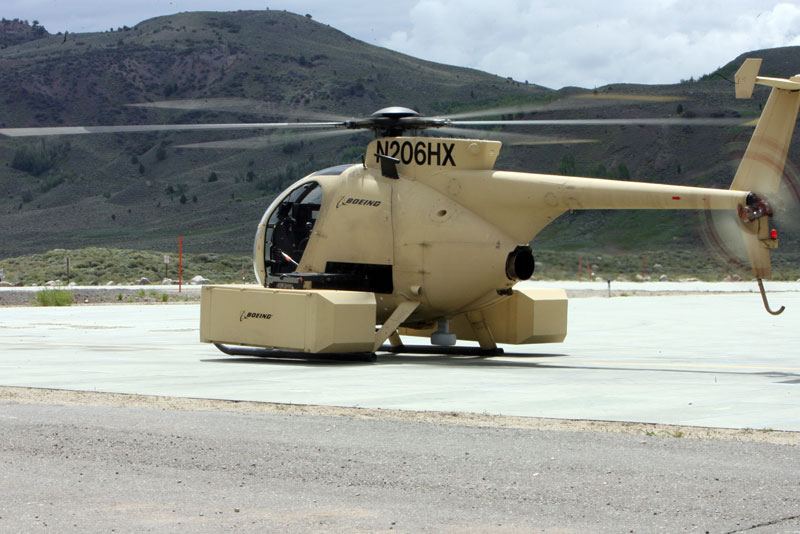
Little Birds have also been modified into slightly-smaller, crew-less UAV models in the AH-5X and MH-6X forms (also known as the "Unmanned Little Bird" or ULB). This program is currently (as of 2009) evaluating the Little Bird airframe as a remotely-piloted casualty evacuation platform that sports two identifiable "casualty crates", each with a listed weight limit of 300lbs. These compartments are situated along each fuselage side. Tests have been promising and have included the use of 200lb dummies within these crates to simulate human weight. Ready-crews await the incoming ULB and spring in to action to assist the wounded once the helicopter has safely landed.
The only operator of the Little Bird remains the United States Army and the FBI hostage rescue team.
As an aside, the LOH program was later opened once more in 1967. This next round of evaluation produced the Bell OH-58 "Kiowa" light helicopters for the US Army.
August 2014 - It was announced by the US DoD that Boeing was formally awarded a $234,700,000 contract for the production and deliver of 24 AH-6I ("International") helicopters for Saudi Arabia. Saudi Arabia is on order for 36 of the helicopters.
December 2018 - The AH-6i remains a contender in the Australian light reconnaissance helicopter requirement. Some fifteen helicopters are sought for the requirement for the Army service.
December 2018 - Chile is considering the AH-6i, the Bell Model 407, and the Airbus Helicopters H145M for its eight-strong light helicopter requirement. These would succeed the in-service, though aging, MD530F models in same role for the Chilean Air Force.
Power & Performance Those special qualities that separate one aircraft design from another. Performance specifications presented assume optimal operating conditions for the Boeing MH-6 Little Bird Light Attack / Observation / Transport Helicopter.
1 x Allison T63-A-5A OR T63-A-700 turboshaft engine developing up to 650 horsepower while driving a six-blade main rotor and a 4-blade tail rotor. Propulsion
175 mph 282 kph | 152 kts Max Speed
18,701 ft 5,700 m | 4 miles Service Ceiling
267 miles 430 km | 232 nm Operational Range
2,061 ft/min 628 m/min Rate-of-Climb
Structure The nose-to-tail, wingtip-to-wingtip physical qualities of the Boeing MH-6 Little Bird Light Attack / Observation / Transport Helicopter.
2 (MANNED) Crew
32.2 ft 9.80 m O/A Length
27.2 ft (8.30 m) O/A Width
9.8 ft (3.00 m) O/A Height
1,592 lb (722 kg) Empty Weight
3,100 lb (1,406 kg) MTOW
Armament Available supported armament and special-mission equipment featured in the design of the Boeing (Hughes) AH-6 / MH-6 Little Bird Light Attack / Observation / Transport Helicopter .
Mission-specific ordnance can include any of the following combinations across two mounting stations (AH-6):
1 x 30mm M230 Chaingun / automatic cannon.
2 x 7.62mm M134 Miniguns.
2 x 12.7mm GAU-19 Gatling guns.
2 x M261 7-shot rocket pods (2.75" Hydra 70 rockets).
2 x AGM-114 "Hellfire" Anti-Tank, Guided-Missiles (ATGMs).
2 x TOW ATGMs.
2 x "Stinger" short-range, air-to-air missiles.
Variants Notable series variants as part of the Boeing (Hughes) AH-6 / MH-6 Little Bird family line.
AH-6C - Special Forces Attack; based on the OH-6A Cayuse.
EH-6E - Aerial Command Post; electronic warfare
MH-6E - Improved Transport Model.
AH-6F - Special Forces Attack Model.
AH-6G - Special Forces Attack Model.
MH-6H - Special Forces Transport Model.
AH-6I ("International") - Saudi Arabia export model based on the AH-6S.
AH-6J - Improved Variant; updated engine, GPS and FLIR system; based on MD 530MG; attack model.
MH-6J - Improved Variant; updated engine, GPS and FLIR system; based on MD 530MG; transport model.
AH-6M - Mission Enhanced Little Bird (MELB); highly modified form; attack model.
MH-6M - Mission Enhanced Little Bird (MELB); highly modified form; transport model.
AH-6S "Phoenix" - Proposed light attack model for US Army's Armed Aerial Scout (AES) program.
AH-6X ULB ("Unmanned Little Bird") - UAV development based on the civilian MD 530F model; attack model.
MH-6X - UAV development based on the civilian MD 530F model; transport model.
Operators Global customers who have evaluated and/or operated the Boeing (Hughes) AH-6 / MH-6 Little Bird. Nations are displayed by flag, each linked to their respective national aircraft listing.
Total Production: 40 Units Contractor(s): Hughes / McDonnell Douglas / Boeing / MD Helicopters - USA
[ Malaysia; Saudi Arabia; United States ]
1 / 10
Front underside right view of an unarmed Littlle Bird helicopter
2 / 10
Front left side view of an armed AH-6 Little Bird on display; note rocket pods
3 / 10
Front underside right view of an incoming MH-6 Little Bird with full passenger compliment; note side benches for seating
4 / 10
Front left side view of an MH-6 Little Bird in flight
5 / 10
Close-up detail view of the front left side of an AH-6 Little Bird; note dual rocket and minigun armament
6 / 10
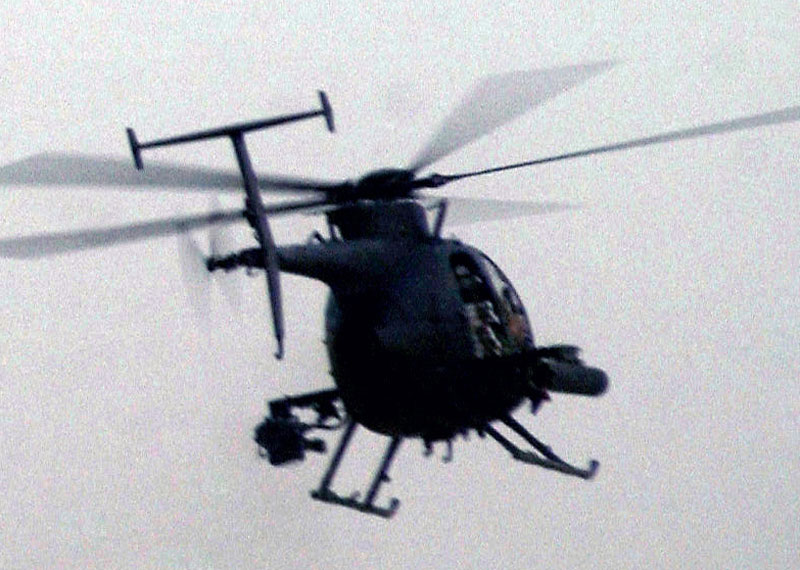
Rear right side view of a passing AH-6 Little Bird helicopter; note minigun and rocket armament
7 / 10
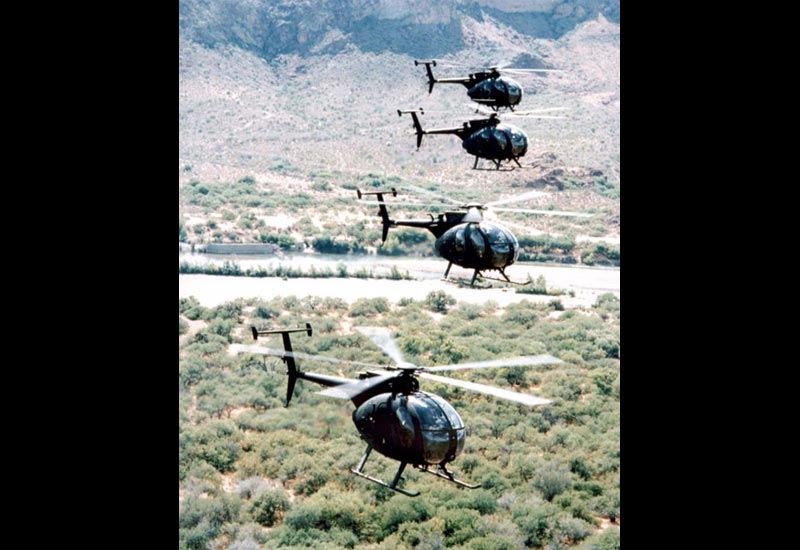
A flight of four Little Bird helicopters
8 / 10
A full Little Bird helicopter comes in for a landing
9 / 10
An Unmanned Little Bird undergoing evaluation; note side casualty crates
10 / 10
Rear left side view of an Unmanned Little Bird on display
The "Military Factory" name and MilitaryFactory.com logo are registered ® U.S. trademarks protected by all applicable domestic and international intellectual property laws. All written content, illustrations, and photography are unique to this website (unless where indicated) and not for reuse/reproduction in any form. Material presented throughout this website is for historical and entertainment value only and should not to be construed as usable for hardware restoration, maintenance, or general operation. We do not sell any of the items showcased on this site. Please direct all other inquiries to militaryfactory AT gmail.com. No A.I. was used in the generation of this content.