Military Factory
Military Pay Chart
Global Firepower
Military Industrial Complex
Second World War
Home
Military Pay Scale
Military Ranks
Small Arms
Aircraft
Land Systems
Navy
Education
Military Factory Facebook Logo
flag of Soviet Union

Tupolev Tu-22 (Blinder) Medium Bomber / Reconnaissance Aircraft (1962)

Authored By Staff Writer | Last Updated: 5/1/2012

The Tu-22 Blinder medium bomber began service in the 1960s and was retired in the 1990s.

Find a School Near You
Follow Military Factory on Facebook:
Trending on Military Factory:
Recent Articles:
The Soviet/Russian Tupolev concern has had a long and established history in developing and producing large bomber-class aircraft for the Soviet/Russian Air Force. The Tu-22 was developed in the latter part of the 1950s and brought online in the early 1960s to provide a far-reaching offensive punch to Soviet Air Force operations. At the time of its inception, the Tu-22 became the Soviet Union's first supersonic bomber aircraft in service. Despite its impressive appearance and technological heavy infrastructure, the Tu-22 failed to live up to expectations seeing only moderate combat service and production numbers not exceeding 311 units. All have since been retired from operational service.

The Tupolev Tu-16 ("Badger")

Throughout most of the 1950s, the Soviet Air Force relied on the Tupolev Tu-16 (NATO: "Badger") for its strategic bombing role. The type was first introduced in 1954 and built to the tune of 1,500 examples with license-production occurring elsewhere. Global operators were numerous and included Egypt, Georgia, Iraq and the Ukraine as well as the Soviet Union/Russia. The aircraft was fitted with two turbojet engines supplying 21,000lbs of thrust each which allowed for a top speed of 650 miles per hour and a range out to 4,400miles. However, the aircraft managed a history dating back to the early 1950s and was only capable of subsonic speeds.

By this time in the Cold War, Soviet authorities looked for a supersonic solution and authorized development of a successor to the Tu-16. The new aircraft would have strong air defense penetration capabilities and field a comparable payload to the Tu-16 it was to replace. Of course this being the Cold War, provision for nuclear free-fall bombs was also a requirement. Technology finally allowed for better aerodynamics and improved engine output which allowed the initial "Samolet 105" prototype by Tupolev to become the "Samolet 105A". First flight was recorded on September 7th, 1959 and, after testing and evaluation, the aircraft was adopted into Soviet air service as the Tu-22. The first production run revealed the Tu-22B variant and made public to the world in July of 1961. Upon identifying the new breed, NATO observers assigned the codename of "Blinder" the aircraft. Formal entry into Soviet air service occurred sometime in 1962. By the end of production, some 311 Tu-22 Blinder aircraft were delivered with production spanning 1960 to 1969.

Tu-22 Blinder Walk-Around

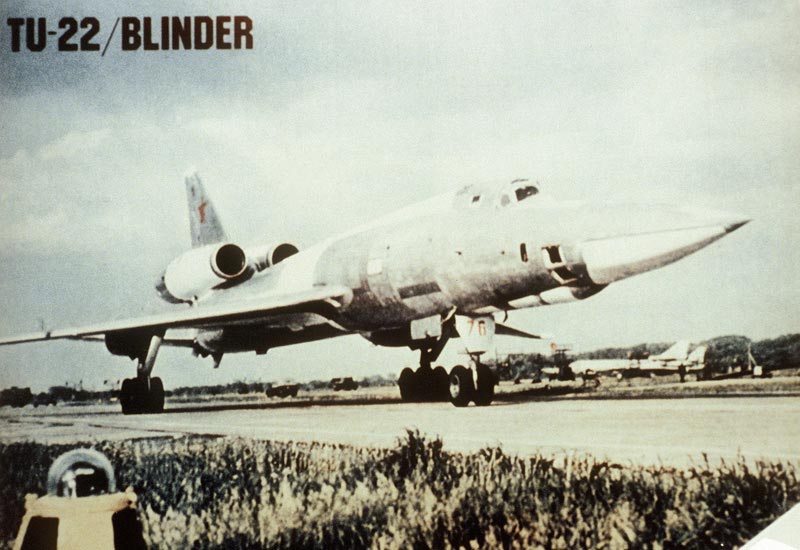
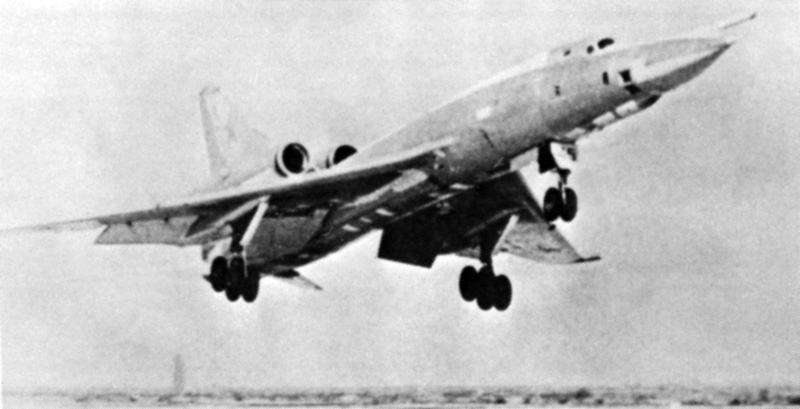
Design of the Tu-22 produced a very elegant shape though utilitarian to the core as in previous Soviet aircraft attempts of the Cold War. This route of simplicity usually led to a very capable and robust aircraft and the Tu-22 was no exception. The fuselage was highly tubular and area-ruled in its shape with a very well-pointed nose cone housing a nav/attack radar suite. The cockpit sat a ways behind the nose cone and was home to three crew to include the pilot, navigator and weapons officer. The pilot sat at the front left with the navigator at his lower right. The weapons officer was situated to the rear of the pilot. A fuselage spine defeated any useful rearwards visibility and the heavily framed cockpit hindered forward and side views to an extent. Wings were well-swept, low-mounted and fitted amidships for the required stability at supersonic speeds. Strakes were noted along the surface of each wing. The empennage the most unique design aspect of the Tu-22 for it was home to the twin turbojet engine nacelles mounted at the base of the single vertical tail fin. This allowed for more internal volume at the wings and fuselage for the carrying of ordnance and fuel. A pair of swept horizontal planes were also noted. The undercarriage consisted of a conventional nose- and main-leg arrangement. An internal weapons bay allowed for the carrying of various munition types. All told, the Tu-22 was a massive aircraft by any regard. All three crew positions featured downward-firing ejection seats.

Standard defensive armament for the Tu-22 series was 1 x 23mm AM-23 or R-23 series cannon and this was fitted to a remote-controlled turret to be found in the tail. This weapon placement protected the vulnerable "six" of the aircraft and operated by the weapons officer. Offensive firepower was managed through an internal bomb bay buried in the fuselage at amidships and this could range from 24 x FAB-500 series general purpose conventional drop bombs to nuclear bombs as required. Only later production forms managed missile support. The included navigation-attack radar suite allowed for modernized support. Up to 20,000lbs of stores could be taken aloft. In the case of missile support, the Tu-22 was typically fielded with 1 x Kh-22 (AS-4 "Kitchen") cruise missile.

Power for the Tu-22 was provided for by a pair of Dobrynin RD-7M-2 series turbojet engines. Output was 24,250lbs thrust on dry (each) and up to 36,376lbs of thrust with afterburner (essentially raw fuel pumped into the engine for short bursts of power and, thus, speed). Maximum speed was 938 miles per hour (Mach 1.42) with an operational range of 3,000 miles. The Tu-22 could operate as high as 40,500 feet. Maximum take-off weight was 202,400lbs.

Operational Service

Once in operational service, several design flaws became apparent, leading to accidents poor turn-around times. The aircraft proved a handful to fly even for trained personnel and the range of its engines was never fully suitable for the long-range bomber role. The high technological aspects of the aircraft also meant long maintenance times and low flying rates. As a Tu-16 successor, the Tu-22 was never to live up to the expectations heaped upon it. Initial pilots were poorly experienced and the aircraft lacked a co-pilot position from which to share the required workload. Many were eventually lost to mechanical fault.

The Tu-22 was used in anger by the Libyan Air Force on several occasions with mixed results. Other notable actions were by the Iraqi Air Force during the Iran-Iraq War. Again, results were mixed as losses mounted and all Tu-22s were ultimately destroyed in the opening rounds of Operation Desert Storm. The Soviet Air Force operated their Tu-22s during the Soviet-Afghan War though accounts were limited.

Conventional Bomber and Reconnaissance Tu-22 Models

The Tu-22 was produced in several notable variants during her operational tenure. The initial run included the Tu-22B ("Blinder-A") which was limited to conventional/nuclear bombing. Only 15 of this type were produced and this stock was generally utilized for training and developmental service. The bombing-capable Tu-22R ("Blinder-C") was a dedicated reconnaissance platform fitted with additional photographic equipment and first appeared in 1962. The Tu-22RD was similar in form and function though completed with refueling equipment for virtually unlimited operational ranges. The Tu-22RK was another reconnaissance form that kept its bombing roots in check though delivered with special ELectronic INTelligence equipment (ELINT). The Tu-22RDK was simply the ELINT model with refueling provisions. A modernization program created the Tu-22RDM reconnaissance platform while the Tu-22P ("Blinder-E") was a new ELINT model. The Tu-22PD was its inflight-refueling compatible counterpart.

Tu-22 Missile Carriers

Provision for missile ordnance was made available with the arrival of the Tu-22K ("Blinder-B") which appeared in 1965. The Tu-22KD the same with provision for inflight refueling. Like others before it, the Tu-22K model was also evolved to become the Tu-22KP, an electronic warfare aircraft version (EWA) that retained its conventional bombing capabilities. These began appearing in 1968 and were armed with radar-homing missiles to help defeat land-based tracking installations. The Tu-22KPD was the same model only with inflight refueling facilities.

Tu-22 Trainer Derivatives
There existed a pair of trainer variants and these were known by the designations of Tu-22U ("Blinder-D") and Tu-22UD. The pair was distinguished by the latter's installation of inflight refueling equipment. As a whole, these additions were further distinguished by their raised instructor's cockpit position.

Conclusion

The Tu-22 Blinder series of medium bombers is no longer in use by any modern air power. Libyan Tu-22s were ultimately scrapped as the Libyan Air Force lacked the spares required to continually maintain their expensive, technologically-laden aircraft. Iraq lost their some of their Tu-22 stock in the bloody Iran-Iraq War of the 1980s to which all were ultimately destroyed or scrapped in the upcoming Gulf War of the early 1990s. The Ukrainian Air Force inherited their Tu-22 inventory from the dissolved Soviet Union and these were ultimately put out to pasture when their time had come. The Soviet Union passed most - if not all - of their Tu-22 stock to successor states after the dissolving of the Empire.

By 2001, only Ukraine and Libya were thought to be fielding the Tu-22 in a frontline operational role. The last known Tu-22 in service was ultimately retired sometime in the 1990s by the Russian Air Force.

A related development of the Tu-22 - and a further evolution of its design - became the Tu-22M "Backfire" strategic strike, reconnaissance and maritime bomber of the 1970s. This derivative sported a "swing-wing" (variable geometry wings) and split air intakes as well as new engines buried within the fuselage. Though related to the Tu-22 and borrowing much of its configuration, the Tu-22M is essentially an all-new aircraft development and went on to have a profound operational career when compared to the original Tu-22 series.
Text ©2003-2013 www.MilitaryFactory.com • All Rights Reserved • No Reproduction Permitted
MilitaryFactory.com does NOT sell equipment/weaponry. Material presented throughout this website is for historical and entertainment value and should not to be construed as usable for hardware restoration, maintenance or general operation. Please consult manufacturers for such information. Our disclaimer. Email corrections / Comments to MilitaryFactory at Gmail dot com.
Picture of Tupolev Tu-22 (Blinder)
Pic of the Tupolev Tu-22 (Blinder)
Image of the Tupolev Tu-22 (Blinder)
View All Images (3)

Specifications for the
Tupolev Tu-22 (Blinder)
Medium Bomber / Reconnaissance Aircraft


Country of Origin: Soviet Union
Manufacturer: Tupolev - USSR
Initial Year of Service: 1962
Production: 311


Focus Model: Tupolev Tu-22R (Blinder)
Crew: 3


Length: 136.48ft (41.6m)
Width: 76.02ft (23.17m)
Height: 33.23ft (10.13m)
Weight (Empty): 0lbs (0kg)
Weight (MTOW): 202,825lbs (92,000kg)


Powerplant: 2 x Dobrynin RD-7M-2 turbojet engines developing up to 36,376lbs of thrust each with afterburner.


Maximum Speed: 938mph (1,510kmh; 815kts)
Maximum Range: 3,045miles (4,900km)
Service Ceiling: 43,635ft (13,300m; 8.3miles)
Rate-of-Climb: 0 feet per minute (0m/min)


Hardpoints: 3
Armament Suite:
STANDARD:
1 x 23mm AM-23 OR R023 series cannon in remote-controlled tail turret.

Up to 20,000lbs of ordnance including conventional drop bombs, free-fall nuclear bomb or 1 x semi-recessed cruise missile (Tu-22K).


Variants:
Tu-22B ("Blinder-A") - Initial Production Model; conventional bombing capability; 15 examples produced.


Tu-22R ("Blinder-C") - Dedicated reconnaissance platform; conventional bombing capability retained.

Tu-22RD - Based on the Tu-22R with inflight refueling equipment.

Tu-22RK - ELINT version of Tu-22R

Tu-22RDM - Tu-22RK with inflight refueling capability.

Tu-22P ("Blinder-E") - Electronic Warfare Aircraft (EWA) with ELINT capabilities.

Tu-22PD - Tu-22P with inflight refueling equipment.

Tu-22K ("Blinder-B") - Provision for AS-4 "Kitchen" cruise missile.

Tu-22KD - Tu-22K with inflight refueling capability.

Tu-22KP - Electronic Warfare Aircraft (EWA) with conventional bombing capabilities; provision for Kh-22P radar-homing missile as well.

Tu-22KPD - Tu-22KP with inflight refueling capability.

Tu-22U ("Blinder-D") - Two-Seat Conversion Trainer with redesigned cockpits.

Tu-22UD - Modified trainer models with inflight refueling capabilities.

Tu-22M - Revised swing-wing development of T-22 with new engines and split air intakes; additional pilot.


Operators: Libya; Iraq; Russia; Soviet Union; Ukraine

ALL AIRCRAFT CATEGORIES

BY DECADE:


1900 to 1909
1910 to 1919
1920 to 1929
1930 to 1939
1940 to 1949
1950 to 1959
1960 to 1969
1970 to 1979
1980 to 1989
1990 to 1999
2000 to 2009
2010 to 2019
2020 to 2029
VIEW ALL
Compare Aircraft


BY TYPE:


Anti-Submarine Warfare (ASW)
Attack Helicopters
Bomber Aircraft
Medium Bombers
Heavy Bombers
Close-Air Support (CAS)
Commercial Aircraft
Dive Bombers
Electronic Warfare Aircraft (EWA)
Experimental / X-Planes
Fighter Aircraft
Floatplane Aircraft
Flying Boat Aircraft
Aerial Refueling Tankers
Helicopters (ALL)
Interceptor Aircraft
Multi-Role Aircraft
Navy Carrier Aircraft
Night Fighters
Reconnaissance / Scout
Search & Rescue (SAR)
Scout Helicopters
Special Purpose
Torpedo Bombers
Trainer Aircraft
Transport Aircraft
Transport Helicopters
Unmanned Aerial Vehicles (UAVs)
Unmanned Combat Air Vehicles (UCAVs)


COLLECTIONS:


4th Generation Fighter Aircraft
5th Generation Fighter Aircraft
US X-Planes
Classic US Warbirds
French Military Helicopters
Grumman "Cats"
Howard Hughes Aircraft
Indian Air Force
Israeli Air Force
Libyan Aircraft
Modern Chinese Aircraft
Modern Chinese Fighters
Modern Military Aircraft
Modern North Korean Aircraft
Modern Trainer Aircraft
Modern US Aircraft
Mikoyan Aircraft
Sukhoi Aircraft
Syrian Aircraft
Top 10 Fighter Aircraft of All Time


AIRCRAFT BY CONFLICT:


Arab-Israeli War (1948)
Cuban Missile Crisis (1959-1962)
Falklands War (1982)
Indo-Pak War (1965, 1971)
Iran-Iraq War (1980-1988)
Lebanon War (1982)
Operation Allied Force (1999)
Operation Desert Storm (1991)
Six Day War (1967)
Spanish Civil War (1936)
Soviet-Afghan War (1979-1989)
Yom Kippur War (1973)


MISCELLANEOUS:


Aircraft Cockpits
Aircraft Manufacturers List
Aircraft Timeline

WORLD WAR 2:


1939 Aircraft
1940 Aircraft
1941 Aircraft
1942 Aircraft
1943 Aircraft
1944 Aircraft
1945 Aircraft
1946 Aircraft
Australian Aircraft
Battle of Britain Aircraft
Bombers
Four-Engine Bombers
British Aircraft
British Bombers
British Transports
Dive Bombers
Canadian Aircraft
Fighters
Chinese Aircraft
French Aircraft
German Aircraft
German Fighters
German Flying Boats
German Jets
Secret Weapons of the Luftwaffe
Italian Aircraft
Imperial Japanese Aircraft
Imperial Japanese Fighters
Mitsubishi Bombers
Navy Aircraft
Pearl Harbor
Polish Aircraft
Romanian Aircraft
US Aircraft
US Bombers
US Navy Aircraft
Soviet Aircraft
Torpedo Bombers
Trainer Aircraft
Transport Aircraft
Tuskegee Airmen Aircraft
W.A.S.P. Aircraft
WW2 Aircraft Ranked by Speed
VIEW ALL


WORLD WAR 1:


1914 Aircraft
1915 Aircraft
1916 Aircraft
1917 Aircraft
1918 Aircraft
Aircraft Timeline
Austro-Hungarian Aircraft
Bomber Aircraft
British Aircraft
Fighters
Flying Boats
French Aircraft
Imperial German Aircraft
Italian Aircraft
Scout Aircraft
Russian Empire Aircraft
US Aircraft
WW1 Aircraft Ranked by Speed
VIEW ALL


KOREAN WAR:


Australian Aircraft
Korean War Aces
Korean War Jets
North Korean Aircraft
US Military Aircraft
VIEW ALL


VIETNAM WAR:


Helicopters
North Vietnam Air Force
US Airpower
VIEW ALL


COLD WAR:


1950s French Aircraft
British V-Bombers
Cold War Bombers
Soviet Aircraft
Soviet Bombers
Soviet Interceptors
Soviet Helicopters
Strategic Air Command
US Aircraft
US Bombers
US Interceptors
VIEW ALL

Site Disclaimer | Privacy Policy | Site Map | MF Origins


©2013 www.MilitaryFactory.com • Content ©2003-2013 MilitaryFactory.com • All Rights Reserved • Site Contact Email: militaryfactory at gmail dot com. The "Military Factory" name and MilitaryFactory.com logo are registered ® trademarks and protected by all applicable domestic and international intellectual property laws.


Top MF Stuff: 2013 Military Pay Scale | Military Ranks | WW2 Weapons | Sniper Rifles | Kts to Mph | WW1 Aircraft | Automatic Rifles | Aircraft Cockpits | Vietnam War Weapons | Main Battle Tanks | Submachine Guns | Shotguns | French Military Victories


Most photographic images appearing on this site are courtesy of the United States Department of Defense and are approved for public use. Other images acquired through the public domain. Digital art work courtesy of Dan Alex. Business Consulting by Kyle Williams. Material presented throughout this website is for historical and entertainment value and should not to be construed as usable for hardware restoration, maintenance or general operation. Please consult manufacturers for such information.


eXTReMe Tracker