|
|
| |
|
Bristol Beaufort
The Bristol-brand Beaufort served as the RAFs principle torpedo bomber from 1940-1943, then replaced by the more capable Beaufighter.
By Staff Writer
The Bristol Beaufort enjoyed a strong run between the war years of 1940-1943 as the primary British torpedo bomber in service. Designed as the successor to the aged biplane Vildebeest design by Vickers, the Beaufort saw success in the role until being eventually replaced itself by the more capable Bristol-brand Beaufighter. Nevertheless, the Beaufort would be used in good number throughout a number of fronts that would include the Pacific Theater, the Middle East and the Mediterranean.
The Bristol Beaufighter featured accommodations for four personnel. The twin engine Mk I design was originally fitted with Bristol-type Taurus VI piston engines with the later Mk II marks featuring American-brand Pratt & Whitney radials. Defensive armament consisted of 7.7mm machine guns: two mounted in the nose position and an additional two in a dorsal gun position. It should be noted, however, that some Beauforts fitted additional 7.7mm machine guns in beam (waist gunner) positions and a rear-firing array under the nose assembly. Bombload capacity was a respectable 2,000lbs of traditional drop bombs. A 1,605lb torpedo could be fitted in place of the bombs. The aircraft was also quite capable of mine laying sorties and produced a plethora of such missions with successful results during its years of service with the RAF.
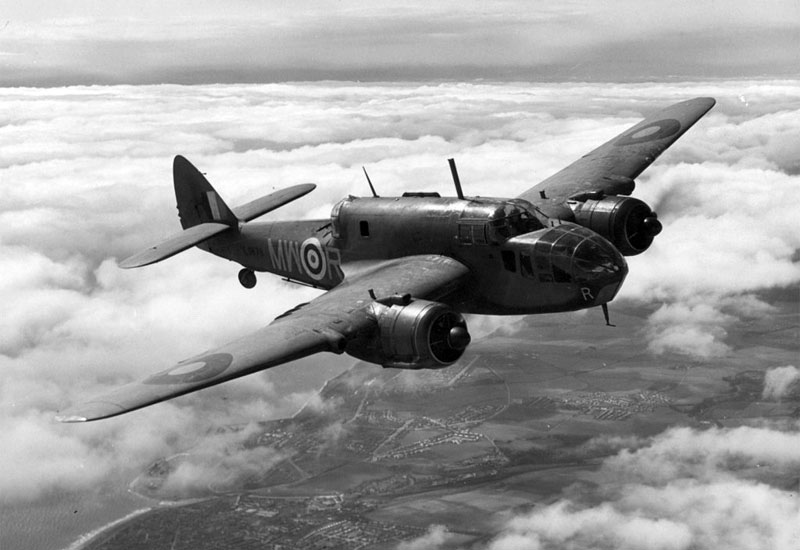
Design was of a conventional approach. The wings were of monoplane layout and low-mounted on the fuselage. The identifiable dorsal turret was mounted at rear as part of the upper fuselage design, limiting the arc of fire to the rear, above and sides only. The nose assembly was of a greenhouse style design with the cockpit mounted behind the nose area and above.
Beauforts were largely responsible for the disruption of Axis supply lines in the English Channel and the Mediterranean. Australia produced the Beaufort as a local version in the form of the Mk V-IX series for their Royal Australian Air Force. Operations for the RAF were also present in the Middle East under British control. The last models of the Beaufort were produced as trainers with the top turret completely removed. As mentioned earlier, the system as a whole was eventually replaced by the Bristol Beaufighter in the middle years of the war. The Beaufighter is detailed elsewhere on this site.
Text ©2003-2010 www.MilitaryFactory.com • All Rights Reserved •
No Reproduction Without Permission • Corrections / Comments to MilitaryFactory at Gmail dot com
|
| |
|
|
| |
| Specifications for the Bristol Beaufort Mk I |
Dimensions: |
Length: 44.26ft (13.49m)
Width:57.81ft (17.62m)
Height: 14.24ft (4.34m)
|
Performance: |
About MACH |
Max Speed: 265mph (426kmh; 230kts)
Max Range: 1,600miles (2,575km)
Rate-of-Climb: 0ft/min (0m/min)
Service Ceiling: 16,499ft (5,029m; 3.1miles)
|
|
Structure: |
Accommodation: 4
Hardpoints: 4
Empty Weight: 13,100lbs (5,942kg)
MTOW: 21,228lbs (9,629kg)
|
Powerplant: |
| Engine(s): 2 x Bristol Taurus VI radial piston engines generating 1,130hp each. |
|
Armament Suite: |
2 x 7.7mm machine guns in nose
2 x 7.7mm machine guns in dorsal turret
Maximum bombload of up to 2,000lbs.
OPTIONAL:
1 x 1,605lb 457mm torpedo
1 x 7.7mm rear-firing machine gun under nose
2 x 7.7mm machine guns in beam positions
|
|
|
| Special Aircraft Collections |
|
|
| Recent Military Aircraft Additions |
|
| Contacting MilitaryFactory.com |
| We can only get better if you tell us how. You can contact MilitaryFactory.com at MilitaryFactory at gmail dot com (replace "at" with "@" and "dot with ".") with any questions, comments or corrections. We also accept related military imagery that you approve for us to use on our website. Keep in mind, however, that due to volume, we may not directly respond to your inquiry. Please add us to your list of non-blocked recipients! |
|
|

| Variants |
Mk I - Initial Production Version; fitted with Bristol Taurus II 1,010hp powerplants; 965 produced.
Mk II - Fitted with American Pratt & Whitney Twin Wasp radial piston engines; 415 produced.
Trainer - Final production versions completed sans dorsal turret.
|
|
|