Military Factory
Military Pay Chart
Global Firepower
Military Industrial Complex
Second World War
Home
Military Pay Scale
Military Ranks
Small Arms
Aircraft
Land Systems
Navy
Education
Military Factory Facebook Logo
flag of United Kingdom

BAC TSR-2 Tactical Strike and Reconnaissance Aircraft (1959)

Authored By Staff Writer | Last Updated: 4/24/2013

The BAC TSR-2 became a Cold War-era case study of a promising aircraft derailed by ballooning program costs and political meddling.

Find a School Near You
Follow Military Factory on Facebook:
Trending on Military Factory:
Recent Articles:
Along the same lines as the prototype North American XB-70 Valkyrie strategic bomber of the United States Air Force, the BAC TSR-2 was to be England's "super" Cold War tactical strike and reconnaissance bomber (the "TSR" in the formal designation equates to "Tactical Strike / Reconnaissance"). The program was intended to provide the United Kingdom with a supersonic, low-level bombing platform capable of delivering both conventional and nuclear weapons with precision. From the outset, the TSR-2 was on pace to become just what was intended. However, ballooning program costs (primarily due to low initial estimates) and political changes in British government soon doomed the aircraft to the pages of aviation history.

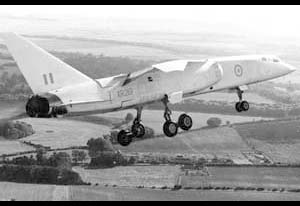
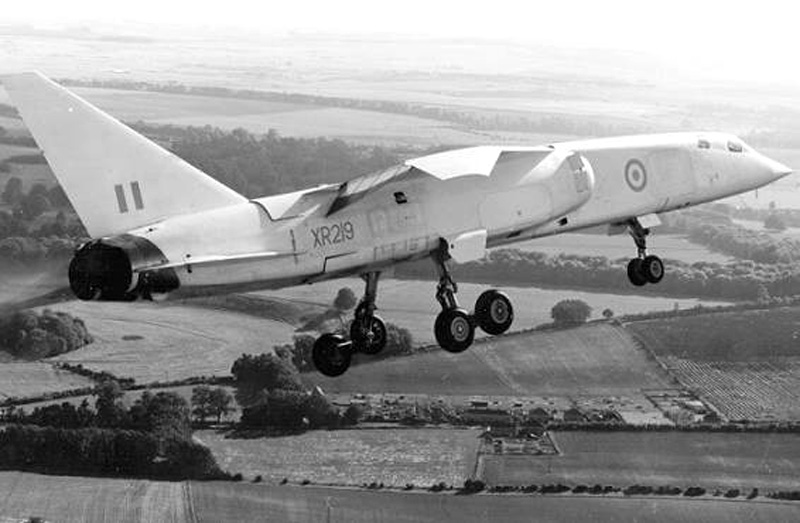
The TSR-2 was initially a product of the English Electric and Vickers-Armstrong aviation concerns with the primary aim of replacing English Electric Canberras as Britain's principle long-range, low-level supersonic bomber (as well as possibly the entire family of nuclear-capable "V-Bombers"). Design work began in 1958 to which the project was approved in 1959. English Electric and Vickers-Armstrong were then pushed into a merger with Bristol and Hunting to become the British Aircraft Corporation (BAC) in 1960. The aircraft utilized the latest advances in swept wing technology to provide a pleasing airframe with exceptional airflow qualities. The fuselage consisted of a tubular design with slab sides and a raised spine behind the pair of inline cockpits for its crew of two. The main wing elements were set at amidships and high mounted to provide excellent clearance and lift. Intakes were fitted well aft of the cockpit and aspirated the pair of Bristol-Siddeley Olympus B.OI22R (Mk 320) turbojet powerplants. The side-by-side engines exhausted under a single vertical tail fin. At the rear sides of the fuselage were low-set horizontal stabilizers arranges in a traditional fashion. All wing surfaces were swept along their leading and trailing edges. The undercarriage was wholly retractable and of the tricycle arrangement with a two-wheeled nose leg and two twin-wheeled main legs. The undercarriage legs were noticeable long given the TSR-2 a decidedly tall appearance when at rest. Internal controls were advanced and included Heads Up Displays (HUDs), specialized weapons systems and communications (by Plessi) facilities, forward and side-looking (by EMI) radars and integrated terrain-following capabilities (by Ferranti) for low-level approaches. Onboard cameras covered the reconnaissance role. Avionics design was handled by Marconi.

First flight of a prototype airworthy TSR-2 was recorded on September 27th, 1964. While the TSR-2 proved itself enough to warrant a serial production order, the rising development and production costs and the now-governing Labour Party forced the TSR-2 into mothballs and subsequent cancellation in 1965 - just a short six years after the entire project was initially green-lighted. The TSR-2 prototype managed a mere 13 airborne hours across two dozen controlled flights and it was this sole TSR-2 form that proved the only airworthy mount of the 23 total airframes reaching various stages of completeness.

The British military then elected to order the American General Dynamics F-111 Aardvark through a 50-strong order. However, this was also cancelled amidst rising procurement costs. The need was then fulfilled through a combination fielding of the American McDonnell Douglas F-4 Phantom II and the Blackburn Buccaneer. The Panavia Tornado eventually superseded the latter in the strike role.

BAC was made defunct on April 29th, 1977. Only two airframes of the TSR-2 project survived the subsequent scrapping initiative posed after the program's cancellation. One prototype can be found at the RAF Museum at Cosford and the other at the Imperial War Museum of Duxford.

As completed, the TSR-2 presented a running length of 89 feet with a wingspan of 37 feet and height of 23.7 feet. Empty weight was approximately 55,000lbs with a maximum take-off weight of 103,500lbs. The Bristol Siddeley Olympus engines outputted at 22,000lbs dry thrust each (44,000 combined) with 30,610lbs of thrust (60,000lbs combined) when use afterburner. Maximum speed was Mach 2.35 with a range (ferry) out to 2,880 miles and combat radius of 860 miles operating at altitudes up to 40,000 feet (estimated). Rate of climb was in the vicinity of 15,000 feet per minute, giving the airframe an excellent response time.

The TSR-2 was designed to carry ordnance across an internal and external weapons arrangement. Up to 6,000lbs of stores were housed in an internal bomb bay with up to 4,000lbs held externally for a total of 10,000lbs of possible weaponry. The airframe would have supported the carrying and release of the "Red Beard" 15 kiloton nuclear weapon or 6 x 1,000lbs of conventional drop bombs. There was noted support for the WE.177 nuclear bomb across four hardpoints. The TSR-2 could also make use of 37" rocket pods for the strike role.
Text ©2003-2013 www.MilitaryFactory.com • All Rights Reserved • No Reproduction Permitted
MilitaryFactory.com does NOT sell equipment/weaponry. Material presented throughout this website is for historical and entertainment value and should not to be construed as usable for hardware restoration, maintenance or general operation. Please consult manufacturers for such information. Our disclaimer. Email corrections / Comments to MilitaryFactory at Gmail dot com.
Picture of BAC TSR-2
View All Images (1)

Specifications for the
BAC TSR-2
Tactical Strike and Reconnaissance Aircraft


Country of Origin: United Kingdom
Manufacturer: British Aircraft Corporation - UK
Initial Year of Service: 1959
Production: 23


Focus Model: BAC TSR-2
Crew: 2


Length: 89.01ft (27.13m)
Width: 37.14ft (11.32m)
Height: 23.79ft (7.25m)
Weight (Empty): 54,750lbs (24,834kg)
Weight (MTOW): 103,573lbs (46,980kg)


Powerplant: 2 x Bristol-Siddeley Olympus B.01.22R turbojets with afterburner generating 30,600lbs of thrust each.


Maximum Speed: 835mph (1,344kmh; 726kts)
Maximum Range: 2,877miles (4,630km)
Service Ceiling: 39,370ft (12,000m; 7.5miles)
Rate-of-Climb: 15,000 feet per minute (4,572m/min)


Hardpoints: 4
Armament Suite:
Mission-specific ordnance up to 10,000lbs across internal (6,000lbs) and external (4,000lbs) bay/hardpoints to include nuclear bombs, conventional bombs and rocket pods.


Variants:
TSR-2 - Main Series Designation; 1 flyable airframe completed with as many as 23 airframes in various stages of completeness.


Operators: United Kingdom

ALL AIRCRAFT CATEGORIES

BY DECADE:


1900 to 1909
1910 to 1919
1920 to 1929
1930 to 1939
1940 to 1949
1950 to 1959
1960 to 1969
1970 to 1979
1980 to 1989
1990 to 1999
2000 to 2009
2010 to 2019
2020 to 2029
VIEW ALL
Compare Aircraft


BY TYPE:


Anti-Submarine Warfare (ASW)
Attack Helicopters
Bomber Aircraft
Medium Bombers
Heavy Bombers
Close-Air Support (CAS)
Commercial Aircraft
Dive Bombers
Electronic Warfare Aircraft (EWA)
Experimental / X-Planes
Fighter Aircraft
Floatplane Aircraft
Flying Boat Aircraft
Aerial Refueling Tankers
Helicopters (ALL)
Interceptor Aircraft
Multi-Role Aircraft
Navy Carrier Aircraft
Night Fighters
Reconnaissance / Scout
Search & Rescue (SAR)
Scout Helicopters
Special Purpose
Torpedo Bombers
Trainer Aircraft
Transport Aircraft
Transport Helicopters
Unmanned Aerial Vehicles (UAVs)
Unmanned Combat Air Vehicles (UCAVs)


COLLECTIONS:


4th Generation Fighter Aircraft
5th Generation Fighter Aircraft
US X-Planes
Classic US Warbirds
French Military Helicopters
Grumman "Cats"
Howard Hughes Aircraft
Indian Air Force
Israeli Air Force
Libyan Aircraft
Modern Chinese Aircraft
Modern Chinese Fighters
Modern Military Aircraft
Modern North Korean Aircraft
Modern Trainer Aircraft
Modern US Aircraft
Mikoyan Aircraft
Sukhoi Aircraft
Syrian Aircraft
Top 10 Fighter Aircraft of All Time


AIRCRAFT BY CONFLICT:


Arab-Israeli War (1948)
Cuban Missile Crisis (1959-1962)
Falklands War (1982)
Indo-Pak War (1965, 1971)
Iran-Iraq War (1980-1988)
Lebanon War (1982)
Operation Allied Force (1999)
Operation Desert Storm (1991)
Six Day War (1967)
Spanish Civil War (1936)
Soviet-Afghan War (1979-1989)
Yom Kippur War (1973)


MISCELLANEOUS:


Aircraft Cockpits
Aircraft Manufacturers List
Aircraft Timeline

WORLD WAR 2:


1939 Aircraft
1940 Aircraft
1941 Aircraft
1942 Aircraft
1943 Aircraft
1944 Aircraft
1945 Aircraft
1946 Aircraft
Australian Aircraft
Battle of Britain Aircraft
Bombers
Four-Engine Bombers
British Aircraft
British Bombers
British Transports
Dive Bombers
Canadian Aircraft
Fighters
Chinese Aircraft
French Aircraft
German Aircraft
German Fighters
German Flying Boats
German Jets
Secret Weapons of the Luftwaffe
Italian Aircraft
Imperial Japanese Aircraft
Imperial Japanese Fighters
Mitsubishi Bombers
Navy Aircraft
Pearl Harbor
Polish Aircraft
Romanian Aircraft
US Aircraft
US Bombers
US Navy Aircraft
Soviet Aircraft
Torpedo Bombers
Transport Aircraft
Tuskegee Airmen Aircraft
W.A.S.P. Aircraft
WW2 Aircraft Ranked by Speed
VIEW ALL


WORLD WAR 1:


1914 Aircraft
1915 Aircraft
1916 Aircraft
1917 Aircraft
1918 Aircraft
Aircraft Timeline
Austro-Hungarian Aircraft
Bomber Aircraft
British Aircraft
Fighters
Flying Boats
French Aircraft
Imperial German Aircraft
Italian Aircraft
Scout Aircraft
Russian Empire Aircraft
US Aircraft
WW1 Aircraft Ranked by Speed
VIEW ALL


KOREAN WAR:


Australian Aircraft
Korean War Aces
Korean War Jets
North Korean Aircraft
US Military Aircraft
VIEW ALL


VIETNAM WAR:


Helicopters
North Vietnam Air Force
US Airpower
VIEW ALL


COLD WAR:


1950s French Aircraft
British V-Bombers
Cold War Bombers
Soviet Aircraft
Soviet Bombers
Soviet Interceptors
Soviet Helicopters
Strategic Air Command
US Aircraft
US Bombers
US Interceptors
VIEW ALL

Site Disclaimer | Privacy Policy | Site Map | MF Origins


©2013 www.MilitaryFactory.com • Content ©2003-2013 MilitaryFactory.com • All Rights Reserved • Site Contact Email: militaryfactory at gmail dot com. The "Military Factory" name and MilitaryFactory.com logo are registered ® trademarks and protected by all applicable domestic and international intellectual property laws.


Top MF Stuff: 2013 Military Pay Scale | Military Ranks | WW2 Weapons | Sniper Rifles | Kts to Mph | WW1 Aircraft | Automatic Rifles | Aircraft Cockpits | Vietnam War Weapons | Main Battle Tanks | Submachine Guns | Shotguns | French Military Victories


Most photographic images appearing on this site are courtesy of the United States Department of Defense and are approved for public use. Other images acquired through the public domain. Digital art work courtesy of Dan Alex. Business Consulting by Kyle Williams. Material presented throughout this website is for historical and entertainment value and should not to be construed as usable for hardware restoration, maintenance or general operation. Please consult manufacturers for such information.


eXTReMe Tracker