|
|
| |
|
Blackburn / Hawker Siddeley Buccaneer
The British Royal Navy utilized the excellent Blackburn Buccaneer.
By Staff Writer
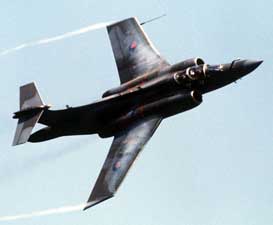
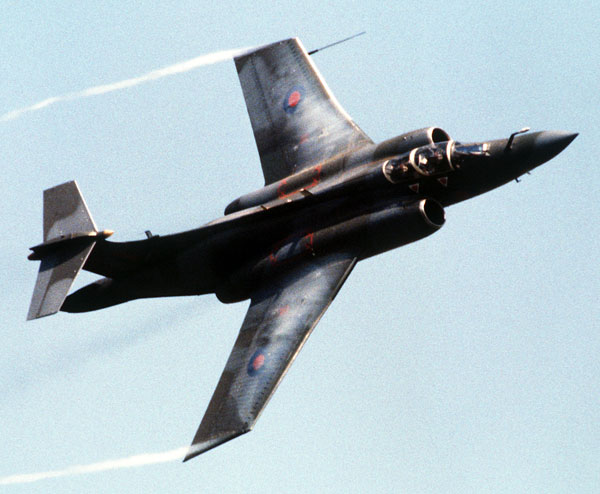
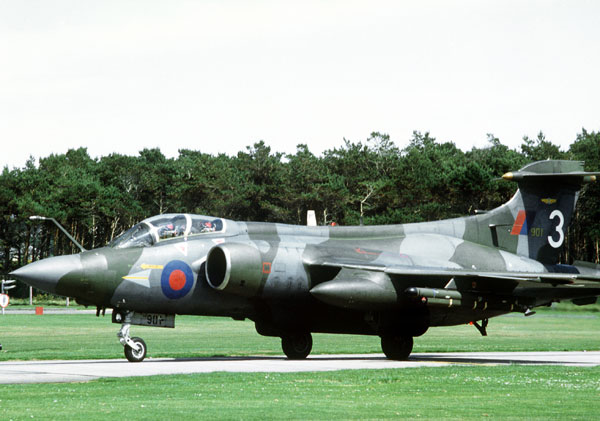
The Blackburn Buccaneer was a highly-respected low-level carrier-borne strike aircraft utilized by the Royal Air Force and the Royal Navy. The Buccaneer featured a crew of two seated in tandem, an internal weapons bay to compliment the external stores and an ingenious tailcone that could be split vertically and used as a large-area air brake. The prototype Buccaneer first flew in 1958 and would lead to a total of twenty pre-production models.
Initial Buccaneers, designated as S.Mk 1 - were ordered with the Gyron Junior 7,100lb thrust engines where as performance issues were addressed with the S.Mk 2 featuring the Rolls-Royce Spey Mk 101 turbofan engine generating 11,200lbs of standard thrust. Future innovations for the system would lead to the inclusion of rocket-assisted take-offs for carrier operations.
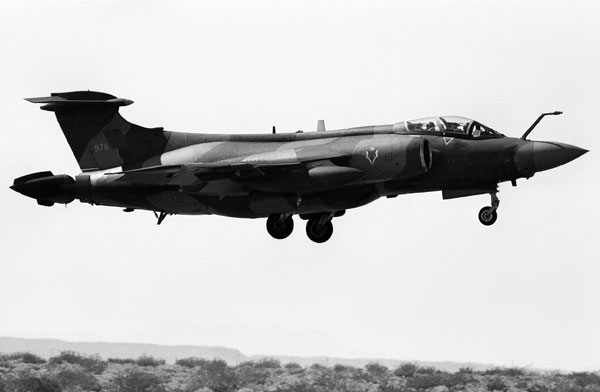
The Royal Navy variant featured increased range and provisions for in-flight refueling. With the advent of smaller carriers for the Royal Navy, the Buccaneer's future was in doubt. Thusly many were relegated to RAF service whilst some were procured by South Africa as the S.Mk 50. These Buccaneers featured the 8,000lb standard thrust Bristol Siddeley Stentor rocket motors for short take-off operations.
As a strike fighter, the Buccaneer could be counted on to carry a myriad of air-surface weaponry including iron bombs, structure-destroying missiles, anti-ship missiles and rocket pods. The internal weapons bay was quite sizeable and forced external fuel pods to be utilized more often than not.
In the end, modernization programs helped to extend the life of the Buccaneer as a frontline service strike aircraft.
Text ©2003-2010 www.MilitaryFactory.com • All Rights Reserved •
No Reproduction Without Permission • Corrections / Comments to MilitaryFactory at Gmail dot com
Last Revision: 5/6/2009
|
| |
|
|
| |
| Specifications for the Blackburn / Hawker Siddeley Buccaneer |
Dimensions: |
Length: 63.42ft (19.33m)
Width:44.00ft (13.41m)
Height: 0.00ft (0.00m)
|
Performance: |
About MACH |
Max Speed: 646mph (1,040kmh; 562kts)
Max Range: 1,108miles (1,783km)
Rate-of-Climb: 0ft/min (0m/min)
Service Ceiling: 41,998ft (12,801m; 8.0miles)
|
|
Structure: |
Accommodation: 2
Hardpoints: 4
Empty Weight: 29,800lbs (13,517kg)
MTOW: 62,001lbs (28,123kg)
|
Powerplant: |
| Engine(s): 2 x Rolls-Royce Spey Mk 101 turbofan engines generating 11,100lbs of standard thrust. |
|
Armament Suite: |
Mission-specific armament may include:
2 x Martel anti-ship missiles
2 x Sea Eagle anti-ship missiles
7,000lbs of ordnance including 4,000lbs of that carried in internal bays.
|
|
|
| Pictures of the Blackburn / Hawker Siddeley Buccaneer |
|
| Special Aircraft Collections |
|
|
| Recent Military Aircraft Additions |
|
| Contacting MilitaryFactory.com |
| We can only get better if you tell us how. You can contact MilitaryFactory.com at MilitaryFactory at gmail dot com (replace "at" with "@" and "dot with ".") with any questions, comments or corrections. We also accept related military imagery that you approve for us to use on our website. Keep in mind, however, that due to volume, we may not directly respond to your inquiry. Please add us to your list of non-blocked recipients! |
|
|

Aircraft Quick Profile |
 |
| 1962 |
Designation: Blackburn / Hawker Siddeley Buccaneer
Classification Type: Carrier-Borne Low-Level Strike Bomber
Contractor: Blackburn / Hawker Siddeley - UK
Country of Origin: United Kingdom
Production Total: 190 |
 |
|
Operators: South Africa; United Kingdom
|
|
|
|
| Variants |
S.Mk 1 - Initial Production Model of which forty were produced; Fitted with Gyron Junior 101 turbojet engines delivering 7,100lbs of standard thrust.
S.Mk 2 - Powered by 2 x Rolls-Royce Spey Mk 101 turbofans for increased performance.
S.Mk 2A - Royal Navy Buccaneers reallocated to Royal Air Force usage.
S.Mk 2B - Updated and improved Buccaneers with provision for Martel air-to-surface anti-ship missile systems.
S.Mk 50 - South African model featuring Bristol Siddeley Stentor rocket motor for increased take-off performance.
|
|
|