|
|
| |
|
Vickers Wellington
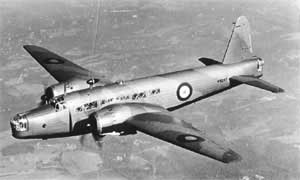
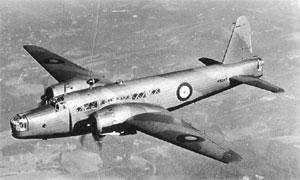
The Wellington was the principle bomber of the RAF at the start of World War 2.
By Staff Writer
The Vickers-produced Wellington medium-class bomber was a principle bomber of the Royal Air Force at the start of the Second World War, serving up until late 1943 when it was relegated to maritime support roles. The Wellington saw production numbers exceed 11,400 and provided an exceptional record for night bombing sorties in which it excelled. Outlasting its other 1930's designed contemporaries, the Wellington proved a vital and successful additional to the Royal Air Force's offensive reach.
The Vickers Wellington was designed as early as 1932 to a requirement for a medium two-engine bomber. The resulting Wellington first flew in 1936 and joined Bomber Command in 1938, just in time for the development of the Second World War. Still utilizing construction (an internal lattice structure was utilized) and design technology that would prove obsolescent by the middle years of the war, the Wellington powered on. The system would go on to be powered by a mix of Hercules, Pegasus and Merlin engines throughout her career. Engines were mounted on a mid-wing monoplane which were in turn mounted onto a stout fuselage. Crew accommodations ranged from 5 to 6 personnel. An internal bombload capacity was limited to 4,500lbs of ordnance and defensive armament was a mix of 7.7mm machine guns - two in the front turret, four in the rear turret and an additional two in beam positions. Though this array might appear to some as impressive on paper, it was soon found that the Wellington suffered from large defenseless angles in her design. As such, early daylight bombing raids proved disastrous for the type.
It would not be until the Wellington was featured into night time raiding sorties did the type shine. The Wellington would go on to form a powerful addition to Bomber Command's plans to derail the German war machine in the night time hours. As much as the Wellington progressed throughout its time in the war, it was nonetheless become evermore outclassed by the addition of new Allied bombers and new Axis fighters. As such, the Wellington would fly its last offensive mission in October of 1943. Even so, the type would go on in other forms, particularly fulfilling the role of maritime patrol - this type armed with two torpedoes and specialized equipment. Other Wellingtons served in the dedicated transport, crew trainer and even as a research test bed for the new development of turbojet technology.
Text ©2003-2009 www.MilitaryFactory.com • All Rights Reserved •
No Reproduction Without Permission • Corrections / Comments to MilitaryFactory at Gmail dot com
|
| |
|
|
| |
| Specifications for the Vickers Wellington Mk III |
Dimensions: |
Length: 64.57ft (19.68m)
Width:86.15ft (26.26m)
Height: 16.40ft (5.00m)
|
Performance: |
About MACH |
Max Speed: 255mph (411kmh; 222kts)
Max Range: 1,540miles (2,478km)
Rate-of-Climb: 930ft/min (283m/min)
Service Ceiling: 18,996ft (5,790m; 3.6miles)
|
|
Structure: |
Accommodation: 5 or 6
Hardpoints: 0
Empty Weight: 18,971lbs (8,605kg)
MTOW: 34,000lbs (15,422kg)
|
Powerplant: |
| Engine(s): 2 x Bristol Hercules XI radial piston engines generating 1,500hp each. |
|
Armament Suite: |
2 x 7.7mm machine guns in nose turret
4 x 7.7mm machine guns in tail turret
2 x 7.7mm machine guns in beam positions
Up to 4,500lbs of internal stores.
|
|
|
| Special Aircraft Collections |
|
|
| Recent Military Aircraft Additions |
|
| Contacting MilitaryFactory.com |
| We can only get better if you tell us how. You can contact MilitaryFactory.com at MilitaryFactory at gmail dot com (replace "at" with "@" and "dot with ".") with any questions, comments or corrections. We also accept related military imagery that you approve for us to use on our website. Keep in mind, however, that due to volume, we may not directly respond to your inquiry. Please add us to your list of non-blocked recipients! |
|
|

Aircraft Quick Profile |

Image courtesy of the Royal Air Force.
|
 |
 |
| 1938 |
Designation: Vickers Wellington
Classification Type: Medium Bomber
Contractor: Vickers - UK
Country of Origin: United Kingdom
Production Total: 11,461 |
 |
|
Operators: the United Kingdom
|
|
|
|
| Variants |
Mk I - Initial Production Model Series; fitted with Pegasus radial engines.
Mk IA - Fitted with Nash & Thompson type nose and tail turrets.
Mk IC - Ventral turret replaced by lateral position guns.
Mk II - Fitted with Merlin powerplants.
Mk III - Fitted with either Hercules III or Hercules XI type powerplants.
Mk IV - Fitted with Twin Wasp powerplants.
Mk V - Pressurized cabins for high-altitude operation; fitted with Hercules powerplant; did not see combat service.
Mk VI - Pressurized cabins for high-altitude operation; fitted with Merlin powerplant; did not see combat service.
Mk X - Fitted with Hercules XVIII; final production version of bomber type; last flown in 1943.
DW.Mk I - Maritime Variant; anti-mine equipment
DW.Mk IC - Dedicated Mine Layer
GR.Mk VIII - Fitted with ASV radar system and Pegasus powerplant.
GR.Mk XI - Torpedo Bomber; fitted with Hercules engines.
GR.Mk XII - Torpedo Bomber; fitted with Hercules engines.
GR.Mk XIV - Torpedo Bomber; fitted with Hercules engines.
T.Mk XVII - Trainer Variant
T.Mk XVIII - Trainer Variant
C.Mk XV - Transport Conversion Models of the Mk IC model.
C.Mk XVI - Transport Conversion Models of the Mk IC model.
|
|
|