Military Factory
Military Pay Chart
Global Firepower
Military Industrial Complex
Second World War
Home
Military Pay Scale
Military Ranks
Small Arms
Aircraft
Land Systems
Navy
Education
Military Factory Facebook Logo
flag of Nazi Germany

Dornier Do 17 (Flying Pencil) Medium Bomber (1937)

Authored By Martin Foray | Last Updated: 4/12/2011

The German Luftwaffe Dornier Do 17 bomber was initially an impressive aircraft design of the late 1930s, eventually losing headway by the early 1940s to improved Allied fighter designs.

The Dornier Do 17 was a medium-class bomber fielded primarily by the German Luftwaffe in the years leading up to World War 2. The aircraft saw extensive action in the early phases of the war and played a major role in the falls of Holland, Belgium and France. It was also used in the invasion of the Balkans, Greece and Crete and saw its last major participation in the invasion of the Soviet Union. While Germany never maintained a revolutionary stable of bombers in its inventory aircraft such as the Do 17 formed a major part of the initial German spearheads across Europe. The aircraft was dubbed as the "Flying Pencil" for its thin shape resembling that of a writing instrument. In all, some 2,139 Dornier Do 17 bombers and associated derivatives were completed.

Background

After World War 1, Germany's war making capacity was extremely limited following the terms of the 1919 Treaty of Versailles that lay most of the blame for war at the feet of the German Empire. As such, the nation was allowed no military aircraft, submarines (nor warships of any kind) or tanks. Her internal defense was handled by a small standing army and armored cars for policing duties. This all changed when Adolph Hitler rose to power and was handed the Chancellery before ultimately taking total control as dictator. In an effort to curb unemployment and secure the faithful of the middle class as well as build up his war machine, he put Germans to work in factories making his weapons of war.

In the years leading up to total war in Europe, the German propaganda machine took control of the minds of the German people. It utilized whatever greatness was found in German discoveries and creations and set forth to create a bloated image of the New Germany. Such was the case in aircraft development where designs began appearing that promoted particular strengths in their respective civilian guises. It was not long before the military value of these designs was noticed by both German authorities and outside parties such as Britain and France. With that said, many of the rebuilding German Luftwaffe's early aircraft became nothing more than conversions of these commercial-minded models. While these systems excelled in their original forms, limitations soon shown over the life of such systems when converted to their military cousins - the Dornier Do 17 proving no exception.

Dornier Do 17 Origins

The Dornier Do 17 series of aircraft actually began as a dedicated commercial venture in 1932. Dornier constructed a mailplane with limited passenger seating capacity that utilized a slim fuselage, two engines set upon a high-mounted monoplane wing assembly and a single vertical tail fin. The flight deck was held at the extreme forward of the aircraft and the passenger cabin was actually two split areas - a two-seat arrangement fitted behind the cockpit and a four-seat arrangement installed aft of the main wing spar. An internal cargo hold managed goods for transport. The initial Do 17 V1 prototype went airborne in 1934. Dornier then delivered a pair of similar prototypes to Lufthansa for evaluation but these were rejected particularly for their split passenger cabin arrangement. The Do 17 lay in limbo before a Dornier test pilot considered the airframe for a military bomber venture for the German Luftwaffe. Dornier engineers then re-envisioned the type by removing the passenger and cargo holds, installing an internal bomb bay and splitting the single vertical tail fin into two smaller vertical tail fins (the latter move served to ensure an unfettered vantage point for a dorsal machine gunner). Defensive armament was added to complete the revision. Dornier then produced five additional prototypes to fit this design scheme and the militarized Do 17 was born.

The Dornier Do 17 is Born

At the time of its inception, the Do 17 was an excellent performing airframe. She proved faster than any fighter development of the time and her handling was fighter-like in itself. Pilots appreciated her rugged status and her flight handling characteristics for an aircraft of this type were exemplary. The German Luftwaffe accepted the type into service and production began on two similar models - the Do 17E-1 and the Do 17F-1. The Do 17E-1 was a dedicated medium bomber capable of an 1,100lb internal bomb load while the Do 17F-1 was a dedicated reconnaissance platform doing away with the bomb load in favor of adding two downward-facing reconnaissance cameras (Rb 50/30 and Rb 75/30 types) and extra internal fuel for increased operational ranges. Both of these mounts were fitted with BMW VI inline liquid-cooled inline engines delivering 750 horsepower and production was limited.

Dornier Do 17 Walk-Around

In her completed production form, the Do 17 still maintained much of her original mailplane/passenger origins. All of the flight positions were held in the forward portion of the airframe. As such, much glazing was added to help improve respective vantage points. Wings were shoulder-mounted along the thin fuselage and fitted ahead of amidships. Wings were straight in design and tapered off at the tips. Each wing fitted a radial piston engine in streamline nacelles along their leading edges. The fuselage tapered off into the empennage to which a double vertical tail fin configuration was affixed. This supplied the dorsal gunner a wider field of fire. The undercarriage was of a traditional arrangement with a pair of main landing gear legs and a tail wheel - all were fully retractable into the engine nacelles (main legs) and the tail section.

Armament

The glazed nose housed a crewmember with access to a forward-facing machine gun. The lower flightdeck floor was a gondola-type appendage with a rearward, downward-facing machine gun meant to counter enemy attacks from below and the rear. A dorsal gunner was situated at the rear of the flight deck with access to a machine gun to cover the all-important rear and upper quadrants of the Do 17. Side gunners managed machine guns meant to stop broadside strikes from incoming enemy fighters. In all, the basic Do 17 crew had access to four machine guns in early models and up to eight machine guns in later models. Machine guns were of the MG 15 series of 7.92mm caliber. Bomb loads ranged from 1,000 to over 2,000lbs for the life of the aircraft (depending on variant). Needless to say, fighting conditions aboard any Do 17 airframe were relatively cramped.

First Combat - the Spanish Civil War

It was not long before many of the early German military creations received their formal baptism of fire. Spain became embroiled in a civil war that became known simply as the Spanish Civil War (1939-1939) that pitted the forces of the Republic government against the rebellious Nationalists. Germany sided with the Nationalists and committed their new Do 17s bombers, Junkers Ju 87 dive bombers, Messerschmitt Bf 109 fighters and Panzer light tanks. Both production versions of the Do 17 eventually made their way to the battlefront as part of the "Condor Legion". In combat, the types were exceptional and surpassed the qualities of the fighters that sought to destroy them. Their bombing nature made them lethal opponents and the design was deemed to have passed its initial test.

After-Action Revisions

Work had already begun on improved forms of both Do 17 production models. These became the Do 17M and Do 17P designations respectively. Both versions were intended to fit the much improved Daimler-Benz DB600A series engines of 1,000 horsepower but precedence was handed over to fighter development. As such, the Do 17M was given Bramo 323 Fafnir nine-cylinder, air-cooled radial piston engines of 900 horsepower while the Do 17P was fitted with the BMW 132N series. These newer designs were given larger internal space with room for over 2,200lbs of stores and improved defensive armament based on combat experience gained in the all-important Spanish Civil War. Again, these versions were limited production aircraft.

The Do 17S appeared next and was a high-speed reconnaissance platform that never materialized into a serial production model. Another reconnaissance version, the Do 17U was produced in three prototypes and twelve operational models and (as in the Do 17S) introduced a stepped cockpit, increasing internal space and, thusly, the operating crew to five personnel. Both were fitted with the Daimler-Benz DB600 series as well as improved defensive armament.

The Do 17Z would prove the definitive model of the Do 17 series. She retained the changes inherent in the Do 17S and Do 17U but was fitted instead with Bramo Fafnir radial piston engines. These proved rather underpowered when the airframe was at full combat load so Bramo delivered their 323P supercharged engines of 1,000 horsepower each to the mix. From there, the Do 17Z was evolved into a multi-role bomber/reconnaissance platform that allowed the Luftwaffe dual use of the single airframe. In all, the Do 17Z encompassed the Do 17Z-1 bomber with Bramo 323A-1 Fafnir radials, the Do 17Z-2 with its Bramo 323P Fafnir radials of 1,000 horsepower, the Do 17Z-3 dual-role bomber/reconnaissance model, the Do 17Z-4 trainer with dual-controls and the Do 17Z-5 reconnaissance platform of extended range and specialized water equipment.

Invasion of Poland

When Germany committed to its invasion of Poland on September 1st, 1939, its numbers across nine Kampfgruppens totaling 370 Do 17s ensured that the type was an ever-present performer in actions against the Polish military. Air superiority was quickly reached and the Do 17 could operate in relative safety over Polish skies, often times tackling ground targets at lower, more accurate, levels. The first target by Do 17 flight groups was the railway bridge at Dirschau, it being bombed by Do 17Z elements of the III/KG 3. The Do 17 made up a large portion of the Luftwaffe offensive punch in these early phases.

The Fall of France and the Battle of Britain

The Do 17 was utilized in similar roles come the invasion of France and these were primarily the Do 17Z models. Dorniers were used across all major German campaigns including attacks on Allied warships in the English Channel. The last viable Allied forces were driven from France through the port city of Dunkirk. France was ill-equipped, both militarily and politically to deliver a counter-blow against the German onslaught and, with France's capitulation, the stage was set for the Battle of Britain.

Air superiority would again have to favor the Germans if the land invasion of the British Isles would go forth. However, by this time, the Do 17 was beginning to show its limitations of having been born out of a mailplane requirement. At the beginning of her career, she was faster than any fighter fielded by her enemies but by 1940, the type soldiered on in essentially her original late 1930s form. This gave time for the Allies to deliver more impressive fighter mounts in the British Hawker Hurricane and the Supermarine Spitfire. The era of the Do 17 was drawing to a close.

The Battle of Britain formally began on July 10th, 1940 and there were some 212 Do 17 bombers and reconnaissance versions on hand. The British mounted a valiant defense of fighter and anti-aircraft protection against the marauding German forces. The Do 17 was still a capable mount but her slim fuselage design limited her bomb load capabilities. Additionally, her underside was proving a vulnerable soft spot to ground-based anti-aircraft artillery. While featuring adequate speed, the newer Allied fighters could match and often times surpass her once-heralded performance. She still held an inherent defensive maneuver in which she could fall in to a wing-over dive to escape enemy fighters and her defensive armament still served to keep them at bay to an extent. Ultimately, however, both the resolve of the English people and the skill of her pilots, communications personnel and grounds crew managed to keep the German war machine at bay. Hitler indefinitely postponed all manner of invasion plans for the British mainland for the near future.

Yugoslavia and Croatia

Yugoslavia became an early export user of the Do 17 and they received the Do 17M as the Do 17Kb-1, Do 17Kb-2 and Do 17Kb-3. The Do 17Kb-1 was the dedicated bomber variant while the Do 17Kb-2 and Do 17Kb-3 were the reconnaissance mounts. Key differences between these and the German brands were in the former's use of French Gnome-Rhone 14 Na/2 radial piston engines and Belgian Fabrique-National FN Browning machine guns. Structurally, the Yugoslavian versions were completed with the early nose designs of the prototypes but essentially followed the German lines from there. At least twenty Do 17 aircraft were delivered to the Yugoslav air arm while a license was granted for local production. Such production was underway at State Aircraft Factory by the end of 1939. Imported Yugoslavian Do 17Z models were to be known as "Do 215".

The Germans eventually set their sights on the nation of Yugoslavia and went to war on April 6th, 1941. The assault also included forces from Italy, Albania, Hungary and Bulgaria. The war lasted until April 17th, 1941 resulting in a complete conquest. Yugoslavia was occupied and, with it, its factories came under German control. At least 70 Do 17s were available at the time of war but 26 were destroyed by the Luftwaffe while others made harrowing escapes to other lands. The Independent State of Croatia was born out of the ashes of Yugoslavia and went on to inherit Do 17s.

The End of the Road

Despite her early showing, the Do 17 was often times outmatched as British tactics and equipment improved and losses mounted to unacceptable levels. The Luftwaffe began converting to the newer and more prolific Junkers Ju 88 medium bombers and the reach of the Do 17 shrunk by each passing month. The type was still fielded in two groups strong over the Balkans and participated in the invasions of Greece and Crete. At the time of the German invasion of the Soviet Union through Operation Barbarossa on June 22nd, 1941, only a single Do 17 group existed. Production of the Do 17Z model was actually given up in 1940 to the tune of some 522 aircraft.

Do 17 Extended Use

Remaining Do 17s were outclassed in many key areas by Luftwaffe terms and the Ju 88 consistently took over her bombing and reconnaissance roles from there on but lesser military-inclined nations allied to the Axis powers could still make use of the type. As such, surplus used Do 17s (including captured Yugoslavian versions) were passed on by the Luftwaffe to air elements in Croatia (newly formed from the Yugoslavian conquest). From there, these aircraft served with security forces in combating internal partisan elements by late 1942.

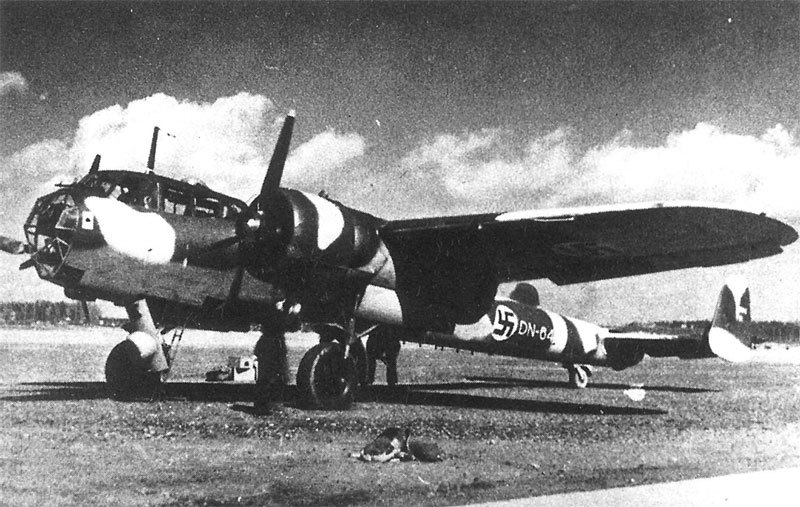
In Finland, the Finns had already fallen to the might of the Soviet Army during the "Winter War" (November 30th, 1939 - March 13th, 1940). The "Continuation War" began on June 25th, 1941 and saw the Finns now allied with the Nazi powers for both were now at war with the Soviet Union. The Luftwaffe delivered at least five Do 17Z-2 model aircraft to the Finnish air arm for bombing work. These aircraft soldiered on until the middle of 1944.

Other Notable Do 17s

Despite its inadequate bomber capabilities by this point in the war, the Do 17 legacy endured in some notable forms. The Do 17Z-6 "Kauz" was a "one-off" conversion that mated the nose assembly and nose-mounted cannon armament of the Junkers Ju 88C-2 production model with the Do 17Z-3 series. The type served as a three-man night-fighter for the foreseeable future with its three machine guns and single cannon as well as infrared technology. The Do 17Z-10 "Kauz II" was of similar scope but given an all-new nose design fitting two cannons and four machine guns.

The Do 215

The Luftwaffe also took over Do 17Z deliveries that were initially slated for both Yugoslavia and Sweden. These were to serve in the air arms of their respective countries but were never delivered prior to the war proper. The Luftwaffe accepted eighteen of these aircraft and modified their systems to produce a long-range reconnaissance variants under the initial designations of Do 215B-0 and Do 215B-1. Do 215B-2 was reserved for a bomber variant that never entered production. While still allied to the Soviet Union, two Do 215B-3s were delivered to the Russians. The Do 215B-4 was initially a photographic reconnaissance version but was later modified for night-fighter sorties. The Do 215B-5 was a similar night-fighter design with improved radar. Beyond that, the Do 215 served out its last with the forces of Hungary while others (mostly Do 17E and Do 17F models) fell into excellent service as glider tugs for the Luftwaffe. Very few complete Do 17/Do 215 airframes lasted the war.

The Do 217

The Do 217 was nothing more than a Do 17 fitted with Daimler-Benz DB 601A series engines of 1,075 horsepower. Key differences included a larger fuselage and a revised tail section as well as increased weight. The type was requested by the RLM in 1937 looking for a Do 17Z model with a larger bomb load capacity and achieved first flight in August of 1938. Despite its Do 17 pedigree, the Do 217 was considered by most to be of an all-new design attempt and lacked the strong flight qualities of the original. Do 217s were used for general bombing duties as well as anti-ship sorties.
Text ©2003-2013 www.MilitaryFactory.com • All Rights Reserved • No Reproduction Permitted
MilitaryFactory.com does NOT sell equipment/weaponry. Material presented throughout this website is for historical and entertainment value and should not to be construed as usable for hardware restoration, maintenance or general operation. Please consult manufacturers for such information. Our disclaimer. Email corrections / Comments to MilitaryFactory at Gmail dot com.
Picture of Dornier Do 17 (Flying Pencil)
View All Images (1)

Specifications for the
Dornier Do 17 (Flying Pencil)
Medium Bomber


Country of Origin: Nazi Germany
Manufacturer: Dornier - Germany
Initial Year of Service: 1937
Production: 2,139


Focus Model: Dornier Do17 (Flying Pencil)
Crew: 5


Length: 51.84ft (15.8m)
Width: 59.06ft (18.00m)
Height: 14.93ft (4.55m)
Weight (Empty): 11,486lbs (5,210kg)
Weight (MTOW): 18,940lbs (8,591kg)


Powerplant: 2 x BMW Bramo 323P Fafnir air-cooled engines generating 1,000hp.


Maximum Speed: 255mph (410kmh; 221kts)
Maximum Range: 204miles (329km)
Service Ceiling: 26,903ft (8,200m; 5.1miles)
Rate-of-Climb: 0 feet per minute (0m/min)


Hardpoints: 0
Armament Suite:
4 to 8 x 7.92mm MG 15 machine guns in nose, dorsal turret, ventral turret and beam gunner positions.

OPTIONAL:
1 or 2 x 20mm FF cannons (night-fighter derivatives).

Between 1,000lbs and 2,200lbs of internal ordnance depending on model variant (see variants).


Variants:
Do 17 - Base Model Series Designation


Do 17 V1 - Initial Prototype appearing in 1934; mailplane and passenger model; single vertical tail fin; three-man crew.

Do 17 V2 - Second Prototype; for Lufthansa review

Do 17 V3 - Third Prototype; for Lufthansa review

Do 17 V4 - Fourth Prototype; militarized form; bomb bay replacing passenger and cargo cabins; twin vertical tail fins.

Do 17 V5 - Fifth Military Prototype

Do 17 V6 - Sixth Military Prototype

Do 17 V7 - Seventh Military Prototype; glazed redesigned nose and floor; four-man crew; aft-facing 7.92mm machine gun fitted.

Do 17 V8 - Eight Military Prototype; glazed redesigned nose and floor; four-man crew; aft-facing 7.92mm machine gun fitted.

Do 17 V9 - Ninth Military Prototype; glazed redesigned nose and floor; four-man crew aft-facing 7.92mm machine gun fitted.

Do 17E-1 - Initial Production Model; bomber variant; 1,650lbs of internal stores; fitted with BMW VI 12-cylinder 750 horsepower engines.

Do 17F-1 - Initial Production Model; reconnaissance variant; fitted with cameras; fitted with BMW VI 12-cylinder 750 horsepower engines.

Do 17M - Improved Bomber; fitted with Bramo 323A-1 Fafnir radial engines of 900 horsepower; up to 2,205lbs of internal stores.

Do 17M/U1 - Dinghy added.

Do 17M-1/Trop - Tropicalized Variant with tropical environment filters on engines.

Do 17P - Improved Reconnaissance Platform; fitted with BMW 132N engines of 865 horsepower.

Do 17P-1/Trop - Tropicalized Variant with tropical environment filters on engines.

Do 17Kb-1 - Yugoslavian Export Designation; bomber variant based on Do 17M; Gnome-Rhone 14 Na/2 radial engines; FN-Browning machine guns.

Do 17Kb-2 - Yugoslavian Export Designation; reconnaissance variant based on Do 17P; Gnome-Rhone 14 Na/2 radial engines; FN-Browning machine guns.

Do 17Kb-3 - Yugoslavian Export Designation; reconnaissance variant based on Do 17P; Gnome-Rhone 14 Na/2 radial engines; FN-Browning machine guns.

Do 17S - High-Speed Reconnaissance; prototype; fitted with DB 600 engines.

Do 17U - Pathfinder Variant; redesigned forward fuselage for stepped cockpit; increase five man crew; fitted with DB 600 engines.

Do 17U-0 - Three Prototypes

Do 17U-1 - Twelve Production Models

Do 17Z - Definitive Do 17 Model

Do 17Z-1 - Changes as in the Do 17S and Do 17U; fitted with Bramo 323A-1 Fafnir radial piston engines.

Do 17Z-2 - Fitted with Bramo 323P supercharged engines of 1,000 horsepower.

Do 17Z-3 - Dual-Role Bomber/Reconnaissance Mount.

Do 17Z-4 - Dual control trainer variant

Do 17Z-5 - Long-range maritime variant

Do 17Z-6 "Kauz" - Ju 88C-2 cannon-nose with Do 17Z-3 airframe; 3 x MG 15 machine guns and 1 x 20mm FF cannon; crew of three.

Do 17Z-10 "Kauz II" - Redesigned nose; 4 x MG 15 machine guns and 2 x 20mm FF cannons; Spanner Anlage IR detector; crew of three.

Do 215 - Yugoslavian Export Model of the Do 17Z

Do 215A-1 - Export Model

Do 215B-0 - Luftwaffe long-range reconnaissance

Do 215B-1 - Luftwaffe long-range reconnaissance

Do 215B-2 - Bomber Variant; never produced

Do 215B-3 - Soviet Export Models; two delivered

Do 215B-4 - Revised photographic camera equipment; later converted to night-fighter as the Do 215B-5.

Do 215B-5 - Night-fighter conversion model of the Do 215B-4; fitted with FuG 202 Lichtenstein BC AI radar.

Do 217 - Revised Do 17 airframe design; fitted with Daimler-Benz DB 601A engines of 1,075 horsepower; enlarged fuselage; revised tail section; increased operating weight; based on the Do 17Z.


Operators:
Croatia; Egypt; Finland; Hungary; Nazi Germany; Soviet Union; Spain; United Kingdom; Yugoslavia

ALL AIRCRAFT CATEGORIES

BY DECADE:


1900 to 1909
1910 to 1919
1920 to 1929
1930 to 1939
1940 to 1949
1950 to 1959
1960 to 1969
1970 to 1979
1980 to 1989
1990 to 1999
2000 to 2009
2010 to 2019
2020 to 2029
VIEW ALL
Compare Aircraft


BY TYPE:


Anti-Submarine Warfare (ASW)
Attack Helicopters
Bomber Aircraft
Medium Bombers
Heavy Bombers
Close-Air Support (CAS)
Commercial Aircraft
Dive Bombers
Electronic Warfare Aircraft (EWA)
Experimental / X-Planes
Fighter Aircraft
Floatplane Aircraft
Flying Boat Aircraft
Aerial Refueling Tankers
Helicopters (ALL)
Interceptor Aircraft
Multi-Role Aircraft
Navy Carrier Aircraft
Night Fighters
Reconnaissance / Scout
Search & Rescue (SAR)
Scout Helicopters
Special Purpose
Torpedo Bombers
Trainer Aircraft
Transport Aircraft
Transport Helicopters
Unmanned Aerial Vehicles (UAVs)
Unmanned Combat Air Vehicles (UCAVs)


COLLECTIONS:


4th Generation Fighter Aircraft
5th Generation Fighter Aircraft
US X-Planes
Classic US Warbirds
French Military Helicopters
Grumman "Cats"
Howard Hughes Aircraft
Indian Air Force
Israeli Air Force
Libyan Aircraft
Modern Chinese Aircraft
Modern Chinese Fighters
Modern Military Aircraft
Modern North Korean Aircraft
Modern Trainer Aircraft
Modern US Aircraft
Mikoyan Aircraft
Sukhoi Aircraft
Syrian Aircraft
Top 10 Fighter Aircraft of All Time


AIRCRAFT BY CONFLICT:


Arab-Israeli War (1948)
Cuban Missile Crisis (1959-1962)
Falklands War (1982)
Indo-Pak War (1965, 1971)
Iran-Iraq War (1980-1988)
Lebanon War (1982)
Operation Allied Force (1999)
Operation Desert Storm (1991)
Six Day War (1967)
Spanish Civil War (1936)
Soviet-Afghan War (1979-1989)
Yom Kippur War (1973)


MISCELLANEOUS:


Aircraft Cockpits
Aircraft Manufacturers List
Aircraft Production
Aircraft Timeline

WORLD WAR 2:


1939 Aircraft
1940 Aircraft
1941 Aircraft
1942 Aircraft
1943 Aircraft
1944 Aircraft
1945 Aircraft
1946 Aircraft
Australian Aircraft
Battle of Britain Aircraft
Bombers
Four-Engine Bombers
British Aircraft
British Bombers
British Transports
Dive Bombers
Canadian Aircraft
Fighters
Chinese Aircraft
French Aircraft
German Aircraft
German Fighters
German Flying Boats
German Jets
Secret Weapons of the Luftwaffe
Italian Aircraft
Imperial Japanese Aircraft
Imperial Japanese Fighters
Mitsubishi Bombers
Navy Aircraft
Pearl Harbor
Polish Aircraft
Romanian Aircraft
US Aircraft
US Bombers
US Navy Aircraft
Soviet Aircraft
Torpedo Bombers
Trainer Aircraft
Transport Aircraft
Tuskegee Airmen Aircraft
W.A.S.P. Aircraft
WW2 Aircraft Ranked by Speed
VIEW ALL


WORLD WAR 1:


1914 Aircraft
1915 Aircraft
1916 Aircraft
1917 Aircraft
1918 Aircraft
Aircraft Timeline
Austro-Hungarian Aircraft
Bomber Aircraft
British Aircraft
Fighters
Flying Boats
French Aircraft
Imperial German Aircraft
Italian Aircraft
Scout Aircraft
Russian Empire Aircraft
US Aircraft
WW1 Aircraft Ranked by Speed
VIEW ALL


KOREAN WAR:


Australian Aircraft
Korean War Aces
Korean War Jets
North Korean Aircraft
US Military Aircraft
VIEW ALL


VIETNAM WAR:


Helicopters (ALL)
Transport Helicopters
North Vietnam Air Force
US Airpower
VIEW ALL


COLD WAR:


1950s French Aircraft
British V-Bombers
Cold War Bombers
Soviet Aircraft
Soviet Bombers
Soviet Interceptors
Soviet Helicopters
Strategic Air Command
US Aircraft
US Bombers
US Interceptors
VIEW ALL

Site Disclaimer | Privacy Policy | Site Map | MF Origins


©2013 www.MilitaryFactory.com • Content ©2003-2013 MilitaryFactory.com • All Rights Reserved • Site Contact Email: militaryfactory at gmail dot com. The "Military Factory" name and MilitaryFactory.com logo are registered ® trademarks and protected by all applicable domestic and international intellectual property laws.


Top MF Stuff: 2013 Military Pay Scale | Military Ranks | WW2 Weapons | Sniper Rifles | Kts to Mph | WW1 Aircraft | Automatic Rifles | Aircraft Cockpits | Vietnam War Weapons | Main Battle Tanks | Submachine Guns | Shotguns | French Military Victories


Most photographic images appearing on this site are courtesy of the United States Department of Defense and are approved for public use. Other images acquired through the public domain. Digital art work courtesy of Dan Alex. Business Consulting by Kyle Williams. Material presented throughout this website is for historical and entertainment value and should not to be construed as usable for hardware restoration, maintenance or general operation. Please consult manufacturers for such information.


eXTReMe Tracker