Military Factory
Military Pay Chart
Global Firepower
Military Industrial Complex
Second World War
Home
Military Pay Scale
Military Ranks
Small Arms
Aircraft
Land Systems
Navy
Education
Military Factory Facebook Logo
flag of France

Nieuport 11 (Bebe) Fighting Scout (1915)

Authored By Staff Writer | Last Updated: 2/18/2013

The Nieuport 11 Bebe had its roots in a racing aircraft and proved a major component in ending the dreaded Fokker Scourge.

Find a School Near You
Follow Military Factory on Facebook:
Trending on Military Factory:
Recent Articles:
The Nieuport 11 "Bebe" (or "Baby" - known officially as the "Nieuport 11 C1") was one of the first true Allied fighters of World War 1. Developed from a prewar design intended for competition, the militarized form brought with it the expected excellent performance inherent in a racing platform. Designed in a mere four months, the Nieuport 11 - retaining the "Bebe" nickname of its predecessor - proved instrumental in ending the dominance of German Fokker-based aircraft during 1916 in what came to be known as the "Fokker Scourge". The French Nieuport series, as a whole, would end up becoming one of the best fighter lines in all of World War 1, eventually becoming collectively recognized by the name of "Nieuport Fighting Scouts".

Societe Anonyme Des Etablissements, established in 1909 and founded by Eduoard de Nie Port, had delved successfully into racing sesquiplane airframes for some time prior to World War 1. The sesquiplane approach was something of a biplane configuration though the lower wing assembly was decidedly smaller than the upper. With the war reaching its stride by August of 1914, and a growing faith in biplane winged aircraft, the Nieuport firm was charged with production of Voisan biplane aircraft which sported a "pusher" propeller arrangement, necessitated by the lack of a competent machien gun synchronization system when firing through a spinning propeller. These platforms proved adequate attempts at countering German fighter designs of the time but German offerings were seemingly always one step ahead which helped to maintain the tactical advantage for the interim.

Nieuport Chief Designer Gustave Delage began designing a new type of biplane prior to World War 1 which would have competed in the 1914 Gordon Bennett Trophy Race. The aircraft was of a sesquiplane wing arrangement and given the company designation of "Nieuport 10". However, with France's commitment to open war in the middle of 1914, thought turned to developing the single-seat Nieuport 10 into a militarized form capable of competing with German offerings on equal terms. The aircraft's staggered wing configuration required support of distinctive V-aligned struts and applicable wire bracing - the latter common to aircraft of the period. The Nieuport 10 was itself adopted as a general purpose mount (sometimes armed with an upper wing Lewis machine gun) and two-seat trainer platform by the French Air Force during the war. It garnered the nickname of "Bebe" - or "Baby" - a name that stuck with the militarized version for the span of her operational career. The Nieuport 10 was further adopted by Britain, Belgium, Brazil, Finland, Italy, Japan, Russia, Serbia, Thailand, Ukraine, the United States and the Soviet Union.

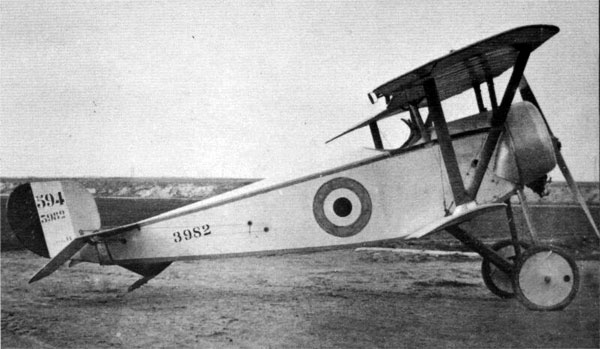
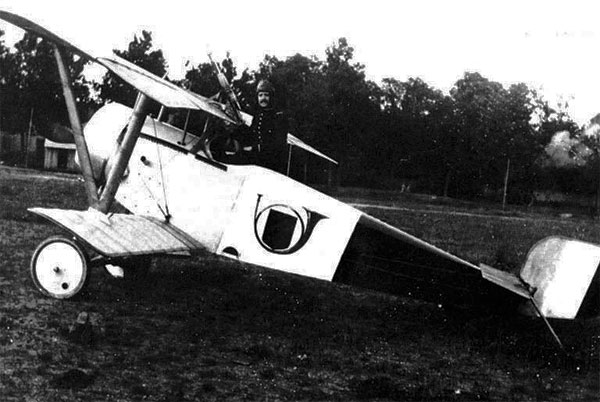
In the new militarized form, Delage attempted to retain much of the excellent performance specifications inherent in the preceding competition-minded racer. This approach would lay the foundation for a whole line of excellent French fighting aircraft still to come and make the Nieuport name a household brand by war's end. Delage's pursuit eventually realized the "Nieuport 11", a lightweight, single-seat fighter-type with the same single-bay sesquiplane wing arrangement of the Nieuport 10. The Nieuport 11 was the quintessential fighter of its time featuring a fixed two-wheel undercarriage with tail skid, an open-air cockpit and biplane wings. The aircraft owed its fine lines, smooth contours and general pedigree to the Nieuport racer prior and were fielded with a front-mounted 80 horsepower Le Rhone 9C, 9-cylinder, air-cooled rotary piston engine powering a two-blade propeller. The pilot sat positioned just behind and below the upper wing element with a generally good view out of the cockpit.

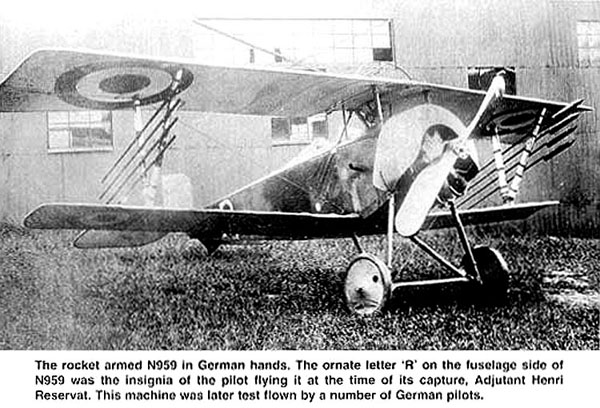
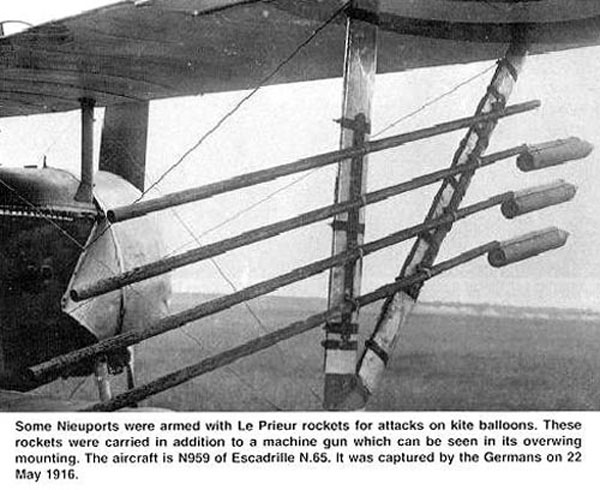
Primary armament was a single Hotchkiss- or Lewis-type 7.7mm (.303 caliber) machine gun fitted in the center of the upper wing as the Allies still lacked a viable synchronized machine gun solution that the Germans were already operating with. However, early Nieuport 11s were not armed in any way, being true scouts in their reconnaissance role (primarily with British and French scout squadrons). Only when armed did they become "fighting scouts" and could be operated in a fighter-type role when countering enemy aircraft and balloons. The Nieuport 11 was later cleared to fire up to 8 x Le Prieur anti-balloon rockets - these weapons, crude by modern standards, looked like nothing more than oversized bottle rockets fitted in a staggered arrangement along the sides of the V-struts.

Production of Nieuport 11's was handled by Societe Anonyme des Etablissements Nieuport with first deliveries beginning in 1915. The type was fielded operationally for the first time on January 5th, 1916 and utilized in a frontline role until the summer of 1917 before given up for better, modern types.

Upon its introduction, the Nieuport 11's biplane wing design (generating more lift at the expense of increased drag) allowed Allied pilots to easily outmaneuver their German Fokker Eindekker monoplane contemporaries thanks, in part, to the utilization of ailerons in the design (as opposed to the rather utilitarian "wing-warping" action fielded by German Eindeckers). Additional benefits of the Nieuport 11 design lay in its excellent inherent speed, rate-of-climb and agility for the period. If the Nieuport 11 had but one limitation, it was in its lack of a synchronized machine gun system which limited armament. The placement of the machine gun along the upper wing forced a special reloading process to be worked, an operation that took the aircraft and pilot out of the fight for dangerously long periods of time. It should also be noted that the Nieuport 11 held a propensity for the wing assembly to buckle violently in high-speed flight, leading to fractures or outright break ups (mainly due to the single-bay, V-strut nature of the design). As such, it often took an experienced pilot to overcome these drawbacks and eventually make a name for himself while flying the Nieuport 11. Several names did, in fact, earn the status of "Ace" after having flown Nieuport 11s during portions of their career - names such as Ball, Baracca, Bishop, Navarre and Nungesser.

Italy produced the Nieuport 11 under license in 646 examples as the "Nieuport 1100". Sources suggest that local production occurred in Russia, Spain and the Netherlands as well. Such production and reproduction of Nieuport 11s proved - both directly and indirectly - the excellence of the Gustave Delage design.

The Bebe was officially retired from front-line service sometime in the summer of 1917 with the last Bebe squadrons being fielded in Italy. During its reign, the Bebe was largely responsible for a change in tactics on the part of the Germans - particularly during the pivotal Battle of Verdun (1916) where the "Baby" inflicted heavy losses on the enemy. As such, the value of the Nieuport 11 system to the Allied cause could not be overstated.

Back in 1916, Nieuport also unveiled the "Nieuport 16" in an attempt to modernize and improve the Nieuport 11 design for the changing requirements of war. The Nieuport 16 fielded a Le Rhone 9J rotary engine of 110 horsepower in a revised cowling. The attempt was more or less abandoned when the designed proved too "front-heavy". This initiative, however, led to the direct development of the "Nieuport 17" which went on to replace the Nieuport 11 beginning in March of 1916 and, itself, would become one of the most famous warplanes of World War 1.

Despite its relatively short career in the air, production of Nieuport 11s totaled approximately 7,200 Bebes which was an impressive number when accepted in the scope of World War 1 fighter production.
Text ©2003-2013 www.MilitaryFactory.com • All Rights Reserved • No Reproduction Permitted
MilitaryFactory.com does NOT sell equipment/weaponry. Material presented throughout this website is for historical and entertainment value and should not to be construed as usable for hardware restoration, maintenance or general operation. Please consult manufacturers for such information. Our disclaimer. Email corrections / Comments to MilitaryFactory at Gmail dot com.
Picture of Nieuport 11 (Bebe)
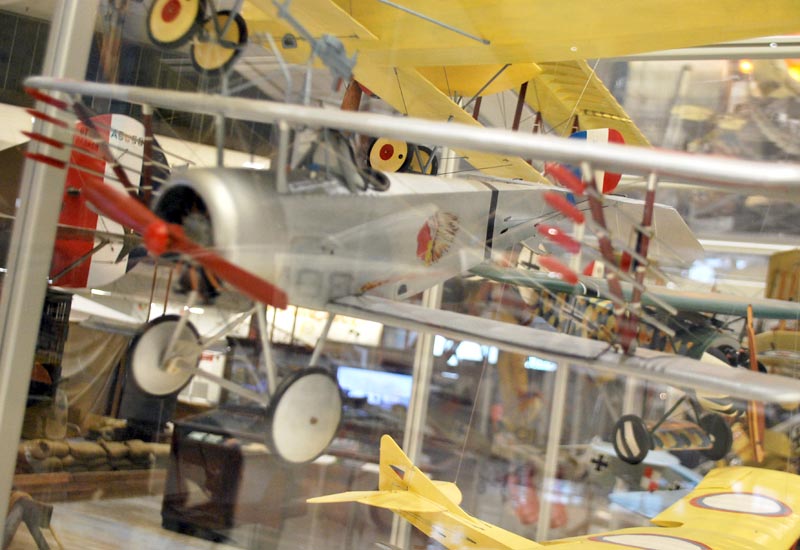
Pic of the Nieuport 11 (Bebe)
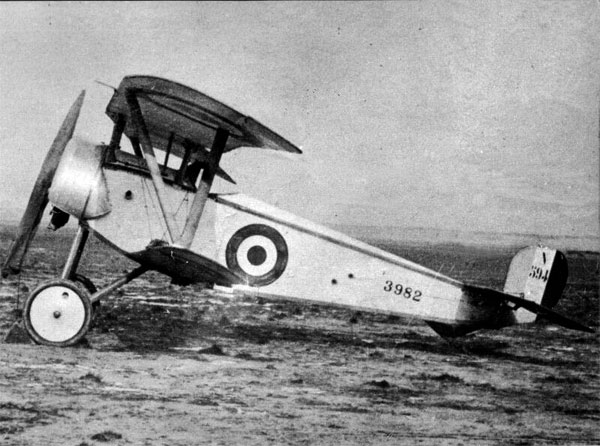
Image of the Nieuport 11 (Bebe)
View All Images (5)

Specifications for the
Nieuport 11 (Bebe)
Fighting Scout


Country of Origin: France
Manufacturer: Societe Anonyme des Etablissements Nieuport - France / Macchi - Italy
Initial Year of Service: 1915
Production: 7,200


Focus Model: Nieuport 11 (Bebe)
Crew: 1


Length: 19.03ft (5.8m)
Width: 24.77ft (7.55m)
Height: 8.04ft (2.45m)
Weight (Empty): 758lbs (344kg)
Weight (MTOW): 1,213lbs (550kg)


Powerplant: 1 x Le Rhône 9C 9-cylinder air-cooled rotary engine generating 80 horsepower.


Maximum Speed: 97mph (156kmh; 84kts)
Maximum Range: 205miles (330km)
Service Ceiling: 15,092ft (4,600m; 2.9miles)
Rate-of-Climb: 660 feet per minute (201m/min)


Hardpoints: 8
Armament Suite:
STANDARD:
1 x 7.7mm Lewis or Hotchkiss machine gun in upper wing.

OPTIONAL:
8 x La Prieur anti-balloon Rockets fitted alongside the V-type struts.


Variants:
Nieport 10 - Two-Seat Biplane Fighter Design on which the smaller Nieuport 11 is based on.


Nieport 11 C1 - Official Designation

Nieport 11 "Bebe" - Unofficial Base Series Designation; based on the larger Nie.10 model.

Nieuport 16 - "Improved" 11 Model; fitted with Le Rhone 9J rotary piston engine of 110 horsepower; appearing in 1916.

Nieport 17 C1 - "Improved" 16 Model with larger engine and better performance.

Nieuport 1100 - Italian license-production by Macchi; 646 examples produced.


Operators: Belgium; Colombia; Czechoslovakia; France; Italy; Netherlands; Romania; Russia; Serbia; Siam; Ukraine; United Kingdom; Yugoslavia

ALL AIRCRAFT CATEGORIES

BY DECADE:


1900 to 1909
1910 to 1919
1920 to 1929
1930 to 1939
1940 to 1949
1950 to 1959
1960 to 1969
1970 to 1979
1980 to 1989
1990 to 1999
2000 to 2009
2010 to 2019
2020 to 2029
VIEW ALL
Compare Aircraft


BY TYPE:


Anti-Submarine Warfare (ASW)
Attack Helicopters
Bomber Aircraft
Medium Bombers
Heavy Bombers
Close-Air Support (CAS)
Commercial Aircraft
Dive Bombers
Electronic Warfare Aircraft (EWA)
Experimental / X-Planes
Fighter Aircraft
Floatplane Aircraft
Flying Boat Aircraft
Aerial Refueling Tankers
Helicopters (ALL)
Interceptor Aircraft
Multi-Role Aircraft
Navy Carrier Aircraft
Night Fighters
Reconnaissance / Scout
Search & Rescue (SAR)
Scout Helicopters
Special Purpose
Torpedo Bombers
Trainer Aircraft
Transport Aircraft
Transport Helicopters
Unmanned Aerial Vehicles (UAVs)
Unmanned Combat Air Vehicles (UCAVs)


COLLECTIONS:


4th Generation Fighter Aircraft
5th Generation Fighter Aircraft
US X-Planes
Classic US Warbirds
French Military Helicopters
Grumman "Cats"
Howard Hughes Aircraft
Indian Air Force
Israeli Air Force
Libyan Aircraft
Modern Chinese Aircraft
Modern Chinese Fighters
Modern Military Aircraft
Modern North Korean Aircraft
Modern Trainer Aircraft
Modern US Aircraft
Mikoyan Aircraft
Sukhoi Aircraft
Syrian Aircraft
Top 10 Fighter Aircraft of All Time


AIRCRAFT BY CONFLICT:


Arab-Israeli War (1948)
Cuban Missile Crisis (1959-1962)
Falklands War (1982)
Indo-Pak War (1965, 1971)
Iran-Iraq War (1980-1988)
Lebanon War (1982)
Operation Allied Force (1999)
Operation Desert Storm (1991)
Six Day War (1967)
Spanish Civil War (1936)
Soviet-Afghan War (1979-1989)
Yom Kippur War (1973)


MISCELLANEOUS:


Aircraft Cockpits
Aircraft Manufacturers List
Aircraft Timeline

WORLD WAR 2:


1939 Aircraft
1940 Aircraft
1941 Aircraft
1942 Aircraft
1943 Aircraft
1944 Aircraft
1945 Aircraft
1946 Aircraft
Australian Aircraft
Battle of Britain Aircraft
Bombers
Four-Engine Bombers
British Aircraft
British Bombers
British Transports
Dive Bombers
Canadian Aircraft
Fighters
Chinese Aircraft
French Aircraft
German Aircraft
German Fighters
German Flying Boats
German Jets
Secret Weapons of the Luftwaffe
Italian Aircraft
Imperial Japanese Aircraft
Imperial Japanese Fighters
Mitsubishi Bombers
Navy Aircraft
Pearl Harbor
Polish Aircraft
Romanian Aircraft
US Aircraft
US Bombers
US Navy Aircraft
Soviet Aircraft
Torpedo Bombers
Transport Aircraft
Tuskegee Airmen Aircraft
W.A.S.P. Aircraft
WW2 Aircraft Ranked by Speed
VIEW ALL


WORLD WAR 1:


1914 Aircraft
1915 Aircraft
1916 Aircraft
1917 Aircraft
1918 Aircraft
Aircraft Timeline
Austro-Hungarian Aircraft
Bomber Aircraft
British Aircraft
Fighters
Flying Boats
French Aircraft
Imperial German Aircraft
Italian Aircraft
Scout Aircraft
Russian Empire Aircraft
US Aircraft
WW1 Aircraft Ranked by Speed
VIEW ALL


KOREAN WAR:


Australian Aircraft
Korean War Aces
Korean War Jets
North Korean Aircraft
US Military Aircraft
VIEW ALL


VIETNAM WAR:


Helicopters
North Vietnam Air Force
US Airpower
VIEW ALL


COLD WAR:


1950s French Aircraft
British V-Bombers
Cold War Bombers
Soviet Aircraft
Soviet Bombers
Soviet Interceptors
Soviet Helicopters
Strategic Air Command
US Aircraft
US Bombers
US Interceptors
VIEW ALL

Site Disclaimer | Privacy Policy | Site Map | MF Origins


©2013 www.MilitaryFactory.com • Content ©2003-2013 MilitaryFactory.com • All Rights Reserved • Site Contact Email: militaryfactory at gmail dot com. The "Military Factory" name and MilitaryFactory.com logo are registered ® trademarks and protected by all applicable domestic and international intellectual property laws.


Top MF Stuff: 2013 Military Pay Scale | Military Ranks | WW2 Weapons | Sniper Rifles | Kts to Mph | WW1 Aircraft | Automatic Rifles | Aircraft Cockpits | Vietnam War Weapons | Main Battle Tanks | Submachine Guns | Shotguns | French Military Victories


Most photographic images appearing on this site are courtesy of the United States Department of Defense and are approved for public use. Other images acquired through the public domain. Digital art work courtesy of Dan Alex. Business Consulting by Kyle Williams. Material presented throughout this website is for historical and entertainment value and should not to be construed as usable for hardware restoration, maintenance or general operation. Please consult manufacturers for such information.


eXTReMe Tracker