Military Factory
Military Pay Chart
Global Firepower
Military Industrial Complex
Second World War
Home
Military Pay Scale
Military Ranks
Small Arms
Aircraft
Land Systems
Navy
Education
Military Factory Facebook Logo
flag of United States

Grumman / Northrop Grumman C-2 Greyhound Carrier-based Cargo Aircraft (1967)

Authored By Staff Writer | Last Updated: 11/5/2012

The C-2 Greyhound transport was developed from the carrier-based E-2 Hawkeye Airborne Early Warning aircraft.

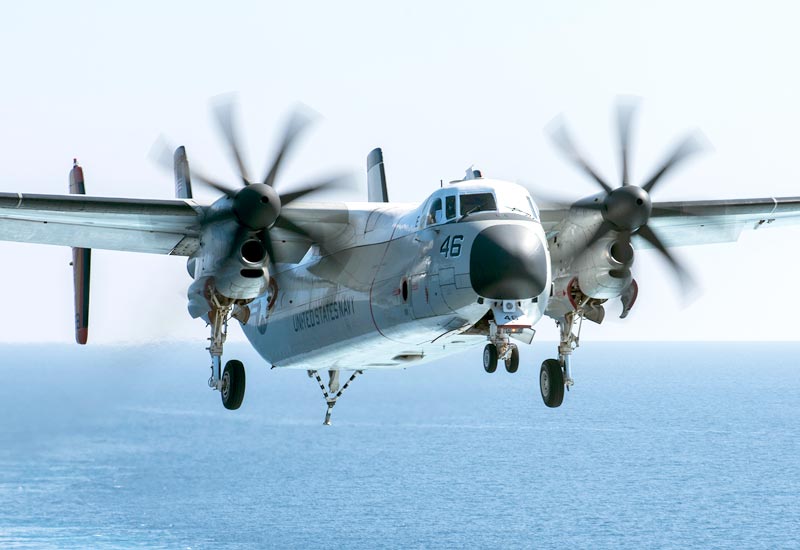
The Grumman C-2 Greyhound was developed from the successful Grumman E-2 Hawkeye. Whereas the latter was a dedicated carrier-based Airborne Early Warning platform, the Greyhound was evolved into a carrier-based transport featuring a proper role classification of "Carrier Onboard Delivery" or COD. The Greyhound has proven an invaluable addition to US carrier operations across the world, being able to capably shuttle personnel, supplies and spare parts from land-bases to carriers at sea with outstanding turn-around times. Greyhounds served in Operation Desert Storm and continue to support ongoing US Navy operations in Operation Enduring Freedom. Some 39 C-2(R) models remain in active service. The C-2 Greyhound replaced the similar Grumman C-1 Traders in the same carrier-based role. C-1 Traders were twin piston-engine transports developed from the Grumman S-2 Tracker and appeared in 1952, operating until 1988.

The Greyhound prototype achieved first flight in 1964 while C-2A production began in 1965, lasting until 1968. A modernization program brought existing Greyhounds up to speed in 1973. This was followed by a second production batch beginning in 1984 and consisting of the improved C-2A(R) ("R" for "Reprocured") models and were ordered to replace original Greyhounds in service. The C-2A(R) was essentially the same Greyhound aircraft of old with the exception that these new production models fitted an updated avionic package and airframe refinements throughout in an effort to bring the old girl up to modern status. With the arrival of the C-2A(R), original C-2A systems were gradually removed from service by 1987. Production of C-2A(R) models lasted from 1985 through 1989.

Design of the Greyhound sported many of the features that characterized the E-2 Hawkeye series. The Greyhound retained the identifiable four-fin tail assembly and the straight, high-wing monoplanes. Wing systems were foldable for improved carrier storage by "twisting" down and then folding towards the empennage, just outboard of each engine nacelle. As in the Hawkeye, engines on the Greyhound are mounted under each wing, fitted into streamlined nacelles. Each engine - Allison T56-A-425 turboprops of 4,800 shaft horsepower - the same engines fitted to the Hawkeye - were fitted with four-bladed Hamilton-Standard constant-speed propellers. If there were any differentiating factors between the two aircraft (not taking into account the Hawkeye's obvious fuselage-mounted radome) it was in the Greyhound's stout fuselage and shortened snub nose. The Greyhound utilized a conventional fully-retractable tricycle undercarriage with main gears fitted to each engine nacelle and a nose wheel at the forward-most portion of the fuselage. When at rest, the Greyhound took on a noticeably low profile, useful for the loading and unloading process. A cargo door was fitted to the rear of the fuselage as was an onboard powered winch to help with the heavy stuff. The Greyhound was also cleared for airdrop service actions involving either personnel or cargo as required.

Performance from the Allison powerplants netted a top speed of 345 miles-per-hour along with a cruise speed upwards of 289 miles-per-hour. A range of 1,496 miles was possible as was a service ceiling of up to 33,500 feet with a rate-of-climb of 2,610 feet-per-minute. Payload limitation was listed at up to 10,000lbs consisting of either passengers or cargo. In the former, the Greyhound could seat up to 26 personnel or 12 medical litters as needed. Standard operational crew were two pilots and two aircrew personnel.

Production of this fine transport aircraft was limited to just 58 examples, costing the American tax payer at least $38.96 million dollars per unit. The United States Navy remains the sole operator of the C-2 Greyhound system and, as of this writing, current service Greyhounds have been entered into a "Critical Life Extension Program", otherwise known as "SLEP" - an effort to once again increase their service lives as the United States Navy admits no plans to replace the type.

UPDATE: November 2012 - A modified, modernized C-2 Greyhound is expected to square-off against a Bell Boeing V-22 Osprey tilt-rotor helicopter for the future of Carrier Onboard Delivery (COD) operations of the United States Navy. Though both types hold inherent benefits and drawbacks, though the selection of the latter could very well change the scope of USN operations at sea with its STOVL capabilities.
Text ©2003-2013 www.MilitaryFactory.com • All Rights Reserved • No Reproduction Permitted
MilitaryFactory.com does NOT sell equipment/weaponry. Material presented throughout this website is for historical and entertainment value and should not to be construed as usable for hardware restoration, maintenance or general operation. Please consult manufacturers for such information. Our disclaimer. Email corrections / Comments to MilitaryFactory at Gmail dot com.
Picture of Grumman / Northrop Grumman C-2 Greyhound
View All Images (1)

Specifications for the
Grumman / Northrop Grumman C-2 Greyhound
Carrier-based Cargo Aircraft


Country of Origin: United States
Manufacturer: Grumman / Northrop Grumman - USA
Initial Year of Service: 1967
Production: 58


Focus Model: Grumman / Northrop Grumman C-2A Greyhound
Crew: 4 + 26


Length: 56.76ft (17.3m)
Width: 80.71ft (24.60m)
Height: 15.91ft (4.85m)
Weight (Empty): 33,753lbs (15,310kg)
Weight (MTOW): 49,395lbs (22,405kg)


Powerplant: 2 x Allison T56-A-425 turboprop engines delivering up to 4,800shp each.


Maximum Speed: 331mph (533kmh; 288kts)
Maximum Range: 1,491miles (2,400km)
Service Ceiling: 33,497ft (10,210m; 6.3miles)
Rate-of-Climb: 2,610 feet per minute (796m/min)


Hardpoints: 0
Armament Suite:
None.


Variants:
C-2A - Initial Production Model Designation; 19 examples produced.


C-2A(R) - Reprocured C-2A Models; 39 examples produced.


Operators:
United States

ALL AIRCRAFT CATEGORIES

BY DECADE:


1900 to 1909
1910 to 1919
1920 to 1929
1930 to 1939
1940 to 1949
1950 to 1959
1960 to 1969
1970 to 1979
1980 to 1989
1990 to 1999
2000 to 2009
2010 to 2019
2020 to 2029
VIEW ALL
Compare Aircraft


BY TYPE:


Anti-Submarine Warfare (ASW)
Attack Helicopters
Bomber Aircraft
Medium Bombers
Heavy Bombers
Close-Air Support (CAS)
Commercial Aircraft
Dive Bombers
Electronic Warfare Aircraft (EWA)
Experimental / X-Planes
Fighter Aircraft
Floatplane Aircraft
Flying Boat Aircraft
Aerial Refueling Tankers
Helicopters (ALL)
Interceptor Aircraft
Multi-Role Aircraft
Navy Carrier Aircraft
Night Fighters
Reconnaissance / Scout
Search & Rescue (SAR)
Scout Helicopters
Special Purpose
Torpedo Bombers
Trainer Aircraft
Transport Aircraft
Transport Helicopters
Unmanned Aerial Vehicles (UAVs)
Unmanned Combat Air Vehicles (UCAVs)


COLLECTIONS:


4th Generation Fighter Aircraft
5th Generation Fighter Aircraft
US X-Planes
Classic US Warbirds
French Military Helicopters
Grumman "Cats"
Howard Hughes Aircraft
Indian Air Force
Israeli Air Force
Libyan Aircraft
Modern Chinese Aircraft
Modern Chinese Fighters
Modern Military Aircraft
Modern North Korean Aircraft
Modern Trainer Aircraft
Modern US Aircraft
Mikoyan Aircraft
Sukhoi Aircraft
Syrian Aircraft
Top 10 Fighter Aircraft of All Time


AIRCRAFT BY CONFLICT:


Arab-Israeli War (1948)
Cuban Missile Crisis (1959-1962)
Falklands War (1982)
Indo-Pak War (1965, 1971)
Iran-Iraq War (1980-1988)
Lebanon War (1982)
Operation Allied Force (1999)
Operation Desert Storm (1991)
Six Day War (1967)
Spanish Civil War (1936)
Soviet-Afghan War (1979-1989)
Yom Kippur War (1973)


MISCELLANEOUS:


Aircraft Cockpits
Aircraft Manufacturers List
Aircraft Production
Aircraft Timeline

WORLD WAR 2:


1939 Aircraft
1940 Aircraft
1941 Aircraft
1942 Aircraft
1943 Aircraft
1944 Aircraft
1945 Aircraft
1946 Aircraft
Australian Aircraft
Battle of Britain Aircraft
Bombers
Four-Engine Bombers
British Aircraft
British Bombers
British Transports
Dive Bombers
Canadian Aircraft
Fighters
Chinese Aircraft
French Aircraft
German Aircraft
German Fighters
German Flying Boats
German Jets
Secret Weapons of the Luftwaffe
Italian Aircraft
Imperial Japanese Aircraft
Imperial Japanese Fighters
Mitsubishi Bombers
Navy Aircraft
Pearl Harbor
Polish Aircraft
Romanian Aircraft
US Aircraft
US Bombers
US Navy Aircraft
Soviet Aircraft
Torpedo Bombers
Trainer Aircraft
Transport Aircraft
Tuskegee Airmen Aircraft
W.A.S.P. Aircraft
WW2 Aircraft Ranked by Speed
VIEW ALL


WORLD WAR 1:


1914 Aircraft
1915 Aircraft
1916 Aircraft
1917 Aircraft
1918 Aircraft
Aircraft Timeline
Austro-Hungarian Aircraft
Bomber Aircraft
British Aircraft
Fighters
Flying Boats
French Aircraft
Imperial German Aircraft
Italian Aircraft
Scout Aircraft
Russian Empire Aircraft
US Aircraft
WW1 Aircraft Ranked by Speed
VIEW ALL


KOREAN WAR:


Australian Aircraft
Korean War Aces
Korean War Jets
North Korean Aircraft
US Military Aircraft
VIEW ALL


VIETNAM WAR:


Helicopters (ALL)
Transport Helicopters
North Vietnam Air Force
US Airpower
VIEW ALL


COLD WAR:


1950s French Aircraft
British V-Bombers
Cold War Bombers
Soviet Aircraft
Soviet Bombers
Soviet Interceptors
Soviet Helicopters
Strategic Air Command
US Aircraft
US Bombers
US Interceptors
VIEW ALL

Site Disclaimer | Privacy Policy | Site Map | MF Origins


©2013 www.MilitaryFactory.com • Content ©2003-2013 MilitaryFactory.com • All Rights Reserved • Site Contact Email: militaryfactory at gmail dot com. The "Military Factory" name and MilitaryFactory.com logo are registered ® trademarks and protected by all applicable domestic and international intellectual property laws.


Top MF Stuff: 2013 Military Pay Scale | Military Ranks | WW2 Weapons | Sniper Rifles | Kts to Mph | WW1 Aircraft | Automatic Rifles | Aircraft Cockpits | Vietnam War Weapons | Main Battle Tanks | Submachine Guns | Shotguns | French Military Victories


Most photographic images appearing on this site are courtesy of the United States Department of Defense and are approved for public use. Other images acquired through the public domain. Digital art work courtesy of Dan Alex. Business Consulting by Kyle Williams. Material presented throughout this website is for historical and entertainment value and should not to be construed as usable for hardware restoration, maintenance or general operation. Please consult manufacturers for such information.


eXTReMe Tracker