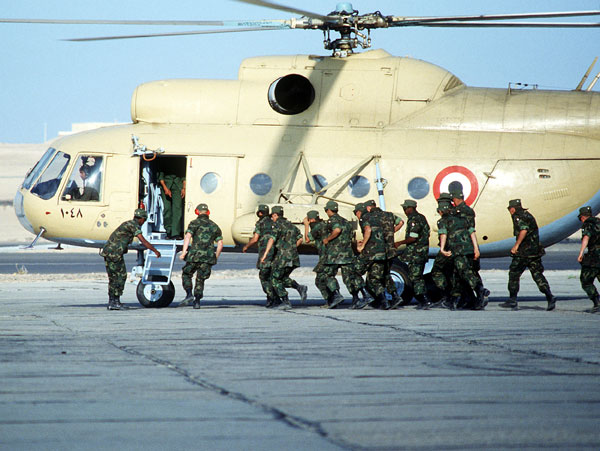
Numbering well over 12,000 production examples, the Mil Mi-8 (NATO reporting name of "Hip") can be viewed as one of the most successful helicopter designs of all time. It has seen use as a passenger transport, troop transport, vip transport, reconnaissance, electronic warfare, assault, artillery spotter and airborne command post throughout its tenure with the various nations that have purchased the aircraft. Even today, the Mi-8 remains in use as an operational-level instrument in many of the air forces and army groups that have seen value in the type. As of this writing, production continues despite some 42 years since the first Mi-8 rolled off of the assembly lines at the Mil Moscow Helicopter Plant - then under the Soviet banner.
The Mi-8 was developed as a replacement for the Mi-4 "Hound", a piston-engined transport helicopter appearing in 1953 that could seat up to fourteen personnel. Utilizing some of the successful internal workings of the Mi-4, the new Mil design featured a single Soloviev turboshaft engine of 2,700 shaft horsepower mated to an all-new enlarged fuselage. The prototype took on the name of Mi-8 ("Hip-A") and achieved first flight on July 9th, 1961. Follow-up developmental testing soon revealed the design to lack in power and, as such, the single engine idea was dropped in favor of a twin-engined design featuring two Isotov TV2 turboshaft engines. A five-blade main rotor was also used in this revision which produced the second prototype, first flying on September 17th, 1962. Minor revisions followed and the Mi-8 was fully introduced in Soviet Air Force service sometime in 1967. The initial production versions all fell under the NATO designation of "Hip-C" and constituted the base militarized model and a civilian model (noted for its square windows instead of round). Since then, the Hip series has been expanded to include a plethora of upgraded and specially-designed versions.
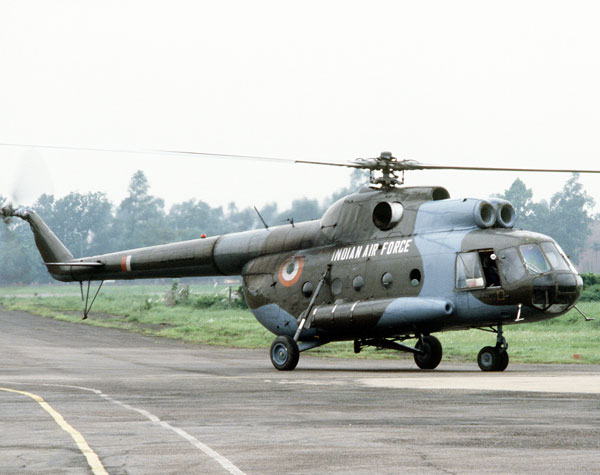
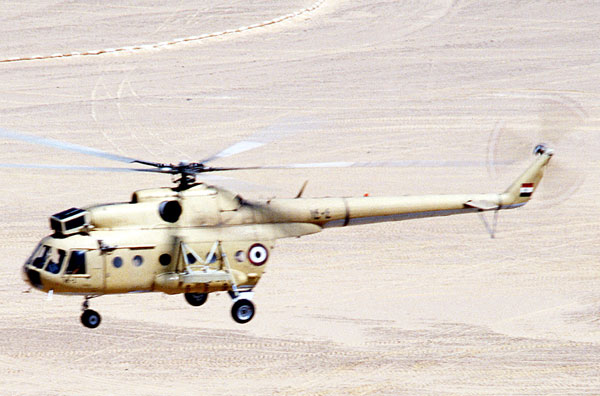
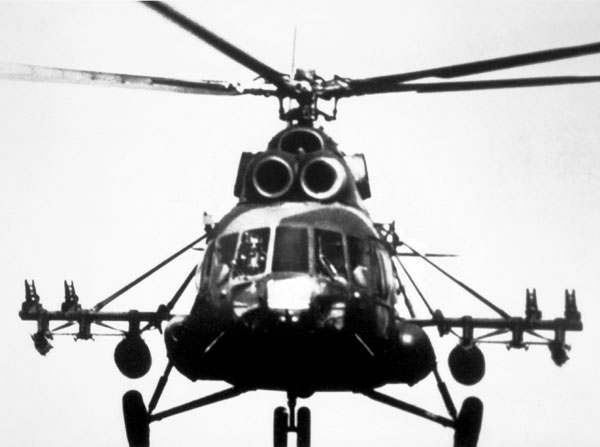
Externally, the Mi-8 maintains a most utilitarian look about her. She sports a low-slung front crew area with extensive glazing that offers up excellent views from the cockpit. Immediately to the cockpit's rear is the spacious crew cabin with side-mounted sliding doors. On most versions, the tricycle undercarriage is static (one such Hip offered a retractable undercarriage) which adds to the types distinct look. Two engines are mounted above and to the rear of the crew cabin area and power a large five-blade main rotor system. The empennage is also a distinct feature of this rotorcraft as it sits high in the design and sports a single vertical tail fin, horizontal plane and a three-blade tail rotor mounted to the starboard side (the similar Mi-17 mounts the tail rotor to port). A modified Hip system features a rear-loading ramp. The crew consists of a pilot, co-pilot and a loadmaster.
Performance specifications of the common Mil Mi-8T "Hip-C" model are provided for by the twin Klimov-brand TV3-117Mt turboshaft engines generating up to 1,950 shaft horsepower each. Speeds top off at 260 kilometers per hour while a maximum range of 280 miles is possible. A ferry range of 596 miles is noted as is a service ceiling of 14,765 feet.
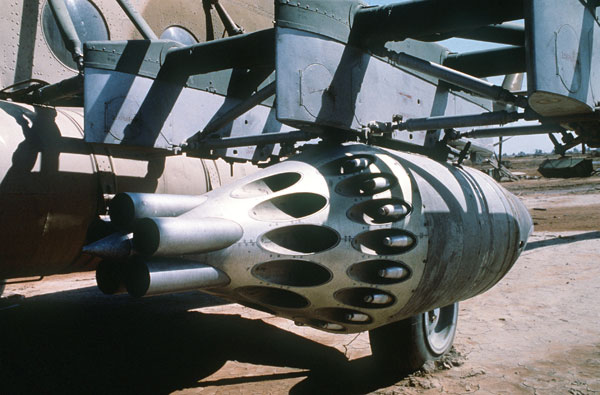
When armed, the Hip can sport a variety of mission-specific munitions. This includes the use of anti-tank missiles on outrigger pylons, rocket pods and even drop bombs. Self-defense can be handled by a side-mounted PK machine gun or equivalent. One particular Hip model mounted a 12.7mm machine gun in the nose for increased lethality. With the Hip being a multi-role type helicopter system capable of up to 3,300lbs of armament, it can mount virtually any approved ordnance package that the operator needs for a particular mission.
Operators of the Mi-8 cover the world over and appear in both militarized and civilian guises. Prominent military operators include Russia, Afghanistan, Armenia, Azerbaijan, Turkey, Bangladesh, Bulgaria, Croatia, the Czech Republic, Ethiopia, Georgia, Hungary, India, Iran and Serbia. Notable operators also include the United States, which featured the type with their 6th Special Operations Squadron for training purposes. The American-based contracting group, Blackwater USA, used the type as well.
Anyway one looks at it, the expansive reach of this system has ensured an excellent legacy for the machine. Despite newer and more technologically advanced systems since the inception of the Mi-8, the Hip continues to serve in many frontline units across the globe. It is expected that the helicopter will continued to do so for many more years to come.
December 2014 - The newest incarnation of the Mi-8 is in flight-testing as the Mi-171A2. This product features an all-glass cockpit, new rotors, and digitally-controlled Klimov VK2500PS-03 turboshaft engines of 2,400 shaft horsepower each. Avionics are by Radio-Electronic Technologies (KBO-17 series). A follow-up (second) prototype is also in the works.
July 2017 - Debuted at MAKS 2017 was the Mi-8AMTSh-VA production variant for Arctic environment service.
August 2020 - An improved version of the Mi-8AMT(Sh)-VN helicopter, the Mi-171Sh "Strom", was displayed at Army2020. Russian special forces are the prime early candidate for this mark.
Power & Performance Those special qualities that separate one aircraft design from another. Performance specifications presented assume optimal operating conditions for the Mil-Mi-8T (Hip-C) Multirole Medium-Lift Helicopter.
2 x Klimov TV3-117Mt turboshaft engines developing 1,950 shaft horsepower each and drivign a five-blade main rotor and three-blade tail rotor. Propulsion
162 mph 260 kph | 140 kts Max Speed
14,764 ft 4,500 m | 3 miles Service Ceiling
280 miles 450 km | 243 nm Operational Range
Structure The nose-to-tail, wingtip-to-wingtip physical qualities of the Mil-Mi-8T (Hip-C) Multirole Medium-Lift Helicopter.
3 (MANNED) Crew
59.6 ft 18.17 m O/A Length
69.8 ft (21.29 m) O/A Width
18.2 ft (5.56 m) O/A Height
16,006 lb (7,260 kg) Empty Weight
26,455 lb (12,000 kg) MTOW
Armament Available supported armament and special-mission equipment featured in the design of the Mil Mi-8 (Hip) Multirole Medium-Lift Helicopter provided across 6 hardpoints.
Up to 6 x Hardpoints for rocket pods, anti-tank missiles and bombs. Ordnance can include a combination of the following:
Variants Notable series variants as part of the Mil Mi-8 (Hip) family line.
V-8 ("Hip-A") - Single-Engine Prototype
V-8A - Twin-Engine Prototype; fitted with TV2-117 series turboshaft engines.
V-8AT - Mi-8T Utility Prototype
Mi-8 ("Hip-B") - Twin-Engine Prototype
Mi-8TG - Converted LPG gas-capable Mi-8
Mi-18 - Prototype based on Mi-8; lengthened fuselage; sliding starboard-side door added; retractable undercarriage.
Mi-8T ("Hip-C") - Initial quantitative production model; provision for 4 x UV-16-57 rocket pods; side-facing PK machine gun.
Mi-8TV - Armed version based on the Mi-8T model.
Mi-8TVK / Mi-8TB ("Hip-E") - Gunship Variant; provision for 6 x UV-32-57 rocket pods, 4 x AT-2 "Swatter" anti-tank missiles and 2 x 551lb drop bombs; KV-4 machine gun fitted to nose.
Mi-8TBK ("Hip-F") - Gunship Export Model; provision for 6 x Malyutka anti-tank missiles.
Mi-8IV ("Hip-G") - Utility transport; provision for 4 x UV-16-57 rocket pods; side-facing PK-machine gun.
Mi-9 - Export version of the Mi-8IV model.
Mi-8PPA ("Hip-K") - Export Electronic Warfare / Airborne Command Post; fitted with 6 antenna structures.
Mi-8PD - Polish Airborne Command Post
Mi-8PS / Mi-8TPS ("Hip-D") - Command Post / Communications Platform.
Mi-8SMV ("Hip-J") - Airborne Jamming Platform
Mi-8VPK / Mi-8VZPU ("Hip-D") - Airborne Communications Platform.
Mi-8AMT - Unarmed Transport
Mi-8AMT(Sh) - Based on the Mi-8MTV; fitted with electro-optic sight and radar system; armed or unarmed version.
Mi-8AMT(Sh)-VA - Arctic environment variant; debuted at MAKS 2017.
Mi-8AMT(Sh)-VN
Mi-8AV - Minelayer.
Mi-8VT - Mine Clearer.
Mi-8MB - MEDEVAC variant.
Mi-8MTO - Night Attack Model.
Mi-8R - Reconnaissance Platform.
Mi-8K - Reconnaissance / Artillery Observation Platform.
Mi-8PT - Staff Transport; improved communications suite.
Mi-8SKA - Photo-Reconnaissance Platform
Mi-8T(K) - Photo-Reconnaissance Platform
Mi-8TZ - Fuel Transport
Mi-8T ("Hip-C") - Utility Transport; seating for 24; fitted with 2 x Klimov TV2-117A turboshaft engines of 1,677 shaft horsepower each.
Mi-8P - Civilian Transport; seating for up to 32; in-flight galley and restroom facilities.
Mi-8S "Salon" - Civilian VIP Transport; seating for up to 11; in-flight galley and toilet facilities.
Mi-8M - Russian Service Designation for similar Mi-17 "Hip".
Mi-8MPS - Search and Rescue (SAR) Variant
Mi-8MA - Cold Weather Exploration Variant
Mi-8MT - Aerial Crane Variant
Mi-8MTV - Improved "hot and high" model; fitted with TV3-117VM turboshaft engines.
Mi-8AT - Civilian Transport; fitted with revised and improved TV2-117AG series turboshaft engines.
Mi-8ATS - Agricultural Sprayer
Mi-8TL - Accident Investigation Model
Mi-8TM - Transport Model; fitted with weather radar.
Mi-8TS - Hot Weather Variant
Mi-8VIP - Luxury VIP Transport; seating for up to 9.
Mi-8PA - Heavy Material Transport; single production examples used by Japan.
Mi-171 - Ulan-Ude export equivalent of the Mi-8AMT.
Mi-171A - Civilian market passenger transport
Mi-171A1 - Civilian market cargo transport
Mi-171A2 - Digitally-controlled Klimov VK-2500PS-03 engines of 2,400shp; new rotor; glass cockpit.
Mi-171C - Local Chinese-built variant of the Mi-171; under Sichuan Lantian Helicopter Company Ltd brand label; outfitted with twin radar configuration; single ramp door at rear.
Mi-171E - Fitted with VK-2500-03 series engines for extreme weather service.
Mi-171LL - Flying testbed for Mi-171 series
Mi-171M - Modernized Mi-171; standard operating crew of two (from three).
Mi-171S - Mi-171 completed with Western-minded avionics suite.
Mi-171Sh - Export variant of the Mi-8AMTSh
Mi-172 - Kazan export equivalent of the Mi-8AMT.
Mi-8MTV-3 - Kazan export equivalent of the Mi-8AMT.
Mi-17 ("Hip") - Developed from the Mi-8; known as the Mi-8M in Russian service; tail rotor mounted to port-side; fitted with TV3-117MT engines, larger rotor and transmission.
Mi-17MD - Kazan-developed Mi-8 with rear ramp and dolphin-nose housing radar.
Mi-17KF - Kazan-developed Mi-8 with Western-type electronics suite.
Mi-171Sh "Strom" - Enhanced variant of the Mi-8AMT(Sh)-VN; displayed at Army2020 in Russia.
Operators Global customers who have evaluated and/or operated the Mil Mi-8 (Hip). Nations are displayed by flag, each linked to their respective national aircraft listing.
Total Production: 12,500 Units Contractor(s): Mil Moscow Helicopter Plant - Soviet Union / Russian Helicopters - Russia
[ Afghanistan; Albania; Algeria; Angola; Anguilla; Armenia; Azerbaijan; Turkey; Belarus; Bangladesh; Bhutan; Bosnia and Herzegovina; Bulgaria; Burkina Faso; Canada; Cambodia; China; Colombia; Croatia; Cuba; Czech Republic; Djibouti; East Germany; Ecuador; Egypt; Estonia; Ethiopia; Finland; Germany; Georgia; Ghana; Guinea-Bissau; Hungary; Israel; India; Indonesia; Iran; Iraq; Kazakhstan; Kenya; Kyrgyzstan; Laos; Latvia; Libya; Lithuania; Macedonia; Madagascar; Malaysia; Montenegro; Maldives; Mali; Mexico; Moldova; Mongolia; Mozambique; Myanmar; Nepal; New Zealand; Nicaragua; North Korea; North Vietnam; Pakistan; Peru; Poland; Romania; Russia; Senegal; Serbia; Sierra Leone; Sri Lanka; Slovakia; Somalia; South Africa; South Sudan; Soviet Union; Sudan; Syria; Tajikistan; Turkmenistan; Uganda; Ukraine; Uzbekistan; United States; Vietnam; Venezuela; Yemen; Yugoslavia; Zambia ]
1 / 5
Image from the United States Department of Defense imagery database.
2 / 5
Image from the United States Department of Defense imagery database.
3 / 5
Image from the United States Department of Defense imagery database.
4 / 5
Image from the United States Department of Defense imagery database.
5 / 5
Image from the United States Department of Defense imagery database.
The "Military Factory" name and MilitaryFactory.com logo are registered ® U.S. trademarks protected by all applicable domestic and international intellectual property laws. All written content, illustrations, and photography are unique to this website (unless where indicated) and not for reuse/reproduction in any form. Material presented throughout this website is for historical and entertainment value only and should not to be construed as usable for hardware restoration, maintenance, or general operation. We do not sell any of the items showcased on this site. Please direct all other inquiries to militaryfactory AT gmail.com. No A.I. was used in the generation of this content.