Global Firepower     |     Military Industrial Complex     |     Second World War History
spacer
Military Factory Part of the
MF Network Logo
Network
spacer
Home 2010 Military Pay Scale Military Aircraft Small Arms Land Systems Navy Ships Military Education US Ranks WW2 Weapons US Military Medals
 
2010 Military Pay Scale Chart - for Army, Navy, Air Force and Marines Military Factory on Facebook
 
spacer
spacer
  By Decade
   · 1900 to 1909
   · 1910 to 1919
   · 1920 to 1929
   · 1930 to 1939
   · 1940 to 1949
   · 1950 to 1959
   · 1960 to 1969
   · 1970 to 1979
   · 1980 to 1989
   · 1990 to 1999
   · 2000 to 2009
   · 2010 to 2019
   · View All Aircraft
  By Type
   · Attack Helicopters
   · Bombers
   · Close-Air Support
   · Commercial
   · Dive Bombers
   · Electronic Warfare
   · Experimental
   · Fighters
   · Floatplanes
   · Flying Boats
   · Fuel Tankers
   · Helicopters
   · Interceptors
   · Multi-Role
   · Navy Aircraft
   · Night-Fighters
   · Recon Aircraft
   · Recon Helos
   · Special Purpose
   · Torpedo Bombers
   · Trainer Aircraft
   · Transport Aircraft
   · Transport Helos
   · UAVs
  World War 2
   · Full List
   · 1939
   · 1940
   · 1941
   · 1942
   · 1943
   · 1944
   · 1945
   · Australia
   · Battle of Britain
   · Bombers
   · Britain
   · British Bombers
   · Dive Bombers
   · Canada
   · Fighters
   · China
   · France
   · Germany
   · German Fighters
   · German Flying Boats
   · German Jets
   · Italy
   · Japan
   · Mitsubishi Bombers
   · Poland
   · USA Aircraft
   · USA Bombers
   · Romania
   · Soviet Union
   · Torpedo Bombers
   · WASP Aircraft
  World War 1
   · Full List
   · 1914
   · 1915
   · 1916
   · 1917
   · 1918
   · Aces
   · Austria-Hungary
   · Bombers
   · Britain
   · Fighters
   · France
   · Germany
   · Italy
   · Recon Aircraft
   · Russia
   · USA
  Korean War
   · Full List
   · Aces
   · Australia
   · USA
   · North Korea
  Vietnam War
   · Full List
   · United States
   · North Vietnam

Military Factory on Facebook


Military Factory > Military Aircraft > Boulton Paul Defiant
spacer

Boulton Paul Defiant

The Boulton Paul Defiant became a defensive night-fighter over Britian in World War 2.
By Staff Writer  Share
spacer
More Pictures Cockpit View 3 View Plan QuickGraphs StatsCentral

The inter-war years saw a vast shift to more modern and potent aircraft platforms. The Boulton Paul Defiant followed as only the RAF's third such monoplane aircraft and, amazingly enough, the Defiant also became the RAF's first four machine gun fighter. The defiant arose from the Air Ministry Specification F.9/35, which called for a twin-seat monoplane fighter with all of its armament concentrated in rear-mounted, hydraulically powered dorsal turret. For whatever reason, warplanners were high on the idea of a fighter aircraft sporting a battery of concentrated fire power in a powered turret system. The idea being that the aircraft could maneuver its way into enemy bomber formations and wreak havoc with its excellent armament at will, all the while being able to protect itself from pesky enemy fighters.

Boulton Paul already had some experience in producing such a concept by building some 59 of Hawker's Demon aircraft in the early-to-mid 1930s. These aircraft were fighter developments of the Hawker Hart and sported an enclosed gun turret at the rearward portion of the fuselage. The turrets were designed by Frazer-Nash and proved to be a sound solution, allowing for heavy armament and better gun sights to be fitted and work in conjunction with the gunner's tendencies. Early forms of the turret were manually powered and drafty but external power sources and enclosures of frame and glass were soon developed to evolve the design to its more traditional form.

The Defiant was an interesting concept to say the least. In many ways, it harkened back to the days of World War 1, where scout airplanes were being armed for self-defense while being sent out over the Front to spy on enemy ground movements. These early aircraft sported simple defensive armaments in a rear-placed cockpit, providing the rear gunner with an adequate field-of-fire from trailing enemy fighters. In practice, this concept worked but it is still interesting to compare that line of early-century thinking with developments in the inter-war years nonetheless.

The first of two Defiant prototypes went airborne on August 11th, 1937 with an order of 400 following. However, only three were actually in RAF hands by the outset of World War 2. Within time, deliveries eventually built up No 264 Squadron and made them the first operational Defiant group on December 8th, 1939. The aircraft and her aircrews would have to wait till May 12th, 1940 to sample their first taste of combat against the German Luftwaffe. Early results proved promising as the aircraft served up no fewer than 65 enemy air kills before the end of May 1940 thanks to its excellent armament load.

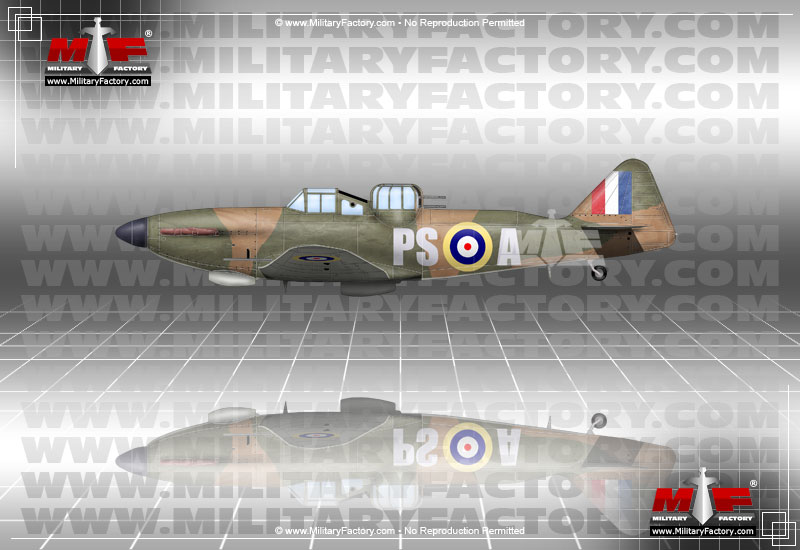
The bread and butter of the Defiant system lay in its hydraulically-powered rear turret. Unsuspecting enemy pilots, thinking the Defiant was susceptible from attacks from the rear, were greeted with a hail of hot lead from the 4 x 7.7mm (.303 caliber) Browning air-cooled machine guns. The machine guns were paired two to a side and the entire turret system could scan a 360-degree area above the aircraft. Visibility was somewhat hampered by the heavy framing around the glassy enclosure but in theory, the layout was deemed acceptable. Six-hundred rounds of 7.7mm ammunition were afforded each gun, making for a staggering total of 2,400 rounds available to the gunner. Bringing the guns to bear successfully on an enemy aircraft usually yielded favorable results to Defiant crews, that is, should an enemy fighter pilot be foolish enough to contend with the aircraft from the rear.

Despite these early successes, Luftwaffe crews eventually realized the limits of the Defiant design. The turret, despite its available firepower, proved to add substantial drag and weight to the limited Defiant airframe resulting in poor performance when compared to later Luftwaffe aerial implements. Performance was everything to a dog-fighting aircrew and the Defiant would not suffice in the role - at least not in the long term. Once it became common knowledge based on experience that the Defiant mounted no forward-facing defensive armament whatsoever, Luftwaffe crews made it their strategy to attack the aircraft from the front. Though the 4-gun armament of the Defiants could be brought to bear in the forward position, this was seldom the practice as protecting the aircraft's rear was grand priority for most Defiant crews. As expected, losses of the aircraft type began to mount to the point that the Defiant was pulled from daytime action in August of 1940.

All was not lost for the Defiant series however, as they were reinstituted back into action as converted night-fighters. Defiants were now were fielded with the new mark of Defiant NF.Mk I and were naturally based on the standard Mk I marks from earlier. The NF.Mk IA followed soon afterwards with the potent AI.Mk IV / VI interception radar systems for increased lethality in the dark of night. The British were already proving themselves masters with radar development and would utilize this expertise throughout its defensive parameter during the Battle of Britain. During the span of 1940 through 1941, the Defiant accounted for more enemy air kills than any other RAF aircraft could boast - an impressive statistic considering the RAF also had access to the durable Hurricanes and the excellent Spitfires. At its peak of use, no fewer than 13 RAF squadrons were fielding Defiants in the defensive role.

The Defiant Mk I sported a top speed of 304 miles per hour with a 404 mile range. The service ceiling was reported at approximately 30,350ft, making it comparable to other early forms of new monoplane fighters. Power was derived from a single Rolls-Royce brand Merlin III series liquid-cooled V12 piston engine of 1,030 horsepower. A total of 723 Mk I series fighters were produced.

The Defiant NF.Mk II followed the Mark I series into the fold. These were essentially improved versions of the previous base mark but were more dedicated platforms to fulfill the night-fighter role with differences including an increase to its vertical tail surface and the implementation of the AI Mk IV airborne interception radar. The Defiant NF.Mk II series sported specifications that were a bit different, with a top speed listed at 313 miles per hour and a service ceiling of 30,350 feet. Range was now increased to roughly a 465-mile range. Power was now derived from a single Rolls-Royce Merlin XX series piston engine of 1,280 horsepower. 210 total NF.Mk II models were produced.

Additional marks became the ASR.Mk I model series, these issued as air-sea rescue platforms fitted with dingies underside. The TT.Mk I's were nothing more than target tug conversion models of the Mk I series with some 150 converted for the role. The TT.Mk III were also target tug aircraft, though these were produced as 140 new-build systems sans the four-gun turret.

Despite its early successes and increasing losses to follow, the Defiant found a niche in the nightfighter role which suited it quite well. Advancements in night time radar no doubt helped to extend the life of the platform, as did Britain's need for more defensive measures. The lack of front-facing armament no doubt was a terrible oversight in the design, but Boulton Paul engineers did what they could with what they knew for the time. In the end, the Boulton Paul Defiant became a memorable part of military aviation history in what could very well have been a rocky and forgettable tale if events had dictated otherwise. Sadly, only one complete Boulton Paul Defiant example exists, this being appropriately held by the Royal Air Force Museum in Hendon, London.

Text ©2003-2010 www.MilitaryFactory.com • All Rights Reserved • No Reproduction Without Permission • Corrections / Comments to MilitaryFactory at Gmail dot com

Last Revision: 2/17/2010


  Specifications for the Boulton Paul Defiant Mk II
Dimensions:
Length: 35.33ft (10.77m)
Width: 39.34ft (11.99m)
Height: 11.32ft (3.45m)

Performance: (About MACH)
Max Speed: 313mph (504kmh; 272kts)
Max Range: 465miles (748km)
Rate-of-Climb: 1,900ft/min (579m/min)
Service Ceiling: 30,348ft (9,250m; 5.7miles)

Structure:
Accommodation: 2
Hardpoints: 0
Empty Weight: 6,281lbs (2,849kg)
MTOW: 8,424lbs (3,821kg)

Powerplant:
Engine(s): 1 x Rolls-Royce Merlin XX piston engine generating 1,280hp.
Armament Suite:
4 x 7.7mm Browning machine guns in a hydraulically-powered rear turret.
 

  Pictures of the Boulton Paul Defiant
     
Picture of Boulton Paul Defiant
Picture of the Boulton Paul Defiant
     
View All 2 Images

More Pictures CompareX2 CompareX4 QuickGraphs StatsCentral


Compare and Contrast Military Aircraft Specifications

  Special Aircraft Collections

Aircraft by Conflict:
Arab-Israeli War (1948)
Falklands War
Indo-Pak War
Iran-Iraq War
Operation Allied Force
Operation Desert Storm
Six Day War
Spanish Civil War (1936)
Yom Kippur War

Special Collections:
1950s French Aircraft
American X-Planes
British V-Bombers
Classic US Warbirds
Grumman "Cats"
Indian Air Force
Israeli Air Force
Mikoyan-Gurevich
Modern Chinese Military Aircraft
Sukhoi Aircraft


Korean Air War:
Korean War Aircraft
Aces
Australia
United States
North Korea

Vietnam Air War:
Vietnam War Aircraft

Cold War
American Cold War Bombers
American Cold War Interceptors
Cold War Aircraft
United States
Soviet Union
Soviet Bombers of the Cold War
Soviet Helicopters of the Cold War
Soviet Interceptors of the Cold War

Modern Aircraft
Modern Military Aircraft
United States
Unmanned Aerial Vehicles

Miscellaneous
MiG-15 Versus Sabre
Top 10 Fighters of All Time
WW2 Aircraft Ranked by Speed
Aircraft Cockpits


  Recent Military Aircraft Additions
Thumbnail picture of the Focke-Wulf Ta 152
Focke-Wulf Ta 152
Thumbnail picture of the Republic XF-84H Thunderscreech
XF-84H Thunderscreech
Thumbnail picture of the HESA Shafaq
HESA Shafaq

  Contacting MilitaryFactory.com
We can only get better if you tell us how. You can contact MilitaryFactory.com at MilitaryFactory at gmail dot com (replace "at" with "@" and "dot with ".") with any questions, comments or corrections. We also accept related military imagery that you approve for us to use on our website. Keep in mind, however, that due to volume, we may not directly respond to your inquiry. Please add us to your list of non-blocked recipients!


  Aircraft Quick Profile:


Picture of the Boulton Paul Defiant
Image courtesy of Dan Alex.


View More Images

flag of United Kingdom
1937

Designation: Boulton Paul Defiant
Classification Type: Nightfighter
Contractor: Boulton Paul - UK

Country of Origin: United Kingdom
Production Total: 1,075

Operators: Australia; India; Canada; Poland; United Kingdom; United States

  Variants
P.82 - Prototype Fighter Designation; examples produced.

Mk I - Fitted with Rolls-Royce Merlin III engine of 1,030 horsepower; 723 examples produced.

NF.Mk I - MK I models converted to night-fighter role.

NF.Mk IA - NF.MK I models with AI.Mk IV / VI radar system.

ASR.Mk I - Air-Sea Rescue model fitted to carry dingy boats for role.

TT.Mk I - Target Tug Conversions of Mk I model series; 150 converted.

NF.Mk II - Nightfighter variant with improved Merlin XX powerplant of 1,280 horsepower; increased vertical tail surface; AI Mk IV airborne interception radar; 210 examples produced.

TT.Mk III - Target-Tug Aircraft; 140 new-builds; sans turret.

  Collections
  • Aircraft of the W.A.S.P.s
  • Sons of Empire - WW2 Aircraft of Japan
  • Aircraft of the Battle of Britain
  • X-Planes Throughout History
  • French Aircraft of World War 1
  • The German Luftwaffe in World War 2
  • Nightfighters - In a Class All Themselves
  • The Top Ten Fighters of All Time
  • Carrier "Born" Aircraft - Navy Mounts
  • If Boats Could Fly - Flying Boat Aircraft
  • World War 1 Aircraft Ranked by Speed
  • World War 2 Aircraft Ranked by Speed


  Recent Articles:
 
Little MF Logo Much Noise But Little Else Came From the Republic XF-84H Thunderscreech
spacer
Little MF Logo Tragic Giant - K-141 Kursk
spacer
Little MF Logo The Mighty Mo - Battleship for Life
spacer
Little MF Logo Upping the Ante - the Iranian HESA Shafaq Advanced Trainer
spacer
Little MF Logo The G3M Nell Left Many Terrified or Dead in Her Wake
spacer
Little MF Logo The Hawker Sea Hawk Quietly Made a Name for Itself
spacer
Little MF Logo The Ha-Go was a Top Light Tank During WW2


Site Disclaimer | Privacy Policy | Site Map | MF Origins

©2010 www.MilitaryFactory.com • Content ©2003-2010 MilitaryFactory.com • All Rights Reserved • Site Contact Email: militaryfactory at gmail dot com (replace "at" with "@" and "dot" with ".")

eXTReMe Tracker

Top MF Stuff: 2010 Military Pay Scale Chart | Military Ranks | World War 2 Weapons | Sniper Rifles | Conversion Calculators

Most photographic images appearing on this site are courtesy of the United States Department of Defense and are approved for public use. Other images acquired through the public domain. Digital art work courtesy of Dan Alex. Business Consulting by Kyle Williams

Material presented throughout this website is for historical and entertainment value and should not to be construed as usable for hardware restoration, maintenance or general operation. Please consult manufacturers for such information.