Global Firepower | Military Industrial Complex | Second World War History
Home | Military Pay Scale Chart | Aircraft | Infantry Weapons | Military Vehicles | Navy Ships | Military Education | French Military Victories | Military Ranks | WW2 Weapons
Military Factory Latest from Military Factory
Thumbnail picture of the Dardo infantry fighting vehicle
Dardo IFV
Thumbnail picture of the Supermarine Scimitar fighter
Supermarine Scimitar
Thumbnail picture of the Centauro B1 8x8 tank killer
Centauro 8x8
Thumbnail picture of the Novi Avion fighter
Novi Avion
Thumbnail picture of the FR F2 bolt-action sniper rifle
FR F2
Thumbnail picture of the Lebel Model 1886 bolt-action rifle
Lebel Model 1886
2009 Military Pay Scale Chart - for Army, Navy, Air Force and Marines
  BY DECADE
    · 1900 to 1909
    · 1910 to 1919
    · 1920 to 1929
    · 1930 to 1939
    · 1940 to 1949
    · 1950 to 1959
    · 1960 to 1969
    · 1970 to 1979
    · 1980 to 1989
    · 1990 to 1999
    · 2000 to 2009
    · 2010 to 2019
    · View All Aircraft
  BY TYPE
    · Attack Helicopters
    · Bombers
    · Close-Support
    · Commercial
    · Dive Bombers
    · Experimental
    · Fighters
    · Floatplanes
    · Flying Boats
    · Fuel Tankers
    · Helicopters
    · Interceptors
    · Multi-Role
    · Navy Aircraft
    · Night-Fighters
    · Recon Aircraft
    · Recon Helos
    · Special Purpose
    · Torpedo Bombers
    · Trainer Aircraft
    · Transport Aircraft
    · Transport Helos
    · UAVs
  WORLD WAR 2
    · Full List
    · 1939
    · 1940
    · 1941
    · 1942
    · 1943
    · 1944
    · 1945
    · Australia
    · Battle of Britain
    · Bombers
    · Britain
    · Dive Bombers
    · Canada
    · Fighters
    · China
    · France
    · Germany
    · German Fighters
    · German Jets
    · Italy
    · Japan
    · Mitsubishi Bombers
    · Poland
    · USA Aircraft
    · USA Bombers
    · Soviet Union
    · Torpedo Bombers
  WORLD WAR 1
    · Full List
    · 1914
    · 1915
    · 1916
    · 1917
    · 1918
    · Aces
    · Austria-Hungary
    · Bombers
    · Britain
    · Fighters
    · France
    · Germany
    · Italy
    · Recon Aircraft
    · Russia
    · USA
  KOREAN WAR
    · Full List
    · Aces
    · Australia
    · USA
    · North Korea
  VIETNAM WAR
    · Full List
    · United States
    · North Vietnam

Military Factory > Military Aircraft > Bell P-39 Airacobra
 
 
More Pictures Cockpit View 3 View Plan QuickGraphs StatsCentral

Bell P-39 Airacobra

Essentially a failed fighter design, the Bell P-39 Airacobra succeeded in the ground attack role.
By Staff Writer

Bookmark and Share

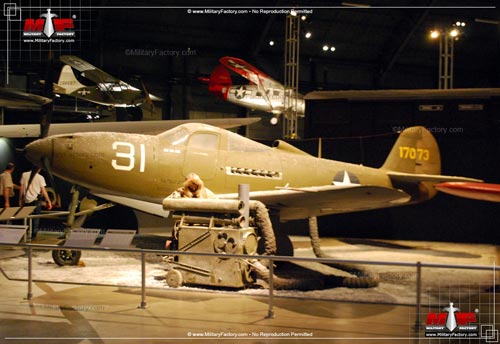
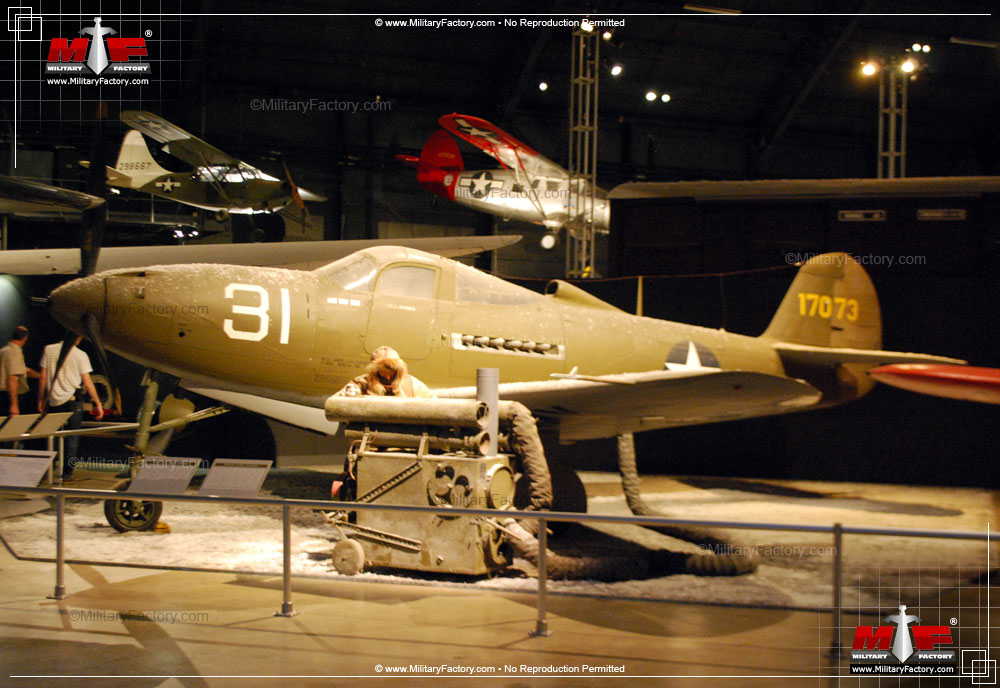
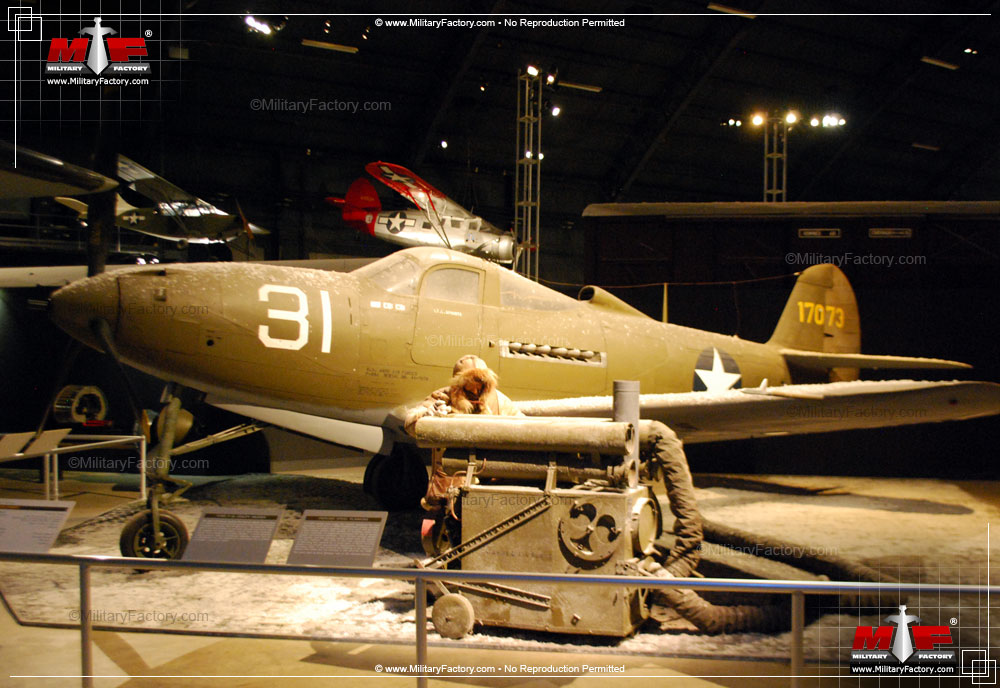
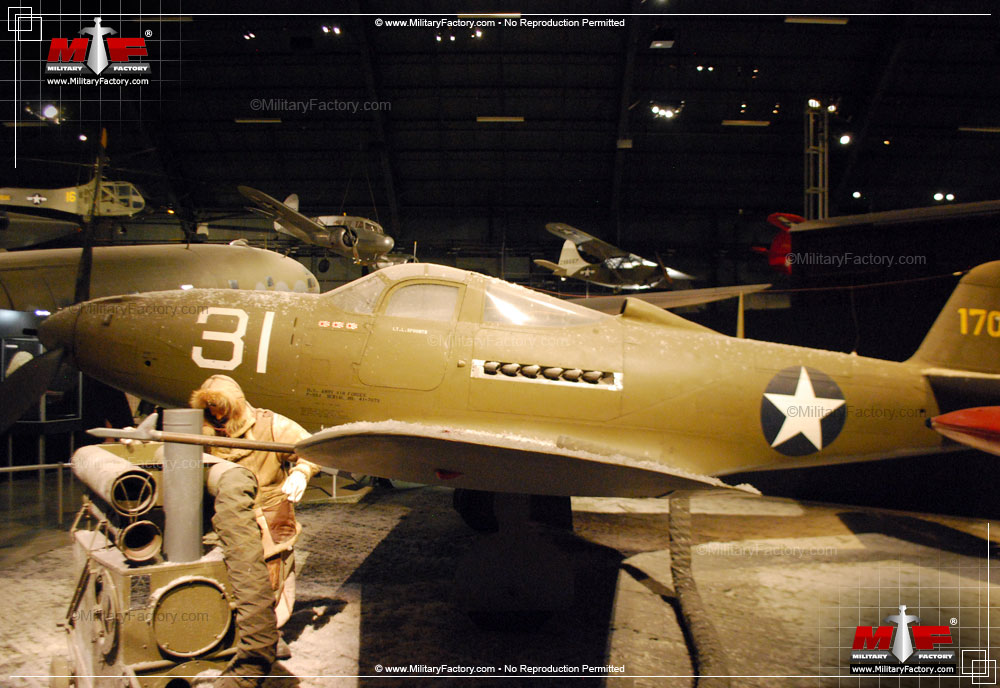
The Bell P-39 Airacobra is yet another in the long line of aircraft studies stemming from World War 2 in the "what-might-have been" category. The system had all the looks of a top performer, armament that could go head to head with any contemporary and a design philosophy that could have brought about a whole new era is aircraft engineering. Unfortunately for the aircraft, several key requirements effectively doomed the Airacobra as a subjective failure, never quite living up to expectations. The system served well, but not for its intended role of high performance fighter. Instead, the aircraft went on to be a steady performer in the low-level attack role (excelling in combat under 10,000 feet), was sent en masse to the Soviets via Lend-Lease and shunned altogether by the British, who found that the aircraft possessed none of the advertised capabilities as marketed by the Bell prototype.

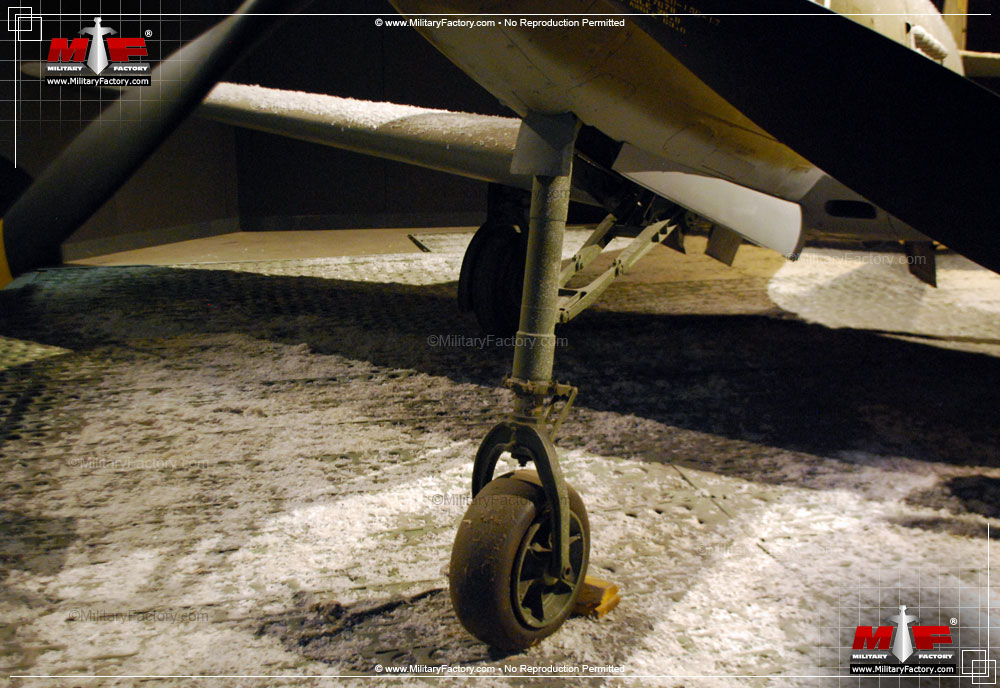
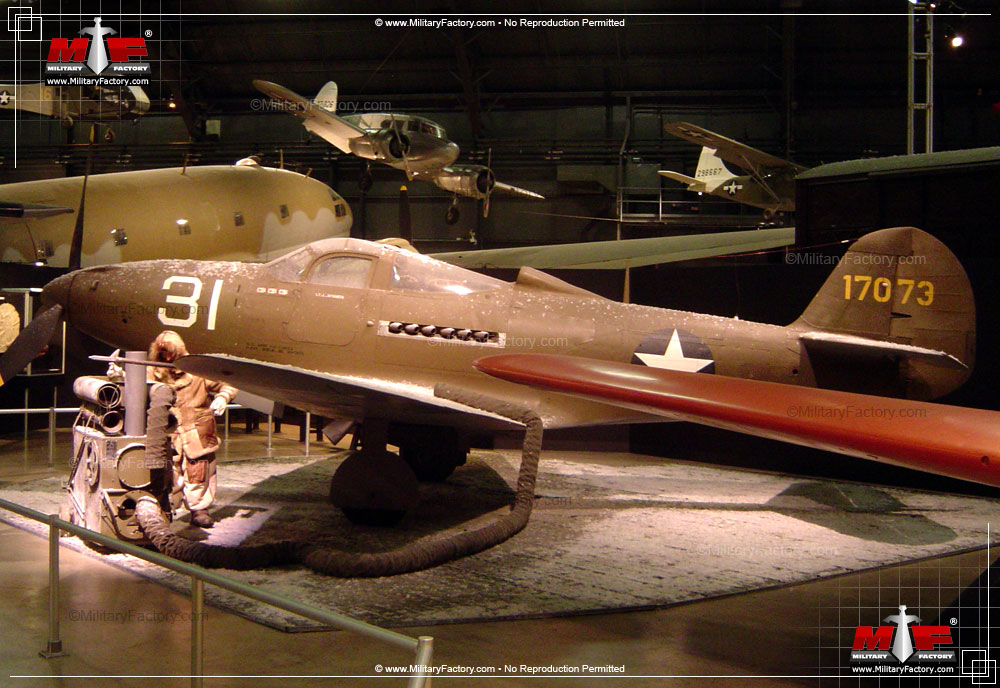
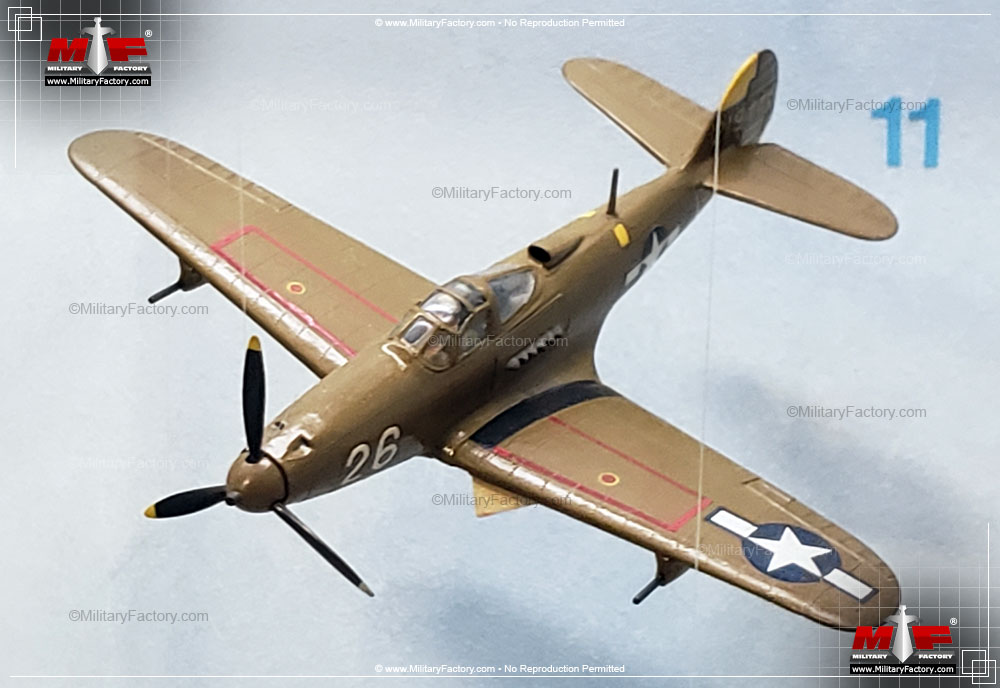
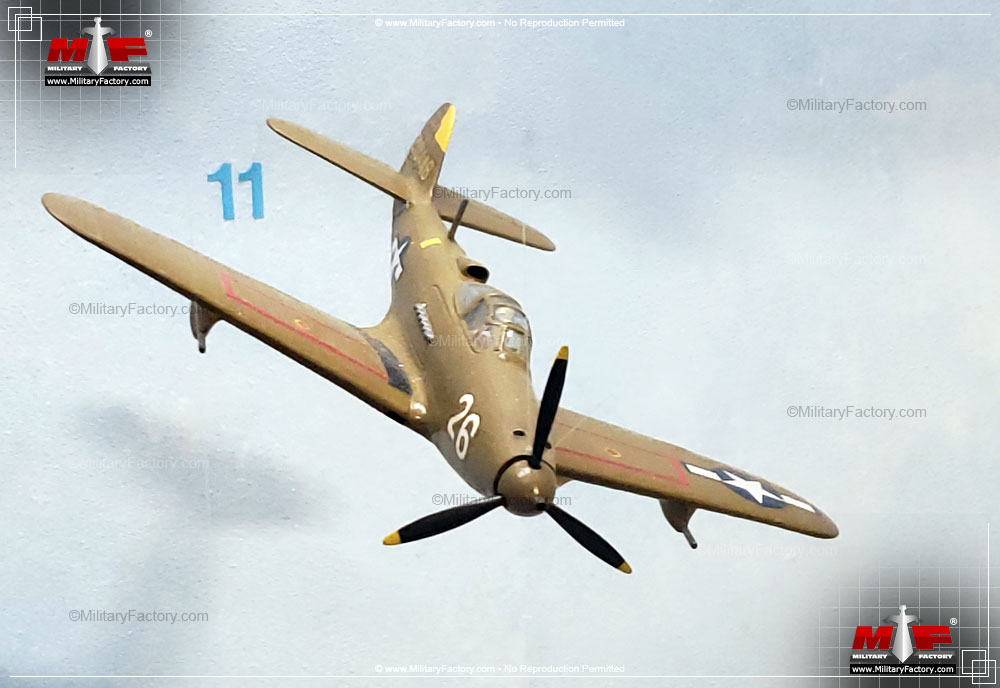
Generally a very pleasing aircraft to look at, the P-39 design came about at a time when streamlining shapes were just coming into their own. The P-39 was a vast departure from most aircraft being conceived of at the time and featured several elements that distinguished the type from her contemporaries. Chief among these was in the internal layout, with the Allison series engine mounted in the middle of the fuselage, just aft of the pilots cockpit. The engine ran an extended shaft through a center bearing underneath the pilots feet to the front fuselage section where the three-blade propeller and reduction gear was mounted. As a result of this engine placement, the engine had to be fed through intakes mounted on the fuselage. In its early form, this meant intakes added to the sides of the fuselage just aft of the cockpit. Other forms sported intakes in the wing roots and the most identifiable form saw the intake planted on the top of the fuselage. Wings were low-mounted monoplane types and the empennage features a traditional T-style arrangement with a single vertical fin. The P-39 also featured a powered tricycle landing gear system, a relatively new concept in the art of aircraft design as a whole.

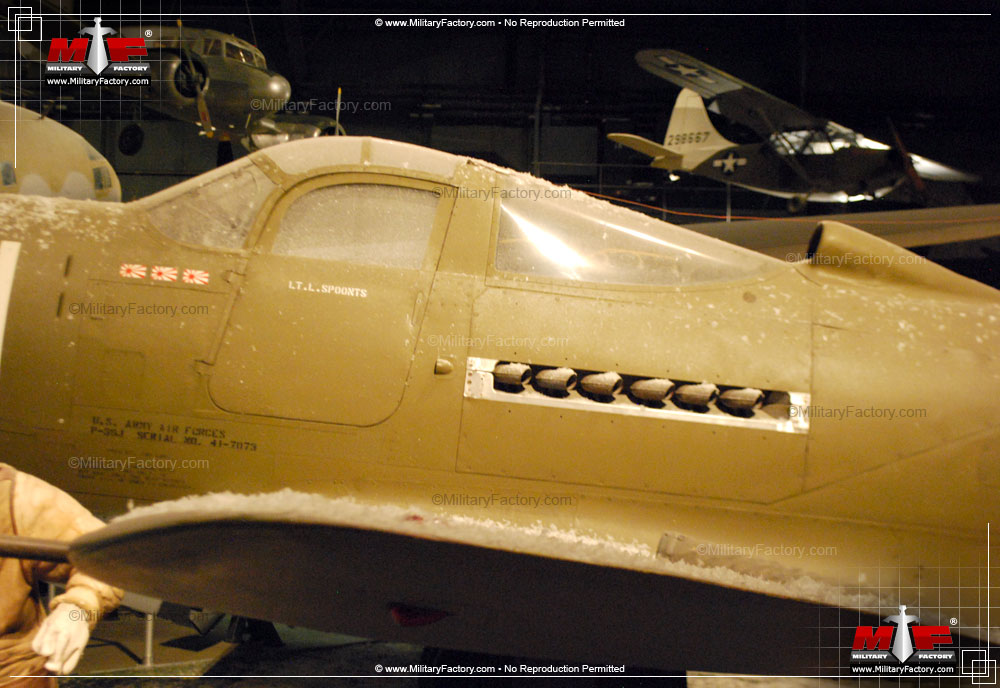
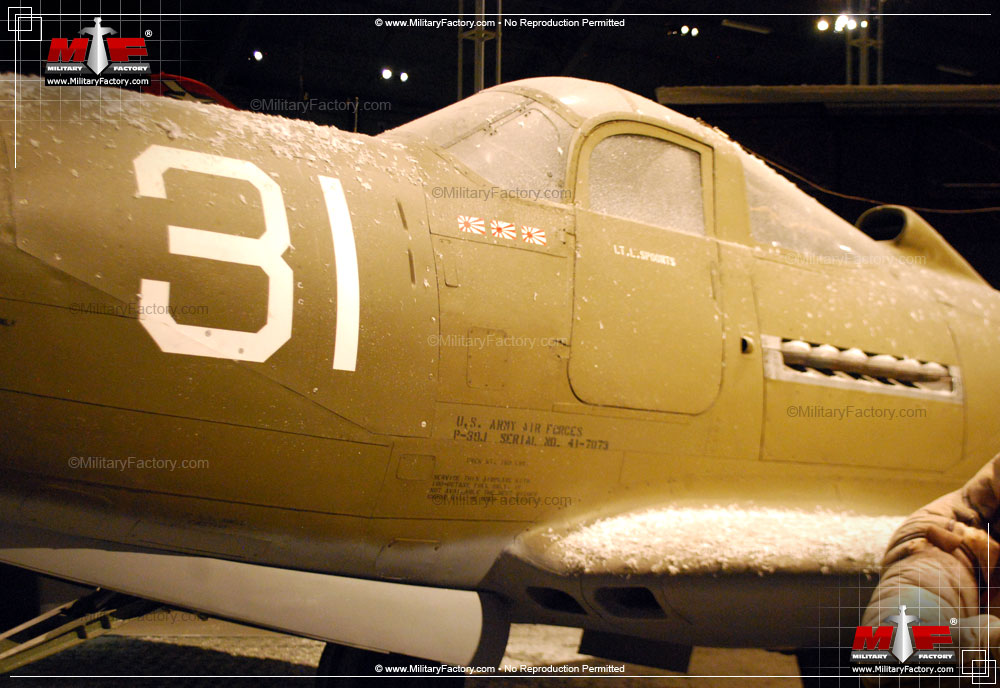
In what turns out to be effectively an early form of the "bubble" canopy, the Airacobra featured a complex canopy design which offered up unparallel vision over the entire design. The pilot sat in a very automotive-style cockpit that featured two swing doors on either side of his seat. The windows in these doors were fully retractable and done so through a car-like crank handle. Upon having to exit his aircraft in the event of damage or power loss, the pilot simply jettisoned the doors via lever and rolled out a side and off the wing. If enough time was allotted, he could even make his way to the wings edge and make a controlled jump.

Cockpit design was simple and similar in scope to the P-38 Lightning and P-40 Warhawk in most respects. Control levers were dominated by the throttle lever, easily the largest of the group. Most of the main control gauges were held in a center column running from knee-to-face height and offering up easy access. The throttle and other controls were held off to the lower left in a separate assembly that included the gun controls. Space-wise, the cockpit fit the build of a standard 5'8" pilot (standard for the time at least) and offered up limited comfort for sorties lasting several hours. Beyond that, however, many a veteran would curse the system's limited conveniences on long trips. Internally, nothing was spared in constructing a cockpit worthy of any pilots life. The cockpit featured air-tight sections to keep fumes from the nose-mounted armament out at forward and fumes from the engine from creeping in from the rear. All vital systems were held in this area of the aircraft, which itself featured rugged and sturdy construction practices that would become synonymous with Bell Aircraft for a time.

The Bell P-39 design came about at a time when the world was turning increasing hostile on both sides of the United States. Troubles in Europe were readily apparent with the political and military movements occurring in Germany and Italy. Expansionism by the Empire of Japan in Asia were another area of real concern and forced an internal evaluation of American military power and might as it stood. Systems then in service were found to be wholly inadequate for the new methods of war and attempts were no in motion at rectifying the critical situation. Enter Larry Bell, president of the Bell Aircraft Corporation.

If change was what the United States military was after, then change is what it found in this visionary. Bell had already made a splash on the aircraft design scene with their failed - yet incredibly interesting - first attempt with the Bell FM-1 "Airacuda". This "bomber-destroyer" was to have been the military answer as ultimate bomber interceptor with the most distinct design feature being the 37mm cannons mounted in wing engine nacelles along with a gunner to each cannon. Engines were of a pusher type (Allison brand) but the aircraft proved to be simply too heavy to be as effective as advertised. The aircraft did go on, however, to field an entire squadron before production ended.

In any case, development of the Airacuda (beginning the Bell tradition of naming convention featuring the word "air" in official designations) forced Bell's team to tackle the seemingly impossible. The experience garnered in the creation of the XFM-1 Airacuda was priceless and convinced the promising team that they could develop an aircraft for the US Army's new requirement - an interceptor. Besides the Curtiss P-36s and P-40 Warhawks and Seversky P-35s in service, the US Army had very little to go on in the way of tangling with Japan's best fighters and bombers. No aircraft to effectively seek out attacking bombers at night, not aircraft to threaten the new crop of Japanese fighter command and no aircraft to speak of to efficiently bomb or cannon ground targets in any way with much repeated success. The canvas was generally a blank one and Bell and his team went to work.

Bell's engineers took some new information to heart. First and foremost, armament of contemporary American fighters at the time was wholly inadequate for use against the new generation of bombers. Aircraft were still being fielded with a World War 1-style arrangement featuring just two rifle-caliber (7.62mm) machine guns. Bell engineers took a radical approach to arming their prime fighter design and made the centerpiece of the it the powerful - though slow-firing - Oldsmobile-brand 37mm cannons. This alone brought the new design leaps ahead of anything in service at the time. The 37mm cannon would be supplemented with heavy caliber machine guns for additional punch in the form of 12.7mm (.50 caliber) types mounted in the wings. The design crews optimism was not in question as such an aircraft would surely be reckoned with in any skies around the world but it did present several speed bumps in the thought process. A large caliber weapon as requested by the design team meant that there would have to be proper and adequate placement for the system somewhere in the fuselage. As a result, the P-39 was basically a design set around the position of this cannon - effectively being that the Airacobra was an aircraft designed around the primary armament.

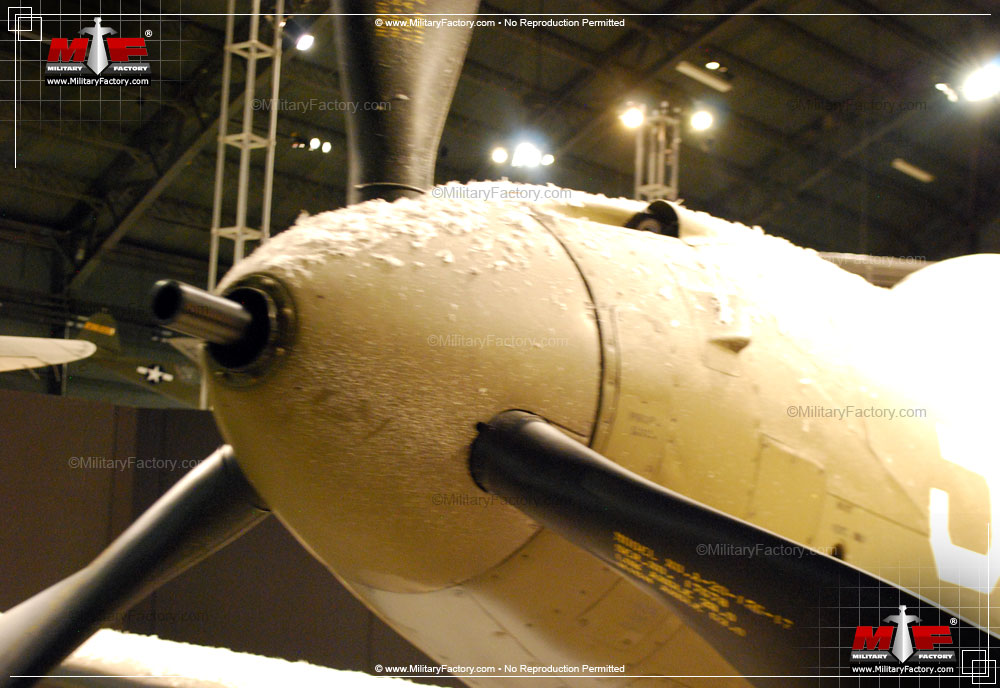
From one point of view, the addition of the 37mm cannon forced a design that was highly unorthodox while on the other it provided the aircraft a solid center of gravity for which to fire such a powerful weapon. Being centered in the fuselage and firing through the front, the aircraft could be of such high containment that eventual weight changes within the structure would generally have very little effect in the way of the aircrafts overall performance specs. The weapon was hence mounted in the upper forward portion of the fuselage nose with the barrel protruding and firing out through the propeller hub. Two 12.7mm machine guns were also added to the upper-forward portion of the fuselage to compliment the cannon arrangement with more direct fire. These systems were synchronized to fire through the spinning propeller blades and had their rate-of-fire effected but not entirely in an inadequate sense. Additional 12.7mm machine guns were added to either wing - one to a wing for an impressive overall armament capability. The resulting aircraft, with the powerful and turbosupercharged (the turbosupercharger was mounted on the port side of the fuselage)Allison V-1710-17 liquid-cooled engine of 1,150 horsepower, was now designated officially as the XP-39.

The XP-39 was, at least outwardly, very similar to the final P-39 models in production. However, several elements soon became apparent with the program that would forever change the destiny of the aircraft - and effectively tarnished its rather impressive image. Despite production already beginning on several YP-39s, the US Army involved itself evermore in the Airacobra's design. With several old hands still holding power in the branch, the US Army decided to modify the Airacobra design to make it more ideal for use as a close-support platform capable of operating under the control of ground forces instead of being its own independent aerial entity. As such, the P-39 was now being asked to provide better performance under a 10,000 feet ceiling limit. This meant the deletion of the ultra-important turbosupercharger - a requisite component in the aircrafts design that was all necessity when performing to the specs as found in the new German and Japanese fighters. It was thought that the deletion of the component would assist in making the P-39 a more stable and aptly-performing low-level system. What it did, however, was rob the aircraft of its performance gains that so wowed interested purchasing parties. The air intake was now moved to the upper portion of the fuselage (the more identifiable "look" to the P-39 that we recognize today) and another Allison engine was selected for production that would provide better low-level performance akin to what the US Army was looking for.

The initial production P-39 systems became the P-39C models and were quickly followed by the P-39D series. The aircraft almost took on the designation of P-45 due to the radical list of changes from the original proposal through it was eventually settled on the P-39 designation with appropriate letters detailing the significance in changes and additions. P-39C models had a pair of 7.62mm (.30 caliber machine guns) mounted in between the existing 12.7mm heavy machine guns. Sixty examples of the ordered P-39C models effectively removed the 12.7mm heavy caliber wing-mounted machine guns and replaced them with 4 x 7.62mm types (two machine guns to a wing with 1,000 rounds each) and became P-39D designations while still retaining their nose-mounted 12.7mm heavy machine guns (200 rounds each). The 37mm cannon (30 rounds) was still in place. The completed P-39C and D models initially went to war with the 31st Pursuit Group (later becoming "Fighter" Group). I t was also found later that the P-39 made for a stable bombing platform, particularly in the dive-bombing role, and had affixed a single 500lb bomb to the centerline fuselage underside.

In an attempt by the Bell company to widen the interest of the P-39 design, the XFL-1 "Airabonita" was devised to showcase to the United States Navy as a carrier-borne aircraft alternative to the aging models being fielded. This model - of which only a single prototype was ever constructed - was a slightly revised P-39 with the most noticeable change to the system being the use of a traditional undercarriage. The aircraft was powered by the Allison V-1710-6 series engine and flew for the first time on May 13th, 1940. As might be expected, this version failed to win over the naval audiences and went down in Airacobra lore as yet another attempt. Additionally, the Airacobra was successfully mated with a radio-control feature that made her a popular remote-controlled target drone for some time. Additional variations also included a bizarre modification that produced the dual-seat trainer version which saw the fuselage extended to include a forward seating placement instead of the nose armament. These appeared in limited form from existing F and Q models and took the designation of TP-39.

Among early users of the type were the British which, with German pressing up against their door, were in desperation to find legitimate fighter contenders for which to arm their fighter squadrons in place of their hawker Hurricanes. P-39s in service with Britain took on the designation of Airacobra Mk I and, despite the shortcomings inherent in a turbosupercharger-less aircraft, were nonetheless thrown into the fray. To add to the mix, the P-39s in British service were beginning to show signs that these aircraft were not intended for use in the British Isle elements. The aircraft were prone to breakdowns and mechanical failures particularly in their landing gears. The rugged airfields of Britain were nothing in comparison to the test-bed runways found in the United States. The mechanical service records of the Airacobra Mk I's got progressively worse as time wore on making the aircraft a much-hated breed on the Isle. To add insult to injury, it was soon found that dangerous fumes were being pumped into the cockpit after the firing of the 37mm cannon, fume levels deadly enough to kill a man. As a result, orders were issued that all RAF pilots use their oxygen masks from the point of engine ignition to the point of engine shutoff for their own safety. Whatever surplus P-39s on order the Brits had, they gladly passed them on to the hard-pressed forces of the Soviet Union (eventually to receive P-39N and P-39Q models in quantity by war's end). Any remaining P-39s after that were returned to America which, in turn, shipped them off for use to Australia (these as the P-400) - another hard-pressed nation at war or under threat. The Russians found particular favor with the type as a close-support fighter. It proved to be quite stable and the 37mm cannon was enough to give German armor a run for its money. Being that all of the powerful armament was basically concentrated in the nose section, this allowed for relatively easy targeting of slow-moving enemy ground units. This also provided for a very effective recoil-absorbing airframe to further the inherent capabilities. It got to the point that some Russian P-39N and Q models deleted all wing armament altogether to have concentrated firepower all in the nose. In any case, the Airacobra proved its limited worth in Lend-Lease though as a fighter, they were still relatively easy pickings for the Germans. France initially ordered the type early in the war but was forced to wait before receiving units due to the country's capitulation. They would be one of the last sole users of the machine by war's end and for a time afterwards. The P-39 would also be fielded in limited quantities by Allied Italian forces for a time but did little to show for their use of the machine.

Not to say that the P-39 was an essentially useless fighter-to-fighter platform. It should be noted that the aircraft could provide a fair fight in the hands of a skilled pilot knowing the limitations of his system. If the Airacobra could drag an opponent down below 10,000 feet, it stood a definite chance to overtake him through ingenuity and firepower (controlled friendly war games with even the fabled F4U Corsairs showed this to be true). Performance-wise, however, the P-39 was devoid of any truly exceptional qualities when compared to the types that were purpose-built for the fighter role including the P-47 Thunderbolts.

The P-39 was set into service in the Panama Canal zone under fear that the area was ripe for an attack from either ocean. After the surprise attacks on Pearl Harbor on December 7th, 1941, the P-39 was pushed into the Pacific Theater of war and saw first actual combat with the 8th Pursuit Group albeit short of parts and mechanical know-how on the part of pilot and crews alike. Following the initial P-39C and P-39D models were the P-39F and P-39G model series sporting an Aeroproducts-brand propeller system. Several more variations ensued for the type but most revolved around differing engines for the most part.

The Airacobra aircrews and groundcrews surely showed their mettle in the conflict basically doing much with very little. It became evermore apparent that the P-39 in the Pacific Theater would soon need to be addressed and was - for the most part - properly done so with the addition of the P-38 Lightnings delivered en masse to the region. Airacobra crews fought on, however, with their beautiful little ugly machines.

In the end, the P-39 was very much of what was not intended for the design. It lacked fighter performance thanks to the US Army decision to take out the turbosupercharger and fit in a lower-rated Allison. The aircraft was specifically and primarily constructed for that of a fighter but much of this was lost when the system was relegated to the close-support role. The primary armament was the systems true saving grace as the down-graded wing armament did not endear itself with contemporary aircraft. And a fighter design intended to be the United States answer became nothing more that a temporary answer for air forces around the globe. The landing gear issues and general mechanical reliability did not endear the system to most either though the aircraft was still well regarded for those pilots that saw beyond the glaring deficiencies. In the end, the Airacobra was a snake that truly lacked a poisonous bite in her intended role though she seemed to make for it in other ways, primarily through her cannon armament, distinctive appearance and resourcefulness in overall design - internally and externally. In any case, the P-39 was a modest success, just not for the host country that designed and marketed the aircraft. The P-39 Airacobra was what was made available the United States Military at the start of the nation's involvement in the conflict, fighting alongside the Curtiss P-40 Warhawk until better fighter models were made ready.

Text ©2003-2009 www.MilitaryFactory.com • All Rights Reserved • No Reproduction Without Permission • Corrections / Comments to MilitaryFactory at Gmail dot com

Last Revision: 7/6/2009


  Specifications for the Bell P-39M Airacobra
arrow downDimensions:
Length: 30.15ft (9.19m)
Width:33.99ft (10.36m)
Height: 11.84ft (3.61m)

arrow downPerformance: About MACH
Max Speed: 386mph (621kmh; 335kts)
Max Range: 650miles (1,046km)
Rate-of-Climb: 3,333ft/min (1,016m/min)
Service Ceiling: 35,991ft (10,970m; 6.8miles)

arrow downStructure:
Accommodation: 1
Hardpoints: 1
Empty Weight: 5,611lbs (2,545kg)
MTOW: 8,400lbs (3,810kg)

arrow downPowerplant:
Engine(s): 1 x Allison V-1710-83 water-cooled engine generating 1,200hp.
arrow downArmament Suite:
1 x 37mm Oldsmobile cannon firing through the propeller hub with 34 rounds.
2 x 12.7mm machine guns in the upper forward fuselage with 200 rounds each.
4 x 7.62mm machine guns in wings (2 to a wing) with 1,000 rounds each.

OPTIONAL:
1 x 500lb bomb externally mounted on the centerline fuselage.

  Pictures of the Bell P-39 Airacobra
     
Picture of Bell P-39 Airacobra
Picture of the Bell P-39 Airacobra
Image of the Bell P-39 Airacobra
     
arrow upView All 11 Images

CompareX2 CompareX4 Conversions Dictionary Acronyms

Compare and Contrast Military Aircraft Specifications

  Special Aircraft Collections
Aircraft by Conflict:
Falklands War
Indo-Pak War
Operation Allied Force
Operation Desert Storm
Six Day War
Yom Kippur War

Special Collections:
American X-Planes
Classic US Warbirds
Grumman "Cats"
Indian Air Force
Israeli Air Force
Mikoyan-Gurevich
V-Bombers


Korean Air War:
Korean War Aircraft
Aces
Australia
United States
North Korea

Vietnam Air War:
Vietnam War Aircraft

Cold War
Cold War Aircraft
United States
Soviet Union
Soviet Bombers of the Cold War

Modern Aircraft
Modern Military Aircraft
United States

Miscellaneous
MiG-15 Versus Sabre
Top 10 Fighters of All Time


  Recent Military Aircraft Additions
Thumbnail picture of the Supermarine Scimitar fighter
Supermarine Scimitar
Thumbnail picture of the Novi Avion fighter
Novi Avion
Thumbnail picture of the Arado Ar TEW 16/43-23 jet-powered fighter
Arado TEW 16/43

  Contacting MilitaryFactory.com
We can only get better if you tell us how. You can contact MilitaryFactory.com at MilitaryFactory at gmail dot com (replace "at" with "@" and "dot with ".") with any questions, comments or corrections. We also accept related military imagery that you approve for us to use on our website. Keep in mind, however, that due to volume, we may not directly respond to your inquiry. Please add us to your list of non-blocked recipients!
Flying Boats

  Aircraft Quick Profile


Picture of the Bell P-39 Airacobra
Image courtesy of the United States Air Force Museum.

flag of United States
1938

Designation: Bell P-39 Airacobra
Classification Type: Fighter
Contractor: Bell Aircraft Corporation - USA

Country of Origin: United States
Production Total: 9,584

Operators: Australia; France; Italy; Poland; Portugal; Soviet Union; United Kingdom; United States


  Variants
XP-39 - Prototype Model Designation sans armament.

YP-39 - Prototype Preproduction Models of which 13 were produced; improved XP-39 model.

YP-39A - Preproduction XP-39 Model fitted with an Allison V-1710 engine sans turbocharger; single high-altitude test frame conversion model.

YP-39B - Based on the XP-39; fitted with new engine sans turbocharger; single unit produced.

P-45 - Initial Production Designation offered by the US Army to signify major changes to model P-39C; later dropped in favor of P-39 designation.

P-39C - Initial Production Models; 80 examples produced; 60 P-39C models became P-39D types.

P-39D - Production Model fitted with self-sealing fuel tanks and increased heavier armament (addition of 2 x 12.7mm machine guns in upper forward fuselage); Allison V-1710-35 water-cooled engine generating 1,150hp; conversion models from P-39C series.

P-39D-1 - Lend-Lease Model with Hispano-brand 20mm cannon; improved P-39D models with self-sealing fuel tanks; 863 examples produced.

P-39D-2 - Lend-Lease Model with Allison V-1710-63 (E6) powerplant; improved P-39D-1 model series; 158 on order; 1 conversion model from P-139D-1.

XP-39E - 3 examples produced with new powerplant of Continental I-1430-1 at 2,100hp; becoming the XP-63 "Kingcobra" prototype.

P-39E - Improved P-39D-1 model; though 4,000 were on order none of this type were produced.

P-39F-1 - Based on the P-39D model but fitted with Aeroproducts-produced constant-speed propeller system.

P-39F-2 - P-39F models modified for photo reconnaissance duties; 2 converted as such.

P-39G - 1,800 were ordered though eventually becoming the K, L, M and N models in the series.

P-39H - Designation Not Used

P-39J - Modified P-39D-1 model series with new engine and auto boost feature; 25 examples produced.

P-39K - Fitted with V-1710-63 powerplant and Curtiss-produced propeller system; based on P-39F model series; 210 examples produced.

P-39L - Modified P-39K series with Curtiss brand propellerand rocket rails installation; 250 examples produced.

P-39M - Fitted with V-1710-83 powerplant capable of 1,200hp and a larger propeller system; gearing changed; 240 examples produced.

P-39N - Improved P-39M series; fitted with V-1710-85 powerplant; decreased armor protection and fuel for increased weight and performance.

P-39P - Designation Not Used

P-39Q - Improved P-39N series; 1 x 37mm cannon and 4 x 12.7mm machine guns - two held in underwing gunpods and synchronized to fire through the propeller.

Bell Model 14 - French Order Model Designation; never delivered.

Airacobra Mk I - British Delivery Models

P-400 Airacobra I - Royal Air Force Designation

TP-39F - Dual-Seat Trainer Model

RP-39Q - Limit Production Dual-Seat Trainer Model

F2L - US Navy Target Drone Designation

XFL-1 "Airabonita" - Single Example Prototype Model for evaluation by US Navy; traditional landing gear array instead of tricycle type.

A-7 - Proposed Radio-Controlled Drone

TDL - US Navy Radio-Controlled Target Drone

  Collections
  • Sons of Empire - WW2 Aircraft of Japan
  • Aircraft of the Battle of Britain
  • X-Planes Throughout History
  • French Aircraft of the Great War
  • The German Luftwaffe in World War 2
  • Nightfighters - In a Class All Themselves
  • The Top Ten Fighters of All Time
  • Carrier "Born" Aircraft - Navy Mounts
  • If Boats Could Fly - Flying Boat Aircraft


Free GI Bill Guide

Top MF Stuff: Military Pay Scale Chart | Military Ranks | World War 2 Weapons | Sniper Rifles | Conversion Calculators


©2009 www.MilitaryFactory.com • Content ©2003-2009 MilitaryFactory.com • All Rights Reserved • Disclaimer Privacy Policy Site Map Origins
Most photographic images appearing on this site are courtesy of the United States Department of Defense and are approved for public use.
Other images acquired through the public domain. Digital art work courtesy of Dan Alex.
Business Consulting by Kyle Williams

Material presented throughout this website is for historical and entertainment value and should not to be construed as usable for
hardware restoration, maintenance or general operation. Please consult manufacturers for such information.

Site Contact: militaryfactory at gmail dot com (replace "at" with "@" and "dot" with ".") eXTReMe Tracker