Military Factory
Military Pay Chart
Global Firepower
Military Industrial Complex
Second World War
Home
Military Pay Scale
Military Ranks
Small Arms
Aircraft
Land Systems
Navy
Education
Military Factory Facebook Logo
flag of Ukraine

Antonov An-70 Medium Transport (2014)

Authored By Staff Writer | Last Updated: 10/13/2012

Development of the Antonov An-70 began in the late 1980s to which one prototype has been made available as of 2012.

Find a School Near You
Follow Military Factory on Facebook:
Trending on Military Factory:
Recent Articles:
The Antonov An-70 is a Ukrainian transport aircraft - currently in development as of 2012 - intended to replace the aging fleets of An-12 series aircraft in the same role. The An-12 was first introduced in 1959 and saw production reach 1,248 units through a myriad of available variants with use of the type widespread among Soviet allied nations and states. The newer An-70 represents a larger, more powerful airframe with improved heavy-hauling capabilities and range allowing it to fulfill a breath of military- and civilian-minded roles as required. To date, two examples have been completed, the first prototype was lost to accident (along with its crew) while the second prototype was hastily developed from a static testbed. The An-70 is formally categorized as a medium-range transport which allows for intra-theater operations in the military sense.

Development of the An-70 was undertaken before the fall of the Soviet Empire (1991) with Russia and Ukraine taking an equal interest in the program and, thusly, funding was readily available for project growth. After the fall of the Soviet Union, the program suffered through the expected budget cuts and loss of the Russians as a prime supporting force. Nevertheless, progress was made to the point that the initial prototype undertook its first flight on December 16th, 1994. The fall of the Empire ushered in a new world and this included more interaction with the West. As such, the An-70 was deliberately completed with a modular configuration in which its digital suite could conform to NATO standards in the event that the aircraft would serve in foreign nations allied to the West. Over the next few months, the aircraft successfully completed required testing until, on February 10th, 1995, the prototype collided with an Antonov An-72 chase plane used in monitoring the in-flight testing. The An-70 was a complete loss.

Sold on the prospect of the An-70's capabilities, the accident forced the hand of Antonov to modify an existing An-70 static airframe to a fully-flyable prototype for continued development. Within two years, the follow-up prototype was made ready and recorded its own first flight on December 8th, 1996. It is this prototype that is currently being utilized to iron out the remaining test phases of the An-70 program. In January of 2001, the prototype was forced to complete a belly landing after a loss of power (two engines were shut down as well). The airframe was expectedly damaged in the ensuing landing and required months of repairs. Three important test flights were recorded as recently as September 2012 - showcasing the project's rather slow evolution (now spanning over two decades). The internals of the aircraft have been naturally modernized. While Russia does not maintain a direct stake in the program anymore, it is still interested in procuring the An-70 in number for its air force.

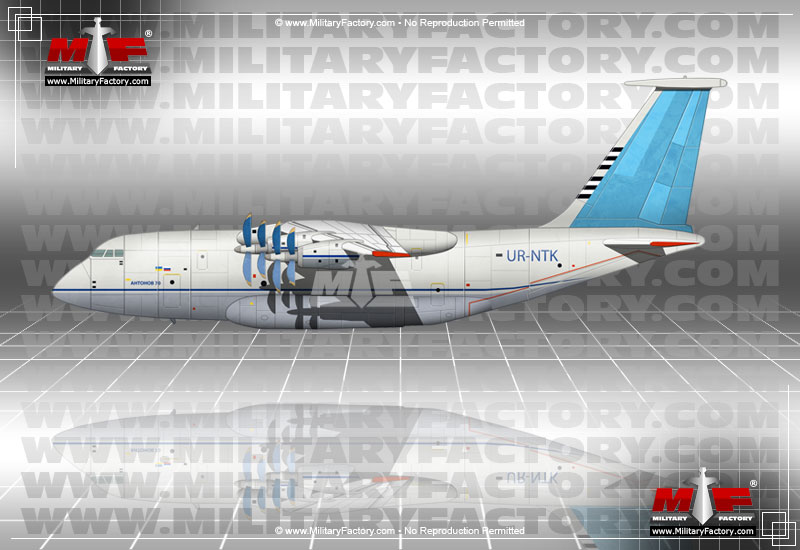
The outward design of the An-70 is typically Antonov. The fuselage is of a highly-contoured tubular shape with a short nose cone, forward-set flight deck and low ground clearance. The four engines are set in underwing nacelles (two to a wing) to which each wing is high-mounted along the fuselage sides for the required ground clearance of the engines and their respective propellers. Wings are naturally swept in a conventional fashion to promote maximum aerodynamic airflow. Access to the cargo hold is through a large access area at the rear of the aircraft (promoting a raised empennage base). The empennage is capped by a tall vertical tail fin with fuselage-mounted horizontal tailplanes. The undercarriage consists of a multi-wheeled main unit under amidships as well as a twin-wheeled nose landing gear leg under the flight deck. The typical base crew includes two pilots and a flight engineer as well as one or two other support personnel. There are several rectangular man-sized access doors along the sides of the fuselage.

The An-70 is outfitted with 4 x Progress D-27 series propfan engines of 13,900 horsepower each driving a pair of contra-rotating propellers. Propfan engines are relatively new developments in the world of aviation. The concept was solidified by Hamilton Standard in 1975 and patented in 1979. This advanced system of propulsion basically seeks to combine the performance capabilities of a modern turbofan engine with the economical benefits of a turboprop engine. The end result is an engine that proves not as thirsty as a turbofan with all of the inherent advantages of such a turbofan engine's thrust output. The An-70 benefits from this arrangement and can reach speeds of 485 miles per hour (cruise = 466mph) with a range of 5,000 miles and service ceiling nearing 40,000 feet.

Dimensionally, the An-70 sports a running length of 134 feet with a height of 54 feet and wingspan of 145 feet. She fields a weight of 146,000lbs when empty with a 320,000lb maximum take-off weight specification.

The deep wide body nature of the An-70 design allows it to conform to whatever cargo requirements an operator may need. This includes a cargo payloads of over 100,000lbs or seating for 300 combat troops and gear or up to 200 medical litters with support staff. Additionally, there is a proposed An-70 variant, the "An-112KC", which is intended as an inflight refueler - the cargo hold dedicated to large fuel stores and specialized equipment. The major difference between this variant and the base An-70 is a two-engine configuration (the two inboard engines are retained, the outboard pairing deleted). The outboard pairing is replaced by drag hose equipment as fuel is funneled through each wing, down the hoses and into the awaiting trailing aircraft's exposed fuel receptacle. At one point, the An-122KC was a long-shot contender for the United States Air Force's KC-X next generation inflight refueler program though the Antonov submission was expectedly rejected by the Americans. Another potential program (this by the Germans) pitted the French Airbus 400M (Atlas) against the An-70 in the late 1990s. However, the An-70 lost out on the potentially lucrative deal (largely due to European German politics) and the A400M was selected in its place.

As of this writing (2012), only Ukraine and Russia are the expected prime operators of the An-70 series. They have not reached operational service in the numbers required as of yet though Ukraine is expected to procure at least two early examples while the Russian Air Force is on record for 60 examples, these being delivered through 2020. The Russian Air Force version is slightly modified to suit strict operating requirements. This modernized form was flown as recently as September 27-30 to further testing.

Serial production will be handled by Aviant of Kiev, Ukraine.
Text ©2003-2013 www.MilitaryFactory.com • All Rights Reserved • No Reproduction Permitted
MilitaryFactory.com does NOT sell equipment/weaponry. Material presented throughout this website is for historical and entertainment value and should not to be construed as usable for hardware restoration, maintenance or general operation. Please consult manufacturers for such information. Our disclaimer. Email corrections / Comments to MilitaryFactory at Gmail dot com.
Picture of Antonov An-70
View All Images (1)

Specifications for the
Antonov An-70
Medium Transport


Country of Origin: Ukraine
Manufacturer: Antonov - Ukraine
Initial Year of Service: 2014
Production: 2


Focus Model: Antonov An-70
Crew: 3 + 300


Length: 133.53ft (40.7m)
Width: 144.55ft (44.06m)
Height: 53.74ft (16.38m)
Weight (Empty): 146,012lbs (66,230kg)
Weight (MTOW): 319,670lbs (145,000kg)


Powerplant: 4 x Progress D-27 propfan engines developing 13,880 horsepower each.


Maximum Speed: 485mph (780kmh; 421kts)
Maximum Range: 4,971miles (8,000km)
Service Ceiling: 39,370ft (12,000m; 7.5miles)
Rate-of-Climb: 82 feet per minute (25m/min)


Hardpoints: 0
Armament Suite:
None.


Variants:
An-70 - Base Series Designation


An-70T - Basic Transport Model

An-70KC - Proposed inflight refueler; twin-engine design with applicable refueling equipment installed.


Operators: Russia (expected); Ukraine (expected)

ALL AIRCRAFT CATEGORIES

BY DECADE:


1900 to 1909
1910 to 1919
1920 to 1929
1930 to 1939
1940 to 1949
1950 to 1959
1960 to 1969
1970 to 1979
1980 to 1989
1990 to 1999
2000 to 2009
2010 to 2019
2020 to 2029
VIEW ALL
Compare Aircraft


BY TYPE:


Anti-Submarine Warfare (ASW)
Attack Helicopters
Bomber Aircraft
Medium Bombers
Heavy Bombers
Close-Air Support (CAS)
Commercial Aircraft
Dive Bombers
Electronic Warfare Aircraft (EWA)
Experimental / X-Planes
Fighter Aircraft
Floatplane Aircraft
Flying Boat Aircraft
Aerial Refueling Tankers
Helicopters (ALL)
Interceptor Aircraft
Multi-Role Aircraft
Navy Carrier Aircraft
Night Fighters
Reconnaissance / Scout
Search & Rescue (SAR)
Scout Helicopters
Special Purpose
Torpedo Bombers
Trainer Aircraft
Transport Aircraft
Transport Helicopters
Unmanned Aerial Vehicles (UAVs)
Unmanned Combat Air Vehicles (UCAVs)


COLLECTIONS:


4th Generation Fighter Aircraft
5th Generation Fighter Aircraft
US X-Planes
Classic US Warbirds
French Military Helicopters
Grumman "Cats"
Howard Hughes Aircraft
Indian Air Force
Israeli Air Force
Libyan Aircraft
Modern Chinese Aircraft
Modern Chinese Fighters
Modern Military Aircraft
Modern North Korean Aircraft
Modern Trainer Aircraft
Modern US Aircraft
Mikoyan Aircraft
Sukhoi Aircraft
Syrian Aircraft
Top 10 Fighter Aircraft of All Time


AIRCRAFT BY CONFLICT:


Arab-Israeli War (1948)
Cuban Missile Crisis (1959-1962)
Falklands War (1982)
Indo-Pak War (1965, 1971)
Iran-Iraq War (1980-1988)
Lebanon War (1982)
Operation Allied Force (1999)
Operation Desert Storm (1991)
Six Day War (1967)
Spanish Civil War (1936)
Soviet-Afghan War (1979-1989)
Yom Kippur War (1973)


MISCELLANEOUS:


Aircraft Cockpits
Aircraft Manufacturers List
Aircraft Timeline

WORLD WAR 2:


1939 Aircraft
1940 Aircraft
1941 Aircraft
1942 Aircraft
1943 Aircraft
1944 Aircraft
1945 Aircraft
1946 Aircraft
Australian Aircraft
Battle of Britain Aircraft
Bombers
Four-Engine Bombers
British Aircraft
British Bombers
British Transports
Dive Bombers
Canadian Aircraft
Fighters
Chinese Aircraft
French Aircraft
German Aircraft
German Fighters
German Flying Boats
German Jets
Secret Weapons of the Luftwaffe
Italian Aircraft
Imperial Japanese Aircraft
Imperial Japanese Fighters
Mitsubishi Bombers
Navy Aircraft
Pearl Harbor
Polish Aircraft
Romanian Aircraft
US Aircraft
US Bombers
US Navy Aircraft
Soviet Aircraft
Torpedo Bombers
Transport Aircraft
Tuskegee Airmen Aircraft
W.A.S.P. Aircraft
WW2 Aircraft Ranked by Speed
VIEW ALL


WORLD WAR 1:


1914 Aircraft
1915 Aircraft
1916 Aircraft
1917 Aircraft
1918 Aircraft
Aircraft Timeline
Austro-Hungarian Aircraft
Bomber Aircraft
British Aircraft
Fighters
Flying Boats
French Aircraft
Imperial German Aircraft
Italian Aircraft
Scout Aircraft
Russian Empire Aircraft
US Aircraft
WW1 Aircraft Ranked by Speed
VIEW ALL


KOREAN WAR:


Australian Aircraft
Korean War Aces
Korean War Jets
North Korean Aircraft
US Military Aircraft
VIEW ALL


VIETNAM WAR:


Helicopters
North Vietnam Air Force
US Airpower
VIEW ALL


COLD WAR:


1950s French Aircraft
British V-Bombers
Cold War Bombers
Soviet Aircraft
Soviet Bombers
Soviet Interceptors
Soviet Helicopters
Strategic Air Command
US Aircraft
US Bombers
US Interceptors
VIEW ALL

Site Disclaimer | Privacy Policy | Site Map | MF Origins


©2013 www.MilitaryFactory.com • Content ©2003-2013 MilitaryFactory.com • All Rights Reserved • Site Contact Email: militaryfactory at gmail dot com. The "Military Factory" name and MilitaryFactory.com logo are registered ® trademarks and protected by all applicable domestic and international intellectual property laws.


Top MF Stuff: 2013 Military Pay Scale | Military Ranks | WW2 Weapons | Sniper Rifles | Kts to Mph | WW1 Aircraft | Automatic Rifles | Aircraft Cockpits | Vietnam War Weapons | Main Battle Tanks | Submachine Guns | Shotguns | French Military Victories


Most photographic images appearing on this site are courtesy of the United States Department of Defense and are approved for public use. Other images acquired through the public domain. Digital art work courtesy of Dan Alex. Business Consulting by Kyle Williams. Material presented throughout this website is for historical and entertainment value and should not to be construed as usable for hardware restoration, maintenance or general operation. Please consult manufacturers for such information.


eXTReMe Tracker