Military Factory
Military Pay Chart
Global Firepower
Military Industrial Complex
Second World War
Home
Military Pay Scale
Military Ranks
Small Arms
Aircraft
Land Systems
Navy
Education
Military Factory Facebook Logo
flag of Russia

Mikoyan MiG-29K (Fulcrum-D) Carrier-Based Multi-Role Fighter (2009)

Authored By Staff Writer | Last Updated: 5/17/2013

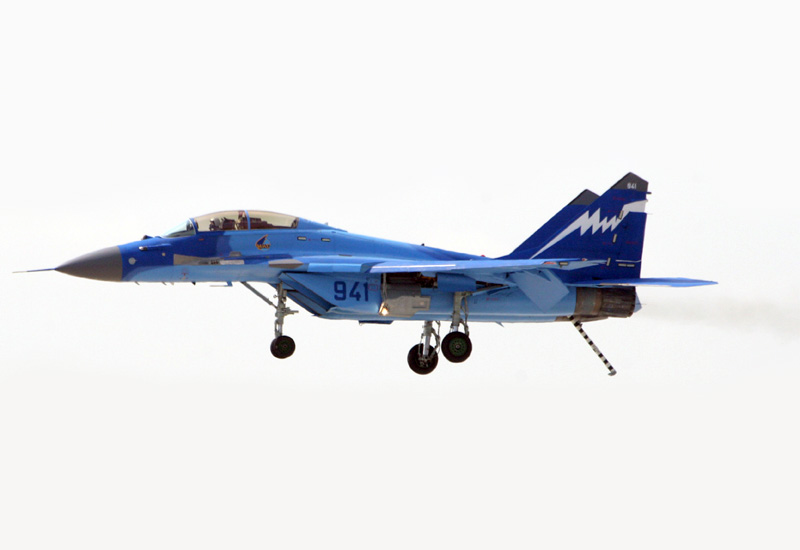
The Mikoyan MiG-29K Fulcrum-D is a highly modified and navalized form of the successful Soviet-era MiG-29 Fulcrum air superiority fighter.

Find a School Near You
Follow Military Factory on Facebook:
Trending on Military Factory:
Recent Articles:
Little MF Logo
Little MF Logo
Little MF Logo
Little MF Logo
Little MF Logo
Little MF Logo
Little MF Logo
Little MF Logo
Little MF Logo
Little MF Logo
The Mikoyan MiG-29K (NATO = "Fulcrum-D") is a navalized variant of the successful Mikoyan MiG-29 Fulcrum family of fighters. The navalized form was originally developed to a 1980s Soviet Navy carrier-based fighter requirement. While the Soviet Navy eventually settled on the larger Sukhoi Su-27 "Flanker" series (as the "Su-33"), the MiG-29K design has recently seen growing interest by both the Russian and Indian navies thanks largely to the acquisition by the Indian Navy of the ex-Kiev class Admiral Gorshkov aircraft carrier (to become the INS Vikramaditya in December of 2012). A dozen MiG-29K aircraft were included as part of the deal due to their more compact size, lower procurement cost and advanced capabilities. In turn, the Russian Navy has decided to replace its aged and exceedingly expensive fleet of Su-33 carrier-based fighters with the newer budget-friendly MiG-29K models by 2015.

Both Sukhoi and Mikoyan, longtime aircraft suppliers to the Soviet/Russian Air Force (and notable rivals to one another), submitted their proposed designs to the Soviet Navy for a standard carrier-based fighter platform. The original land-based Sukhoi Su-27 Flanker was developed to counter the American McDonnell Douglas F-15 Eagle while the Mikoyan MiG-29 Fulcrum was developed to counter the American General Dynamics F-16 Fighting Falcon. As such, the Su-27 was a much larger aircraft with broadened inherent capabilities while the MiG-29 was noticeably more compact and cheaper to produce and maintain. Both Soviet-era designs proved successful (and highly capable) and went on to see considerable sales to Soviet-allied states and nations. Within time, the Soviet Navy required a similarly capable carrier-based fighter and the two Soviet concerns took to modifying their land-based designs as the MiG-29M and Su-27K respectively. The Soviet Navy eventually settled on the larger Su-27-based design though no more than 25 of the Su-33 were ever procured for the Soviet Navy's four Kiev-class aircraft carriers.

For the MiG-29 design, a reinforced undercarriage was devised for the rigors of deck operation and folding wings of greater area were introduced for improved storage aboard the space-strapped Soviet carriers. Anti-corrosion coatings were used where possible to help counter the effects of the salty sea. Additionally, recovery was made possible by the installation of an arrestor hook under the tail unit.

At this time in Soviet Naval history, the Kiev-class of aircraft carriers were a mix of "fighting cruiser" and dedicated aircraft carrier. As such, the bow of the Kiev-class family was reserved for offensive armament in the form of cannon, missiles and torpedo launchers to help contend with enemy air, surface and submarine threats while the port side of the design held the angled stern-to-port flight deck. These carriers were principally designed to operate the Yakovlev Yak-38 Forger VTOL (Vertical Take-Off and Landing) jump jets and navy helicopters which required little-to-no runway for their take-off and recovery. With the advent of more dedicated navalized aircraft, a ski jump ramp would have to be utilized to facilitate take-off (a feature common to many European aircraft carrier designs). The initial navalized MiG-29 prototype became the "MiG-29KVP" and first flight was recorded on August 21st, 1982.

A more modified form - the "MiG-29M" - soon followed this design and, for the Soviet Navy requirement, the system was redesignated as the MiG-29K ("K" indicating its "ship-based" usage in Russian). The new MiG design incorporated HOTAS (Hands On Throttle and Stick) functionality, an advanced multi-function active homing radar in the nose, revised air intakes, increased wing area and a retained capability to deliver precision-guided air-to-ground weaponry. Three color multi-function displays were utilized in the cockpit for a truly modernized, all-glass approach. The MiG-29K would, therefore, be more than a fleet defense fighter and could undertake ground strike sorties as needed - similar in scope to the American McDonnell Douglas F/A-18 Hornet. A two-seat derivative was also developed to facilitate training of new MiG-29K pilots. The second cockpit reduced internal fuel volume and thusly limited operational ranges while some of the combat qualities of the MiG-29K design were lessened to a degree.

The modified MiG-29K recorded its first flight on July 23rd, 1988 and completed its first carrier landing in November of the following year along the deck of the Admiral Kuznetsov. More testing followed to work out the expected project kinks and the program received a major setback with the fall of the Soviet Union as a world communist power by 1991. While delayed, the MiG-29K was never abandoned in full and by the time Russian military financing was in check, the MiG-29K would still have a role to play for Mikoyan continued its development as a private venture in the interim years.

The Kiev-class of aircraft carriers in service to the Soviet-now-Russian Navy had lived their usefulness and were becoming exceedingly expensive to operate and maintain. The Russians clearly had no short-term need with these aging systems and the military budget forced their sale. China purchased the Kiev and Minsk while, after a prolonged negotiation period, the Indian government purchased the Admiral Gorshkov to become their INS Vikramaditya. The vessel saw her bow-mounted armament removed and a ski jump ramp installed for the more conventional aircraft carrier role (though not truly a "flat top" design by Western standards). Currently undergoing trials as of this writing (2012), the INS Vikramaditya is set to be handed over to Indian authorities in December of 2012. Along with the purchase of the Admiral Gorshkov, the Indian Navy also elected to purchase an initial dozen MiG-29K carrier-based fighters in a package deal as the larger Sukhoi Su-33 limited how many fighters could be stocked on the Kiev carrier deck. Additionally, several two-seat MiG-29KUB aircraft were also procured for pilot training. In all, the Indian Navy expects to procure some 45 MiG-29K and MiG-29KUB fighters. 15 have already been produced and these include the required engines, fly-by-wire controls and advanced radar sought by the Indian Navy.

Comparatively, the Indian Navy's decision to procure the MiG-29K over the Su-33 in number went on to have an influence on Russian Navy plans in replacing its existing Su-33 fleet with the MiG-29K in turn. As such, the Su-33 fleet will be retired in 2015 pending the arrival of additional MiG-29K fighters. The Russian Navy is intending to procure some 20 MiG-29K fighters as well as 4 MiG-29KUB two-seat fighters. These will primarily stock the Admiral Kuznetsov aircraft carrier, flag ship to the Russian Navy. It is noteworthy that the Kuznetsov itself proved so critical during testing and evaluation of the navalized MiG-29 in years prior.

Basic capabilities of the MiG-29K include Mach 2+ speeds at altitude with a ferry range out to 2,200 miles and service ceiling of 57,000 feet. Rate-of-climb is listed at 65,000 feet per minute which is a strong quality of ship-based fighters needed for interception of incoming threats. The aircraft is powered by a pair of Klimov RD-33MK turbofans with afterburning, outputting at 19,800lbs thrust each. Primary armament is a 30mm GSh-30-1 internal cannon while five of the nine possible hardpoints can be outfitted with jettisonable external fuel tanks for extended operational ranges. Beyond that, the MiG-29K will be cleared to fire air-to-air missiles (infrared, semi-active homing and active homing types), air-to-surface missiles, anti-radiation missiles, anti-ship missiles and rocket pods. Additionally, the type will retain the capability to drop conventional bombs as well as laser-guided munitions, further broadening the tactical reach of the machine. All told, the MiG-29K will be able to undertake a variety of missions including fleet defense, interception, reconnaissance, tracking, ground attack and anti-ship sorties. For the Indian Navy, this is a much broader weapons platform than the existing family of aging BAe Sea Harriers.

The avionics suite includes the SPO-15 Beryoza Radar Warning Receiver (RWR) to identify incoming threats to the aircraft. An infrared search-and-track system is standard while the radar housed in the nose cone is the advanced Zhuk-ME series radar system. The pilot will have access to basic countermeasures through the included Electronic Countermeasures (ECM) pod as well as the requisite chaff and flare dispensing units. A laser targeting pod can also be affixed to the design.

Production of MiG-29K and MiG-29KUB fighters and trainers is ongoing as of this writing (2012). Some 15 have been produced to date with manufacture having began in 2005. The Indian Navy received their first MiG-29K mounts in 2009.

June 25th, 2011 - A two-seat MiG-29KUB was lost to a crash killing both of its pilots. A Russian review blamed the incident on pilot error and not a systems malfunction. Despite this, the Indian MiG-29K order was suspended until further review, delaying large scale acquisition of the type. As such, deliveries have been slow.
Text ©2003-2013 www.MilitaryFactory.com • All Rights Reserved • No Reproduction Permitted
MilitaryFactory.com does NOT sell equipment/weaponry. Material presented throughout this website is for historical and entertainment value and should not to be construed as usable for hardware restoration, maintenance or general operation. Please consult manufacturers for such information. Our disclaimer. Email corrections / Comments to MilitaryFactory at Gmail dot com.
Picture of Mikoyan MiG-29K (Fulcrum-D)
View All Images (1)

Specifications for the
Mikoyan MiG-29K (Fulcrum-D)
Carrier-Based Multi-Role Fighter


Country of Origin: Russia
Manufacturer: Mikoyan OKB - Russia
Initial Year of Service: 2009
Production: 15


Focus Model: Mikoyan MiG-29K (Fulcrum-D)
Crew: 1


Length: 56.76ft (17.3m)
Width: 39.34ft (11.99m)
Height: 14.44ft (4.40m)
Weight (Empty): 0lbs (0kg)
Weight (MTOW): 119,050lbs (54,000kg)


Powerplant: 2 x Klimov RD-33MK turbofan engines with afterburn generating 19,800lbs thrust each.


Maximum Speed: 1,367mph (2,200kmh; 1,188kts)
Maximum Range: 1,243miles (2,000km)
Service Ceiling: 57,415ft (17,500m; 10.9miles)
Rate-of-Climb: 65,000 feet per minute (19,812m/min)


Hardpoints: 9
Armament Suite:
STANDARD:
1 x 30mm GSh-30-1 internal cannon

OPTIONAL:
Mixed ordnance to include air-to-air missiles, air-to-surface missiles, anti-ship missiles, anti-radar missiles, precision-guided munitions, rocket pods, conventional drop bombs and five hardpoints plumbed for jettisonable fuel tanks. Up to 12,125lbs of external stores in all.


Variants:
MiG-29K ("Fulcrum-D") - Base Single-Seat Carrier-Based Fighter.


MiG-29KUB - Twin-Seat Carrier-Based trainer


Operators:
India; Russia

ALL AIRCRAFT CATEGORIES

BY DECADE:


1900 to 1909
1910 to 1919
1920 to 1929
1930 to 1939
1940 to 1949
1950 to 1959
1960 to 1969
1970 to 1979
1980 to 1989
1990 to 1999
2000 to 2009
2010 to 2019
2020 to 2029
VIEW ALL
Compare Aircraft


BY TYPE:


Anti-Submarine Warfare (ASW)
Attack Helicopters
Bomber Aircraft
Medium Bombers
Heavy Bombers
Close-Air Support (CAS)
Commercial Aircraft
Dive Bombers
Electronic Warfare Aircraft (EWA)
Experimental / X-Planes
Fighter Aircraft
Floatplane Aircraft
Flying Boat Aircraft
Aerial Refueling Tankers
Helicopters (ALL)
Interceptor Aircraft
Multi-Role Aircraft
Navy Carrier Aircraft
Night Fighters
Reconnaissance / Scout
Search & Rescue (SAR)
Scout Helicopters
Special Purpose
Torpedo Bombers
Trainer Aircraft
Transport Aircraft
Transport Helicopters
Unmanned Aerial Vehicles (UAVs)
Unmanned Combat Air Vehicles (UCAVs)


COLLECTIONS:


4th Generation Fighter Aircraft
5th Generation Fighter Aircraft
US X-Planes
Classic US Warbirds
French Military Helicopters
Grumman "Cats"
Howard Hughes Aircraft
Indian Air Force
Israeli Air Force
Libyan Aircraft
Modern Chinese Aircraft
Modern Chinese Fighters
Modern Military Aircraft
Modern North Korean Aircraft
Modern Trainer Aircraft
Modern US Aircraft
Mikoyan Aircraft
Sukhoi Aircraft
Syrian Aircraft
Top 10 Fighter Aircraft of All Time


AIRCRAFT BY CONFLICT:


Arab-Israeli War (1948)
Cuban Missile Crisis (1959-1962)
Falklands War (1982)
Indo-Pak War (1965, 1971)
Iran-Iraq War (1980-1988)
Lebanon War (1982)
Operation Allied Force (1999)
Operation Desert Storm (1991)
Six Day War (1967)
Spanish Civil War (1936)
Soviet-Afghan War (1979-1989)
Yom Kippur War (1973)


MISCELLANEOUS:


Aircraft Cockpits
Aircraft Manufacturers List
Aircraft Production
Aircraft Timeline

WORLD WAR 2:


1939 Aircraft
1940 Aircraft
1941 Aircraft
1942 Aircraft
1943 Aircraft
1944 Aircraft
1945 Aircraft
1946 Aircraft
Australian Aircraft
Battle of Britain Aircraft
Bombers
Four-Engine Bombers
British Aircraft
British Bombers
British Transports
Dive Bombers
Canadian Aircraft
Fighters
Chinese Aircraft
French Aircraft
German Aircraft
German Fighters
German Flying Boats
German Jets
Secret Weapons of the Luftwaffe
Italian Aircraft
Imperial Japanese Aircraft
Imperial Japanese Fighters
Mitsubishi Bombers
Navy Aircraft
Pearl Harbor
Polish Aircraft
Romanian Aircraft
US Aircraft
US Bombers
US Navy Aircraft
Soviet Aircraft
Torpedo Bombers
Trainer Aircraft
Transport Aircraft
Tuskegee Airmen Aircraft
W.A.S.P. Aircraft
WW2 Aircraft Ranked by Speed
VIEW ALL


WORLD WAR 1:


1914 Aircraft
1915 Aircraft
1916 Aircraft
1917 Aircraft
1918 Aircraft
Aircraft Timeline
Austro-Hungarian Aircraft
Bomber Aircraft
British Aircraft
Fighters
Flying Boats
French Aircraft
Imperial German Aircraft
Italian Aircraft
Scout Aircraft
Russian Empire Aircraft
US Aircraft
WW1 Aircraft Ranked by Speed
VIEW ALL


KOREAN WAR:


Australian Aircraft
Korean War Aces
Korean War Jets
North Korean Aircraft
US Military Aircraft
VIEW ALL


VIETNAM WAR:


Helicopters (ALL)
Transport Helicopters
North Vietnam Air Force
US Airpower
VIEW ALL


COLD WAR:


1950s French Aircraft
British V-Bombers
Cold War Bombers
Soviet Aircraft
Soviet Bombers
Soviet Interceptors
Soviet Helicopters
Strategic Air Command
US Aircraft
US Bombers
US Interceptors
VIEW ALL

Site Disclaimer | Privacy Policy | Site Map | MF Origins


©2013 www.MilitaryFactory.com • Content ©2003-2013 MilitaryFactory.com • All Rights Reserved • Site Contact Email: militaryfactory at gmail dot com. The "Military Factory" name and MilitaryFactory.com logo are registered ® trademarks and protected by all applicable domestic and international intellectual property laws.


Top MF Stuff: 2013 Military Pay Scale | Military Ranks | WW2 Weapons | Sniper Rifles | Kts to Mph | WW1 Aircraft | Automatic Rifles | Aircraft Cockpits | Vietnam War Weapons | Main Battle Tanks | Submachine Guns | Shotguns | French Military Victories


Most photographic images appearing on this site are courtesy of the United States Department of Defense and are approved for public use. Other images acquired through the public domain. Digital art work courtesy of Dan Alex. Business Consulting by Kyle Williams. Material presented throughout this website is for historical and entertainment value and should not to be construed as usable for hardware restoration, maintenance or general operation. Please consult manufacturers for such information.


eXTReMe Tracker