Arado Ar E.381
The diminuitive Ar E.381 can be seen carried on the underside of this Ar 234 jet-powered bomber.
By Staff Writer
The Ar E.381-series of prototypes was submitted in 1944 for review by the German Air Ministry. Whilst a plethora of companies (including Messerschmitt and Sombold) were competing to fulfill the role of what was to be dubbed "the parasite fighter" - small but fast rocket-powered fighters - the Arado Ar E.381 showed promise.
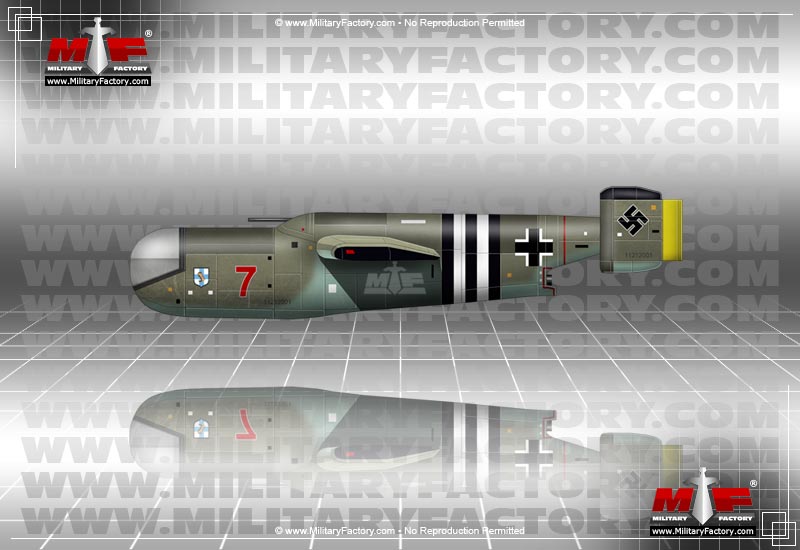
The Ar E.381 went through three major engineering design revisions, from the I to the II and finally to the III variant. Through the progression, the fuselage design was enlarged ever more so and streamlined to a more acceptable form. In the end, the Ar E.381 III would be the closest version to come close to production with the ability to be carried underneath an Arado Ar 234C-3 jet bomber and armed with six RZ65 or 73 type spin-stabilized rockets.
Perhaps the most interesting design element of the Ar E.381 III was the fact that the pilot was confined in the prone position once inside of the vehicle, allowing the design to be truly aerodynamic and not required the use of a true 'cockpit' in that sense.
In concept, the Ar E.381 III would be attached to the underside of the Ar 234 bomber, taken to the desired altitude (reported about 3,281 feet or 1,000 meters) and released. From there, the Ar E.381 III would go into a dive and achieve a momentous speed of up to 510mph. For a second run, the Ar E.381 could ignite it's rocket booster and fly in for another attacking pass.t motor. Once fuel was spent, the system would have to glide home and land under its own power, on a single skid running along the bottom of the fuselage (a braking parachute was also deployed). At most, an Ar E.381III pilot could conceivably make two passes at a bomber formation before running out of fuel.
The Ar E.381 was built to be simplistic, therefore all amenities such as heating were provided by the carrier craft until departure from the main unit. This engineering kept the Ar E.381 light and non-complicated to produce. The system itself could be taken apart into several major components consisting of the wing assembly, the fuselage and the tail section.
In all, several mockups and airframes were constructed for further testing, with a reported unmanned air-towed version undergoing further trials but ultimately the Ar E.381 remained an unfinished concept at best. In the end, the German Air Ministry would not pursue the parasite aircraft idea to the end.
Text ©2003-2009 www.MilitaryFactory.com • All Rights Reserved •
No Reproduction Without Permission • Corrections / Comments to MilitaryFactory at Gmail dot com
Last Revision: 9/9/2009
|