Military Factory
Military Pay Chart
Global Firepower
Military Industrial Complex
Second World War
Home
Military Pay Scale
Military Ranks
Small Arms
Aircraft
Land Systems
Navy
Education
Military Factory Facebook Logo
flag of Soviet Union

Tupolev Tu-2 (Bat) Fast Bomber / Multirole Aircraft (1942)

Authored By Staff Writer | Last Updated: 2/12/2013

The Tupolev Tu-2 Bat served a variety of critical frontline roles for the Soviet Air Force in World War 2.

Find a School Near You
Follow Military Factory on Facebook:
Trending on Military Factory:
Recent Articles:
Russian aviation engineer Andrei Tupolev would lend his surname to a plethora of Soviet-era aircraft after founding his Tupolev OKB concern in 1922. By the late 1930s, the world was at war following the German invasion of Poland in September of 1939 to officially mark the start of World War 2. By 1940, the Soviet Air Force was interested in a high-speed medium bomber platform to lend a modern offensive "punch" in support of various Red Army initiatives - the result becoming the excellent twin-engine "Tu-2" which recorded its first flight on January 29th, 1941 and the series was formally introduced in March 1942. After the formation of NATO in 1949, the Tu-2 was assigned the codename of "Bat" in Western nomenclature.

Light, twin-engined bombers certainly had their place in the aerial inventories of the period concerning World War 2. They offered the high-performance, high-speed flight of dedicated fighter platforms with the firepower of heavier bomber types in one complete package. As such, they could be outfitted with various armament layouts to include machine guns, cannon, bombs and torpedoes while being called upon to carry out differing sortie types consisting of reconnaissance, ground attack, interception and torpedo/dive bombing. In this way, many of these twin-engined heavy fighter-type designs of the war came to become the first true "multirole" fighter platforms and this was embodied through examples produced by all of the major powers of the time - Britain fielded their famous de Havilland "Mosquito" while the Soviets showcased their Tu-2. The Americans managed their Northrop P-61 "Black Widow" night-fighters while the Japanese made good with their Ki-45 "Tony".

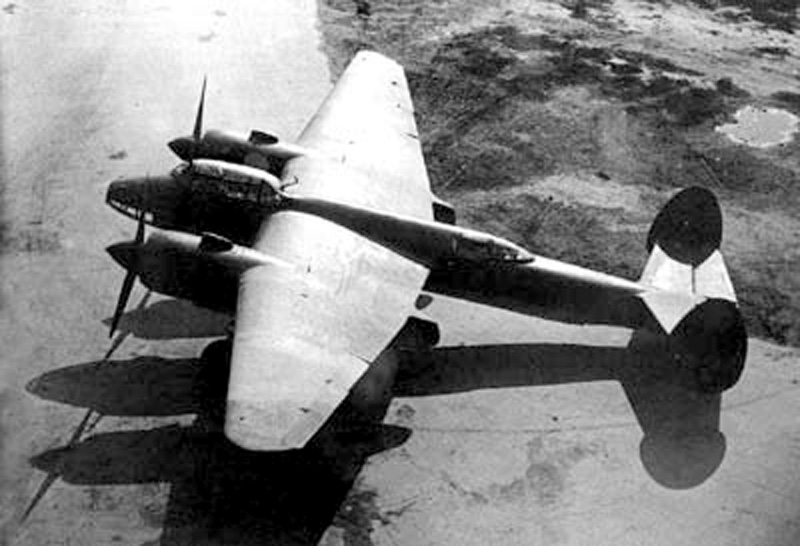
The Tu-2 became one of the more important bombers of the Second World War and proved an overall excellent design. In practice, the airframes proved quite resilient to enemy fire and the harsh operating environments that were the European Winter while their capabilities made them extremely valuable to combined Soviet operations requiring air support. The design centered around a pair of Shvetsov ASh-82 radial piston engines fitted to streamlined nacelles under each wing assembly and powering three-bladed (later four-bladed) propellers. The fuselage was long and slender, containing operating spaces for the four crew as well as a large internal bomb bay. The aircraft featured external hardpoints for munitions as well. Total ordnance capacity was 3,300lbs internally and up to 5,000lbs externally. The forward section of the fuselage contained the elevated cockpit position (inline seating) with the lower nose section glazed for the bombardier. The twin-door bomb bay ran just aft of the bombardier's position along the belly of the aircraft. Base armament consisted of 2 x 20mm ShVAK cannon fitted to the leading edge of the wings suitable for attacking enemy aerial and ground targets. Defense was initially provided by 3 x 7.62mm ShKAS machine guns across three defensive positions (cockpit, dorsal and ventral) though these were later upgraded to the more powerful 12.7mm Berezin UB machine gun types. The undercarriage was fully retractable and of the "tail-dragger configuration to include two single-wheeled main legs and a single-wheeled tail leg. The empennage incorporated a horizontal plane straddled by rounded vertical tail fins which provided the needed stability at low-levels. Overall performance specifications included a top speed of 325 miles per hour with a range out to 1,250 miles and service ceiling up to 29,500 feet. Rate-of-climb was 1,600 feet per minute. All told, the aircraft was regarded as a fast airframe for her class type and much appreciated by Soviet airmen. When utilized as a true fighter thoroughbred, the Tu-2 certainly held her own. Her value was such that she was utilized in all major actions towards the end of the war that would see the Soviets victors over their German invaders.

Production of Tu-2s spanned from September of 1941 to 1951. In June of 1942, the Germans invaded the Soviet Union to open up the East Front and this pressed all manner of Soviet industry to previously unseen levels, requiring entire production lines to be set up in central Russia and many weapons produced in short order. The aircraft went on to have a successful post-war career as well, being showcased in several communist (and Soviet-allied) inventories beyond the Soviet Union. In all, production totaled 2,257 aircraft and stocked the inventories of Bulgaria, China, Hungary, Indonesia, North Korea, Poland and Romania. Amazingly, several managed frontline operational status into the early 1980s (China). Tu-2s saw combat actions in the Chinese Civil War (1927-1950) and Chinese airmen flew sorties in the Korean War against the United Nations. The Chinese also utilized their Tu-2s in forcibly putting down Tibetan upheaval between 1958 and 1962.

It is noteworthy to mention the somewhat "unfriendliness" of Soviet production designations when compared to the basic "A-B-C" or "1-2-3" conventions followed in the West. As such, a "D-model" follows an "S-model" into service while "T" simply signifies a "torpedo" carrying capability.

The Tu-2 spawned into many recognized variants beginning with the ANT-58 3-seat prototype of 1941. This was followed by the ANT-59 four-seat prototype and the ANT-67 five-seater of 1946 outfitted with, interestingly, diesel engines. "Tu-2" was the definitive series marker of 1942 outfitted with 2 x Shvetsov ASh-82 air-cooled engines of 1,450 horsepower. The Tu-2S was an updated design of 1943 with 2 x Shvetsov ASh-82FN radial piston engines of 1,850 horsepower. A long-range variant, the Tu-2D, was unveiled in October of 1944 with larger wings and five crew. The Tu-2DB was a high-altitude reconnaissance bomber variant while the Tu-2F was a photographic reconnaissance platform fielded with camera equipment. The Tu-2G proved a fast cargo hauler with limited capacity and the Tu-2R was a dedicated fast reconnaissance mount. The Tu-2K served as a developmental series for early powered ejection seat testing while the Tu-2N was used to evaluate the British Rolls-Royce Nene turbojet engine. Another testbed, the Tu-2 "Paravan", served to trial a "cable cutting" facility to be used against tethered ground-based enemy obstacle balloons. The Tu-2M was outfitted with 2 x Shvetsov ASh-83 radial piston engines of 1,900 horsepower. The Tu-2RShR was used to trial a 57mm internal cannon arrangement though this would never see serial production. The Tu-2Sh was a prototype ground-attack platform outfitted with various weaponry that came to naught. The Tu-2/104 became an all-weather interceptor mount and the Tu-2T was born as a dedicated torpedo bomber platform (the latter for Soviet Naval Aviation). The Tu-6 was an evolved reconnaissance variant, the Tu-8 a long-range bomber of 1947 and the Tu-10 a high-altitude version of 1943. Training of Tu-2 crew was handled through the downgraded "UTB" variant of 1946 and these were powered by 2 x Shvetsov ASh-21 engines of 690 horsepower.

"Tu-1" served to designate a one-off prototype that saw cancellation in 1947. This was a dedicated twin-engined, three-seat night-fighter in the same vein as the British de Havilland Mosquito.
Text ©2003-2013 www.MilitaryFactory.com • All Rights Reserved • No Reproduction Permitted
MilitaryFactory.com does NOT sell equipment/weaponry. Material presented throughout this website is for historical and entertainment value and should not to be construed as usable for hardware restoration, maintenance or general operation. Please consult manufacturers for such information. Our disclaimer. Email corrections / Comments to MilitaryFactory at Gmail dot com.
Picture of Tupolev Tu-2 (Bat)
View All Images (1)

Specifications for the
Tupolev Tu-2 (Bat)
Fast Bomber / Multirole Aircraft


Country of Origin: Soviet Union
Manufacturer: Tupolev - Soviet Union
Initial Year of Service: 1942
Production: 2,257


Focus Model: Tupolev Tu-2 (Bat)
Crew: 4


Length: 45.28ft (13.8m)
Width: 61.88ft (18.86m)
Height: 13.55ft (4.13m)
Weight (Empty): 16,755lbs (7,600kg)
Weight (MTOW): 25,948lbs (11,770kg)


Powerplant: 2 x Shvetsov ASh-82 radial piston engines developing 1,850 horsepower each.


Maximum Speed: 324mph (521kmh; 281kts)
Maximum Range: 1,243miles (2,000km)
Service Ceiling: 29,528ft (9,000m; 5.6miles)
Rate-of-Climb: 1,610 feet per minute (491m/min)


Hardpoints: 4
Armament Suite:
STANDARD:
2 x 20mm ShVAK cannon in wings
3 x 7.62mm ShKAS rear-firing machine guns (early).
3 x 12.7mm Berezin UB rear-firing heavy machine guns (late).

OPTIONAL:
Up to 3,300lbs of internal (bomb bay) and 5,000lbs of external stores.


Variants:
ANT-58


ANT-59

ANT-67

Tu-1 (ANT-63P)

Tu-2

Tu-2S

Tu-2D

Tu-2DB

Tu-2F

Tu-2G

Tu-2K

Tu-2M

Tu-2N

Tu-2 "Paravan"

Tu-2R

Tu-2RShR

Tu-2Sh

Tu-2/104

Tu-2T

Tu-6

Tu-8

Tu-10

UTB


Operators: Bulgaria; China; Hungary; Indonesia; North Korea; Poland; Romania; Soviet Union

ALL AIRCRAFT CATEGORIES

BY DECADE:


1900 to 1909
1910 to 1919
1920 to 1929
1930 to 1939
1940 to 1949
1950 to 1959
1960 to 1969
1970 to 1979
1980 to 1989
1990 to 1999
2000 to 2009
2010 to 2019
2020 to 2029
VIEW ALL
Compare Aircraft


BY TYPE:


Anti-Submarine Warfare (ASW)
Attack Helicopters
Bomber Aircraft
Medium Bombers
Heavy Bombers
Close-Air Support (CAS)
Commercial Aircraft
Dive Bombers
Electronic Warfare Aircraft (EWA)
Experimental / X-Planes
Fighter Aircraft
Floatplane Aircraft
Flying Boat Aircraft
Aerial Refueling Tankers
Helicopters (ALL)
Interceptor Aircraft
Multi-Role Aircraft
Navy Carrier Aircraft
Night Fighters
Reconnaissance / Scout
Search & Rescue (SAR)
Scout Helicopters
Special Purpose
Torpedo Bombers
Trainer Aircraft
Transport Aircraft
Transport Helicopters
Unmanned Aerial Vehicles (UAVs)
Unmanned Combat Air Vehicles (UCAVs)


COLLECTIONS:


4th Generation Fighter Aircraft
5th Generation Fighter Aircraft
US X-Planes
Classic US Warbirds
French Military Helicopters
Grumman "Cats"
Howard Hughes Aircraft
Indian Air Force
Israeli Air Force
Libyan Aircraft
Modern Chinese Aircraft
Modern Chinese Fighters
Modern Military Aircraft
Modern North Korean Aircraft
Modern Trainer Aircraft
Modern US Aircraft
Mikoyan Aircraft
Sukhoi Aircraft
Syrian Aircraft
Top 10 Fighter Aircraft of All Time


AIRCRAFT BY CONFLICT:


Arab-Israeli War (1948)
Cuban Missile Crisis (1959-1962)
Falklands War (1982)
Indo-Pak War (1965, 1971)
Iran-Iraq War (1980-1988)
Lebanon War (1982)
Operation Allied Force (1999)
Operation Desert Storm (1991)
Six Day War (1967)
Spanish Civil War (1936)
Soviet-Afghan War (1979-1989)
Yom Kippur War (1973)


MISCELLANEOUS:


Aircraft Cockpits
Aircraft Manufacturers List
Aircraft Timeline

WORLD WAR 2:


1939 Aircraft
1940 Aircraft
1941 Aircraft
1942 Aircraft
1943 Aircraft
1944 Aircraft
1945 Aircraft
1946 Aircraft
Australian Aircraft
Battle of Britain Aircraft
Bombers
Four-Engine Bombers
British Aircraft
British Bombers
British Transports
Dive Bombers
Canadian Aircraft
Fighters
Chinese Aircraft
French Aircraft
German Aircraft
German Fighters
German Flying Boats
German Jets
Secret Weapons of the Luftwaffe
Italian Aircraft
Imperial Japanese Aircraft
Imperial Japanese Fighters
Mitsubishi Bombers
Navy Aircraft
Pearl Harbor
Polish Aircraft
Romanian Aircraft
US Aircraft
US Bombers
US Navy Aircraft
Soviet Aircraft
Torpedo Bombers
Trainer Aircraft
Transport Aircraft
Tuskegee Airmen Aircraft
W.A.S.P. Aircraft
WW2 Aircraft Ranked by Speed
VIEW ALL


WORLD WAR 1:


1914 Aircraft
1915 Aircraft
1916 Aircraft
1917 Aircraft
1918 Aircraft
Aircraft Timeline
Austro-Hungarian Aircraft
Bomber Aircraft
British Aircraft
Fighters
Flying Boats
French Aircraft
Imperial German Aircraft
Italian Aircraft
Scout Aircraft
Russian Empire Aircraft
US Aircraft
WW1 Aircraft Ranked by Speed
VIEW ALL


KOREAN WAR:


Australian Aircraft
Korean War Aces
Korean War Jets
North Korean Aircraft
US Military Aircraft
VIEW ALL


VIETNAM WAR:


Helicopters
North Vietnam Air Force
US Airpower
VIEW ALL


COLD WAR:


1950s French Aircraft
British V-Bombers
Cold War Bombers
Soviet Aircraft
Soviet Bombers
Soviet Interceptors
Soviet Helicopters
Strategic Air Command
US Aircraft
US Bombers
US Interceptors
VIEW ALL

Site Disclaimer | Privacy Policy | Site Map | MF Origins


©2013 www.MilitaryFactory.com • Content ©2003-2013 MilitaryFactory.com • All Rights Reserved • Site Contact Email: militaryfactory at gmail dot com. The "Military Factory" name and MilitaryFactory.com logo are registered ® trademarks and protected by all applicable domestic and international intellectual property laws.


Top MF Stuff: 2013 Military Pay Scale | Military Ranks | WW2 Weapons | Sniper Rifles | Kts to Mph | WW1 Aircraft | Automatic Rifles | Aircraft Cockpits | Vietnam War Weapons | Main Battle Tanks | Submachine Guns | Shotguns | French Military Victories


Most photographic images appearing on this site are courtesy of the United States Department of Defense and are approved for public use. Other images acquired through the public domain. Digital art work courtesy of Dan Alex. Business Consulting by Kyle Williams. Material presented throughout this website is for historical and entertainment value and should not to be construed as usable for hardware restoration, maintenance or general operation. Please consult manufacturers for such information.


eXTReMe Tracker