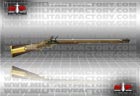
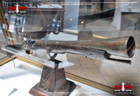
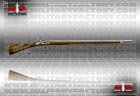
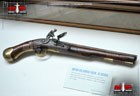
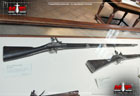
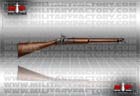
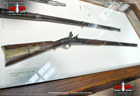
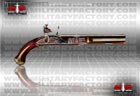
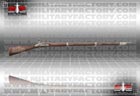
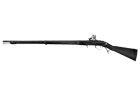
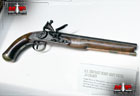
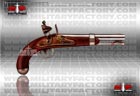
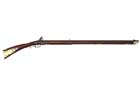
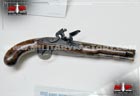
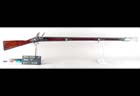
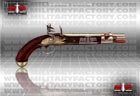
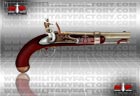
Flintlock guns appeared before the revolutionary percussion cap system and ruled warfare for some 200 years.
Flintlock was a firing action related to early firearms. The firing action consisted of a spring-loaded cock-lever containing a small amount of flint in the hold of a screw-tightened clamp. There was a steel "frizzen", or flashpan, for which the flint to work against. The frizzen covered the supply of gunpowder. As the charge and ball were loaded down into the barrel muzzle-first by way of a ramrod, the operator would then set the cock to be 'half-cocked' and have his weapon ready to fire. When aimed and ready, the operator would then set the cocking lever to 'full-cock';. Pulling the trigger began the firing action for the trigger let loose the cock-lever to which struck the flint against the frizzen. The struck frizzen would expose the gunpowder in the flash pan through a 'touch hole' to the resultant sparks. The resulting spark ignited the gunpowder and set off the main charge, the resulting pressure firing the bullet out of the barrel. Flintlock guns served the world for some 200 to 300 years before being replaced by the percussion principle.
There are a total of [ 20 ] Historical Flintlock Firearms entries in the Military Factory. Entries are listed below in alphanumeric order (1-to-Z). Flag images indicative of country of origin and not necessarily primary operator.
The "Military Factory" name and MilitaryFactory.com logo are registered ® U.S. trademarks protected by all applicable domestic and international intellectual property laws. All written content, illustrations, and photography are unique to this website (unless where indicated) and not for reuse/reproduction in any form. Material presented throughout this website is for historical and entertainment value only and should not to be construed as usable for hardware restoration, maintenance, or general operation. We do not sell any of the items showcased on this site. Please direct all other inquiries to militaryfactory AT gmail.com. No A.I. was used in the generation of this content.