Military Factory
Military Pay Chart
Global Firepower
Military Industrial Complex
Second World War
Home
Military Pay Scale
Military Ranks
Small Arms
Aircraft
Land Systems
Navy
Education
Military Factory Facebook Logo
flag of Nazi Germany

7.5cm Leichtgeschutz 40 (LG 40) Recoilless Rifle (1941)

Authored By Staff Writer | Last Updated: 4/8/2013

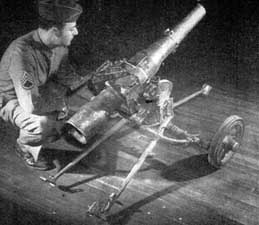
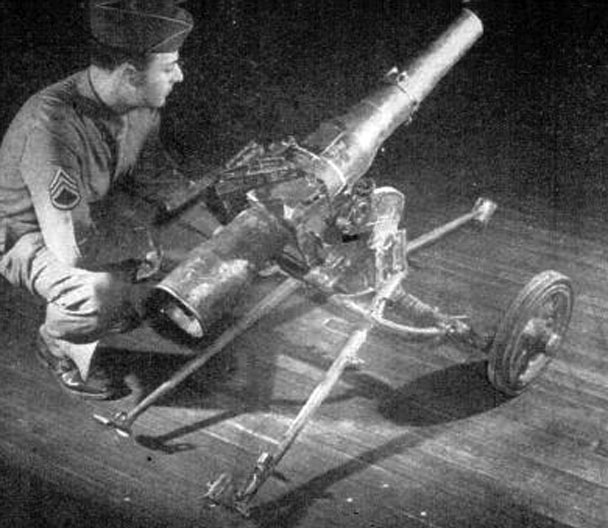
The 7.5cm Leichtgeschutz 40 recoilless weapon was developed for use by lightly armed airborne elements of the German military.

Find a School Near You
Follow Military Factory on Facebook:
Trending on Military Factory:
Recent Articles:
One of the greatest challenges facing warplanners since the advent of the air-dropped warrior - popularly known as the "paratrooper" - was in equipping these soldiers with weaponry beyond their personal standard issue implements. World War 2 spurred development of such systems and these went on to include all manner of solutions such as air-droppable light tanks and artillery. Beginning in 1937, two years before the German invasion of Poland, Rheinmetall began work (edging out rival Krupp) on a recoilless gun design for the German military - specifically its Luftwaffe paratroopers who would be charged with airdropping behind enemy lines, capturing and, most importantly, securing strategic positions ahead of the main operating land force. Targets could include airfields, bridges or key chokepoints that would be well-defended and surprise was the ultimate advantage. The recoilless gun design was adopted by the German military in 1940 and initially assigned the designation of LG1 ("7.5cm Leichtgeschutz 1") though this was quickly given up for the more traditional "LG40" designation to indicate its initial year of existence (1940). The "LG" in the designation was formed from the word "Leichtgeschutz" which translated applicably to "Lightweight Gun". Full-scale production began in 1941.

Recoilless weapon systems allowed for a large-caliber projectile to be launched from a tubular barrel assembly without the need for a complex and heavy recoil system to manage the violent counter-force of the action. This decreased manufacturing time, lightened overall weight and provided a relatively devastating weapon for troops that were traditionally lightly armed by nature. Recoilless weapons would eventually come in two flavors - their barrels either "rifled" with grooves used in rotation of the projectile (for accuracy and extended ranges) and "smoothbore" (the barrel internal lining left smooth, offering no rotation to the projectile while expediting production and lengthening service life of the assembly) - and each was specifically designated as either a "recoilless rifle" or "recoilless gun" respectively. However, the generic term "recoilless rifle" has gone on to designate both types in contemporary documents despite the technicality.

The recoilless rifle/gun was a weapon that could be used in a dual-purpose (DP) role - either as a dedicated artillery-projecting system or as an anti-tank measure depending on the battlefield requirement (and projectile being utilized). The recoilless feature of such weapons allowed for a relatively lightweight design - usually requiring just a crew of two - that could be transported by hand across uneven terrain as needed. However, the recoilless nature of such weapons often restricted engagement ranges and penetration was retarded by a lower launching velocity. As such, they were not a whole battlefield solution though, considering the limitations of the airborne trooper's inventory, they proved a reliable and effective weapon projector nonetheless.

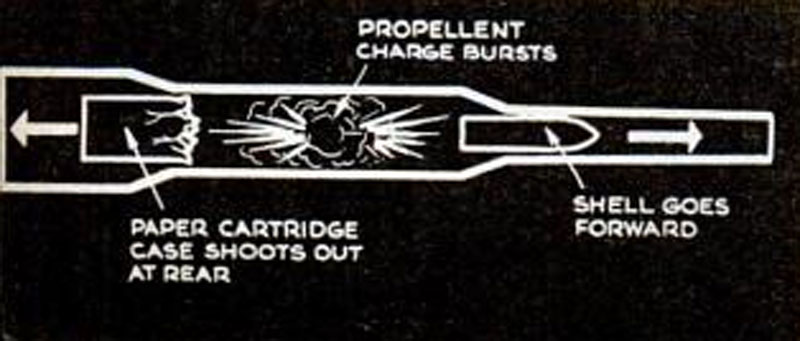
Recoilless rifles did away with their inherently violent recoil forces of the launching munition by providing a complete pre-fabricated single-piece projectile/propellant solution with the exiting propellants forced through the rear of the launch tube (as opposed to it exiting through the muzzle end of the barrel as in a conventional gun). The action therefore consisted of a forward force - the exiting shell - and a rearward countering force - the ejecting cartridge case through the butt of the gun. In this fashion, the recoil force was "controlled". This is not to say that the recoilless weapon did not inherit some form of recoil blast in itself - for it did - though most of the pressures were alleviated through the recoilless action. The overall action relied on a well-vented gas system and, thusly, maintenance of such weapons became exceedingly high over time (when compared to conventional rifled artillery weapons) to prevent fouling of the main action.

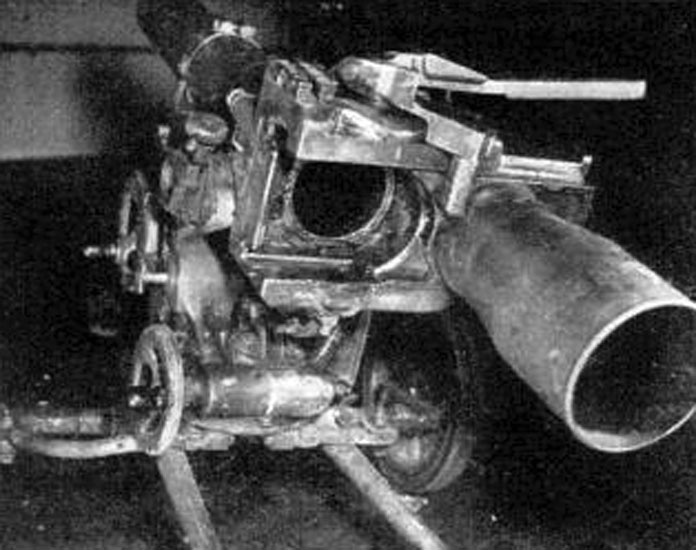
The German LG40 series utilized two specific types of projectiles - a High-Explosive (75x130mm R HE) and an Armor-Piercing (75x200mm R AP) type. These were simply modified variants of existing artillery shells, differentiated only by their cartridge casings (made of paper), which significantly sped up manufacture of each breed. The HE variant was the 7.5cm (75mm) Gebirgsgeschutz 36 while the AP variant was the 7.5cm Feldkanone 16 (New Model) and the 75mm caliber design of the projectile allowed it to be extremely powerful by 1930s/1940s battlefield standards (the same caliber of projectile was used in the Panzer 4 medium tank for example). The 75mm projectile of the LG40 was loaded through the breech of the weapon (as opposed to the muzzle end of the barrel as in a field mortar) utilizing a handle atop the breech which slid the block to the right side, thusly exposing the now-open barrel base for insertion of the 75mm shell.

The weapon, as a whole, weighed several hundred pounds and the barrel (with a tapered neck ahead of its middle section) sported a running length of 1.5 feet (2.5 feet when secured to its mounting support system). The breech consisted of a horizontal sliding breech block similar to those uses by field artillery systems. The gun barrel could be elevated (via a hand wheel) between -15 and +42 degrees for varying attack angles and traverse was effectively a full 360-degrees when attacking line-of-sight targets. A trained and experienced gunnery crew could fire approximately 3 to 6 rounds per minute out to 7,400 yards, giving paratroopers a good "reach" on the battlefield against enemy armor, troop concentrations and even fortifications (the latter to a certain extent). The launch tube sat on a two-wheeled trolley that featured metal (aluminum/magnesium alloy) support legs. The relatively compact size of the entire unit allowed for airdropping via parachute and relocation was simply by two crew grabbing a rear leg of the wheeled carriage and moving the weapon into position.

With the war in Europe now in full swing by 1941, the LG40 was in serial production and fielded in the German invasion of Crete (spawning the famous "Battle of Crete"). The battle commenced on May 20th, 1941 and would last some 11 days as 14,000 German paratroopers were flown in and supported by bombers, gliders and allied units in the attack on positions held by British, Greek, Australian and New Zealand troops. The campaign cost over 23,800 Allies to the comparatively low Axis total of 6,698 (2,700 Italian troops supported the Germans in the assault) and proved an utter German-Axis success early in the war.

The LG40 was fielded in the invasion across two parachute artillery batteries. Troopers enjoyed the relatively lightweight nature of the design and the hitting power of their 75mm shells against all manner of targets. The weapon could fire and be quickly relocated to fire again within minutes and engagement across uneven terrain allowed for firing in elevated mountainous areas. However, the LG40 design was not without its faults for the gas expulsion system proved temperamental and the mounting support system was prone to breakage after extended use. It is notable that neither issue restricted overall use of the weapon during its service life which ran over the entire course of the war -the LG40 saw service into 1945 (the final year of the war). Captured specimens by the Allies proved that the LG40 did in fact offer little to no recoil in practice.

In all, 450 LG40 guns were produced for the German air and land forces (including the Waffen-SS). The success of the 7.5cm LG40 weapon in Crete ushered in the larger-caliber Krupp "10cm LG40" design of 1942.
Text ©2003-2013 www.MilitaryFactory.com • All Rights Reserved • No Reproduction Permitted
MilitaryFactory.com does NOT sell equipment/weaponry. Material presented throughout this website is for historical and entertainment value and should not to be construed as usable for hardware restoration, maintenance or general operation. Please consult manufacturers for such information. Our disclaimer. Email corrections / Comments to MilitaryFactory at Gmail dot com.
Picture of 7.5cm Leichtgeschutz 40 (LG 40)
Pic of the 7.5cm Leichtgeschutz 40 (LG 40)
Image of the 7.5cm Leichtgeschutz 40 (LG 40)
View All Images (3)

Specifications for the
7.5cm Leichtgeschutz 40 (LG 40)
Recoilless Rifle


Country of Origin: Nazi Germany
Manufacturer: Rheinmetall - Nazi Germany
Initial Year of Service: 1941


Overall Length: 750mm (29.53in)
Barrel Length: 458.00mm (18.03in)
Weight (Empty): 319.67lbs (145.00kg)


Cartridge: 75x103mm (HE); 75x200mm (AP)
Action: Recoiless; Single-Shot; Reusable
Feed: Single-Shot
Muzzle Velocity: 1,150ft/sec (351m/sec)
Rate-of-Fire: 6 rounds per minute
Range: 22,300ft (6,797m; 7,433yds)
Sights: Iron


Variants:
7.5cm Leichtgeschutz 1 (LG 1) - Initial Production Designation.


7.5cm Leichtgeschutz 40 (LG 40) - Base Series Designation.


Operators: Nazi Germany

ALL SMALL ARMS CATEGORIES

BY YEAR:


1700 to 1799
1800 to 1899
1900 to 1909
1910 to 1919
1920 to 1929
1930 to 1939
1940 to 1949
1950 to 1959
1960 to 1969
1970 to 1979
1980 to 1989
1990 to 1999
2000 to 2009
2010 to 2019
VIEW ALL
Compare Guns


BY TYPE:


Anti-Aircraft Weapons
Anti-Material Rifles
Anti-Tank Weapons
Automatic Rifles
Bolt-Action Rifles
Carbine Guns
Flamethrowers
Flintlock Guns
Grenade Launchers
Hand Grenades
Lever-Action Rifles
Machine Guns
Mortars
Musket Guns
Pistols / Handguns
Recoilless Rifles
Revolvers
Rocket Launchers
Shotguns
Silenced Guns
Sniper Rifles
Special Weapon Systems
Submachine Guns
VIEW ALL


SPECIAL:


18th Century Warfare
3 Soldiers Statue
Battle of Mogadishu
Chainmail Armor
Firearm Types Defined
French Military Victories
Medieval Crossbow
Medieval Longbow
Vietnam War Casualties
Vietnam War Memorial

WORLD WAR 2:


British Guns
French Guns
German Guns (ALL)
German Rifles
Italian Guns
Japanese Guns
Soviet Guns
US Guns
US Infantry Regiment-Level Guns
Machine Guns
Pistols
Submachine Guns
Sniper Rifles
VIEW ALL


WORLD WAR 1:

Pistols
Rifles
Machine Guns
Mortars
US Guns
VIEW ALL


KOREAN WAR:

Machine Guns
VIEW ALL


VIETNAM WAR:

Mortars
VIEW ALL


COLLECTIONS:


Ancient Weapons
British SAS Weapons
Civil War Guns
Colt Guns
Glock Guns
GROM Polish Special Forces
Guns of Libya
Guns of North Korea
Guns of Syria
Guns of WW1 & WW2
Heckler & Koch Guns
Kalashnikov Guns
Modern Russian Guns
Navy SEAL Weapons
Spetsnaz Weapons
Weapons of Desert Storm
Wild West Guns
Winchester Guns


HOLLYWOOD/GAMES:


Guns of the Walking Dead

Site Disclaimer | Privacy Policy | Site Map | MF Origins


©2013 www.MilitaryFactory.com • Content ©2003-2013 MilitaryFactory.com • All Rights Reserved • Site Contact Email: militaryfactory at gmail dot com. The "Military Factory" name and MilitaryFactory.com logo are registered ® trademarks and protected by all applicable domestic and international intellectual property laws.


Top MF Stuff: 2013 Military Pay Scale | Military Ranks | WW2 Weapons | Sniper Rifles | Kts to Mph | WW1 Aircraft | Automatic Rifles | Aircraft Cockpits | Vietnam War Weapons | Main Battle Tanks | Submachine Guns | Shotguns | French Military Victories


Most photographic images appearing on this site are courtesy of the United States Department of Defense and are approved for public use. Other images acquired through the public domain. Digital art work courtesy of Dan Alex. Business Consulting by Kyle Williams. Material presented throughout this website is for historical and entertainment value and should not to be construed as usable for hardware restoration, maintenance or general operation. Please consult manufacturers for such information.


eXTReMe Tracker