Military Factory
Military Pay Chart
Global Firepower
Military Industrial Complex
Second World War
Home
Military Pay Scale
Military Ranks
Small Arms
Aircraft
Land Systems
Navy
Education
Military Factory Facebook Logo
flag of Imperial Germany

Mauser Model 1871 Bolt-Action Service Rifle (1872)

Authored By Staff Writer | Last Updated: 7/28/2012

The Mauser Model 1871 was the beginning of the Mauser legend.

Find a School Near You
Follow Military Factory on Facebook:
Trending on Military Factory:
Recent Articles:
The Mauser brothers - Paul and Wilhelm - entered firearms history when their Mauser Model 1871 was adopted by the German Army (as the "Gewehr 71"). It became the first such rifle to fire the newly-adopted standardized brass cartridge of the German Army and became one of the first successful examples of a bolt-action design firing a metallic cartridge anywhere in the world. The original weapon series went on to see service until approximately 1888 and ultimately took part in several conflicts of the period including the First Sino-Japanese War, the Boer War, the Boxer Rebellion, the Balkan Wars and World War 1. Variants emerged from the base design and this furthered the reach of the Mauser brand and its respected action - and action that would be borrowed or copied in one form or another for decades later.

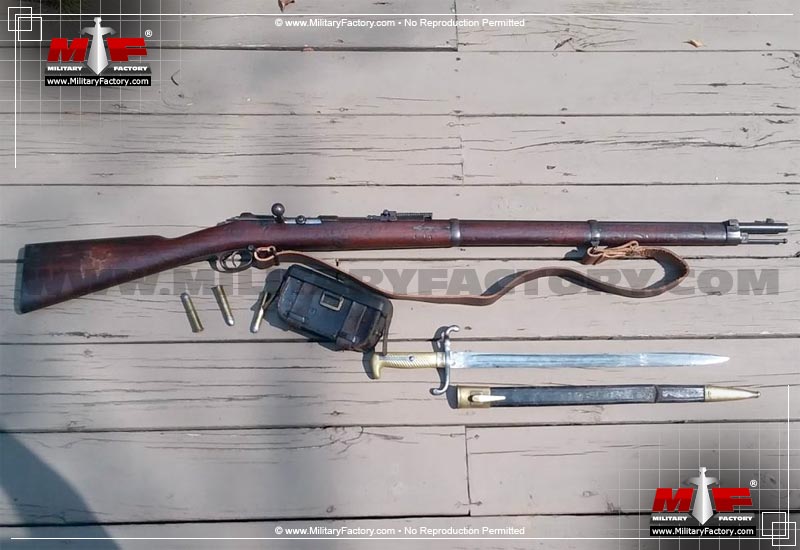
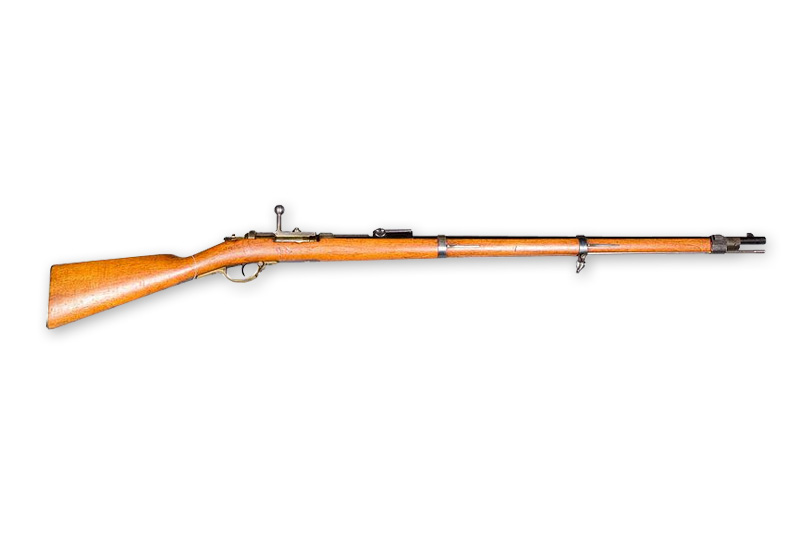
The Model 1871 was of a standard manually-actuated bolt-action design with its bolt handle managing the loading and ejecting of the cartridge. The rifle weighed in at 4.5 kilograms and measured a running length of 1,350mm, being chambered for an 11x60mmR black powder cartridge. It was initially a single-shot rifle design at its core and, as such, there was no integral magazine box as part of the system. Only a later design - the Model 1871/84 (1884) - brought about use of an 8-round tubular magazine, broadening the tactical value of the rifle line considerably. The introduction of the 8-round tubular magazine made the updated Model 1871 Germany's first "repeat-fire" rifle. Another form, the Model 1879, was issued to border guards and chambered for the special 11.15x37.5mmR cartridge - this based on the full-power military-grade version. Overall, these early Mauser rifles all shared the same basic design approach utilizing a single-piece wooden stock with integrated shoulder stock, straight grip and two banded design. Slings allowed for use of a shoulder strap while bayonet mountings were standard, consistent with the warfare doctrine of the period where bayonet charges were still in use. The trigger sat within an oblong trigger ring and all of the major internal working components were held within the mass of the rifle body as expected. There were rear- and front-mounted iron sights for ranged work and overall construction of the rifle consisted of a mix of wood, bronze and iron.

Design work on the weapon began in 1871 and evaluations of it (and other designs) were held throughout the year, leading to the rifle's formal adoption in 1872. The delay was caused by the German Army's requirement that a safety be fitted to which Mauser obliged. Production was undertaken by Spandau in Germany and Steyr in Austria-Hungary with local production even reaching English shores through the concern of the National Arms and Ammunition Company of Birmingham. Many more rifles emerged from localized production elsewhere. Serbian versions of the Model 1871 (Model 1878/80) were later re-chambered for the 7x57mm cartridge and fed from a 5-round magazine (becoming the Model 1880/07). Similarly, Uruguayan Model 1871s evolved their Mauser line to fire a smaller 6.5x53.5mmR cartridge. The Mauser Model 1871 was produced in the millions during its operational service life and operators also included Japan, China, Korea, Ireland and Honduras.
Text ©2003-2013 www.MilitaryFactory.com • All Rights Reserved • No Reproduction Permitted
MilitaryFactory.com does NOT sell equipment/weaponry. Material presented throughout this website is for historical and entertainment value and should not to be construed as usable for hardware restoration, maintenance or general operation. Please consult manufacturers for such information. Our disclaimer. Email corrections / Comments to MilitaryFactory at Gmail dot com.
Picture of Mauser Model 1871
View All Images (1)

Specifications for the
Mauser Model 1871
Bolt-Action Service Rifle


Country of Origin: Imperial Germany
Manufacturer: Spandau - Imperial Germany;
Initial Year of Service: 1872


Overall Length: 1350mm (53.15in)
Barrel Length: 855.00mm (33.66in)
Weight (Empty): 9.92lbs (4.50kg)


Cartridge: 11x60mmR; 10.15x63R; 11.15x37.5R; 9.5x60R; 7x57mm; 7.65x53mm; 6.5x53.5R
Action: Manually-actuated bolt
Feed: Single-Shot (initially)
Rate-of-Fire: 2 rounds per minute
Sights: Iron front and rear


Variants:
Model 1871 - Initial single-shot production form; adopted in 1872.


Model 1879 - Shortened form for Border Guard duty; chambered for 11.15x37.5mmR cartridge; appearing in 1879.

Model 1871/84 - 8-shot tubular magazine; appearing in 1884.


Operators: Britain; China; Imperial Germany; Ireland; Japan; Korea; Serbia; Uruguay

ALL SMALL ARMS CATEGORIES

BY YEAR:


1700 to 1799
1800 to 1899
1900 to 1909
1910 to 1919
1920 to 1929
1930 to 1939
1940 to 1949
1950 to 1959
1960 to 1969
1970 to 1979
1980 to 1989
1990 to 1999
2000 to 2009
2010 to 2019
VIEW ALL
Compare Guns


BY TYPE:


Anti-Aircraft Weapons
Anti-Material Rifles
Anti-Tank Weapons
Automatic Rifles
Bolt-Action Rifles
Carbine Guns
Flamethrowers
Flintlock Guns
Grenade Launchers
Hand Grenades
Lever-Action Rifles
Machine Guns
Mortars
Musket Guns
Pistols / Handguns
Recoilless Rifles
Revolvers
Rocket Launchers
Shotguns
Silenced Guns
Sniper Rifles
Special Weapon Systems
Submachine Guns
VIEW ALL


SPECIAL:


18th Century Warfare
3 Soldiers Statue
Battle of Mogadishu
Chainmail Armor
Firearm Types Defined
French Military Victories
Medieval Crossbow
Medieval Longbow
Vietnam War Casualties
Vietnam War Memorial

WORLD WAR 2:


British Guns
French Guns
German Guns (ALL)
German Rifles
Italian Guns
Japanese Guns
Soviet Guns
US Guns
US Infantry Regiment-Level Guns
Machine Guns
Pistols
Rifles
Submachine Guns
Sniper Rifles
VIEW ALL


WORLD WAR 1:

Pistols
Rifles
Machine Guns
Mortars
US Guns
VIEW ALL


KOREAN WAR:

Machine Guns
VIEW ALL


VIETNAM WAR:

Mortars
VIEW ALL


COLLECTIONS:


Ancient Weapons
British SAS Weapons
Civil War Guns
Colt Guns
Glock Guns
GROM Polish Special Forces
Guns of Libya
Guns of North Korea
Guns of Syria
Guns of WW1 & WW2
Heckler & Koch Guns
Kalashnikov Guns
Modern Russian Guns
Navy SEAL Weapons
Spetsnaz Weapons
Weapons of Desert Storm
Wild West Guns
Winchester Guns


HOLLYWOOD/GAMES:


Guns of the Walking Dead

Site Disclaimer | Privacy Policy | Site Map | MF Origins


©2013 www.MilitaryFactory.com • Content ©2003-2013 MilitaryFactory.com • All Rights Reserved • Site Contact Email: militaryfactory at gmail dot com. The "Military Factory" name and MilitaryFactory.com logo are registered ® trademarks and protected by all applicable domestic and international intellectual property laws.


Top MF Stuff: 2013 Military Pay Scale | Military Ranks | WW2 Weapons | Sniper Rifles | Kts to Mph | WW1 Aircraft | Automatic Rifles | Aircraft Cockpits | Vietnam War Weapons | Main Battle Tanks | Submachine Guns | Shotguns | French Military Victories


Most photographic images appearing on this site are courtesy of the United States Department of Defense and are approved for public use. Other images acquired through the public domain. Digital art work courtesy of Dan Alex. Business Consulting by Kyle Williams. Material presented throughout this website is for historical and entertainment value and should not to be construed as usable for hardware restoration, maintenance or general operation. Please consult manufacturers for such information.


eXTReMe Tracker