Military Factory
Military Pay Chart
Global Firepower
Military Industrial Complex
Second World War
Home
Military Pay Scale
Military Ranks
Small Arms
Aircraft
Land Systems
Navy
Education
Military Factory Facebook Logo
flag of Spain

CETME Modelo 58 / Modelo B (Assault Rifle Modelo 58 / Modelo B) Assault Rifle (1958)

Authored By Staff Writer | Last Updated: 3/14/2012

The CETME Model 58 was a further evolution of the German wartime StG 45 prototype.

Find a School Near You
Follow Military Factory on Facebook:
Trending on Military Factory:
Recent Articles:
The CETME Model 58 holds its origins in the StG 45(M) assault rifle prototype of World War 2. This automatic weapon was in the stages of design during the last few months of the war and only completed in extremely limited numbers - perhaps as few as 30 examples were in circulation - before the end of the war in Europe in May of 1945. Design of the weapon was attributed to Wilhelm Stahle and work on the type began in 1944 under the charge of the fabled Mauser concern. The system was chambered the fire the 7.92x33mm Kurtz (Short) intermediate cartridge and, what made it most unique, it attempted the firing action from a "roller-delayed blowback" assembly first tested in an experimental MG 42 machine gun. This operation essentially involved two locking rollers situated to either side of the firing pin near the base of the cartridge, engaging the sides of the receiver during the firing action and delaying the movement of the bolt head - the barrel remaining fixed in place. The principle was adopted as a cost-effective alternative to the proposed gas-operated, roller-locked breech system intended for the StG 45.

Following the war, many German engineers left Germany proper and some of the Mauser engineers landed in Spain working for the government-run Centro de Estudios Tecnicos de Materiales Especiales ("Technical Studio of Special Materials") - or better known in its abbreviated form as "CETME". Further development of this delayed blowback system ensued until it was refined to the point of proving viable in a rifle frame. Like the original Mauser design, the new automatic weapon was also chambered for the 7.92mm cartridge.

Intent on selling the design to an interested party, the technology was showcased to the West German Army through the Dutch. However, Germany was intent on finding a logistically friendly service rifle in line with the 7.62x51mm NATO standard cartridge. The CETME group continued worked on their design attempt and produced an automatic rifle chambered for a reduced-charge 7.62mm cartridge (7.62x51mm CETME) for sale to the Spanish Army. The resulting product was then offered - and formally adopted - by the Spanish Army in 1958 under the designation of "Assault Rifle Modelo 58". This became the first recorded use of a service rifle utilizing the delayed blowback principle. The West German Army evaluated various competing designs and eventually centered on the CETME rifle - though slightly revised to take on the full-power 7.62x51mm NATO cartridge. License production was undertaken in West Germany as the Heckler & Koch G3 and entered service in 1959, going on to see widespread use around the world in countless conflicts. The Model 58, however, would not repeat this global success.

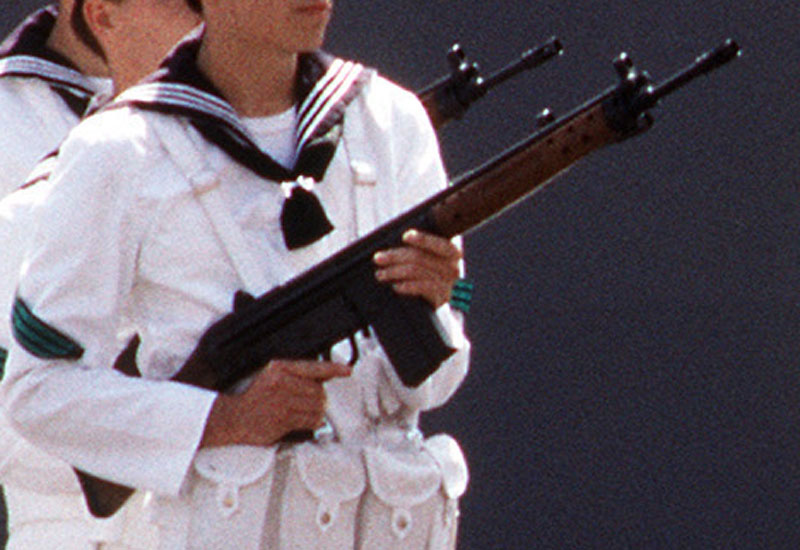
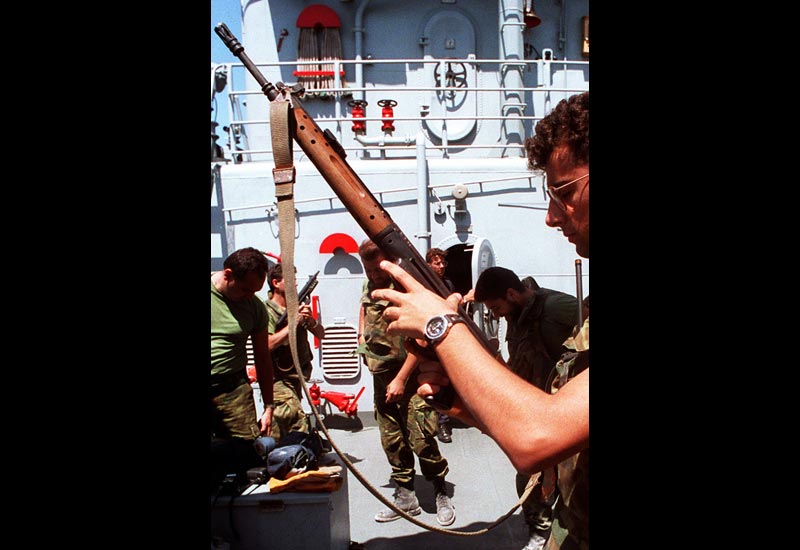
Outwardly, the CETME design certainly followed the lines of the German HK G3 but was an all-Spanish weapon through and through. It sported a solid stock attached to a well-contoured receiver containing all of the pertinent internal working components. The pistol grip was well-angled to the rear of the receiver for a firm, ergonomic hold while the curved trigger unit was set within an oblong trigger ring. The magazine well was ahead of the trigger group and accepted a curved, detachable box magazine with 20 rounds of ammunition. The barrel extended from the forward portion of the receiver and was capped by a flash suppressor. Internally, the CETME matched the HK G3 including its unique delayed blowback operation. A folding bipod was served as standard in original production models and joined at the barrel, aft of the muzzle. When folded, the bipod doubled as a forward grip area so the operator would not touch a hot barrel. Protection n this sense was eventually improved in later production models to help lessen the risk of exposure to the generated heat. The rifle was sighted through a front and rear installation.

Overall length of the CETME Model 58 was approximately 40 inches with the system relying on a 17.7 inch barrel. Weight was in the vicinity of 9lbs. The listed rate-of-fire was 550 to 650 rounds per minute with a muzzle velocity nearing 2,580 feet per second.

On notable change to the CETME Model 58 line occurred in 1974 when the Spanish Army officially made a move to the full-power 7.62x51mm NATO standard cartridge. This decision forced the CETME Model 58 to be internally reworked to accept the more powerful round. Marking this change, the revised rifle forms were designated CETME "Model C". The CETME Model C was then delivered in a 5.56x45mm form as the "Model L" which, in turn, served as the origination of the carbine "Model LC" - both variants appearing in 1988. Still another, even more compact form with many protrusions stripped, was issued to vehicle crews for firing from within their confined spaces.
Text ©2003-2013 www.MilitaryFactory.com • All Rights Reserved • No Reproduction Permitted
MilitaryFactory.com does NOT sell equipment/weaponry. Material presented throughout this website is for historical and entertainment value and should not to be construed as usable for hardware restoration, maintenance or general operation. Please consult manufacturers for such information. Our disclaimer. Email corrections / Comments to MilitaryFactory at Gmail dot com.
Picture of CETME Modelo 58 / Modelo B (Assault Rifle Modelo 58 / Modelo B)
Pic of the CETME Modelo 58 / Modelo B (Assault Rifle Modelo 58 / Modelo B)
View All Images (2)

Specifications for the
CETME Modelo 58 / Modelo B (Assault Rifle Modelo 58 / Modelo B)
Assault Rifle


Country of Origin: Spain
Manufacturer: Centro de Estudios Tecnicos de Materiales Especiales (CETME) - Spain
Initial Year of Service: 1958


Overall Length: 1015mm (39.96in)
Barrel Length: 450.00mm (17.72in)
Weight (Empty): 9.92lbs (4.50kg)


Cartridge: 7.62x51mm CETME; 7.62x51mm NATO
Action: Roller-Locked, Delayed Blowback
Feed: 20-round detachable box magazine
Muzzle Velocity: 2,580ft/sec (786m/sec)
Rate-of-Fire: 600 rounds per minute
Sights: Iron Front and Rear


Variants:
Modelo A - Prototype Form


Modelo A1 - Revised Prototype Form

Modelo 58 - Base Series Designation; chambered for a reduced-charge 7.62mm CETME cartridge.

Modelo B - Main Production Designation

Modelo C - Revised form chambered for the full-powered 7.62x51mm NATO cartridge; appearing in 1974; lighter overall weight.

Modelo E - Proposed revised CETME Modelo C with plastic furniture; weaknesses in modifications led to this conversion being dropped.

Modelo L - Chambered for the 5.56x45mm NATO cartridge; appearing in 1988.

Modelo LC - Carbine form of the Model L; appearing in 1988.

C2 - Compact submachine gun in the mold of the Sterling SMG series.

Ameli - Light Automatic Weapon Variant


Operators: Spain

ALL SMALL ARMS CATEGORIES

BY YEAR:


1700 to 1799
1800 to 1899
1900 to 1909
1910 to 1919
1920 to 1929
1930 to 1939
1940 to 1949
1950 to 1959
1960 to 1969
1970 to 1979
1980 to 1989
1990 to 1999
2000 to 2009
2010 to 2019
VIEW ALL
Compare Guns


BY TYPE:


Anti-Aircraft Weapons
Anti-Material Rifles
Anti-Tank Weapons
Automatic Rifles
Bolt-Action Rifles
Carbine Guns
Flamethrowers
Flintlock Guns
Grenade Launchers
Hand Grenades
Lever-Action Rifles
Machine Guns
Mortars
Musket Guns
Pistols / Handguns
Recoilless Rifles
Revolvers
Rocket Launchers
Shotguns
Silenced Guns
Sniper Rifles
Special Weapon Systems
Submachine Guns
VIEW ALL


SPECIAL:


18th Century Warfare
3 Soldiers Statue
Battle of Mogadishu
Chainmail Armor
Firearm Types Defined
French Military Victories
Medieval Crossbow
Medieval Longbow
Vietnam War Casualties
Vietnam War Memorial

WORLD WAR 2:


British Guns
French Guns
German Guns (ALL)
German Rifles
Italian Guns
Japanese Guns
Soviet Guns
US Guns
US Infantry Regiment-Level Guns
Machine Guns
Pistols
Rifles
Submachine Guns
Sniper Rifles
VIEW ALL


WORLD WAR 1:

Pistols
Rifles
Machine Guns
Mortars
US Guns
VIEW ALL


KOREAN WAR:

Machine Guns
VIEW ALL


VIETNAM WAR:

Mortars
VIEW ALL


COLLECTIONS:


Ancient Weapons
British SAS Weapons
Civil War Guns
Colt Guns
Glock Guns
GROM Polish Special Forces
Guns of Libya
Guns of North Korea
Guns of Syria
Guns of WW1 & WW2
Heckler & Koch Guns
Kalashnikov Guns
Modern Russian Guns
Navy SEAL Weapons
Spetsnaz Weapons
Weapons of Desert Storm
Wild West Guns
Winchester Guns


HOLLYWOOD/GAMES:


Guns of the Walking Dead

Site Disclaimer | Privacy Policy | Site Map | MF Origins


©2013 www.MilitaryFactory.com • Content ©2003-2013 MilitaryFactory.com • All Rights Reserved • Site Contact Email: militaryfactory at gmail dot com. The "Military Factory" name and MilitaryFactory.com logo are registered ® trademarks and protected by all applicable domestic and international intellectual property laws.


Top MF Stuff: 2013 Military Pay Scale | Military Ranks | WW2 Weapons | Sniper Rifles | Kts to Mph | WW1 Aircraft | Automatic Rifles | Aircraft Cockpits | Vietnam War Weapons | Main Battle Tanks | Submachine Guns | Shotguns | French Military Victories


Most photographic images appearing on this site are courtesy of the United States Department of Defense and are approved for public use. Other images acquired through the public domain. Digital art work courtesy of Dan Alex. Business Consulting by Kyle Williams. Material presented throughout this website is for historical and entertainment value and should not to be construed as usable for hardware restoration, maintenance or general operation. Please consult manufacturers for such information.


eXTReMe Tracker