Military Factory
Military Pay Chart
Global Firepower
Military Industrial Complex
Second World War
Home
Military Pay Scale
Military Ranks
Small Arms
Aircraft
Land Systems
Navy
Education
Military Factory Facebook Logo
flag of United States

Manhattan Navy Revolver (1859)

Authored By Staff Writer | Last Updated: 5/20/2013

After Colt patents had expired, firms like the Manhattan Firearms Company copied successful Colt revolver designs such as the Navy.

Find a School Near You
Follow Military Factory on Facebook:
Trending on Military Factory:
Recent Articles:
Manhattan Firearms Company was established by a committee of businessmen in 1856 in preparation for the expiration of Colt revolver patents upcoming in 1857. Production began immediately at the Manhattan facility in Norwich, Connecticut but by 1859, production had been moved to a new facility in Newark, New Jersey. Before the patents had officially expired, however, Manhattan busied itself with manufacture of other expired patent firearms - primarily single-shot revolvers and percussion "pepperboxes". Once the Colt patents became available for copy, the Manhattan concern moved in to cash in and delivered their version of the famous Colt Model 1851 Navy and Model 1849 Pocket revolver models.

The Manhattan versions were nearly identical to the Colt products, so much so that the Colt concern moved in with a lawsuit to prevent their production. Nevertheless, Manhattan generated some 80,000 units sold before the end of their run. The Manhattan Navy was discernable from the original Colt in that they machined extra safety notches along the cylinder which became the primary identifier throughout the years following. Manhattan guns did make an appearance in the American Civil War as did many other lesser known firearms of the time - war dictated the need for just about any viable firearm in existence and firms like Manhattan were not blind to the requirement.

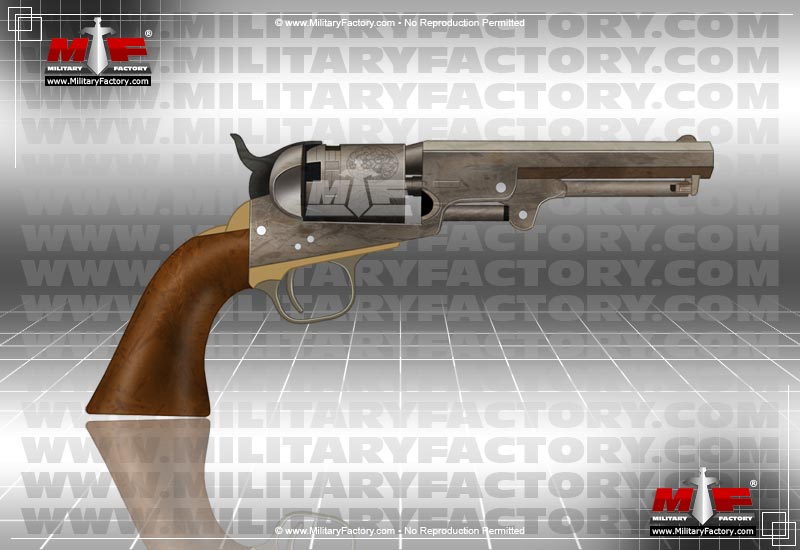
Manhattan Navy revolvers mimicked much of what made Colt revolvers exquisite firearms. Lines were sharp and curved were smooth, exuding both elegance and functionality. Like Colt revolvers before it, the frame was open-topped in nature unlike competing Remingtons. The barrel was octagonal with a loading lever managed underneath the barrel, the lever actuating the integrated rammer against the cylinder chambers. The grips were covered in beautiful walnut and the cylinders unfluted and engraved like the Colts. The hammer was capped by a handy spur for management by the thumb or free hand. The curved trigger unit sat with an oblong brass trigger ring. Loading of the gunpowder and ball ammunition was through the front of the cylinder (5- or 6-shot depending on the model). Percussion caps were affixed to each chamber on the rear portion of the cylinder by hand. The hammer fell onto the cap, providing the spark needed for the ignition of the gunpowder. A front sight was added aft of the muzzle. In all, Manhattan Navy revolvers were mechanically sound, owing much to the original Colt design.

The Manhattan Navy appeared in a variety of series beginning with the original Series I of 1859 of which over 4,000 were produced. The available series were differentiated by serial numbers and available barrel lengths, measuring between 4" and 6.5". The Series II appeared in early January of 1860, numbering perhaps as many as 10,000 examples, while Series III came online in September of 1861 in approximately 30,000 examples. Series IV was first made available in April of 1864 and numbered 24,000 while the final Series V (with its tapered loading lever) appeared from June 1867 onwards in as many as 9,000 examples. Final production lasted until December 1868 of the Series V. Series I through Series IV were all five-shot revolvers while the Series V was of six-shot. All were, however, chambered for the .36 ball cartridge.

The Manhattan concern observed the government contracts being earned by competitors during the American Civil War and chose instead to own the civilian market with their guns. However, this is not to say that Manhattan copied guns were not made available to soldiers in the war, mostly through private purchase. In any case, Manhattan Navy revolvers are a true rarity today, with a decidedly few die-hards having fallen under the spell of the series.

In the post-war world, Manhattan eventually moved on to copying other gun designs including the Smith & Wesson .22 known as the Manhattan "Tip Up". All told, Manhattan production of firearms actually rivaled that of powerhouses Colt and Remington with some 175,000 examples being manufactured. Beyond the Manhattan name, its guns fell under the "London Pistol Company" and "American Standard Tool" brandings. The company officially closed its doors in 1873.
Text ©2003-2013 www.MilitaryFactory.com • All Rights Reserved • No Reproduction Permitted
MilitaryFactory.com does NOT sell equipment/weaponry. Material presented throughout this website is for historical and entertainment value and should not to be construed as usable for hardware restoration, maintenance or general operation. Please consult manufacturers for such information. Our disclaimer. Email corrections / Comments to MilitaryFactory at Gmail dot com.
Picture of Manhattan Navy
View All Images (1)

Specifications for the
Manhattan Navy
Revolver


Country of Origin: United States
Manufacturer: Manhattan Firearms Company - USA
Initial Year of Service: 1859


Overall Length: 0mm (0.00in)
Barrel Length: 127.00mm (5.00in)
Weight (Empty): 0.00lbs (0.00kg)


Cartridge: .36 Ball
Action: Single-Action; Repeating; Percussion Cap
Feed: 5- or 6-shot revolving cylinder
Sights: Front iron


Variants:
Series I - Production from 1859 to 1860; barrel lengths of 4", 5", 6" and 6.5".


Series II - Production from 1860 to 1861; barrel lengths of 4", 5" and 6.5".

Series III - Production from 1861 to 1864; barrel lengths of 4", 4.5", 5" and 6'5".

Series IV - Production from 1864 to 1867; barrel lengths of 4", 4.5", 5" and 6'5".

Series V - Produciton from 1867 to 1868; barrel lengths of 4", 4.5" and 6.5"; tapered loading lever.


Operators: United States

ALL SMALL ARMS CATEGORIES

BY YEAR:


1700 to 1799
1800 to 1899
1900 to 1909
1910 to 1919
1920 to 1929
1930 to 1939
1940 to 1949
1950 to 1959
1960 to 1969
1970 to 1979
1980 to 1989
1990 to 1999
2000 to 2009
2010 to 2019
VIEW ALL
Compare Guns


BY TYPE:


Anti-Aircraft Weapons
Anti-Material Rifles
Anti-Tank Weapons
Automatic Rifles
Bolt-Action Rifles
Carbine Guns
Flamethrowers
Flintlock Guns
Grenade Launchers
Hand Grenades
Lever-Action Rifles
Machine Guns
Mortars
Musket Guns
Pistols / Handguns
Recoilless Rifles
Revolvers
Rocket Launchers
Shotguns
Silenced Guns
Sniper Rifles
Special Weapon Systems
Submachine Guns
VIEW ALL


SPECIAL:


18th Century Warfare
3 Soldiers Statue
Battle of Mogadishu
Chainmail Armor
Firearm Types Defined
French Military Victories
Medieval Crossbow
Medieval Longbow
Vietnam War Casualties
Vietnam War Memorial

WORLD WAR 2:


British Guns
French Guns
German Guns (ALL)
German Rifles
Italian Guns
Japanese Guns
Soviet Guns
US Guns
US Infantry Regiment-Level Guns
Machine Guns
Pistols
Rifles
Submachine Guns
Sniper Rifles
VIEW ALL


WORLD WAR 1:

Pistols
Rifles
Machine Guns
Mortars
US Guns
VIEW ALL


KOREAN WAR:

Machine Guns
VIEW ALL


VIETNAM WAR:

Mortars
VIEW ALL


COLLECTIONS:


Ancient Weapons
British SAS Weapons
Civil War Guns
Colt Guns
Glock Guns
GROM Polish Special Forces
Guns of Libya
Guns of North Korea
Guns of Syria
Guns of WW1 & WW2
Heckler & Koch Guns
Kalashnikov Guns
Modern Russian Guns
Navy SEAL Weapons
Spetsnaz Weapons
Weapons of Desert Storm
Wild West Guns
Winchester Guns


HOLLYWOOD/GAMES:


Guns of the Walking Dead

Site Disclaimer | Privacy Policy | Site Map | MF Origins


©2013 www.MilitaryFactory.com • Content ©2003-2013 MilitaryFactory.com • All Rights Reserved • Site Contact Email: militaryfactory at gmail dot com. The "Military Factory" name and MilitaryFactory.com logo are registered ® trademarks and protected by all applicable domestic and international intellectual property laws.


Top MF Stuff: 2013 Military Pay Scale | Military Ranks | WW2 Weapons | Sniper Rifles | Kts to Mph | WW1 Aircraft | Automatic Rifles | Aircraft Cockpits | Vietnam War Weapons | Main Battle Tanks | Submachine Guns | Shotguns | French Military Victories


Most photographic images appearing on this site are courtesy of the United States Department of Defense and are approved for public use. Other images acquired through the public domain. Digital art work courtesy of Dan Alex. Business Consulting by Kyle Williams. Material presented throughout this website is for historical and entertainment value and should not to be construed as usable for hardware restoration, maintenance or general operation. Please consult manufacturers for such information.


eXTReMe Tracker