Military Factory
Military Pay Chart
Global Firepower
Military Industrial Complex
Second World War
Home
Military Pay Scale
Military Ranks
Small Arms
Aircraft
Land Systems
Navy
Education
Military Factory Facebook Logo
flag of Imperial Japan

Type 10 (Grenade) Fragmentation Hand / Rifle Grenade (1921)

Authored By Staff Writer | Last Updated: 2/12/2013

The indigenously-designed Type 10 fragmentation grenade became the first such weapon to be adopted and issued in quantity to Japanese troops.

Find a School Near You
Follow Military Factory on Facebook:
Trending on Military Factory:
Recent Articles:
The Type 10 grenade proved the first indigenously designed and adopted fragmentation grenade for the Empire of Japan. The weapon was born from observed experience in the use of hand grenades during World War 1 (1914-1918) and became a rather interesting multi-role system for the Empire of Japan's Imperial Japanese Army (IJA) in the lead-up to World War 2 (1939-1945). The Type 10 grenade could be lobbed in a traditional hand grenade fashion, fired from the muzzle of a basic service rifle or launched in mortar-style from the Type 10 Grenade Discharger. Design of the Type 10 grenade began in 1914, leading to an introduction of service in 1921. The Type 10 managed a combat actions into 1945 up to the capitulation of the Empire of Japan.

The fragmentation hand grenade was of a relatively simple function - the operator needing only to pull whatever safety/activation system was attached to the grenade body and lob the unit in the general direction of the target. From there, the grenade would end its time delay fuze and detonate, sending jagged fragments of metal within a large kill radius and beyond. If the grenade did not directly kill its intended target(s), it was guaranteed to maim or provide an excellent psychological effect.

For the Japanese Army, an indigenous grenade solution was the call of the day. The weapon would have to support firing from the muzzle of the then-IJA service rifle - the Arisaka Type 38, a bolt-action design with origins in 1905. The use of the grenade as a "rifle grenade" would broaden the tactical value and reach of the rifleman considerably. However, one early grenade program failed partly due to the rifle's inherent limitations (short barrel, small 6.5mm bore) and the temperamental propellant being utilized in the grenade itself.

The failure of this initial venture then pushed Japanese engineers in the direction of a German signal mortar design with origins in World War 1. With this proven pedigree, the Type 10 grenade was born and, with it, the Type 10 Grenade Discharger - essentially a portable 50mm grenade-launching, mortar-type system that could be issued to riflemen as required. Due to their design, the launch tube (with baseplate attached) was carried at the rifleman's belt and slung over the thigh, freeing his hands during a march. American GIs in World War 2, having come across examples of the Type 10 Grenade Discharger during the fighting across the Pacific, mistakenly understood the weapon to be fired from the thigh and nicknamed the design the "Knee Mortar".

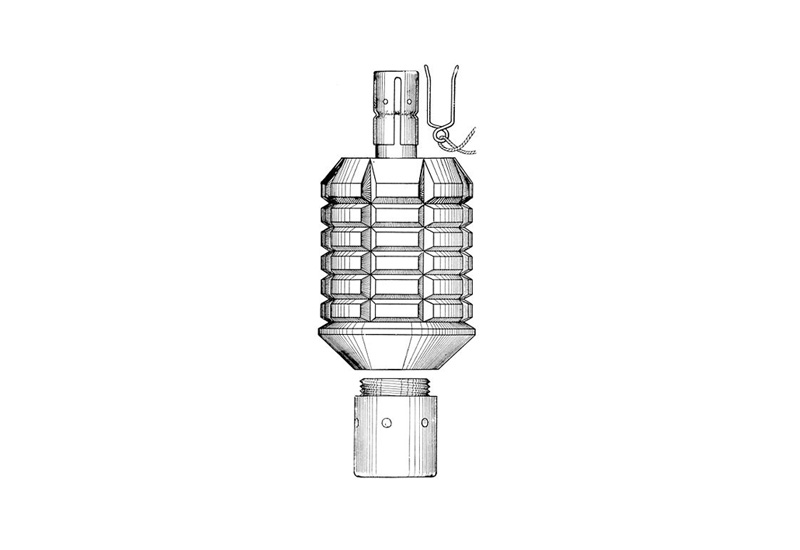
However, the Type 10 Grenade Discharger was only part of the Type 10 system - the other key component being the Type 10 grenade itself. Outwardly, the grenade was of a cylindrical design with a grooved, segmented (commonly referred to as a "pineapple") body for a sound grip. There was a female threaded base and detonation was through a fuse-activated percussion system actuated by removal of a safety pin and then striking the cap top. The internal filling was 50 grams of TNT which formed a portion of the weapon's overall weight of 530 grams. The design was such that the grenade could be lobbed in the normal fashion or launched through two other means - the first via the Type 10 Grenade Discharger in (as in a conventional indirect-fire field mortar) to which a propellant case was threaded onto the grenade's base for propulsion. The second was from the muzzle of a Japanese service rifle in a conventional rifle grenade action, this version having a finned tail assembly threaded onto the base of the grenade for stabilization in flight.

In practice, the Type 10 grenade proved just serviceable enough for early IJA actions in the Pacific. However, the rather long time fuse delay of approximately 7 seconds led to unpredictable successes in the field. If enough time had spanned, the grenade would detonate roughly upon impact. If too little time had spanned, the enemy had a chance to collect the grenade and throw it back. If the fuse was altogether temperamental, the grenade might detonate near the operator when launched, leading to predictably lethal results. There was no doubting the fragmentation portion of the weapon was sound, for it had a proven effect on target areas through its blast radius and metal fragmentation effect.

It was such limitations that led to the development of the Type 91 series grenade which retained the same lobbed/launched qualities of the Type 10. Additionally, the Type 91 was compatible with the Type 10 Grenade Discharger so little in the way of logistics and inventory of the IJA were affected. The Type 91 series was nearly identical externally to the Type 10 grenade and eventually offered in useful grenade, smoke, flare, signal, pyrotechnic and blank forms. The Type 10 did, however, see service until the end of the war in 1945 while also being fielded in the Second Sino-Japanese War (1931-1945) and the Soviet-Japanese Border Wars (1932-1945).
Text ©2003-2013 www.MilitaryFactory.com • All Rights Reserved • No Reproduction Permitted
MilitaryFactory.com does NOT sell equipment/weaponry. Material presented throughout this website is for historical and entertainment value and should not to be construed as usable for hardware restoration, maintenance or general operation. Please consult manufacturers for such information. Our disclaimer. Email corrections / Comments to MilitaryFactory at Gmail dot com.
Picture of Type 10 (Grenade)
View All Images (1)

Specifications for the
Type 10 (Grenade)
Fragmentation Hand / Rifle Grenade


Country of Origin: Imperial Japan
Manufacturer: State Arsenals - Imperial Japan
Initial Year of Service: 1921


Overall Length: 0mm (0.00in)
Barrel Length: 0.00mm (0.00in)
Weight (Empty): 0.00lbs (0.00kg)


Cartridge: Not Applicable
Action: Manually- or Automatically-Actuated; Thrown or Launched
Feed: Single-Use
Rate-of-Fire: 1 rounds per minute
Sights: Not Applicable.


Variants:
Type 10 - Base Series Designation; developed in conjunction with the Type 10 Grenade Discharger.


Operators: Imperial Japan

ALL SMALL ARMS CATEGORIES

BY YEAR:


1700 to 1799
1800 to 1899
1900 to 1909
1910 to 1919
1920 to 1929
1930 to 1939
1940 to 1949
1950 to 1959
1960 to 1969
1970 to 1979
1980 to 1989
1990 to 1999
2000 to 2009
2010 to 2019
VIEW ALL
Compare Guns


BY TYPE:


Anti-Aircraft Weapons
Anti-Material Rifles
Anti-Tank Weapons
Automatic Rifles
Bolt-Action Rifles
Carbine Guns
Flamethrowers
Flintlock Guns
Grenade Launchers
Hand Grenades
Lever-Action Rifles
Machine Guns
Mortars
Musket Guns
Pistols / Handguns
Recoilless Rifles
Revolvers
Rocket Launchers
Shotguns
Silenced Guns
Sniper Rifles
Special Weapon Systems
Submachine Guns
VIEW ALL


SPECIAL:


18th Century Warfare
3 Soldiers Statue
Battle of Mogadishu
Chainmail Armor
Firearm Types Defined
French Military Victories
Medieval Crossbow
Medieval Longbow
Vietnam War Casualties
Vietnam War Memorial

WORLD WAR 2:


British Guns
French Guns
German Guns (ALL)
German Rifles
Italian Guns
Japanese Guns
Soviet Guns
US Guns
US Infantry Regiment-Level Guns
Machine Guns
Pistols
Rifles
Submachine Guns
Sniper Rifles
VIEW ALL


WORLD WAR 1:

Pistols
Rifles
Machine Guns
Mortars
US Guns
VIEW ALL


KOREAN WAR:

Machine Guns
VIEW ALL


VIETNAM WAR:

Mortars
VIEW ALL


COLLECTIONS:


Ancient Weapons
British SAS Weapons
Civil War Guns
Colt Guns
Glock Guns
GROM Polish Special Forces
Guns of Libya
Guns of North Korea
Guns of Syria
Guns of WW1 & WW2
Heckler & Koch Guns
Kalashnikov Guns
Modern Russian Guns
Navy SEAL Weapons
Spetsnaz Weapons
Weapons of Desert Storm
Wild West Guns
Winchester Guns


HOLLYWOOD/GAMES:


Guns of the Walking Dead

Site Disclaimer | Privacy Policy | Site Map | MF Origins


©2013 www.MilitaryFactory.com • Content ©2003-2013 MilitaryFactory.com • All Rights Reserved • Site Contact Email: militaryfactory at gmail dot com. The "Military Factory" name and MilitaryFactory.com logo are registered ® trademarks and protected by all applicable domestic and international intellectual property laws.


Top MF Stuff: 2013 Military Pay Scale | Military Ranks | WW2 Weapons | Sniper Rifles | Kts to Mph | WW1 Aircraft | Automatic Rifles | Aircraft Cockpits | Vietnam War Weapons | Main Battle Tanks | Submachine Guns | Shotguns | French Military Victories


Most photographic images appearing on this site are courtesy of the United States Department of Defense and are approved for public use. Other images acquired through the public domain. Digital art work courtesy of Dan Alex. Business Consulting by Kyle Williams. Material presented throughout this website is for historical and entertainment value and should not to be construed as usable for hardware restoration, maintenance or general operation. Please consult manufacturers for such information.


eXTReMe Tracker